Getting the transcript
Reading the captions from YouTube. A video nobody has opened here before takes 10 to 30 seconds; this page fills in on its own.
Getting the transcript
Reading the captions from YouTube. A video nobody has opened here before takes 10 to 30 seconds; this page fills in on its own.
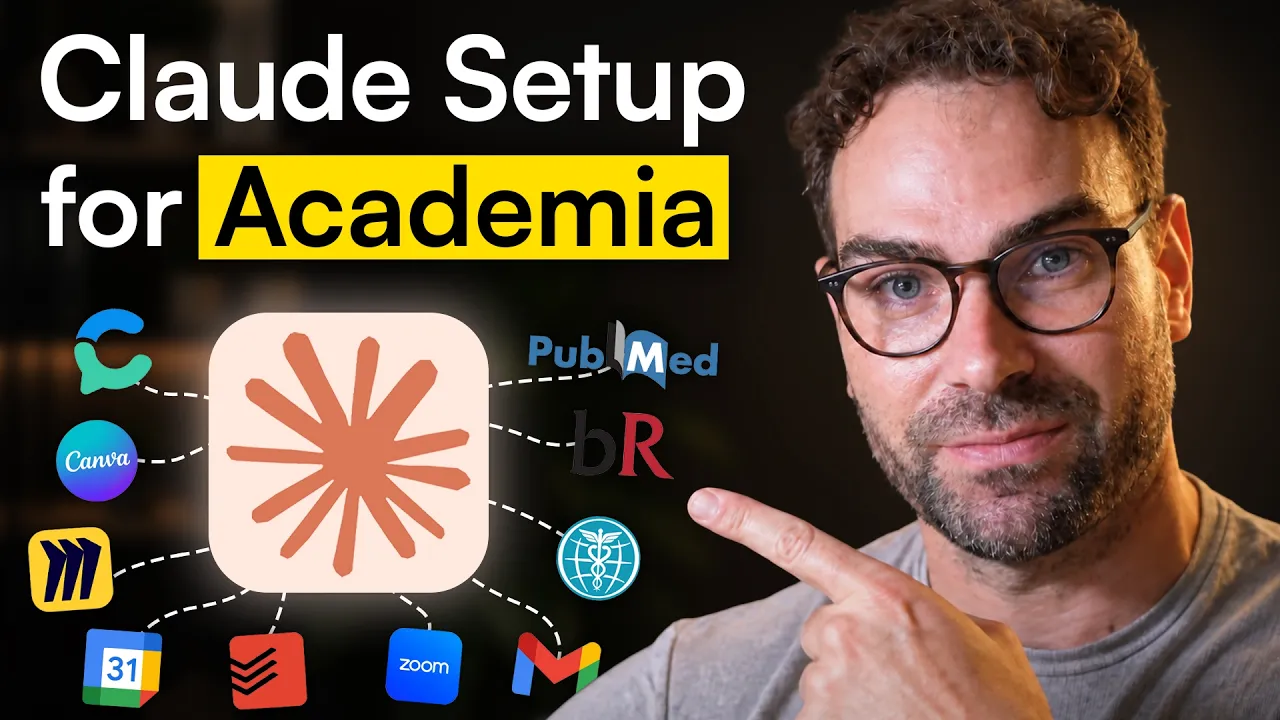
Prof. David Stuckler · @profdavidstuckler
Where viewers went back to watch this video again, from YouTube's public Most replayed graph, lined up with what was said at that moment.
Most replayed moment #1
6:002.6x the video's typical replay level
they have. So, that that's a very useful platform and Consensus is still partial, so you can't completely rely on this, but as a complement to Google Scholar, it is fantastic. The second part I want to show you that is very valuable and what you can customize is skills. I
Said at 5:53
Most replayed moment #2
1:121.9x the video's typical replay level
artifacts, scheduling tasks. Go on the left-hand sidebar straight to customize. Again, you'll see a lot of options. What I want you to do is scroll down here to customize and go Let's go first to connectors. And what The way to think about connectors is that gives Claude vision. It gives it vision into tools and
Said at 1:04
Most replayed moment #3
7:401.9x the video's typical replay level
show you an example. So, here I'm pretending to be someone who's completely lost and I say, "Hey, I'm looking for a topic on educational inequalities. Is this a good topic?" And I'm going to pull up and going to When when you put slash here, it enables you to pick up your skills and pick which skill you want to use.
Said at 7:32
The graph counts replays. It does not show where viewers stopped watching.
Words
2,085
Runtime
9:13
Speaking pace
226wpm
Reading time
9min
226 words per minute, above the 201 75th percentile of 349 measured videos. That distribution comes from the 349-video hook study.
Opening (first 30 seconds)
Are you using Claude skills and connectors for your research? If not, you're missing out. You're practically living in the Stone Age. I'm Professor David Stukler. I've published over 400 peer-reviewed papers in my research career as professor, publishing, reviewing for a living. And in just a few short years, my core workflows in research have completely transformed with AI. And while some of you may be concerned about the ethical and right way to do things, what I'm going to do in this video is I'm going to show you some practical things. These are the same things that I do. I'm going to open up my AI under the hood so
113 words, the words spoken in the first 30 seconds at 226 words per minute.
Free, no signup. See how the first 30 seconds hold attention, with rewrites.
Sentence shape
| Measure | This transcript |
|---|---|
| Sentences | 116 |
| Average words per sentence | 18.0 |
| Longest sentence | 62 words |
| Questions asked | 7 |
| Sentences containing a number | 5 |
Most used terms
Filler phrases
15 in total: like 8 · kind of 2 · you know 2 · actually 1 · basically 1 · literally 1.
A literal whole-word count of the same phrase list the Prepublish browser extension uses, so a phrase inside another word is not counted and a phrase used in its ordinary sense still is. It is a count and not a judgement.
Free, no account. See where attention is likely to drop, with a rewrite for each weak line. The free check shows the scores and the one issue costing the most. Or run it on the words above first.
Free · No login · See a sample audit first if you prefer.
What this transcript is
Every word below is the caption track YouTube publishes for this video, pulled from the video itself and reproduced unchanged. It is not Prepublish's writing, not a summary, and not a re-transcription: it is the video's own published captions. English captions, generated automatically by YouTube, in the video’s original language. Source: the video on YouTube. A channel that would rather this page did not exist can ask for its removal through the contact page, and it is removed.
Are you using Claude skills and connectors for your research? If not, you're missing out. You're practically living in the Stone Age. I'm Professor David Stukler. I've published over 400 peer-reviewed papers in my research career as professor, publishing, reviewing for a living. And in just a few short years, my core workflows in research have completely transformed with AI. And while some of you may be concerned about the ethical and right way to do things, what I'm going to do in this video is I'm going to show you some practical things.
These are the same things that I do. I'm going to open up my AI under the hood so you can see my actual stack, how I've loaded up connectors and skills, and how you can do so today for free. It's going to save you a ton of time. I Look, if I were where you are, I'm just It's amazing what you can do. So much more than I could do 20 years ago when I was a graduate student because you now have this tremendous power at your fingertips.
So, I'm going to share my screen. I'm going to show you how I use Claude. I have shifted over to Claude from ChatGPT, and I think you'll see why by the end of this video. So, I want you to pull up Claude. You'll see a lot of different options for projects, artifacts, scheduling tasks. Go on the left-hand sidebar straight to customize. Again, you'll see a lot of options. What I want you to do is scroll down here to customize and go Let's go first to connectors.
And what The way to think about connectors is that gives Claude vision. It gives it vision into tools and software you already use on your computer. It's going to have two main purposes for us. One is it's going to give us greater vision into real peer-reviewed sources. I'm going to show you how to sync that up in a second. And this massively helps solve the hallucination problems of AI just making up references that has become prevalent over the past several years.
The second is going to be to sync into your email, to-do lists, and other productivity tasks to save you time and enable you to activate some dead spaces in your day and sync things up on the go, especially from your cell phone, which can feed into Claude. The way you're going to add connectors, you're going to click on the top right, click add in any of the connectors I show you here, you can do immediately and they're valuable and free.
So, the first one and probably most powerful one that I use all the time now is Consensus. I was skeptical at first because of the hallucination problem, but what I've come to learn is Consensus has brokered agreements with a lot of publishing houses, so they get full-text sources, some that your universities may not even have. It's free version, I'm not sponsored by them, you got to be really careful with influencers out there who are peddling AI products and getting kickbacks.
I get no kickbacks, I am not selling you any AI software here. I'm not sponsored by Claude either, but Consensus gives you up to 10 searches free and beyond that it is paid. This as I'll show you in a second, has begun to sit kind of on the same pedestal as Google Scholar in my search strategies. I'll show you a live example in a minute. You basically go to add, browse connectors, I'm not going to show you it all here, click Consensus, load it up.
The other thing that's really valuable that I use all the time, if you're doing any health research, is PubMed. This enables you to directly search and retrieve articles from PubMed in your Claude research-related queries. Other ones that are very good right now, I'm constantly curating and updating these, these are the ones I use at the moment, is bioRxiv and clinical trials. As these emerge, I'll keep you posted. The second category is going to be productivity tools.
So, Canva, this is great. This is where I make a lot of my academic presentations. Claude will produce PowerPoint PDFs for you that you can use, but setting this up and syncing it to Canva is just more beautiful and it's easier for you to modify and create high-quality academic presentations that will literally knock their socks off. So, this is great. The other thing for productivity tools, I use Gmail or Outlook. This enables me to not just check my email, draft responses, but also load up drafts and email them to people right away.
It saved me a ton of time. It enables me to check my tone, infelicities of expression. I can even with the right prompting get emails written in my own voice. Google Calendar for scheduling meetings on the go. These are completely free connectors. I encourage you to use it. To Doist, I I use this as a to-do app. I have my old-fashioned list of things to do that I write down, but I also have this on my computer so I can keep track.
Zoom as well. There are a range, but if you're not using these, you're completely missing out. Also, I love this Miro whiteboard tool because I find a lot of the researchers I work with are quite visual. So, that covers connectors. Let me show you an actual search. So, I was one working just the other day, and I wanted to pull up a query from scientific literature. I didn't want just Claude making something up or hallucinating references.
And let me show you what that looked like. So, I was chatting with a researcher who is trying to understand why community college students were often flunking out when they got into four-year universities in the US and what they could do about it, what transition plans were needed. And I asked it here, what you're going to do is say, "Check the Consensus connector for studies." And I asked it to map out gaps. This was a conversation I was having with the researcher.
But what's great here is you see this is pulling up real research studies and citing it. And you can see the summary. A meta-analysis of 62 studies found this. And you'll be able to check that this is not hallucination because you can go open up the actual paper, go right to the source. This will have details about the source research in higher education citations and other details and the abstract. Sometimes you get the full text here or you can pop this into Google Scholar and then get it that way.
But this is massively powerful. I still use Google Scholar for my lit review searches because it's a bit like old-fashioned going to the library and in the library on the shelves you might bump into other papers you didn't think about or realize were important. But when I'm doing a forensic search and I know exactly what I'm looking for, let's say I wanted to find hey Claude, find me a site on how much the prevalence of autism has risen over the risen over the past 20 years, this will forensically go into PubMed and pull me real sources that gives me exactly what I want.
So, when I know what I'm looking for, I already know what good looks like, this is going to get it faster for me than what Google Scholar can generally do. I still like Google Scholar how it's sorts by relevance, it's getting to the most highly cited papers right at the top. It's helps me see how many citations they have. So, that that's a very useful platform and Consensus is still partial, so you can't completely rely on this, but as a complement to Google Scholar, it is fantastic.
The second part I want to show you that is very valuable and what you can customize is skills. I often talk about how as researchers, especially at an early stage, you need to tap into leverage, so you're not just doing one you know, you have one project, one paper, and one burnt-out researcher at the end of it. Especially if you're starting to build teams and get leverage, you'll often find that like I did, you're repeating the same things over and over, you're doing similar tasks over and over.
And skills captures what businesses call standard operating procedures. And you can set up that standard operating procedure and load it as a customized prompt to run every single time. Claude can make this for you. So, if you find yourself having a set of instructions that you need to deploy, you can just go browse and you can actually create your own skill. Ask Claude to make a skill following the set of instructions.
I've made a series of skills because it saves me a ton of time around peer review, around validating topics, and they integrate with our course material and the step-by-step processes that we follow. I'll show you an example in a second, but typically you'll just go upload the skill and then you can invoke the skill later on when you're having a normal chat with Claude. Let me show you our topic validation skill because I have a procedure that I use all the time where first you get in the topic neighborhood, then you want to go through a phase of testing, establishing, validating the topic, and then usually we have a third phase of human judgment and vetting.
And this then, the researchers I work with have this as complimentary and embedded into the courses we use to find their topic. So, we're again constantly staying on top so you don't have to of the best AI ethical workflows and skills. So, let me show you an example. So, here I'm pretending to be someone who's completely lost and I say, "Hey, I'm looking for a topic on educational inequalities. Is this a good topic?" And I'm going to pull up and going to When when you put slash here, it enables you to pick up your skills and pick which skill you want to use.
And I've set it up to say, "Hey, what you know, what kind of topic is this for? Is this a systematic review? Is it for a dissertation? Is it quantitative paper, qualitative paper?" Because the algorithm we're going to use to find your topic is going to be different. And so, I said systematic review here. And this is set up to sync with our system, so don't worry about that too much, but it'll get straight to the point that there's no topic to test yet.
And it spotted that quite nicely. It's like having a conversation with me. And it tells you how to fix it. And this is using I can see it's using our convergence method here, making sure you stay true to your passion. It also in our phases uses things that are part of our systems, like you got to find your nearest neighbor paper, you're going to use PICO to make sure your topic's crystallized, you're going to do a duplication test and a feasibility test along the way so you get real indicators that your topic is good.
And it'll tell you what to do. I've left this skill below for you to check out and you can download and and you just upload it just like I showed you here going into customize and go into add a skill. And curious to know what what you guys think. How are you using these connectors and and skills? I'm constantly testing, vetting, and validating these so that you can use AI workflows and save a bunch of time in in your work and and stay on the right side of angels so that you're blameless and don't do anything that that's on the wrong side of that ethical fence.
If you do want to learn more about using AI and integrating it into your research in a customized way, click the link below, check out our mentorship communities, and see if we are a good fit to work together. And look forward to seeing you guys in the next video.
The words are the caption track's own and nothing is reworded or re-transcribed. Paragraph breaks are placed between sentences so the text reads as prose.
Free tools for your own script: paste a draft and see where it stands before you record it.
Paste your draft and see where viewers are likely to drop off, with a rewrite for each weak line.
Paste the first 30 seconds of your own draft for a hook score and rewrites.
Check your draft against YouTube's advertiser-friendly guidelines before you record it.
Read this channel's public videos and transcripts, and download a writing brief for it.