Getting the transcript
Reading the captions from YouTube. A video nobody has opened here before takes 10 to 30 seconds; this page fills in on its own.
Getting the transcript
Reading the captions from YouTube. A video nobody has opened here before takes 10 to 30 seconds; this page fills in on its own.
Ambition Arc · @TheAmbition-Arc
Words
1,129
Runtime
7:41
Speaking pace
147wpm
Reading time
5min
147 words per minute, below the 160 25th percentile of 349 measured videos. That distribution comes from the 349-video hook study.
Opening (first 30 seconds)
A nun once looked at a young boy struggling through school and told him exactly where he would end up. "If you do not study," she said, "you will be flipping burgers someday." She meant it as a warning. By 2009, the president of the United States was eating his burgers for lunch. Jerry Murrell spent the next 40 years proving it was a prophecy. >> [music] >> He built one of the most
74 words, the words spoken in the first 30 seconds at 147 words per minute.
Free, no signup. See how the first 30 seconds hold attention, with rewrites.
Sentence shape
| Measure | This transcript |
|---|---|
| Sentences | 98 |
| Average words per sentence | 11.5 |
| Longest sentence | 58 words |
| Questions asked | 0 |
| Sentences containing a number | 21 |
Most used terms
Filler phrases
2 in total: like 2.
A literal whole-word count of the same phrase list the Prepublish browser extension uses, so a phrase inside another word is not counted and a phrase used in its ordinary sense still is. It is a count and not a judgement.
Free, no account. See where attention is likely to drop, with a rewrite for each weak line. The free check shows the scores and the one issue costing the most. Or run it on the words above first.
Free · No login · See a sample audit first if you prefer.
What this transcript is
Every word below is the caption track YouTube publishes for this video, pulled from the video itself and reproduced unchanged. It is not Prepublish's writing, not a summary, and not a re-transcription: it is the video's own published captions. English captions, generated automatically by YouTube, in the video’s original language. Source: the video on YouTube. A channel that would rather this page did not exist can ask for its removal through the contact page, and it is removed.
No Script X-ray for this video: YouTube shows a Most replayed graph only once a video has enough views.
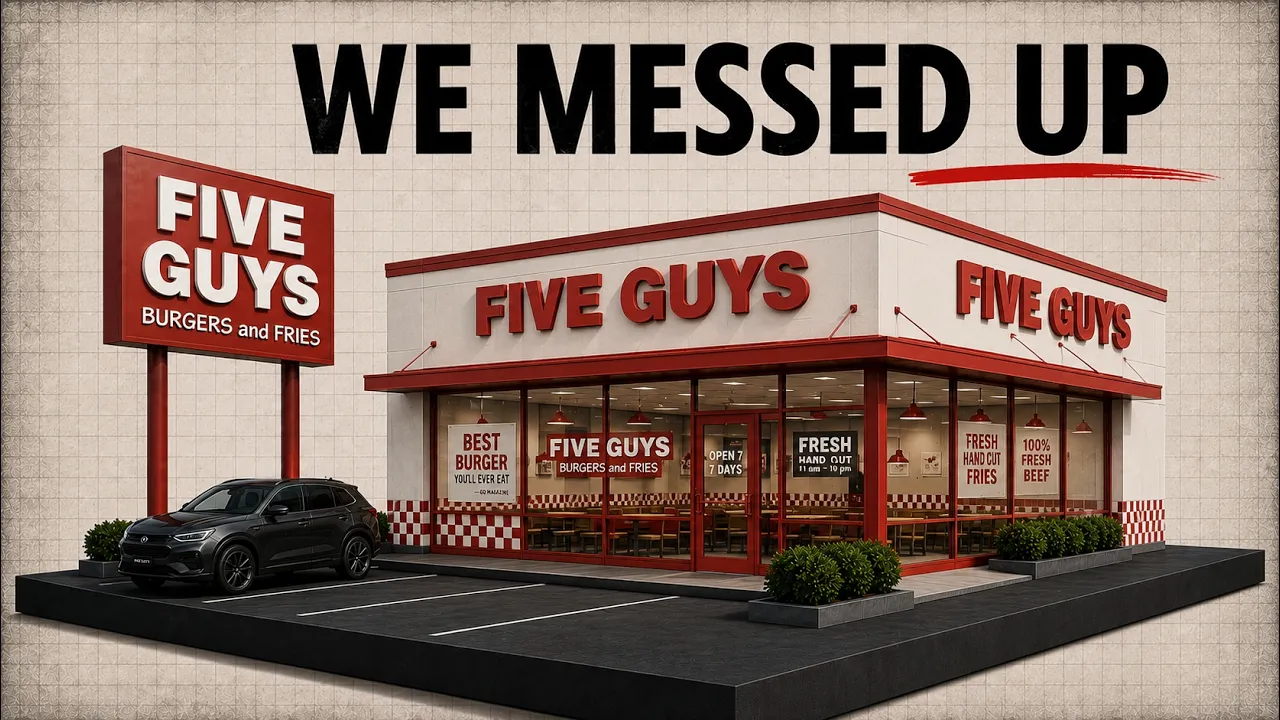
A nun once looked at a young boy struggling through school and told him exactly where he would end up. "If you do not study," she said, "you will be flipping burgers someday." She meant it as a warning. By 2009, the president of the United States was eating his burgers for lunch. Jerry Murrell spent the next 40 years proving it was a prophecy. >> [music] >> He built one of the most beloved burger chains in American history.
No advertising, no gimmicks, no shortcuts, just obsession over one thing. At its peak, Five Guys was doing $1.3 billion a year. Food critics called it the best burger in America. And then Jerry made one decision, one moment where he trusted the people around him more than he trusted himself. And everything he had spent 17 years protecting started to disappear. This is not a story about inflation or viral receipts or the price of beef.
This is a story about a man who knew exactly who he was and then forgot. Jerry grew up in Alpena, Michigan. His mother gave him one piece of wisdom. "If you can serve a good hamburger," she told him, "you can always make money in America." The nuns at school told him something different, that his future was small. That the best he could hope for was a job most people looked down on. He earned an economics degree, became a financial planner, a man whose entire job was spreadsheets and rational thinking about money.
And yet the numbers never felt like enough. In the mid-1980s, Jerry sat down with his wife and their two eldest sons. The boys had no interest in college, and Jerry made a calculation that had nothing to do with spreadsheets. "We have the money saved for your education," he told them. "You can go to college, or we can open a business together." The boys chose the business. $70,000, a strip mall in Arlington, Virginia, 460 square feet, September 1986.
No freezers, fresh beef only, free peanuts, bags overfilled so customers always felt they got more than they paid for. He could not out supply chain McDonald's or out advertise Burger King, but he believed with a certainty that other people found almost unreasonable, that if you made the best thing, people would find it. He was right. For 17 years, Five Guys stayed small. Five stores, a cult following, lines of people who told their friends, who told their friends.
And Jerry refused every offer to franchise. Every single one. He was scared of something specific. He was scared of handing his identity to strangers. What he could not fully say out loud was that Five Guys was not really a business. It was a personality. And personalities cannot be photocopied. He held the line for 17 years. Then in 2002, one of his sons came home with a book, Franchising for Dummies, co-authored by the founder of Wendy's.
The sons pressed it into his hands and said, "We can do this. We can protect it." Jerry called it the roughest period in the family. Long arguments, a company with a soundproof meeting room specifically designed to contain them. He finally agreed. On one condition, he meant completely. Quality was non-negotiable. Every franchisee had to understand the story. It had to be about the food, or it would not work. In 2003, Five Guys opened its first franchise.
Within 18 months, permits for more than 300 locations had been sold. The day those permits were signed felt like victory. What Jerry could not see was that the thing he had protected for 17 years had just been handed to 300 people who had never met him, who had never heard the story of the nun, who had never understood why you would ship fresh buns across the country when frozen ones cost a fraction of the price. Within a decade, there were 1,500 stores across 25 countries.
In 2009, President Obama walked into a Five Guys in Washington, D.C. And every news channel in America ran the clip. Zagat named it the best burger in the United States. The boy told he would end up flipping burgers, the financial planner who threw out every spreadsheet and bet everything on obsession. He had won. And in winning, he had opened a door he could never close again. If this story is hitting different, subscribe to Ambition Ark.
Every week we find the story underneath the story. The next video is about a founder who built a billion-dollar empire, got called a genius by everyone, and then lost it in the most public way possible. You do not want to miss it. When COVID hit in 2020, Five Guys had no place to run. Beef costs exploded, labor costs exploded. Their only option was to raise prices. A combo that cost $14 in 2010 was over $20 by 2024. In 2023, someone posted a receipt, $23, one burger combo.
The internet made it a meme, then a symbol, then a cultural shorthand for everything that felt wrong. Foot traffic collapsed, stores started closing, sales fell more than 10% from their peak. And here is the dark truth. The people who owned most of those 1,500 stores were not Jerry Murrell. They were operators who got into Five Guys to make money, not to protect a philosophy. To make money. When costs rose, they raised prices faster than they needed to.
The incentive was never quality. The incentive was the spreadsheet. The spreadsheet [music] Jerry Murrell had spent his entire career refusing to follow. Jerry once tried to cut tomato slices from two down to one. His son staged a revolt. He backed down. He told that story proudly as proof the culture held. But by the end, Jerry was no longer the one holding the line. His sons were. They were running 1,500 stores, mostly owned by people who had never met him and never heard the story of the nun.
Personal obsession does not franchise. You can write it in the manual. You can put it on the wall. But the thing inside one man who refused to put a freezer in his restaurant because he simply could not bring himself to do it, does not transfer to 300 operators who bought a territory to make money. The nuns were wrong about Jerry Murrell. He did not end up flipping burgers. He did something harder. He built an empire on the belief that the best thing always wins.
And then he handed it to people who believed something else entirely. He watched from the inside as the best thing started to lose. Some things you cannot build your dreams on. Only you can carry them.
The words are the caption track's own and nothing is reworded or re-transcribed. Paragraph breaks are placed between sentences so the text reads as prose.
Free tools for your own script: paste a draft and see where it stands before you record it.
Paste your draft and see where viewers are likely to drop off, with a rewrite for each weak line.
Paste the first 30 seconds of your own draft for a hook score and rewrites.
Check your draft against YouTube's advertiser-friendly guidelines before you record it.
Read this channel's public videos and transcripts, and download a writing brief for it.