Getting the transcript
Reading the captions from YouTube. A video nobody has opened here before takes 10 to 30 seconds; this page fills in on its own.
Getting the transcript
Reading the captions from YouTube. A video nobody has opened here before takes 10 to 30 seconds; this page fills in on its own.
BBC Global · @BBC_Global
This video has no Most replayed graph yet: YouTube shows one only once a video has enough views. These are the moments viewers replayed most in BBC Global's most watched videos.
Most replayed moment at 3:52
2.9x that video's typical replay level
but they do suggest that skills like being able to pause and, and be critical about what you're thinking, what you're looking at, and skills like remembering to do something that you intended to do. Those are the skills that we're seeing impacted by even just a short exposure to something like TikTok.
Said at 3:46
Most replayed moment at 7:56
4.9x that video's typical replay level
a little bit more realistic. You could also provide subsidies to firms that keep their workers instead of firing them. So there's all sorts of other instruments around this that might not be perfect, but that we could use. If companies don't exercise self restraint,
Said at 7:49
The graph counts replays. It does not show where viewers stopped watching.
Words
1,150
Runtime
7:26
Speaking pace
155wpm
Reading time
5min
155 words per minute, below the 160 25th percentile of 349 measured videos. That distribution comes from the 349-video hook study.
Opening (first 30 seconds)
[music] >> The Norse in Greenland were actually the descendants [music] of the Vikings who were traveling across the North Atlantic. Today, we know that they disappeared around 1450. We don't exactly [music] know what happened and why they disappeared. >> We are [music] standing in South Greenland where Eric the Red settled in 985. 25 ships went with him, approximately 500 to 700 people, but only 14 of those ships arrived. Back then, when Eric [music] the
78 words, the words spoken in the first 30 seconds at 155 words per minute.
Free, no signup. See how the first 30 seconds hold attention, with rewrites.
Sentence shape
| Measure | This transcript |
|---|---|
| Sentences | 71 |
| Average words per sentence | 16.2 |
| Longest sentence | 36 words |
| Questions asked | 0 |
| Sentences containing a number | 13 |
Most used terms
Filler phrases
14 in total: actually 5 · like 4 · basically 2 · sort of 1 · uh 1 · you know 1.
A literal whole-word count of the same phrase list the Prepublish browser extension uses, so a phrase inside another word is not counted and a phrase used in its ordinary sense still is. It is a count and not a judgement.
Run the check on the words above: where attention is likely to drop, with a rewrite for each weak line. The free check shows the scores and the one issue costing the most.
What this transcript is
Every word below is the caption track YouTube publishes for this video, pulled from the video itself and reproduced unchanged. It is not Prepublish's writing, not a summary, and not a re-transcription: it is the video's own published captions. English captions, generated automatically by YouTube, in the video’s original language. Source: the video on YouTube. A channel that would rather this page did not exist can ask for its removal through the contact page, and it is removed.
[music] >> The Norse in Greenland were actually the descendants [music] of the Vikings who were traveling across the North Atlantic. Today, we know that they disappeared around 1450. We don't exactly [music] know what happened and why they disappeared. >> We are [music] standing in South Greenland where Eric the Red settled in 985. 25 ships went with him, approximately 500 to 700 people, but only 14 of those ships arrived.
Back then, when Eric [music] the Red lived here, it would be called Qaqortoq, which means a steep slope. It's here [music] where he founded his family and he called it Greenland. >> [music] >> There are several takes on why the Norse actually undertook that quite perilous voyage. When you look at the traditional narrative, which is really found in Icelandic sagas, you have this idea about people setting out from Iceland with Eric the Red and you have this pioneer spirit.
They're looking for new land, new opportunity [music] to set up new farms. But there's also a new narrative that has been emerging over the last 20 years, how Greenland fit into a world economic system that grew out of the Viking Age. >> [music] >> The soft and white gold is the tusk of walrus, the tooth of narwhal, and polar bear skins. The later hunters walrus ivory is making its way all across Europe and even down to the Middle East and Constantinople.
One of the places [music] they used to be walrus was in Iceland. When that was basically totally killed off, the next natural step was actually [music] to move to Greenland. When the Norse first came to Greenland, it was totally unpopulated and had been for around 500 years at least. There was probably a lot of wildlife, so you would have caribou roaming the mountains where the seas would have been just booming, [music] especially seal that was in the millions.
They came in the period that we used to term the Medieval Warm Period, which was sort of a warmer climate interval where the temperatures, at least the scientists say, is about what they are today. >> [music] >> It was very green. There's a lot of shrub which provided you with fuel. There would be meadows where you could start to set up your farms. >> There are two settlements [music] in Greenland during the Norse period and the northern one is around Nuuk.
It's called the Western Settlement. Otherwise, we are standing in Eastern Settlement, which is all South Greenland. >> There is today [music] around almost short of 600 sites recorded in South Greenland. Maybe around 300 farms would have been working throughout the years in that area. The maximum peak population was [music] around 3,000 people. Now, that's a very low number for a stable population. It was a hard life.
You had to produce everything yourself and they probably lived from year to year. When you just look at the [music] archaeology, you are on the edge of the Nordic world. >> They would be trading with Norway. They were depending [music] on importing finished goods like pots or farming tools and so on. [music] They were exporting uh walrus tusks, narwhal tusks, and some furs. >> What was fashion at the time was this hood, which has this piece of fabric hanging down the back.
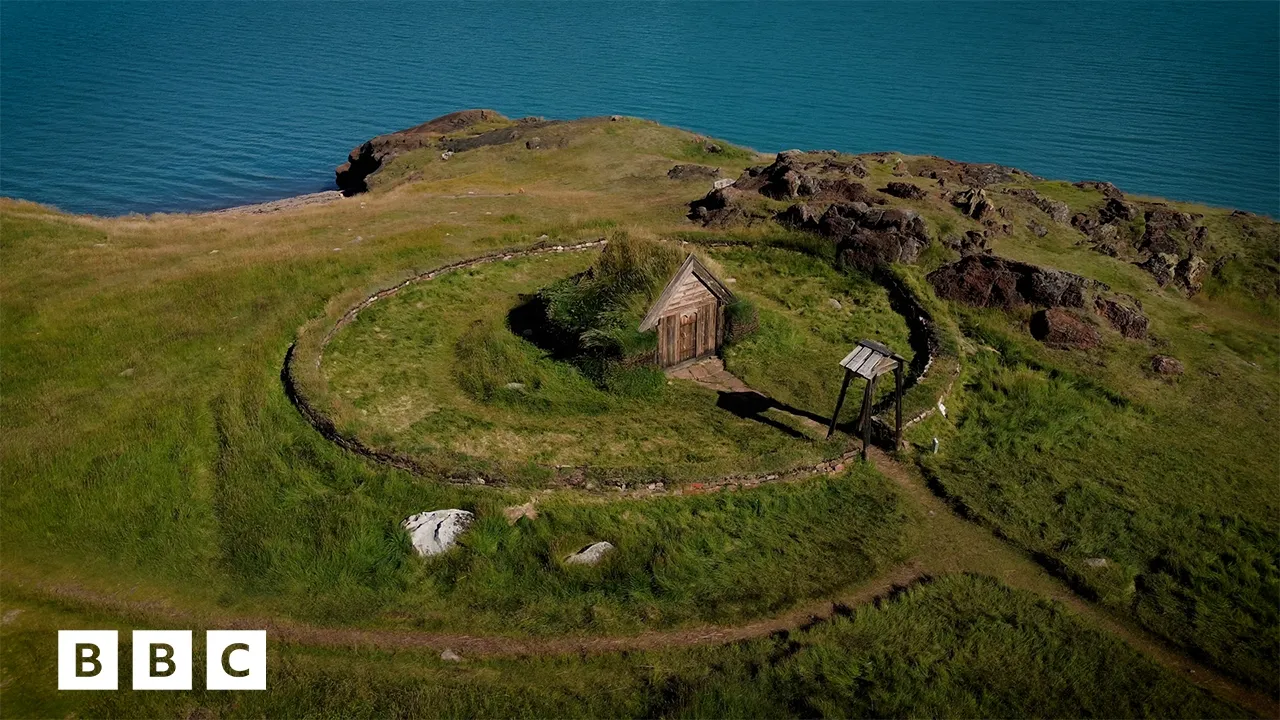
These people were actually following fashion, even though they were living as far away from Europe as they they could at the time. The long-distance international trade stayed super important. >> This is the most well-preserved ruin in Greenland. It's called Valse in English, and it actually [music] means whale island. In Greenlandic, it's called Kakortokak. And it's part of the World Heritage area. This is the [music] big church that was for all the Norse people living in the area.
It has been built in the 1300s. Hans Egede, that was a missionary. They were here in 1723. [music] They were around looking for living Norse people, and they found many ruin [music] sites, and this was one of them. There was a marriage here in 1408, [music] and that was the last letters that was written and registered about the living Norse. >> You can see from the archaeological dates that around 1450, all of them were gone, and we still [music] don't have the definite answer to why that was.
Around 1200, a new wave [music] of Inuit people migrate into Greenland. They are firmly established in the areas where the Norse are hunting the walrus. There's a lot of interaction [music] between the two people, and it looks like they're trading or bartering. One of the first ideas about what had happened to them were basically that after a period of coexistence, that it escalated into violence, and eventually that the Norse were killed by the Inuit.
One of the earliest years was [music] from the first conversations with the local Inuit, and all of those stories inevitably ended in violence. We have now found evidence of the burning of houses as it's told in the Inuit story. Fairly soon after the Norse had arrived in that medieval warm period, the climate [music] switched, and we go into what we then referred to as the little ice age. It got colder, it got stormier, it got more unpredictable.
We now also [music] have a lot of evidence that they were coping, and they were adapting. As the climate is worsening, they go more and more after the seal, which is a really nutritious and healthy [music] food source as well. So, this old idea about that they were very conservative, it doesn't seem to hold true, which makes the mystery even greater. One of the prevailing theories has been that the walrus ivory value was declining.
[music] With the Crusades in the Middle Ages, the markets were open for elephant ivory and it started outcompeting [music] the walrus ivory. The returns on your trade are getting less and less. That was probably also putting a lot of pressure on the economic system. >> [music] >> What makes most sense to me is to think about it a little bit like a gold rush. As soon as the main reason for being there, the gold, [music] is pulled out, there's really no reason for this community to exist, so they gradually start to disappear. >> [music] >> Essentially, Greenland is a ghost landscape from the Middle Ages.
But, that is not the whole story. The [music] climate is getting horrible, it's hard to farm, it's dangerous to hunt, you're feeling more and more, you know, culturally isolated. The Inuit are moving down the coast. Like a perfect storm of bad things happened at the same time. It's a big question what happened to [music] those last people because somebody must have been the last.
The words are the caption track's own and nothing is reworded or re-transcribed. Paragraph breaks are placed between sentences so the text reads as prose.
Free tools for your own script: paste a draft and see where it stands before you record it.
Paste your draft and see where viewers are likely to drop off, with a rewrite for each weak line.
Paste the first 30 seconds of your own draft for a hook score and rewrites.
Check your draft against YouTube's advertiser-friendly guidelines before you record it.
Read this channel's public videos and transcripts, and download a writing brief for it.