Getting the transcript
Reading the captions from YouTube. A video nobody has opened here before takes 10 to 30 seconds; this page fills in on its own.
Getting the transcript
Reading the captions from YouTube. A video nobody has opened here before takes 10 to 30 seconds; this page fills in on its own.
Liam Ottley · @LiamOttley
This video has no Most replayed graph yet: YouTube shows one only once a video has enough views. These are the moments viewers replayed most in Liam Ottley's most watched videos.
Most replayed moment at 5:02
5.8x that video's typical replay level
using no code tools, so there's no excuse why you can't get in there and get your hands dirty and start to build them. So, the first one is a speed to lead system. This is a simple automation that ensures that the business responds to any new customer inquiry or people reaching out to them in seconds, not hours. This
Said at 4:54
The graph counts replays. It does not show where viewers stopped watching.
Words
3,659
Runtime
17:40
Speaking pace
207wpm
Reading time
15min
207 words per minute, above the 201 75th percentile of 349 measured videos. That distribution comes from the 349-video hook study.
Opening (first 30 seconds)
If you're still using spreadsheets, that's like [music] a dead giveaway that you're not where you need to be. >> Accountants will literally spend an hour doing this. We just did [music] it in >> Never seen that before, never experienced it. Extremely efficient. >> This is Josh Thomas. His firm, Thomas and Co, is one of the fastest growing accountancy and tax advisory firms in the UK. >> We're on our fifth year of double in turnover. So, 100% [music] growth 5 years in a row. >> But there's a problem. 25 of his accountants spend more than half [music] of every working
104 words, the words spoken in the first 30 seconds at 207 words per minute.
Free, no signup. See how the first 30 seconds hold attention, with rewrites.
Sentence shape
| Measure | This transcript |
|---|---|
| Sentences | 276 |
| Average words per sentence | 13.3 |
| Longest sentence | 69 words |
| Questions asked | 22 |
| Sentences containing a number | 25 |
Most used terms
Filler phrases
65 in total: like 25 · actually 9 · uh 7 · um 7 · sort of 5 · you know 3 · I mean 2 · basically 2 · literally 2 · right? 2 · kind of 1.
A literal whole-word count of the same phrase list the Prepublish browser extension uses, so a phrase inside another word is not counted and a phrase used in its ordinary sense still is. It is a count and not a judgement.
Free, no account. See where attention is likely to drop, with a rewrite for each weak line. The free check shows the scores and the one issue costing the most. Or run it on the words above first.
Free · No login · See a sample audit first if you prefer.
What this transcript is
Every word below is the caption track YouTube publishes for this video, pulled from the video itself and reproduced unchanged. It is not Prepublish's writing, not a summary, and not a re-transcription: it is the video's own published captions. English captions, generated automatically by YouTube, in the video’s original language. Source: the video on YouTube. A channel that would rather this page did not exist can ask for its removal through the contact page, and it is removed.
If you're still using spreadsheets, that's like [music] a dead giveaway that you're not where you need to be. >> Accountants will literally spend an hour doing this. We just did [music] it in >> Never seen that before, never experienced it. Extremely efficient. >> This is Josh Thomas. His firm, Thomas and Co, is one of the fastest growing accountancy and tax advisory firms in the UK. >> We're on our fifth year of double in turnover.
So, 100% [music] growth 5 years in a row. >> But there's a problem. 25 of his accountants spend more than half [music] of every working week filling in working papers by hand. Over 20 hours a week each. [music] And accountancy firms are already rushing to put AI at the forefront of their business. The ones [music] that move now are going to eat the ones that don't. >> They'll come and take your lunch, and I don't want no one taking my lunch.
[music] So, I've flown to my buyer to see if I can automate the most boring job in his business in 4 days. Oh, yeah. And I've never worked a day of accounting in my life. >> From my extensive experience in the accounting field, a full 12 months at a high school >> [music] >> when I was 16, I could tell you that a working paper is um a portion of the entire deliverable of doing the accounts for a client. >> Here's what [music] I mean.
Every number in a client's accounts has to be backed up before anyone signs it off. Proof it's real [music] or the working behind it. For example, the business says it was paid 4,800 lb. >> [music] >> You find the bank line that proves it and tick it off. Then do the same for the next number. >> It's basically death by a million cuts. [music] Every time an accountant has to generate a working paper, it's not like one big stack of time that's taken up by one thing.
It's more like 15 minutes here, 20 [music] minutes here, 30 minutes here. >> There were 17 of these. So, the first job was to get all 17 on a whiteboard and measure them one by one to find out where the week was actually going. >> First thing we're going to be doing is auditing all of those working papers. So, we've got these headings that we figured out. We've then got like information about the papers so we have some context, frequency, task is done, your duration to complete that, difficulty of it, and the time that we're trying to automate or augment it cuz we can't do everything, but we can pick off the the most the quickest wins.
Like [music] this one, for example, is done for 95% of people. It's low difficulty and it takes an hour. That's like a much higher target for elevations and it takes 15 minutes for only 20% of people. >> Yeah, okay. >> And so, yeah, I mean, that's 250 hours a month. If we could like wipe that off to like 5 minutes, that's that's huge, right? >> Mapping out exactly how much time you spend across so many different schedules and types of working papers, that is a bit of a a shock moment to how much [music] time actually is wasted considering that this [music] can be done by the technology that we have today.
So, for the low value area of the business [music] to be taking up so much time, that that that gives me, you know, an urgency to be able to [music] solve that. >> The VAT is something that all clients use and there's different times related to each of them. So, like an [music] hour for VAT with 100% clients needing it and so we're just looking at how we can pick our shots intelligently and VAT has [music] come to be the centerpiece of of what we're doing here at the moment.
We can get VAT working with [music] this new system and that infrastructure can be sort of scaled and just added on all the other working papers [music] until the entire thing is put through the system we're building. >> So, we picked VAT, one form out of 17, and if it worked, the same machine would take the other 16. There was just one problem with that plan. >> [music] >> Two, actually. Problem one, I don't know about accounting.
So, I basically have to come up to speed on the entire accountancy business model in the space of a few days. And when I realized there's a lot of company knowledge and client knowledge stored in the brains of the account managers and the accountants, that's when I realized this could be a lot more difficult than I thought because we're going to need to download all of that and give the AI system as much knowledge and context [music] as these accountants or the whole thing will fall flat. >> Problem two, a human has to sign it. >> So, AI can do the work, but it can't legally take responsibility for that work.
The hardest part about doing this in a regulated industry is that there's real consequences if something goes wrong. In this very small global online entrepreneur [music] community, word does get around quickly. So, I feel enormous amount of pressure not only to deliver sort of technically, but that's social pressure, and that my reputation is really on the line here. So, who am I risking my reputation for? On paper, Josh Thomas doesn't look like a man who needs saving. >> I've had a Forbes 30 under 30, Castle Finance 2026.
I've won Entrepreneur [music] of the Year twice. This firm has won Best Place to Work three times. And we've also won eight individual separate awards for the firm. >> To understand how a business this successful gets built, and why Josh would let us pull it apart, you have [music] to go back. >> Uh my grandad used to have me do math questions before we ate for tea. So, he'd say, "You know, we're having a fillet steak tonight, Josh.
Uh but you've got to do 20 math questions [music] before we have tea, and you've got to get at least 16 right." The lowest point I'd say was driving to the office every day, the same route, 4:00 in the morning, it's pitch black, and then working [music] in the office until 10:00 p.m. to midnight, depending on the day, and churning through meaningless [music] monotonous work that was just simply keeping the business afloat rather than pushing it forward.
My grandad unfortunately got ill pretty quickly, and uh was extremely healthy and is no longer within 18 months' [music] time, which was like a big shock factor. My grandad was mid-60s, so hadn't yet lived [music] that full life. And up until sort of late 50s, he was he was working a lot, still allowing time for family life as well, but I know if [music] I was to speak to him now, he would wish that he spent more time enjoying life rather than just focusing on building this [music] wealth for the future.
And I think that's a trap that a lot of people get into. They spend so much time building wealth for the future, and the future actually never comes so they can enjoy that wealth. So, how can [music] you try and incorporate enjoying the journey into also building and have that full [snorts and music] balanced life? And I think that's that's what my grandad taught me. >> Day two. The measuring was done. Now we had to build the thing.
Everything this firm knows is either in a spreadsheet or in somebody's head. It all has to come out. >> I've like drawn on the on the screenshot like a green highlight. So, I've highlighted it here, and I've also highlighted it here. So, that's how you know that they match. >> If there's one thing I've learned in these that makers have been doing recently is the spreadsheet is dead and database is now king. And if you're still using spreadsheets, that's like a dead giveaway that you're not where you need to be and you don't have the right rails for AI to be built on top of. >> So, here's the plan.
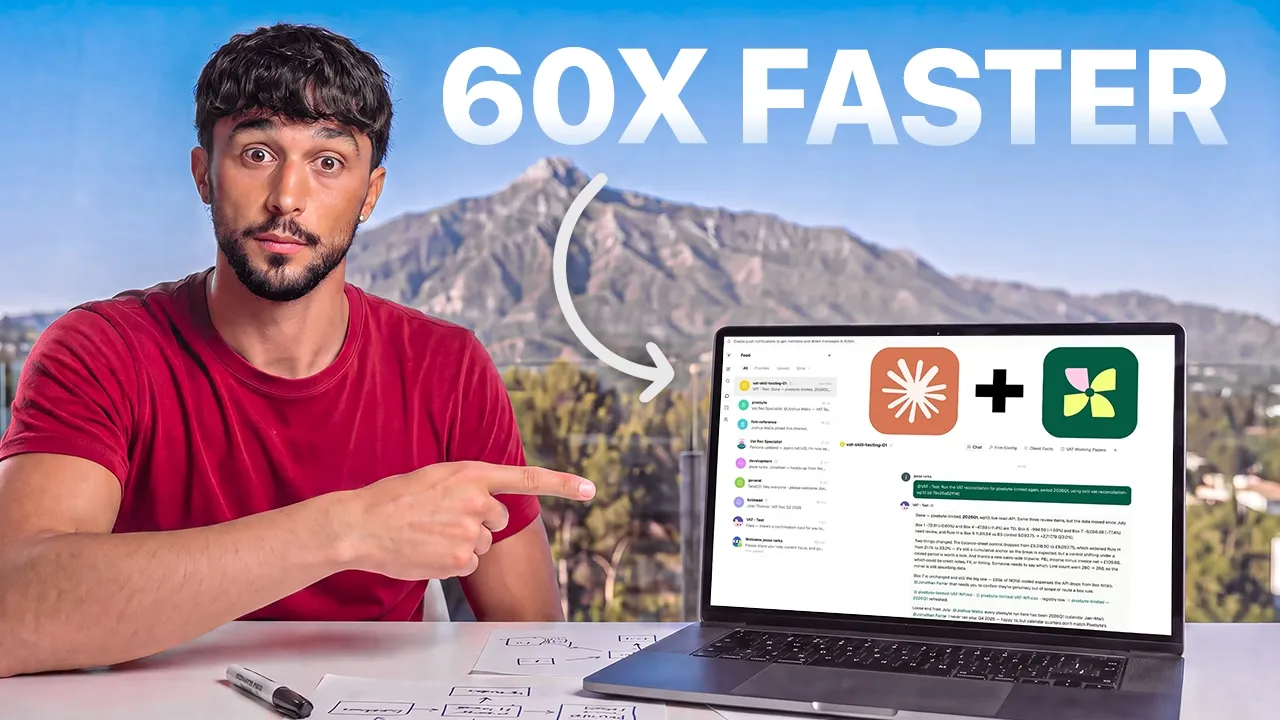
Josh is on developer starts pulling the firm's numbers out of those spreadsheets and into a single database. >> I work very closely with Josh. I'm kind of the technical arm now of Thomas and Co. >> So, we're essentially using AI to package up skills that can take them through a workflow and really speed through the the manual data entry grunt tasks and flag things for the human to review. >> To do all of that, we're using a platform called Kylon, the sponsor of today's [music] episode. >> Okay, so there's something you can run through here, which is this onboarding flow. >> You wake up an agent, give it a name, pick its personality, then give it the basics of the business, in this case, [music] just the firm's website. >> It reads what Thomas and Co. does. >> Mom. >> Checks it to understood the business with Josh, [music] and then asks for one repetitive workflow that eats the team's time.
We already have one [music] in mind. >> Also, the vision would be the first of every month, all management accounts would just run to the point where they're blocked. And you go >> at VAT agent, let's do the VAT reconciliation for quarter two. It would run through that, and it's going going like green green green green green red, or orange. And then the healer goes in and goes, like, "Hey, here's a thing that you need to check up on." >> So, the goal isn't to remove the human, it's to stop wasting the human's time [music] on manual data entry. >> This is getting real now. >> And then we hand it over.
The manager reads it, works out whose job it is, and passes it to the VAT specialist. [music] Nobody in that exchange is a person. >> 48 hours ago, I didn't know what a working paper was, and now I'm teaching a computer how to do it. >> Look, I've been talking arguing and we're So, it knows it's asking for a checking account. >> I'm going to need you to go. >> That's one of the coolest things that I've ever seen. >> That's you can get me excited, and that takes a lot these days. >> So, I'm Josh Wallace.
I'm one of the senior advisors at Thomson Co, dealing mainly in the tax side of things. [music] Just had a test demo with Kylon, and so I'm very excited to put that to use, actually [music] test it on some real data, um and start building out a few more agents that can then sort of talk to each other and effectively [music] become uh a mini sort of workforce. >> Day three. Today, the machine finally gets fed. But, that's a few hours of the developers' time, not ours.
So, Josh, who runs 12-hour days, is taking a morning off. First one in a while. >> [music] [music] >> What up? >> What up, G? >> Boys, we did it. >> It's all done? >> That was it? >> It's all done, right? >> What? >> It's all done. >> Yeah, we got the whole thing. >> Yeah? >> The whole business is automated. >> Yeah? >> Every every skill, the whole business is automated. You don't You don't even need to work ever again. >> Yeah, man. >> I didn't get to sleep all night. >> Yeah, he used to he used to >> I stayed up all night. >> Stayed up all night. >> Really? >> I waited for you. >> Yeah.
Jonathan didn't sleep at all. >> No. >> You should be drinking these instead of me. >> By the time we got back, the API was set up, so the numbers could come straight out of the firm's accounts, and the tax law was going in behind them, chopped up so it could find the one rule it needed instead of reading the whole book. What it still didn't have was the way this firm actually works, and that was still in Josh's head. >> Oh. >> They're going to call you, Mason. >> This is crazy.
Look at >> Hi, Liam Autley. I'm calling about the team. Explain how the team works today so we can design the tracker app that sits inside each client channel. I've got questions across four areas. What working papers look like, how blockers and client requests work, how you communicate with clients, and what you'd want to see at a glance. To start, could you share complete list of working paper types a client could have? >> Yeah, so VAT, month end, >> Let me summarize what I've captured.
Four working paper types: VAT, month end management accounts, year end accounts, and self-assessment. Status flow goes from bank rec complete, reconciliation starts, hits blockers, auto retrieval detection, escalates to human if needed, reconciliation completes, then adjustments in zero or filing. Blockers fall into source data mismatches and missing client info. >> That's insane. >> Damn, I'm out of a job, man. >> [laughter] >> It's doing my job for me. >> I didn't know Kylon had that feature, so that's uh >> It's literally like you're speaking to a dev that has full context laid out. >> Everything in the company, what you're trying to build. >> Yeah. >> That was insane. >> So, we just had a conversation with a a voice agent.
And the voice agent has full context on everything that we're trying to build in Kylon, which is essentially a workspace of all of our agents that specialize in completing our different work streams that currently members of the team that are highly paid currently complete start to finish. We had a voice call for me to transfer context and information across to the voice agent so it can then work on its blockers and missing context, rather than me having to type back and forth and spending an hour doing it.
I just had a voice call conversation, similar to like have a voice call conversation with a friend or a colleague. Um never seen that before, never experienced it, extremely efficient. And the fact that I'll be able to have further conversations with the Killon agent moving forward for any blocker is just mind-blowing. >> Day four, the last real day, and the thing we'd flown out to build had still never run start [music] to finish. >> We're going to assume that that's not happening tomorrow.
We have to get it fully handed off and transferred to you guys. >> Yeah. >> Um today. >> I'm not going to allow myself to just walk off and leave them with an unfinished thing. Like, that means I'm working next week. Who knows how long that iteration and refinement cycle could be. Could take all of tomorrow. We may not even finish it by tomorrow. >> So, the morning went on the handover, not the build. [music] Jesse turned everything we'd worked out into a repo the team could run themselves.
So, the next one of these [music] doesn't need us in the room. That left two things. The pipeline had still never run start to finish on its own. And Josh had nothing he could actually open. No way to see what [music] the agents were doing or what they'd flagged for him. The issue was we'd been cocky and already booked a boat to celebrate on. So, the work came with us. >> All right. So, what are you working on? >> Um I'm waiting for the UAT from Jonathan for and then I'm going to run the first end-to-end test. >> So. >> All right.
I'm working on uh the app for the base for Killon. I'm going using core design for the design and uh UX of it. >> You working on the light testing data? >> I'm working on the tablet for the testing. >> When you're what? >> Tablet. >> When you're tablet. This guy's already clocking off. >> Nah, that's what today's about, actually. It's a bit of um >> A bit of work and a bit of fun. >> So, if you got nothing doing there, Luke.
Jonathan, what you got? >> Just get all the data up there, then to work out the integration kinks, and then yeah, we should be golden. >> Say 2 hours, we could probably be testing this thing? Or at least by the time we come back in. >> Mhm. >> Yeah. >> All right. Let's Let's aim for that. And squeeze in a bit of fun on the way. >> Sounds good. >> Money. >> [music] [music] >> Two hours on the water and the thing I'd been building was ready. >> I have a look at this.
So, I've got the board view. I've got to click see if there is any info about that return. Um any reviews that are pending, any requests that have been sent out. I view all the requests that are waiting from the client. >> Nice. >> And you can go through and table it, or VAT, bookkeeping, or whatever tabs you're going to need. >> Insane. >> Boom, but we've got the yacht, boys. >> And the yacht. >> So, Josh finally had a window into his own firm.
Behind it, nothing had been proven [music] yet. The devs had been at it all day, and we were finally about to find out. Give the machine a VAT reconciliation [music] his accountants had already done by hand, and see if it comes back with the same answer. >> Better check what the devs have been up to. [music] What about other devs have done? >> Are we almost done? >> What was it you were saying? What's happening? See it works. >> I see the pipeline works live. >> Wow. >> Well, wait.
It works. >> Yeah, let's go. >> Well done, Jonathan. Pile on his head. >> It was actually pretty stressful. We had some last minute issues. We spent this whole boat ride, Jonathan and I, just trying to work through this and get the end to end test to work. And as we're pulling into the dock, the test was finally able to run end to end, and according to this so far, it looks like everything matched as it should. >> Building cool things with cool people. >> Mhm. >> And having fun while we do it.
It's good. >> At the end of the week, I feel like my eyes are wide open. I see the opportunity. I see what is now possible. The start of the week, it's a little bit of skepticism, a little bit of uncomfortability, a little bit of unsure of what to expect. But after now going through the week, I just [music] feel like extremely excited about what's to come and what is possible. This week has impacted my business so positively.
It's It's hard to fathom how positively until we get into the future. >> [music] >> And the the returns from the work we put in start to to pay its dues. But I would imagine that we will have a business that's [music] 50-60 times more efficient. We're going to be able to now scale to new heights without having to increase team size. We're going to be able to provide [music] a better service to our clients, which is paramount to me.
Believe you be selling something, you need to truly deliver on what you're selling. And that will allow me to do that to an even higher level now, but [music] do it more efficiently. For me, Jasmine, my fiance, my family, my little brother Lewis, and my my dog Rodney, they're the they're the most important people in my [music] life, and that is what I put all of my hard work, stress, sacrifice. [music] That all makes it worth it.
That's the balancing scale of the negatives, the positives are I can provide [music] for those that mean the most to me. Really understand who you are, what you want, and what you're trying to achieve, >> [music] >> and why you're trying to do that. And don't be swayed by social media or the shiny car or the great watch or the materialism or like I say, the the societal [music] norms of what you should achieve. Get really clear on what you're doing this for because the [music] why is going to drive you through all of that stress, sacrifice, and the hard work that you need to put in.
If [snorts] you're doing what you're doing for someone else's desire or what someone [music] else thinks should be true, then you're not going to have longevity. And to win in business or to win in life, you need to be able to put the work [music] in day after day after day and feel that compounding effect all the time. It's like investing in the stock market. You invest now and every week for the rest of your life, the compounding [music] effect of that is incredible.
So, get really clear on what you are trying to achieve and make sure that [music] is truly your internal why and stick to that and >> [music] >> the results will really compound.
The words are the caption track's own and nothing is reworded or re-transcribed. Paragraph breaks are placed between sentences so the text reads as prose.
Free tools for your own script: paste a draft and see where it stands before you record it.
Paste your draft and see where viewers are likely to drop off, with a rewrite for each weak line.
Paste the first 30 seconds of your own draft for a hook score and rewrites.
Check your draft against YouTube's advertiser-friendly guidelines before you record it.
Read this channel's public videos and transcripts, and download a writing brief for it.