Getting the transcript
Reading the captions from YouTube. A video nobody has opened here before takes 10 to 30 seconds; this page fills in on its own.
Getting the transcript
Reading the captions from YouTube. A video nobody has opened here before takes 10 to 30 seconds; this page fills in on its own.
Chase Chappell · @ChaseChappell
This video has no Most replayed graph yet: YouTube shows one only once a video has enough views. These are the moments viewers replayed most in Chase Chappell's most watched videos.
Most replayed moment at 4:41
1.7x that video's typical replay level
them. Because a strong founder story connects the pain that you once lived, the solution you created, and the mission you believe in, and the struggles that you overcame, and how that transformation now delivers to every customer out there. When you create the story with five key pillars,
Said at 4:35
Most replayed moment at 2:44
7.0x that video's typical replay level
downloaded on your computer so that way you can do this. And one of the first steps is we're going to copy that link. We're going to come in here and click the plus sign, go to connectors, manage connections, and we're going to hit add. We're going to add a custom connector. We'll paste this, and we'll name it Meta
Said at 2:37
Most replayed moment at 4:54
3.8x that video's typical replay level
can recreate it. We're going to go into chat GBT. We're going to start a new chat under chat GBT40. You're going to do the new updated create image option and you're going to paste this exact prompt that I've gone ahead and put together for you below this video that
Said at 4:48
The graph counts replays. It does not show where viewers stopped watching.
Words
1,860
Runtime
8:50
Speaking pace
211wpm
Reading time
8min
211 words per minute, above the 201 75th percentile of 349 measured videos. That distribution comes from the 349-video hook study.
Opening (first 30 seconds)
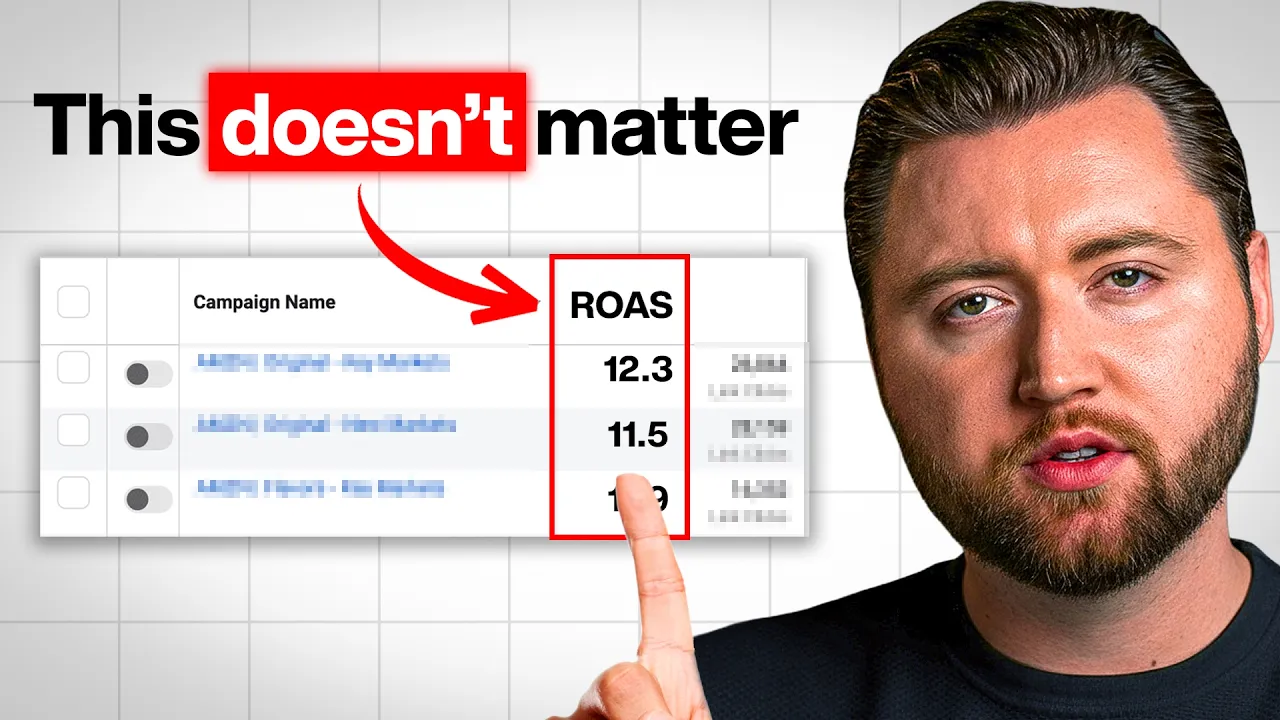
In 2026, rorowaz is one of the most misunderstood metrics in Facebook ads right now. And optimizing for it is exactly why a lot of advertisers can't scale. Now, I know that sounds a little different than what you have probably been taught. And at my agency, we manage over $600 million in ad spend. And I'm inside ad accounts all day long with some of the biggest brands and creators that you shop with online. And in today's video, I'm going to explain why only optimizing for rorowaz in 2026 is going to keep you from scaling and what to do instead. So, what is
106 words, the words spoken in the first 30 seconds at 211 words per minute.
Free, no signup. See how the first 30 seconds hold attention, with rewrites.
Sentence shape
| Measure | This transcript |
|---|---|
| Sentences | 99 |
| Average words per sentence | 18.8 |
| Longest sentence | 67 words |
| Questions asked | 9 |
| Sentences containing a number | 17 |
Most used terms
Filler phrases
10 in total: actually 4 · like 4 · literally 1 · right? 1.
A literal whole-word count of the same phrase list the Prepublish browser extension uses, so a phrase inside another word is not counted and a phrase used in its ordinary sense still is. It is a count and not a judgement.
Free, no account. See where attention is likely to drop, with a rewrite for each weak line. The free check shows the scores and the one issue costing the most. Or run it on the words above first.
Free · No login · See a sample audit first if you prefer.
What this transcript is
Every word below is the caption track YouTube publishes for this video, pulled from the video itself and reproduced unchanged. It is not Prepublish's writing, not a summary, and not a re-transcription: it is the video's own published captions. English captions, generated automatically by YouTube, in the video’s original language. Source: the video on YouTube. A channel that would rather this page did not exist can ask for its removal through the contact page, and it is removed.
In 2026, rorowaz is one of the most misunderstood metrics in Facebook ads right now. And optimizing for it is exactly why a lot of advertisers can't scale. Now, I know that sounds a little different than what you have probably been taught. And at my agency, we manage over $600 million in ad spend. And I'm inside ad accounts all day long with some of the biggest brands and creators that you shop with online. And in today's video, I'm going to explain why only optimizing for rorowaz in 2026 is going to keep you from scaling and what to do instead.
So, what is rorowaz? ROAZ stands for return on ad spend. So if you spend $10,000 on ads and make $40,000 back, you would have a 4x rorowass. And it tells you what you get in return on the money you invest in Facebook ads. Sounds really important, right? So why would I say not to optimize for a high return in ad spend? Because rorowass only measures how efficiently you convert existing demand. It pushes Facebook to chase the easiest sales, which caps scale and kills your long-term growth.
This is so incredibly important. I haven't seen anyone on YouTube talk about this. In fact, inside of Ads Mastery, where I privately mentor brands and creators, we hands-on execute on highlevel stuff just like this. So, when you optimize for rorowaz, the algorithm overly focuses on people who are already close to buying. That looks efficient in the short term, but it limits reach and starves new customer growth. But what it really does is creates an invisible ceiling that prevents the ad account from scaling long term.
And optimizing for rorowaz teaches Facebook to avoid risk and only chase cheap, high intent buyers. and it stops testing new audiences, new creative, which slowly dries up future demand and causes your growth to stall and flatline. All of my private clients across all of my businesses know how much we preach about net new customers in our systems. So, now that we know why we shouldn't optimize only for rorowaz, let's look at what we should do instead for 2026 to scale.
So, I want you to ask yourself this, how much growth did I miss out on by only optimizing for a high return in ad spend? This is where everyone gets stuck and can't scale. So, what do we want to do instead to scale in 2026? Well, we're going to build the ad account around demand creation by optimizing for creative performance and net new customer volume. So, Facebook is constantly expanding who we can sell to instead of recycling the same old buyers.
That means you're willing to accept a little bit lower of a short-term rorowaz in exchange for more customers, more attention, and a bigger, more scalable business over time. And this is how the big brands are built. IM8 Health went from 0 to $100 million in a year. Grunes from 0 to 500 million in two years. Ski, road, AG1, Blenders, Pelaton, Carpay, they all understand this. And now you will too. The goal is not the highest rorowaz possible.
The goal is the lowest rorowaz that you can afford at the highest volume you can handle. All right. So, here we are inside of a Shopify store. And as you can see, this brand over the last 12 months, they were stalling on growth, bouncing between 170, 260, 200, around a 260 monthly mark. And growth had flatlined for the first half of the year. And they couldn't break out. And they were getting a good return in ad spend, 3 to 5x rorowaz, and they were happy with the overall results they were seeing in ads manager, but they couldn't figure out why they couldn't scale.
And as you can see here, the second half of the year, their sales have absolutely exploded and have gone all the way up to 758K just last month. And just to show you what this looks like, the main culprit for this is because they're not acquiring enough new customers in their Facebook algorithm has latched on to the existing customer base and is starting to squeeze all of the new customers down and only focus on the customers who are spending the most with them.
This can cause a flatline on your metrics and prevent growth. So whenever we look at this, you can see they have a very high returning customer rate. And most people would say this is amazing, which it is. But the problem with this is we're not bringing in enough new customers. And so if we just end up reversing this to where we get the algorithm to only focus on acquiring new customers with a little bit lower of a rorowaz, you can see the cells will flip.
And these charts begin to inverse because now the algorithm is going after new customers. And we're able to rapidly scale spend and break out of this flatline. Here's another one where the returning customer rate is at 30%. And their sales were flatlined for those first few months here. And to break out of that, that just reverses. We focus on new customer acquisition. Returning customer rate goes down and sales absolutely explode.
So, a lot of you have a really good returning customer rate of, let's say, 60%. And this is great because you're getting a ton of your customers to come back and buy from you again and again, but it's stagnating your growth because the algorithm on Meta is getting locked in on those same existing customers. So, what you want to do is is be able to acquire new customers and get the algorithm to shift in that direction because once you inverse these charts, you'll begin to see that your sales will rise because we're bringing in new customers.
Meta is now focusing on acquiring those new customers. And then because you have a good returning customer rate already, it's stacking month over month, which allows us to begin to scale again. And most of you will get stuck in this track where this will be flatlined for an entire year. And although your rorowaz looks great, your KPIs look great, it's because the algorithm is secretly stuck in this period of only going after those same buyers over and over again, and we're just not reaching enough new people.
So what are the common reasons that this would end up happening? Well, you don't have enough segmentation. So therefore, the algorithm continues to show back up in front of the same people because Meta knows if somebody's right on the ledge of being able to buy or has already bought from you again and is more likely to buy again, if the goal is rorowaz, the algorithm is automatically going to go for that lowhanging fruit, which prevents you from reaching those new customers.
The second thing that is a culprit for this is if you're sending out emails and you don't have that segmented and excluded from your audience. Well, Meta is now taking credit for those email blasts where you generate a ton of sales, making it look like you have a good return in ad spend, but in reality, you're still not acquiring those new customers and growing. All right, so how do we fix this inside of your Facebook ads manager?
The first thing is we want to exclude and segment out current customers and existing ones. So, you'll add in your email list of current customers. You'll add in anybody who's engaged with your website and start excluding all those people. So that way we can only focus on net new customers to train the algorithm to go in that direction. The next thing is is we're going to make creatives with specific offers for firsttime buyers and discovery and education and product demo based videos.
So that way we're educating and building up that moat to start driving more new people into our funnel. So that way we force the algorithm to start going after new customers and allowing us to be able to stack our growth month over month going forward. So, if you're inside your ad account, what you want to do is ensure that you actually segment out all of your current website visitors and past purchasers. So, that way you get the algorithm to start focusing only on new people.
And then we incorporate this with creatives that are focused on new customer acquisition as well because your old creatives have all this spin built up engagement and it's all stuck on those same buyers over and over again. So to fix this, one of the things we can do is go to custom audiences and start excluding some of these people by excluding all website visitors in the last 180 days. And we exclude those website visitors and past purchasers.
So that way the audience can only focus on people that we have never reached before. And then we just tailor all of our creatives to new customers only where it's education based, product based, demoing it. So that way we can educate more people, drive more discovery, and get more new people into our funnel to be able to convert, which allows us to entirely reverse flatlining to actually scaling. Once again, this increases engagement metrics, which are exactly what Meta's new systems use today in 2026 to decide where to spend your budget, how to optimize delivery.
And that's far better than only optimizing for rorowaz alone, which would only reward you for cheapest conversions and never test the new creative signals themselves. When you optimize for demand creation, the goal changes. You start looking at things like how many new people saw us today? How many new customers did we acquire? This allows you to build a huge loyal fan base and forces Facebook to find new audiences, test new creative, and expand reach and scale way more profitably to new customers.
And when you optimize for demand and volume, you trade off a high return ad spin with stagnant growth for lower short-term return ad spin, higher CPAs early on, more testing and variation. But you have to look at the full picture because in return you get a much bigger audience, a stronger brand, a higher revenue ceiling, and ultimately a way more profitable brand that scales month over month. You are literally trading off a win today for a bigger win for tomorrow.
And if you only optimize and focus on rorowaz, you stay efficient, but you stay small. And if you optimize for demand and net new customers, you build a brand that actually scales. So, now that you understand that rorowaz is holding you back as you scale in 2026, let's dive deeper into this new meta model and how it actually works. From the new algorithm, the new creatives, the account structure, I put everything in this video for you right here.
I'll see you inside shortly.
The words are the caption track's own and nothing is reworded or re-transcribed. Paragraph breaks are placed between sentences so the text reads as prose.
Free tools for your own script: paste a draft and see where it stands before you record it.
Paste your draft and see where viewers are likely to drop off, with a rewrite for each weak line.
Paste the first 30 seconds of your own draft for a hook score and rewrites.
Check your draft against YouTube's advertiser-friendly guidelines before you record it.
Read this channel's public videos and transcripts, and download a writing brief for it.