Getting the transcript
Reading the captions from YouTube. A video nobody has opened here before takes 10 to 30 seconds; this page fills in on its own.
Getting the transcript
Reading the captions from YouTube. A video nobody has opened here before takes 10 to 30 seconds; this page fills in on its own.
Chris Raroque · @raroque
This video has no Most replayed graph yet: YouTube shows one only once a video has enough views. These are the moments viewers replayed most in Chris Raroque's most watched videos.
Most replayed moment at 8:39
3.2x that video's typical replay level
plugin for Claude Code. It's a plugin that you install by using a slash command. And when you have it installed, I've just noticed that it's about like 20 or 30% better at design. If I have this installed and I give it a screenshot, it follows the screenshot a little bit better. Or if I'm just oneshotting a design, 20
Said at 8:33
Most replayed moment at 9:45
5.6x that video's typical replay level
database or how much bandwidth you're consuming with Superbase. So, you want to add these limits because someone could in theory hit up these services and then just rack up a huge bill that way. And there are a lot of cases of this happening where people woke up to a $50,000 bill. So, please add these type of limits
Said at 9:38
Most replayed moment at 3:33
3.5x that video's typical replay level
can I do this better? How can I make sure that my illustration stand out among other apps?" Let me show you what I mean. This is the onboarding for my calorie tracking app Amy. People keep messaging me about this onboarding saying this is one of the best onboarding that they've seen. I think someone actually signed up
Said at 3:25
The graph counts replays. It does not show where viewers stopped watching.
Words
2,947
Runtime
12:23
Speaking pace
238wpm
Reading time
12min
238 words per minute, above the 201 75th percentile of 349 measured videos. That distribution comes from the 349-video hook study.
Opening (first 30 seconds)
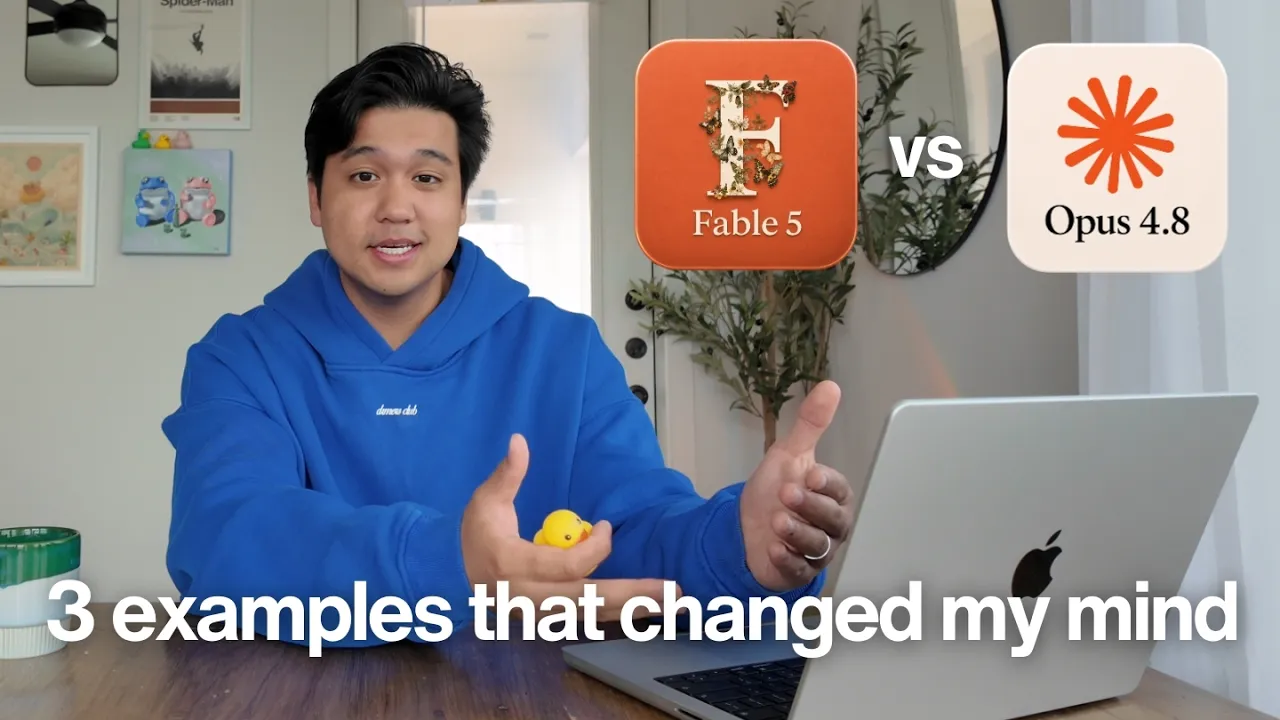
Last week Anthropic released Fable 5, arguably one of the most powerful AI models ever. And then about 48 hours later, it was gone. The US government had it pulled, and at the time of recording, you still can't use it. So many people have been talking about this model, it's gotten a ton of hype. I've been using it extensively, and a lot of people have asked me, is it actually that good? I used it for about 48 hours and pushed it as hard as possible, and I'll be honest with you, yes, I think it is the best coding model I've ever used. But I'm not just going to say that, I'm going to show you
119 words, the words spoken in the first 30 seconds at 238 words per minute.
Free, no signup. See how the first 30 seconds hold attention, with rewrites.
Sentence shape
| Measure | This transcript |
|---|---|
| Sentences | 161 |
| Average words per sentence | 18.3 |
| Longest sentence | 55 words |
| Questions asked | 13 |
| Sentences containing a number | 30 |
Most used terms
Filler phrases
42 in total: like 19 · actually 14 · basically 3 · kind of 2 · literally 2 · I mean 1 · you know 1.
A literal whole-word count of the same phrase list the Prepublish browser extension uses, so a phrase inside another word is not counted and a phrase used in its ordinary sense still is. It is a count and not a judgement.
What this transcript is
Every word below is the caption track YouTube publishes for this video, pulled from the video itself and reproduced unchanged. It is not Prepublish's writing, not a summary, and not a re-transcription: it is the video's own published captions. English captions, generated automatically by YouTube, in the video’s original language. Source: the video on YouTube. A channel that would rather this page did not exist can ask for its removal through the contact page, and it is removed.
Last week Anthropic released Fable 5, arguably one of the most powerful AI models ever. And then about 48 hours later, it was gone. The US government had it pulled, and at the time of recording, you still can't use it. So many people have been talking about this model, it's gotten a ton of hype. I've been using it extensively, and a lot of people have asked me, is it actually that good? I used it for about 48 hours and pushed it as hard as possible, and I'll be honest with you, yes, I think it is the best coding model I've ever used.
But I'm not just going to say that, I'm going to show you what I built in these 48 hours that has convinced me to come to this conclusion. I'm going to show you three things I shipped in those 48 hours that both Opus 4.8 at the ultra code setting and GPT 5.5 extra high, arguably the two best models at coding, both failed at. We'll also go over the catch when it comes to using Fable 5, and there is a big one. And then most importantly, we'll go over is it worth actually paying for when it does inevitably come back, [music] especially if you have to pay for it with API pricing.
If you're new here, welcome to the video. My name is Chris, and I build productivity apps. I usually focus on one app per video, but today's a bit different. Today, we're focusing on a model. For context for my current workflow, I rely on two models. I use Opus 4.8 on the ultra code setting and GPT 5.5 extra high, both the highest setting that you can use these two models at. Those are my two daily drivers, so everything I did with Fable, I'm comparing against those two models.
Now, here's how I tested it, and this is usually how I test all the new models that come out. I actually have a running list of ambitious features that I want to ship that all models have failed at before. And whenever a new model drops, I just throw the list at it. So, that's what I did with Fable, I threw my hardest problems at it. So, the first one is a pretty complex iPad drag and drop problem. One of my apps, Ellie, is a daily planning app, and on the iPhone, I support some pretty complex drag gestures.
You can drag tasks around to reorder them, and you can drag tasks from a list into the calendar. It's a fully custom drag system that I built with custom animations and interactions. On this iPhone version, it feels really good. Like if you look closely, you'll see things swapping pretty cleanly. It feels really responsive. Now, Ellie does have an iPad version, but if I'm being honest, it is not that great. And the reason it's not that great is because I'm not using a fully custom drag system.
I'm using a lot of the out-of-the-box drag stuff that Apple gives you with SwiftUI, which means unfortunately, I don't have a lot of control. I'm pretty limited to when it comes to the drag preview or the animations when things are swapping. So, if you compare them side by side, you can tell that the iPad version is just a little bit off. Something I've always wanted to do and I've attempted in the past, but failed with a bunch of other models is to port this custom drag system I have on the phone to the iPad version of Ellie.
You might be thinking, "Well, I mean, isn't this just a Swift app? Can't you just easily port it over since it's all Swift code?" Unfortunately, it's a little bit more complicated than it looks. On the iPhone, you just have one column, but on the iPad, you can have multiple columns. And even worse, you can drag things between columns, but also drag them into the list on the sidebar, and you can drag things directly into the time box, too.
[music] And because of this, there's like 10 plus edge cases you need to consider. And that's what makes it nearly impossible to one or two shot this problem. The model can't just pattern match. It has to think like 10 steps ahead to make sure it gets it all right and accounts for all of the edge cases. I did try this on Opus 4.8 on the ultra code setting when it first came out, and after 10 prompts, it was just a mess.
And same thing with GPT 5.5 extra high, also couldn't get it. It was able to match the iPhone where you can reorder within a single column, but then it would fail when you tried to drag to multiple columns. And then when I fixed it to work with multiple columns, it wouldn't go into the time box. And then when I fixed the time box, the multi-column somehow broke. Because of all the edge cases, things kept breaking when I used these two models, and in the end, I would have to give up and then just put this problem back on the shelf.
I threw the exact same problem at Fable 5, and it got it in one shot. I was honestly extremely surprised by this and very skeptical, so I did double-check its work pretty thoroughly, but yeah, it actually just got it. I got really excited when I saw this and thought, "Okay, let's keep going down my list. Let's throw an even harder problem at it." So, on the web version of Ellie, I support the ability to drag a task from this Kanban board on the left into the time box on the right.
And that alone is very complicated because I'm using two custom libraries to power the drag animations and the calendar support and getting these two libraries to cooperate is already a nightmare. But the thing that makes this even more difficult is the code. I wrote the code for this like 5 years ago pre-AI by hand. It's like 10,000 lines long and to be honest, it is not good code. It's [music] extremely fragile and anytime you make one change, there is a high possibility that three other things are going to break immediately.
There are three different calendar integrations here. There's recurring tasks, there's lists, things to account for for such a seemingly simple system. Now, that's what exists and there's been one feature that I've wanted for years and so many people have asked for, too. Right now, you can drag from the Kanban into the time box, but you can't go the other direction. So, people want to be able to drag a task from the calendar back into the Kanban.
This sounds really simple in theory, but because of the nightmare that this codebase is and the 50-plus [music] edge cases that exist, I have never been able to pull this off no matter what model I tried in the past. [music] If the iPad refactor required thinking 10 steps ahead, I would say that this required thinking 20 steps ahead. And Fable got it with two prompts. This made literally no sense to me. I absolutely did not trust it, so I spent the next 5 hours just meticulously trying to break it, find edge cases, see what mistakes it probably made, but I literally could not find anything.
It actually looked like everything worked. And this was the moment it clicked for me, okay, I think this model is actually different. Now, another thing I want to point out here is I didn't just trust myself on this. If you've been following the channel, you know that I use Greptile to review all my code and a huge thank you to them for actually sponsoring this video. But even if they weren't, this is the tool I recommend for code reviews.
Greptile is an AI code review service. You connect your repos, toggle it on, and every pull request gets automatically reviewed. It looks at the PR with the surrounding codebase context and then tries to catch real issues like bugs, edge cases, regressions, and it leaves comments directly in the PR. Now, this is massive for me because as a solo developer, I don't have anyone to review my code. So, Greptile's basically a second set of eyes for me, and it is extremely good at catching issues.
It gives every single PR a score out of five, and usually when I'm pushing my own code, like 90% of the time, the first pass gets usually a three out of five, which is a good thing because it means that it caught something that I can fix before I ship this to production. Basically, getting a five out of five on the first shot is very rare. But, everything I shipped with Fable, including the two features I talked about, consistently was getting at minimum a four out of five, and in most cases a five out of five right on the first pass.
And that was another point of confirmation for me that Fable is definitely a different type of model. The code review system I rely on, Greptile, was not finding any serious issues with it. But, back to Greptile, it is an absolute necessity in my current tech stack, and I'll leave a link in the description if you want to check it out. It's completely free to try, no credit card required, and for the peace of mind alone as a solo dev, it is absolutely worth it, in my opinion.
Now, back to testing Fable, the first two things I threw at it were about raw, complicated problems. Next, I wanted to test something else. How creative can it get? I have this app called Amy. It is a calorie tracker in the style of Apple Notes. Now, one user actually requested, "Can I do something with the logo?" Because right now, when you tap it, nothing actually happens. A few other people upvoted it on the feedback board, and I thought, "Okay, let's see what Fable can do with this." So, I gave Fable a semi-deliberately vague prompt, and I said, "Make the logo a button, and when you tap it, make emojis rain down, and I want them to respect physics and bounce off of the gold bar at the bottom." I would expect Opus or GPT 5.5 to get this, but I think it would take about five or six prompts [music] to get it right, especially when it comes to making the physics feel right.
Fable got it in one shot, and it got the physics correct, and the bounce was working perfectly. Let me hear, maybe I'll just show you guys. Okay, so if we tap the logo, >> [music] >> can you guys see that? And it actually does respect the physics, which is really cool. Look at that. That is so cool. But, the part that I loved is I never told it which emojis to use and it took the creative liberty to make sure that all the emojis were food-related emojis.
Again, I do think other models could get this, but it would take like five [music] or six prompts. So, after using it for a bit, I tried to figure out why does this feel different? And also, why does it not feel different for other people who have tried it? Because I've seen a couple of other people who have used it and said, "I don't notice a difference between [music] it and Opus." Here's the best way I can describe it.
Models like Opus 4.8 and GPT 5.5, they can think maybe eight steps ahead, which is pretty good already. But a model like Fable feels like it can think 20 steps [music] ahead. It feels like it's really good at anticipating the shape of problems before I have to point it out. And I think that only matters for a specific type of problem. It shines when the problem is really complex, when it needs to be creative, and especially if you're working in a very large, complex codebase or a really old, fragile one.
Like in my case with a lot of legacy code written pre-AI. So, when people say that they don't feel a difference between Opus and Fable, I think it's because they're throwing tasks that probably only requires thinking >> [music] >> three to five steps ahead, which makes sense because I think Opus and GPT 5.5 are completely fine at handling that. Now, give it something where it needs to think 20 steps ahead, and that's where I think you'll see a way more noticeable difference.
I used the rest of my time to port more functionality to the iPad, doing some much-needed performance work on Ellie, and auditing very legacy parts of my codebase. And it went incredibly well because I think these are the types of things that Fable is really suited for. To be honest, it didn't feel as magical on Amy because I think it's a much newer, smaller codebase. The messier the code or the more complex the system, the more Fable shines.
Now, let's talk about the catch when it comes to using a model like Fable because this is absolutely not a model you can just throw at everything. I was running it on the ultra code setting, so that's the highest setting inside of Claude Code. And typically, my 5-hour session would completely max out and I wouldn't be able to use it after 45 minutes. And sometimes faster when I was working on a multiple things [music] in parallel.
And the reason is because when you're using Claude Code with the ultra mode setting turned on, it's going to use what are called workflows sometimes. [music] And workflows are basically when it will spawn a ton of sub agents to go handle the task for you, which increases your usage [music] tremendously. So, the LE web drag from a time box into the Kanban problem that we solved, it took about 45 minutes to run. And by the end of it, the 5-hour usage session was completely evaporated.
There were actually a couple things I tried but failed because I ran out of usage limit. For example, I tried to port Amy to Android, but after 30 minutes, my session would be completely used up and it really didn't even make it that far. So, it was one thing I was really excited to try, but unfortunately just did not have the time to complete it because the model got pulled. This is, as I guess they warned us, an extremely expensive model.
I would not throw every single problem at it. I would reserve it for a handful of brutal problems that you think Opus or GPT 5.5 won't be able to get. And this actually changed how I think about paying for a model like this. Because Fable's inevitably going to come back, but it's probably going to only be used on API pricing. [music] So, when it comes to using Fable, I have one question on my mind. Would I pay a thousand dollars to get this feature shipped or this problem solved?
That calendar drag to Kanban problem that I've been wanting to solve for years that so many people have asked me for, would I pay a thousand dollars to have that feature shipped? The answer is probably yes, because I've already probably wasted well over a thousand dollars in my own time in the past trying to solve it. And the app actually does make money. So, it does make sense from a business perspective. What about better iPad drag support for LE?
Would I pay a thousand dollars for that? In my case, probably also yes. So, moving forward with Fable, if it's only available on API pricing, I'm changing my mental model a bit. So, it's not just would I pay for the Claude Code subscription, it's now would I pay X amount of dollars to get this problem solved. For my specific problems, because I do make money from the apps that I ship, the answer is usually going to be yes.
And I think for a lot of businesses, that is also going to be the case. I'll be honest, after dropping back to Opus 4.8 and GPT 5.5 after using Fable for 48 hours, it does kind of hurt. And I think it really does solidify that I would pay X amount to be able to solve those problems in just one or two shots. I feel like I'm really going to regret saying that, but it is what it is. So, is the Fable hype justified? In my opinion, for once, I think it actually is.
Again, I feel really bad giving in to the hype, but after using it on real problems in my code base, I think it's definitely warranted. That was my 48 hours with Fable, and if it comes back, hopefully this video helps you figure out is it worth paying for. If you like this kind of content, check out my Instagram and TikTok. I post almost every other day about building productivity apps. And obviously, if you like this content, don't forget to subscribe.
But thank you guys so much for watching, and I will see you guys in the next video. >> [music] [music]
The words are the caption track's own and nothing is reworded or re-transcribed. Paragraph breaks are placed between sentences so the text reads as prose.
Free tools for your own script. No signup, no login.
Paste your draft and see where viewers are likely to drop off, with a rewrite for each weak line.
Paste the first 30 seconds of your own draft for a hook score and rewrites.
Check your draft against YouTube's advertiser-friendly guidelines before you record it.
Read this channel's public videos and transcripts, and download a writing brief for it.