Getting the transcript
Reading the captions from YouTube. A video nobody has opened here before takes 10 to 30 seconds; this page fills in on its own.
Getting the transcript
Reading the captions from YouTube. A video nobody has opened here before takes 10 to 30 seconds; this page fills in on its own.
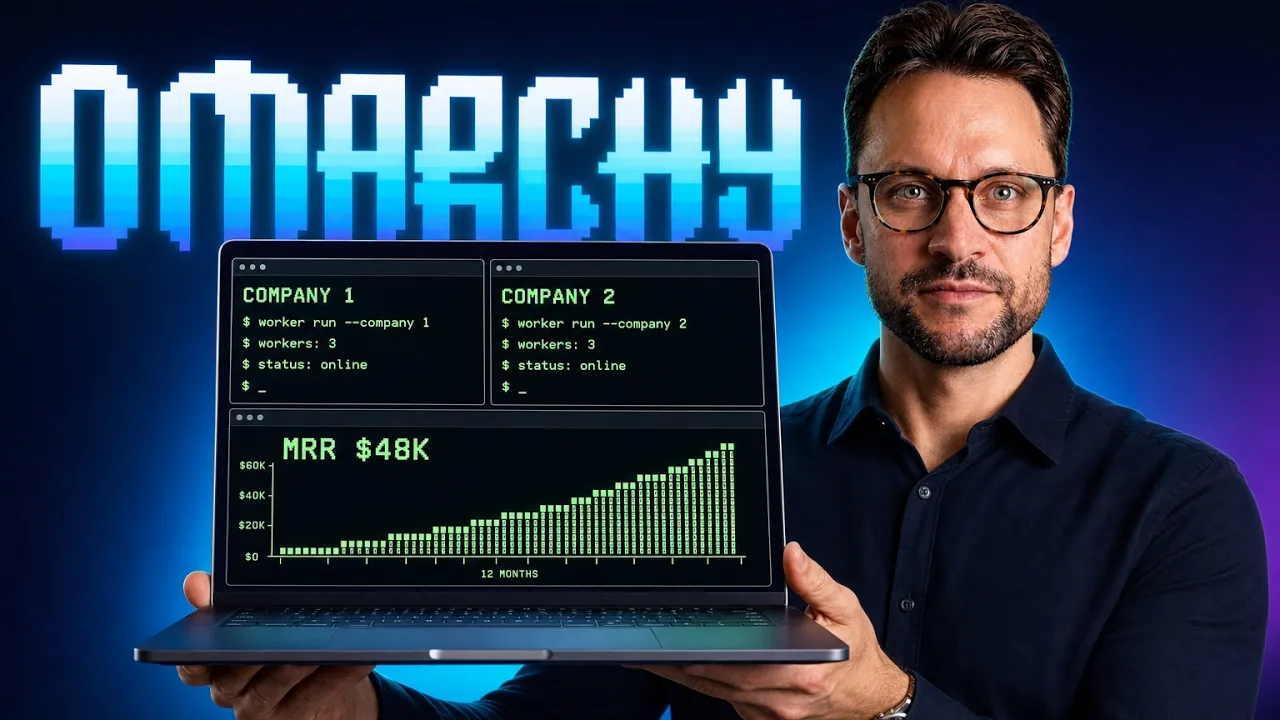
Simon Høiberg · @SimonHoiberg
Words
2,065
Runtime
12:15
Speaking pace
169wpm
Reading time
9min
169 words per minute, between the 160 25th percentile and the 181 median of 349 measured videos. That distribution comes from the 349-video hook study.
Opening (first 30 seconds)
So, last week I installed Omachi and gave an AI agent access to the operating system. And I'm just blown away how good this is. The OS itself is just really well made, but the fact that I can have an AI agent customize anything I want is just next level. I asked it to change some things and inspected the shortcuts and window rules, changed the desktop, reloaded it, and then kept working inside the environment it had just modified. And I remember thinking,
85 words, the words spoken in the first 30 seconds at 169 words per minute.
Free, no signup. See how the first 30 seconds hold attention, with rewrites.
Sentence shape
| Measure | This transcript |
|---|---|
| Sentences | 146 |
| Average words per sentence | 14.1 |
| Longest sentence | 38 words |
| Questions asked | 5 |
| Sentences containing a number | 4 |
Most used terms
Filler phrases
14 in total: like 8 · actually 3 · I mean 1 · basically 1 · kind of 1.
A literal whole-word count of the same phrase list the Prepublish browser extension uses, so a phrase inside another word is not counted and a phrase used in its ordinary sense still is. It is a count and not a judgement.
Free, no account. See where attention is likely to drop, with a rewrite for each weak line. The free check shows the scores and the one issue costing the most. Or run it on the words above first.
Free · No login · See a sample audit first if you prefer.
What this transcript is
Every word below is the caption track YouTube publishes for this video, pulled from the video itself and reproduced unchanged. It is not Prepublish's writing, not a summary, and not a re-transcription: it is the video's own published captions. English captions, generated automatically by YouTube, in the video’s original language. Source: the video on YouTube. A channel that would rather this page did not exist can ask for its removal through the contact page, and it is removed.
No Script X-ray for this video: YouTube shows a Most replayed graph only once a video has enough views.
So, last week I installed Omachi and gave an AI agent access to the operating system. And I'm just blown away how good this is. The OS itself is just really well made, but the fact that I can have an AI agent customize anything I want is just next level. I asked it to change some things and inspected the shortcuts and window rules, changed the desktop, reloaded it, and then kept working inside the environment it had just modified.
And I remember thinking, "Okay, [music] this is insane. I want to build my entire company into this." So, just for context, in case you're new here, I'm Simon Harb Berg. I run a seven-figure SaaS portfolio of four SaaS tools, and this year I doubled down on becoming as natively AI operated as possible. >> [music] >> I already run a huge part of my business with AI agents using Open Claw. I started in Telegram, [music] slowly outgrew it, and started building custom harnesses and a custom desktop and Android app for me and [music] my team.
And now, building my Agentic OS into Omachi itself [music] seems to be the next natural step. So, in this video, I'm going to show you why I'm building my own custom Agentic operating system, why I'm using Omachi as the base, and why it might become the biggest advantage my companies have ever had. So, let me go back a little bit. When I started using Open Claw, Telegram was kind of perfect. I could walk through the mountains here in Switzerland, send an agent a long voice note, put my phone away, and the work would continue without me.
My coding agents runs on a dedicated server. It pulls down the repositories, starts the development environment, and keeps working while my laptop is closed. Another agent watches the infrastructure and investigates anything strange before it becomes my problem. If a difficult support ticket comes in, it checks the customer account and payment first, then goes through the logs and previous conversations before I have to do anything.
I went from talking to chat GPT in a browser to having agents working across the actual company. And this experience has completely changed how I want to operate my businesses. But the more useful my agents became, the worse Telegram became as the main interface. The conversation is fine when I ask for something and get an answer back. But some of this work takes hours. It moves between agents, fails checks, gets revised needs my decision.
In Telegram, all of that becomes an enormous stream of status updates and messages and it all becomes very chaotic very fast. So, I started building a custom harness around my agent team. Take a difficult support ticket. Before, I would read the conversation, tell the agent where to look up the customer, ask it to check the payment in Stripe, search the logs and probably open the code base as well. After a lot of back and forth, I might finally understand what happened.
Me doing all of this orchestrating became the harness. Reading conversations, looking up customers, inspecting relevant logs, comparing with previous tickets and most importantly, learning from previous experience. Just like a human would. I call it OpsLayer. It's become the company system around all of the stuff we do. It's a private internal tool we're building for my companies. Open Claw runs the agents and OpsLayer gives their work an actual place to go.
The final thing we needed was a place to see all of this happening and a place to interface and control the system. So, I built a desktop app with Electron and an Android app with React Native because I wanted the system available everywhere. And I'm telling you, it's been a total game-changer. I now have a Notion-like wiki and internal documentation, linear-like task board where agents and humans can work together, review each other's work and move things forward.
And a secure system for calling tools and APIs where my AI agents never see API keys or credentials. Instead, they call the tools through the harness and a human needs to approve the call before it goes out. And the best part about this is it's built by the agents themselves. I haven't looked at the code behind any of this. And whenever we need something new, I just ask the agents to build it. It's a fully self-improving custom OS for my company that gets better every day.
And here I thought Opslayer, this custom OS we built, was almost perfect. This entire system just worked so unbelievably well. My agents had a place to work, I had a place to control everything, and whenever I wanted something new, they could extend the system themselves. And then, last week I discovered Ultramarine. So, Ultramarine is a Linux-based operating system created by DHH. It's built on Arch Linux and the Hyperland tiling window manager.
And DHH basically packaged the development environment he uses every day so other people can install the whole thing without spending weeks assembling Linux themselves. And DHH is not some random developer. He created Ruby on Rails and co-owns 37signals, the company behind Basecamp. He has been a huge inspiration for me. His way of running his companies, him leaving the cloud and self-hosting all of their tech. A lot of the things I'm doing is inspired by these guys 37signals.
Among others, I have been seeing Ultramarine all over Twitter. People were hyping it like crazy. And at the same time, parts of the Linux community were arguing about the whole thing. Is it actually a Linux distribution? Is it mostly a set of configuration files on top of Arch? Is DHH getting too much attention for packaging work that Linux community had already built. Honestly, I didn't care about any of that. I finally gave it a go and I was blown away.
I started moving around with the keyboard. Applications tiled themselves. The workspaces felt natural and everything was just fast. I could get where I wanted without hunting through windows and dragging them around all day. I absolutely loved it. Then I realized that one of Amachi's big selling points is how deeply AI agents are built into the experience. You add your API key or sign in with your Codex subscription and the AI is just there in the OS ready to work on the system itself.
So, I started asking it to make Amachi mine. Change this shortcut. Add this. Move that. Remove this stuff I didn't want. The agent inspected the Amachi setup, changed the shortcuts and window rules, reloaded the environment, and then continued working inside the version it had just customized for me. That's when it clicked. I have been building towards this experience with React Native, web apps, and Electron cuz that's what I've been used to.
And sure, they get the job done, but Amachi gave me the experience I actually wanted. Something that really, truly felt native. Like an actual operating system built for my company. I know how nerdy this sounds, but this completely blew my mind. This was what I wanted my Agencic OS to be. I want to build the computer around Upstack. And sure, I could keep most of the company system inside an Electron app. I guess that would probably be easier, but I spent a substantial amount of my life working and Amachi simply makes those hours more enjoyable.
And that's important, too. I don't need to invent a fake productivity metric for that. I want my tooling to be something I just love using. Something that just feels right. Though, taste and satisfaction aside, we've started running into a huge problem more and more often, and I think this can finally solve it. I'll have several agents coding at the same time, other jobs running in the background, and then something heavy like Blender or Remotion starts rendering.
At some point, we simply run out of compute. We've solved parts of this by using a queue-like approach where agents simply stand in line, but it's patchy and it slows us down. So, I want to turn that patchy setup into our own private company cloud. Our system already runs inside our own VPS, which we self-host with Hetzner, and the idea is to take another computer, install our version of Hamachi, connect it to this private network, and give it a role.
Opslayer should give that machine the context and work that belongs to that role. It can use the local files and tools, do something useful for the company, and return the result through the same review process we already use. Some machines will be workstations where I or an agent actively does a specialized job. Other machines can contribute CPU or GPU capacity when heavier work needs it. So, we'll have a main control plane on a VPS, for instance, on Hetzner, and then other computers can join this network either for work or just to offer compute capacity.
I'm preparing to create companies in Singapore and the UAE, and I have absolutely no desire to fill them with enormous teams. I want a tiny human team working with highly specialized agents, with the humans still controlling the big decisions. The next company should not start with an empty Notion workspace, 10 new SaaS subscriptions, and months of rebuilding the same operation. It should inherit the systems and the way of working we've already spent months figuring out.
And when that company needs to grow, expansion starts to mean something different. We add internal compute, decide which agents to use it, and keep the human team tiny. That's such a cool version of growing a software company in 2026. We connect another machine, give it a role, and the company gets more capacity without the human team getting bigger. But, let's also be honest here for a second. All of this could also become an excellent way for technical founder to spend months improving a productivity system and avoid the real business.
And that criticism is completely fair. It wouldn't be the first time we've seen this. I mean, couldn't I just use Cloud Code like normal people? Or Grokbot? Or just keep Open Cloud inside Telegram and still get a lot of useful work done? Founders have always been able to procrastinate by improving their tools. It's not really a new thing. Before AI, it was the perfect Notion workspace or a second brain or days spent configuring the perfect Zapier workflow.
You feel productive because you're building something. Meanwhile, nothing important has happened in the company. AI makes the thing much more powerful. It doesn't magically fix that behavior. Maybe it makes it even worse. So, I judge this very simply. The system has to help us do more, make the work better, or make the work itself more enjoyable. Ideally, I want all three. The Harness already changed how I operate my companies.
The work that used to depend on me orchestrating every step now has a place inside Opslayer, and the agents are building and extending the system themselves. And the work is better, too. The agents don't start from a blank chat every time. They get the company context, they can hand work between each other, and anything important comes back to me for a review and approval. So, I can actually trust and use what they produce.
And Oumachi makes the work more enjoyable. It's fast, it's beautiful, and I genuinely love using it. I spend most of my waking hours doing this stuff, so yes, that matters to me. And if I can boot the second machine, give a specialist real company work, and have results come back ready for review the same day, >> [music] >> I've added real capacity. Then, I want to do it again, and again, with the same tiny human team still in control of the important decisions.
That's my dream company, and it's exactly [music] the company I'm going to build. Now, the only thing I'm truly missing is the local self-hosted intelligence, and we are [music] really close. In fact, if you watch this video next, I'm going to show you exactly how close we are. >> [music]
The words are the caption track's own and nothing is reworded or re-transcribed. Paragraph breaks are placed between sentences so the text reads as prose.
Free tools for your own script: paste a draft and see where it stands before you record it.
Paste your draft and see where viewers are likely to drop off, with a rewrite for each weak line.
Paste the first 30 seconds of your own draft for a hook score and rewrites.
Check your draft against YouTube's advertiser-friendly guidelines before you record it.
Read this channel's public videos and transcripts, and download a writing brief for it.