Getting the transcript
Reading the captions from YouTube. A video nobody has opened here before takes 10 to 30 seconds; this page fills in on its own.
Getting the transcript
Reading the captions from YouTube. A video nobody has opened here before takes 10 to 30 seconds; this page fills in on its own.
Theo - t3․gg · @t3dotgg
Where viewers went back to watch this video again, from YouTube's public Most replayed graph, lined up with what was said at that moment.
Most replayed moment #1
4:339.7x the video's typical replay level
actually let my agents do stuff on my computer. When you're ready to move the sessions to the cloud, you should probably do it at swaive.link/browserbase. Hi, Theo from the future here, one day in the future because everything changes really, really fast. I know a lot of you guys are looking at this chart and saying,
Said at 4:26
Most replayed moment #2
14:577.7x the video's typical replay level
prompt. Specifically, this prompt gives a very clear what the goal is. What should this do when behaving properly? We can see here every Anthropic model passed, Gemini 3.5 Flash passed, 5.4.5.5 did as well, Deep Seek V4 three out of four times, GLM and Chem E three out of four times, Memo started to fail more,
Said at 14:50
Most replayed moment #3
19:502.6x the video's typical replay level
a long time. This is the same bench that Anthropic bragged their model got a 78% on, and GPT-5.5 only got a 58.6. Well, what's funny on that is that it's likely their numbers were just entirely wrong. Somebody did the math based on
Said at 19:43
The graph counts replays. It does not show where viewers stopped watching.
Words
6,838
Runtime
32:30
Speaking pace
210wpm
Reading time
29min
210 words per minute, above the 201 75th percentile of 349 measured videos. That distribution comes from the 349-video hook study.
Opening (first 30 seconds)
It's getting harder and harder to know which models are actually good for the work we do as developers. That's what we have benchmarks for though, right? We have all these cool benches like SWE Bench Pro and Arena that are here to tell us what models are actually good at coding, right? Well, about that. While it is cool to see Mythos kill it on SWE Bench Pro, I personally don't believe that Qwen 3.7 Max or GLM 5.1 are meaningfully better than state-of-the-art models from OpenAI. I also don't believe that Gemini 3.5 Flash is just spitting distance away from GPT 5.4 and
105 words, the words spoken in the first 30 seconds at 210 words per minute.
Free, no signup. See how the first 30 seconds hold attention, with rewrites.
Sentence shape
| Measure | This transcript |
|---|---|
| Sentences | 413 |
| Average words per sentence | 16.6 |
| Longest sentence | 75 words |
| Questions asked | 21 |
| Sentences containing a number | 80 |
Most used terms
Filler phrases
80 in total: like 43 · actually 21 · kind of 8 · right? 6 · sort of 1 · uh 1.
A literal whole-word count of the same phrase list the Prepublish browser extension uses, so a phrase inside another word is not counted and a phrase used in its ordinary sense still is. It is a count and not a judgement.
Free, no account. See where attention is likely to drop, with a rewrite for each weak line. The free check shows the scores and the one issue costing the most. Or run it on the words above first.
Free · No login · See a sample audit first if you prefer.
What this transcript is
Every word below is the caption track YouTube publishes for this video, pulled from the video itself and reproduced unchanged. It is not Prepublish's writing, not a summary, and not a re-transcription: it is the video's own published captions. English captions, generated automatically by YouTube, in the video’s original language. Source: the video on YouTube. A channel that would rather this page did not exist can ask for its removal through the contact page, and it is removed.
It's getting harder and harder to know which models are actually good for the work we do as developers. That's what we have benchmarks for though, right? We have all these cool benches like SWE Bench Pro and Arena that are here to tell us what models are actually good at coding, right? Well, about that. While it is cool to see Mythos kill it on SWE Bench Pro, I personally don't believe that Qwen 3.7 Max or GLM 5.1 are meaningfully better than state-of-the-art models from OpenAI.
I also don't believe that Gemini 3.5 Flash is just spitting distance away from GPT 5.4 and 5.5. That's just obviously not true. The numbers on this bench have been nonsense for a while, and that sucks because SWE Bench Pro was meant to be the realistic bench for realistic coding problems. But not only are the problems kind of [ __ ] they're also contaminated. So much of the info on how to solve these problems has leaked that models will regularly cheat, and the cheating is barely even measured by the people verifying the results.
To be a bit frank, this bench kind of sucks, and the fact that it's lasted this long, especially post-contamination, is frustrating. And while Artificial Analysis has been trying their best to pull together a bunch of things to make their own better suite of coding measurements, it's still not great. And to be clear, the Artificial Analysis Coding Agent Bench is less their own bench and more a combination of other benchmarks that already exist that they're running with various harnesses and models.
And when you go look at the problems that these benches are actually testing, you'll realize just why they are so bad. And don't worry, we'll go and do that later in this video. The issue here is almost misleadingly simple. The problems that are being benched against aren't realistic representations of the things we do and the problems that we try to solve using agents every day. The prompts are a bit nonsensical, the structure of the tools they're using doesn't make sense, the repos already have solutions so the models can cheat.
There's a lot wrong with how these benches work when when compare it to the work that we actually do every day. At least that was the case. The SBV is pretty much exactly what I've begged every person I know in the data and research side to make for years now. I wanted a bench that accurately reflects how we actually build things in our real projects with agents. And now we have it. And the results are so damning that I'm going to be accused of bias.
I can't wait to break down what this bench is, how it works, and how much crazier the results are, especially when compared to the ones that we're used to. But first I have to disclose biases. I am an investor in Data Curve. It's part of why I bullied them into doing this and why I'm so happy that they made it. I've also given this company more [ __ ] than almost any other company I've invested in in my life. I am very proud of them for doing this, but I'm not biased towards them in the ways that you might think.
And when it comes to labs, neither I nor Data Curve has a particular bias. We'll talk a bit more about them, but first I do need to be biased for a second for today's sponsor. AI models have finally gotten good enough to make computer use compelling. It's still so insane watching these agents navigate your computer and do things on it until they get stuck. And they get stuck a lot. I just had an agent get stuck when it was trying to update a single input field because it couldn't see the field in the UI.
It was kind of maddening. But then I saw today's sponsor and realized this problem is solved as long as you're using Browserbase. Specifically, when you're using the new Browserbase browse package. It's a browser CLI for your agents. What does that mean? I already thought my AI could use the browser. Well, it can, but it doesn't really know what to do. It's just going to keep screenshotting the page and looking for things and rarely ever manage to find them.
It needs to know where things are. One of the best ways to give it that knowledge is through skills. Browserbase is working on a collection of all the skills needed to navigate all the websites you would care about. First, you add all the relevant websites as skills, and they will look through their indexing to see if they have the information needed to use the site properly. And once all of the skills are added, you just use Claude as you normally do.
Plan a road trip to Utah with EV charging stops and campsites for each night. Book and reimburse on ramp. That's nuts. That's so many different steps that I never would have expected it to one shot it before, but when it has the right skills it can do it. But if you want to be more granular, you can do that, too. You can call different UI elements in a given page that you're on by calling things as simple as browse, click, and then the input that you're trying to click on.
Or you can tell it to type a specific thing like apartments in SF, select an option, press a key, use the mouse to move around or scroll, take a screenshot, get the content. And you can use this with any tool you're already using. The more I've been automating my work and trying to even just get things deployed, the more value I've seen in using a tool like this to actually let my agents do stuff on my computer. When you're ready to move the sessions to the cloud, you should probably do it at swaive.link/browserbase.
Hi, Theo from the future here, one day in the future because everything changes really, really fast. I know a lot of you guys are looking at this chart and saying, "Of course Theo published this video before Opus 4.8 dropped. It's going to make it look so bad." Well, that's what I'm here for now. Data Curve is still working on getting finalized numbers for Opus 4.8, but I want to share what they have so far. They initially ran it using the Claude code harness instead of the Mini SWE harness used for all the other tests, and the results were that it performed roughly as well as Opus 4.7, but for meaningfully cheaper, which is a good change.
It's still significantly slower than OpenAI models and also slightly dumber, especially when you're using it with Claude code. They did do a follow-up test using Mini SWE, though, and saw a massive improvement in the score. That move bumped them all the way to 63%, which puts them pretty close to GPT-3.5 at 70%. They're theorizing as to why Opus performed so much better in Mini SWE in comparison to Claude code. Their current theory is that the Claude code system prompt is kind of holding back the capability of the model to do these one-shot tests.
I'm honestly inclined to believe that. I know that Claude code loves to stop and ask you questions and get feedback on things before it goes, but also the Claude code system prompt is just kind of garbage, so yeah, that doesn't surprise me. If anything's changed since I recorded here, I'll be sure to pin it in the comments, so take a look for that if you want to make sure the numbers haven't shifted since. Everything else in this video is still super valuable simply because it's about the culture around benchmarking, the techniques that we use to measure these things, and most importantly, how we actually prompt these agents in order to get them working in real-world code bases.
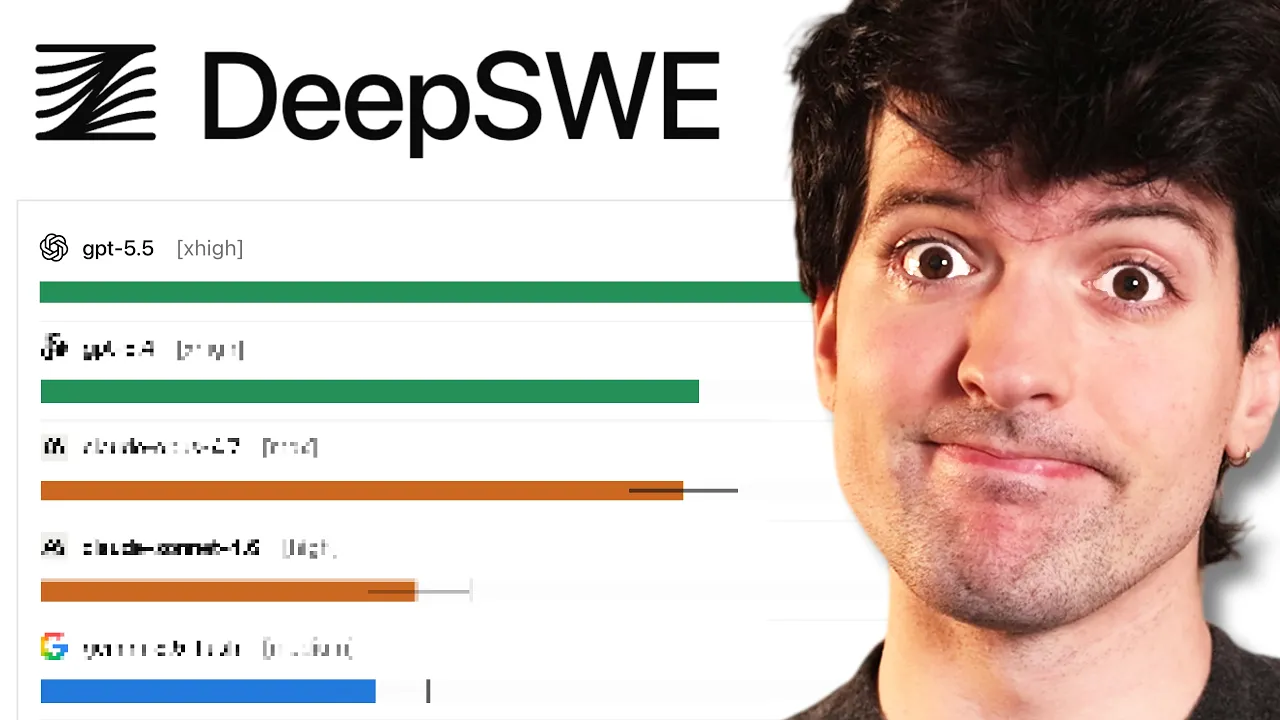
I also slowly descend into madness as I learn how bad SWE bench is, which like, wow. So, yeah, stay tuned for that. While I'm tempted to keep leading you guys on promising the results, I'm not going to do that. I'm just going to show you them, and then we can talk about it. Because OpenAI slaughtered in this bench. GPT-5.5 did the best by far at a 70% success rate. The next highest was 5.4 at a 56%. Then we finally get an Anthropic model with Opus at a 54%.
Then there's a huge drop, and this is the most notable thing here. From Opus 4.7 to Sonnet 4.6, the next highest, we went from 54 to 32, nearly 50% drop. So, what's going on here? What could they possibly be doing that makes OpenAI models so good on this bench and other models so bad? Well, first I'm going to deal with the bias accusations cuz I already see them happening in chat. People seem to think Data Curve is maybe being paid by OpenAI to make this bench.
I was the one who showed this bench to OpenAI, so no, I hit them up and told them about it. Data Curve's job is to sell data to labs to help them get better curation for code data to train the models to be better at coding. The issue they were encountering is that the labs would report their models were really good at code, and then they would go look at the models and look at the results, and they saw a ton of [ __ ] Because they were so confused about the gap between these models and how they were reported to be at code versus the actual experience using them, they went deep, especially on SWE bench pro.
This bench used to be one of the best ones we had for coding tasks, but honestly, the quality of the problems in it isn't very high, but more importantly, the quality of the analysis of the results is absolute garbage. They use an AI to analyze the results to verify them to make sure that things went as expected. And the analyzer and verifier often disagree when they run these tests. There are many cases where the verifier failed, but the analyzer judged it correct as many as 19 to 28% of runs.
Cheated is the bucket that things fall under if the verifier said that the code worked in the past, but the analyzer looks at the history of what it did and determines that it did something it shouldn't have. And that hit roughly 13% of Opus 46 to 47 trials. 87% of cheated runs involved the agent reading out of the dot get history in order to cheat and find the right shape. I didn't realize they actually wrote the analyzer to compare what the verifier from SWE-Pro did and they found these gaps.
Their audit found that SWE-Pro misgrades about 8% false positives and 24% false negatives. And when you combine that with the contamination going on, the bench kind of sucks. If you have doubts on this bench, this chart should be the one that convinces you. It shows what the numbers were in SWE-Bench Pro and how they come out on this new Deep SWE-Bench instead. If you've ever used a model like Gemini 3 Flash to try and code, you understand the fact that it getting a 35% when Sonnet got a 54% is nonsense.
Those models aren't within 30% of each other. They're different worlds. Sonnet 4.6 can actually do work and Gemini 3 cannot do [ __ ] There's definitely some confirmation bias here where I and a lot of people that I talked to have seen and experienced models behaving in the way that this bench measures. I personally don't use Gemini models for real dev work because they so quickly fail just running in loops with tool calls, failing to find the right file, writing code that doesn't compile at all.
They're just not good in real work. They might be able to edit one CSS file to make things pretty. When it comes to actually navigating a code base and getting things done, no, not even [ __ ] close. And when SWE-Bench Pro finds Sonnet 4.6 to be 1.5x better than Gemini 3 flash. Their bench sees Sonit 4 6 is six times better than Gemini 3 flash. That is a massive jump and shows just how much better this bench is. What's craziest to me is the gap from the bottom to the top being so big.
Let's compare like Haiku versus 5 5. In SWE bench pro, there's 20 points between them. On deep SWE, there is 70. There's finally an actual range that is useful to look at and learn from. So, what makes this test so different? How are they getting such crazy results? Are they putting in hints to make it so the open AI models perform better and the Anthropic ones perform worse? No. They made it more realistic. All of the tasks are written from scratch.
They're not using existing commits or PRs. There's way more diversity in the tasks that they're doing. It's not like half Python like SWE bench is. The prompts are half the length of SWE bench pro prompts, but the solutions require five times more code and two times more output tokens. But, the most important part is the verification layer. Verifiers are handwritten to test software behavior rather than implementation details.
A lot of this comes down to prompting and I really like how they talk about it here. They mention that strong models will test their own work unless the prompt tells them not to. This is one of the biggest problems with SWE bench pro is that it tells the models to not write their own tests to verify results. So, the models will write the code and then hope it works because certain models will do what you tell them to.
Certain ones won't. And since Opus models and Claude models in general tend to just kind of ignore what you ask a lot of the time and do things they probably shouldn't. They'll cheat more. They'll make tests when they're told not to more. And they'll put themselves in a scenario where they're more likely to get the right answer by hacking, cheating, and doing those things. Since this test is way simpler prompts, like two sentences instead of two paragraphs, the results are that the model can do what it thinks is right more.
And if it doesn't have the resources to cheat, it has to make resources itself and the results are way, way more reliable. They wrote numbers showing how often did a model write tests when it wasn't supposed to in the SWE Bench Pro versus when they wrote tests in in Deep SWE cuz they're not telling it it can or can't. And you'll see here for Opus 47, it wrote tests 28% of the time even though it was told not to, and it wrote them 83% of the time when not given an instruction.
By 4, wrote tests almost half as much at 18% in SWE Bench Pro, and now it's up to 85% with this bench instead. To put it bluntly, SWE Bench Pro tests how good our models at contaminated Python repos that they're allowed to cheat in and told explicitly to not write tests, and how likely they are to ignore it. So, SWE Bench Pro is realistic in the sense that it's only being tested on existing work people have done with really shitty, poorly written prompts, and Opus is indeed better at ignoring your prompts.
So, if you're looking for the model that does the best job at ignoring what you ask, Opus seems to be really good at that. If you're looking for a model that does exactly what you ask, we now have a bench that shows it. There are so many other fun things to dig into here like wall clock times, output tokens, and actual cost to run the bench, and we'll talk about that all in a sec, but first I want to actually show some of the examples because they published them.
Deep SWE prompts are aligned with the way developers talk to their agents. They're behavior focused, short, and free of large interface definition blocks rather than overly verbose and prescriptive. Agents must discover where and how to implement the change. So, a substantial share of the capabilities being evaluated involve end-to-end exploration instead of just the execution of an over-specified engineering task. Public benches sourced from GitHub issues and pull requests often carry more detail, repro steps, additional context, code snippets, and tests that assume specific symbols or signatures.
Deep SWE instead scores observable behavior, which lets prompts stay short and natural even when the underlying tasks are substantially longer. So, the prompts are half the length, the amount of lines added is five times more, and the amount of files touched is also much bigger, too. Their range of technologies is much better overall, about 30% TypeScript, 30% Go, 30% Python, and then a couple other things. This is across 91 active repos and five languages versus SWE bench, which is 12.
Most importantly, though, all of the tasks are novel, so there aren't existing solutions on GitHub for them to find and use to cheat. Now, the drop in the false positive and false negative rate is crazy. Their verifiers only had false positives .3% of the time. SWE bench pro is almost 10% and then 24% false negatives down to 1.1. So, let's take a look at some of these examples. I'll just hit the top three here. This one is for Happy DOM, which is a JS interface of a web browser without the GUI.
This is really useful for testing and doing things on the DOM without a real DOM. This also means it has a ton of complex implementation details you have to get right. Here's the prompt. Happy DOM currently leaves some asynchronous work in an invalid state after disposal. When shut down through happydom.close, page. close, browser.close, or a navigation that swaps out the active page state interrupts request or response body consumption, the read must reject with a DOM exception named abort error.
The same shutdown behavior should apply to multipart form data parsing. Successful reads that are not interrupted should remain unchanged and fully buffered response bodies should remain readable after shutdown. Scheduled timers and request animation frame callbacks associated with the discarded page must also be cleared. Great. This is a good prompt. Specifically, this prompt gives a very clear what the goal is. What should this do when behaving properly?
We can see here every Anthropic model passed, Gemini 3.5 Flash passed, 5.4.5.5 did as well, Deep Seek V4 three out of four times, GLM and Chem E three out of four times, Memo started to fail more, Gemini 3 Flash errored half the time, 3.1 Pro mostly failed, and now we're back in hell. I want you all to really think about these types of problems as we go over this stuff because you should have the opportunity to make similar things.
If you've tried using models for your work and you find the results aren't very good? Every time that happens, write it down. Have some notes somewhere where you write down the models you tried, the prompt you used, the tools you were using, and the code base and the hash that you were on when you tried the prompt. Maybe fiddle around with the prompt a bit and see if making slight adjustments can get you the result that you're looking for.
But most importantly, keep a corpus of these failures. Keep track of the times the agents couldn't do the work that you wanted them to do, and keep that around cuz when new tools come out you can measure it yourself. You can even create your own mini benchmarks. These models are very good at doing that. If you can collect these examples, throw them into some sandbox somewhere and see which agents can and can't solve them, you now have a useful measurement for what models do and don't make sense for you and your business.
You might even have something good enough to share publicly. We need benches so badly, and if you are experiencing models not doing what they should in your day-to-day work, you have something that I don't, the data to make one of these benchmarks. Do it. It's not that hard to do, and you'd be amazed how quickly the research community notices when you put together a small, seemingly shitty benchmark. I have been absolutely floored how positive the response was to Snitch Bench and Skate Bench.
These two crappy benchmarks made by a YouTuber who had some weird questions he wanted answered. Take advantage of this opportunity. It's not that hard to build. It kind of feels like the SUV Bench Pro creators are making it hard to read their prompts cuz this is the only way to actually look, and this is a This is a mess. So the first example they have is for NodeBB B, which is a Node.js based forum software that I haven't heard of anybody using in a long time.
Like, "Oh, there are still people committing. Cool, that's good to see. The project's not dead." But they took an actual issue that existed. I think they even have a link to it somewhere. Oh, they have the patch and the test patch to test things. The problem statement is what I want to read. This is the example. "Email validation status not handled correctly in ACP and confirmation logic." Title. Description. "The admin control panel ACP does not accurately reflect the email validation status of users.
Also, validation and confirmation processes rely on key expiration, which can prevent correct verification if these keys expire. There's no fallback to recover the email if it's not found under the expected keys. This leads to failures when trying to validate or resend confirmation emails. This is awful. There are steps to reproduce, which is helpful, but this formatting is terrible, especially ending it with labels.
What? This is a horrible prompt. This is a terrible prompt. This is not measuring [ __ ] So, all the SWE bench runs append just garbage to the system prompt, and I finally was able to dig and find it thanks to Chat for letting me get here. You're a helpful assistant that can interact with a computer to solve tasks. I've uploaded a code repository in the directory working there. Consider the following PR description. This is where the problem goes.
That problem is the awful thing I just read over here a second ago. Can you help implement the necessary changes to the repository so the requirements specified in the description are met? I've already taken care of all changes to any of the test files described in that problem. This means you don't have to modify the testing logic or any of the tests in any way. This part in particular is awful, telling it it doesn't have to modify testing logic or add tests.
This one line should invalidate SWE bench by itself. This is so bad. Like like why is Snitch bench, my like shitty benchmark checking if models are willing to hit the government up when you're doing medical malpractice, better architected and better designed than this [ __ ] Your task is to make the minimal changes to non-test files in the directory to ensure that the description of the problem is satisfied. Follow these steps to resolve the issue.
One, as a first step, it might be a good idea to find and read the relevant code. Two, create a script to reproduce the error and execute it using the bash tool. Three, edit the source code of the repo to resolve the issue. Four, rerun your reproduce script and confirm the error is fixed. Five, think about edge cases and make sure your fix handles those as well. Your thinking should be thorough, and so it's fine if it's very long.
Are you joking? Well, at least we know how Gemini models perform okay on SWE-bench because they are told exactly how to do things. I don't know about y'all, but personally, I don't write 15 steps when I ask a model to go fix some small bug. This is the type of prompting that would have almost sounded like it made sense in the GPT-3 days, but the fact that we're still using this bench today is I'll just be [ __ ] frank, it's pathetic.
It's actually pathetic. And this has been the industry standard for a long time. This is the same bench that Anthropic bragged their model got a 78% on, and GPT-5.5 only got a 58.6. Well, what's funny on that is that it's likely their numbers were just entirely wrong. Somebody did the math based on the reporting from Data Curve and calculated that the actual score 5.5 should have gotten is probably an 86.7, not a 68.5.
Insane. And again, for comparison, let's look at a deep SWE prompt. Fix prompt QL label sorting across typed and untyped values in this Go project, Prometheus. Very well-regarded library for monitoring systems and time series database stuff. I know we use Prometheus at Twitch. I never touched it, but I know there's a very legit library. Label sorting must use multi-domain typed comparison. Current behavior does not produce a stable total order when labeled mixed heterogeneous typed and untyped string representations.
Values with leading white space are never parsed as any type form and must be sorted before all other values. Within this leading white space group, ordering is by natural sort of the original strings. Order classes are as follows. Details of how this should be ordered. Numeric parsing must accept scientific exponents and optional leading plus signs. A bare exponent marker with no following digits is not a valid number and falls back to untyped natural sorting.
Yada yada, you get the idea. This isn't telling it how to solve the problem. This is telling it what the problem is and what the solution should look like. This is a a prompt. If your prompts look more like the absolute If your prompts look more like the mental illness that is SWE agent's system prompt here, and less like what I just showed here in deep SWE, you probably should be going with whatever the results of SWE bench pro are because shitty prompts from shitty prompters with 5,000 too many characters seems like they're measuring that fine.
I like prompting like this. My prompts are me describing the problem and roughly what the solution looks like to the agent and then trusting it to go do its thing. Also interesting on this one, this big go project that required a lot of code to change for it to work, the solution was 805 lines of code. GLM 51 did okay on this. It actually got a 50% score. GPT 54 got three out of seven, so technically did worse than GLM 51. 55 similarly had three out of seven.
Opus only got it twice. Very interesting. The more you read into this, the more it makes sense why this gap is so big. And I want to be clear, all of this shit's obvious. This isn't them doing some crazy novel thing with the bench. They just sat and put in the work that nobody else wanted to do because you have to verify these results, and that's a shitload of reading shitty code. Nobody wants to do that, and I am thankful that they were willing to put in the work to go do it because they finally got us a bench with results that mean something.
And now we can look at the other results that mean things because finally we have a bench that's good enough that token outs, cost outs, and wall clock times are useful as well as the comparisons of different agents that I think is really cool, too. Let's actually start with that. They used the mini SWE agent from SWE bench, which is a super minimal agent harness that just gives the agent the ability to use bash. They tried running against the official harnesses from the other models as well, and the results were telling.
The pass rate when they used mini SWE agent with Claude Opus was a 50%, but when they switched the Claude code, it dropped 10%. It did actually do more output tokens with mini SWE agent than it did with Claude code, though, which is notable. With GPT 55, it scored identically in the subset they tested with the same harness, but it used more output tokens in Codex. Not a lot more, and to be clear, both of those numbers are way smaller than the Opus run, where the worst run with Codex CLI was 25K outputs, and with Claude code, the better case for Opus, it was 48, almost doubling.
And then Gemini 3.1 Pro got a 40% in the mini agent, but still only got a 20% through the official Gemini CLI. Surprise. They did all this testing so they wanted to make sure that this agent wouldn't be meaningfully disadvantageous to any one model family, and it seems like the results came out fair as a result. So, let's look at the fun numbers. Score versus output tokens per trial. For those who wonder why I hate 3.5 Flash so much, here you go.
There's a chart that shows it. It scored less than half as well as GPT55 did, and it used comically more tokens. GPT55 did 47K tokens per trial on average. 3.5 Flash did 150,000, 3X the tokens. Opus did it 2X at 97K, again compared to 47K, double the number of tokens and a lower score. This goes even further with the cost comparisons, where Opus ends up being more than 3X more expensive than any other option. If you wonder why Anthropic's revenue is growing so fast, this is probably part of it.
Fact that they charge so much more for their intelligence because it burns way more tokens and doesn't perform that well as a result. If you want to spend a lot of money on AI and you're trying to maximize your AI spend at your company, you should definitely be using Opus. The numbers tell you why. So, they cost $16 per run average. GPT55 cost $5.80 average. By 4 was even cheaper at $3.30. My favorite number here though is the Gemini 3.5 Flash number because the model's a Flash model.
It should be way cheaper than OpenAI, right? Right? Like why would I use the $30 per million out model when I could use the $9 per million out model that's so fast and just as smart. Oh, it's cuz it cost almost the exact same amount of money in the end. But it's a flash model, it's fast, right? Let's look at the performance. Oh yeah, it was faster. It finished in 15 minutes versus 20 minutes. Okay, so it was like 20% faster and it was 3x dumber and roughly the same price.
Why would you use 35 flash for like anything? Yeah. These numbers are crazy. I can already predict what a lot of the questions in the comment section are going to be. So let's address as many of them as we can. First, I am sure people are asking, "What about Opus 46? What about the new Quen models?" Let's turn those things on. Here's Opus 46, Quen 36, Haiku and Minimax. Cool. Turns out Opus 46 bombed this test. I'm not quite sure the details as to why.
I haven't talked to the team about it yet, but Opus 46 really struggled with this bench. So maybe all the things Anthropic was saying about Opus 47 being better at these long tasks were true in the end. Looks like it very well could be the case. I will talk to them more and try to run this myself out of curiosity. But all the other things I just turned on landed much lower. This is probably the most damning bench for open weight models ever because none of them get to even half the score of the last generation of state-of-the-art models.
Sure, when you look at artificial analysis, things look less bad. It's like, "Look, Mimo V25 got a 54. Kimik 26 got a 54 as well. Opus was a 57 and 55's only a 60. Like that's not that big of a gap. Even DeepSeek V4 Pro did a 52. Like clearly open weight's catching up, right?" Well, uh no. Kimik 26 scores as well as 54 mini and 54 mini is not a good model. If 54 is more than doubling every single open weight score, that's pretty damning.
And this also confirms the experience I had with DeepSeek V4 Pro where if you isolated it to one file to solve one small thing, it worked fine. But if you wanted to actually do real work in a real code base, it falls off immediately. I am very thankful to have this bench. It has confirmed so many of the things that I and you guys as well have felt as we use these things, that the gap between Opus 5455 and everything else is huge.
That 55 is a meaningful jump in the ability for agents to do serious work with minimal context. And that when you actually use these things for real work, giving them real problems to solve, the gap between the open weight models and the state of the art models feels way more than 5%, which is what other tests were showing. And again, when you compare this to the Code Arena bench, you see why I don't trust the old benchmarks.
I believe this one is mostly a front-end test, which sure, GPT 55 is not as good at generating a homepage or a marketing site as Claude Opus is. Cool. These numbers make no sense. In a world of people running with these types of results, it is such a relief, genuinely, to have a company that I invested in and that was a bunch of nerdy Waterloo kids just a few years ago have the same frustrations I had with the [ __ ] quality of benchmarks and data and come out to show us what it should look like.
I know this video's going to get flamed with accusations of paid bias or shill or whatever, and I guarantee every single one of those people is either working on small projects or hasn't given the newest OpenAI models a proper shot, because the gap between open weight models and cheap old models for real data base development work compared to the state of the art is massive. And any benchmark comparing these things should show that.
And thankfully, we're seeing other people do this as well. SWE rebench is another attempt to do a realistic coding bench that is getting more attention right now that shows pretty much the exact same breakdown as we just saw. Claude Code is a little closer to 55, but not like a lot closer. 55's a little closer to using Claude Code, and their custom harness doesn't seem to behave quite as well as Claude code and Codex do in their testing, but it shows a very similar split here with the massive gap between the best open weight models and the current state of the art.
So, these results aren't as unique as they might seem. They only seem unique because we've been fed [ __ ] benchmarks for the last few months if not years. All of that said, this bench isn't perfect. It's missing a few things I would really like to see. Ideally, we would have more tests comparing the official harnesses versus the one that they built with mini SWE. It'd be cool to do the whole run with both. It would also be really awesome if they included things that are a little more annoying to put in.
Stuff like composer 2.5 from cursor, which you can't really use in your own harness, so they'd have to make this work with other harnesses. It would also be cool if they made a way harder version with more private data. They were almost too transparent with the examples, which makes it easier for things to be trained on this bench in the future to force high scores. So, I hope they do a much bigger private version where models don't score quite as well.
A benchmark dropping with a 70% score is a bit scary cuz that means it's going to hit 100% by the end of the year at this rate. So, I would love a version of this benchmark that like knocks a zero off of everything. What if 55 got a seven instead of a 70? That'd be really cool. They were super transparent with the limitations of their benchmark. They specified that by running through mini SWE agent with only the single bash tool in the shared prompt that different models might not behave as well because of the differences in the harness.
GPT expects apply patch and Claude expects the text editor tool. Routing every edit through bash might actually hurt them from being able to do as well as they can in their own harnesses. It's also of note that devs don't actually use mini SWE agent. I don't know anyone who uses it. I don't think it's meant to be used. It's not pie, although it is similar to pie, so I guess if you like pie, it'll be close-ish. They're using things like Codex CLI, Claude code, cursor, and the Gemini CLI, which their leaderboard does not reflect.
They want this bench to be as realistic as possible, so they're calling this out even though nobody else calls these things out cuz none of them are trying to measure actual usage data day for coders. They're just trying to measure roughly arbitrarily how intelligent is the model. The corpus draws only from active open-source repos with at least 500 stars on GitHub. This keeps the tasks anchored in real maintained code, but the results may not generalize to long-tail repos or proprietary codebases.
Also very good call out. Because Deep SEC-Eval is focused on these long horizon tasks, bug localization and refactoring are underrepresented. So, if a model's really good at debugging or refactoring and not on solving big feature ads or harder problems like they're benching, it won't be represented well here. It's possible that Gemini 31 Pro is the best debugging and refactoring model ever, we wouldn't see that here.
The bench only covers five languages as well. It's mostly concentrated on TypeScript, Go, and Python. Widely used languages like C++ and Java aren't represented yet. Also something cool to fix in the future. But remember, they wrote all the verifiers by hand, so any language that they add here, they needed an employee who understands it well enough to verify the results. And while the prompts are shorter, they much more so reflect how devs actually message with agents.
Behavioral verification needs some minimum specificity to know what surface to test against, which puts a floor on how terse a prompt can be before the test becomes ambiguous. Yep. If this type of thing excites you and you made it this far into the video, you might want to go click the link in the description because they have a hiring button, and I know they would be pumped if they heard you came from my video, so make sure you let them know.
This was absolutely phenomenal work from Serena and team. They did a great job on this bench. I've been begging for anyone to make a bench like this for a while now, and it's so cool to see it not just exist, but confirm the experiences that I and my other engineering friends have been having working with these things. And this gets me even more excited for the next generation of models. I hope this video is helpful to you.
I know it was really exciting to me. Let me know what y'all think, and until next time. Peace nerds.
The words are the caption track's own and nothing is reworded or re-transcribed. Paragraph breaks are placed between sentences so the text reads as prose.
Free tools for your own script: paste a draft and see where it stands before you record it.
Paste your draft and see where viewers are likely to drop off, with a rewrite for each weak line.
Paste the first 30 seconds of your own draft for a hook score and rewrites.
Check your draft against YouTube's advertiser-friendly guidelines before you record it.
Read this channel's public videos and transcripts, and download a writing brief for it.