Getting the transcript
Reading the captions from YouTube. A video nobody has opened here before takes 10 to 30 seconds; this page fills in on its own.
Getting the transcript
Reading the captions from YouTube. A video nobody has opened here before takes 10 to 30 seconds; this page fills in on its own.
vidIQ · @vidIQ
Where viewers went back to watch this video again, from YouTube's public Most replayed graph, lined up with what was said at that moment.
Most replayed moment #1
2:512.6x the video's typical replay level
idea, format, or topic on YouTube, whether it comes from a tutorial or not. By the way, Renee and Matt really pushed this copying templates thing hard by dressing up in multiple fruit outfits. Or did they use AI? And then not declare it. Anyway, I want to jump forward now to AI personas.
Said at 2:43
Most replayed moment #2
4:342.5x the video's typical replay level
content is made. >> So, now you know, AI in itself does not determine whether or not content is demonetized, but the nature and intent of the content does. Okay, now let's jump over to unsatisfying or off-putting content. I've left this one till the end
Said at 4:26
Most replayed moment #3
7:372.3x the video's typical replay level
are really questioning the reason YouTube have given. So far, they say demonetization of their channel has cost them $15,000. But of course, no thread on Reddit survives without the scrutiny of the community, and they got to work. Thursday found the channel, which the original poster did not reveal, and then
Said at 7:29
The graph counts replays. It does not show where viewers stopped watching.
Words
1,895
Runtime
10:08
Speaking pace
187wpm
Reading time
8min
187 words per minute, between the 181 median and the 201 75th percentile of 349 measured videos. That distribution comes from the 349-video hook study.
Opening (first 30 seconds)
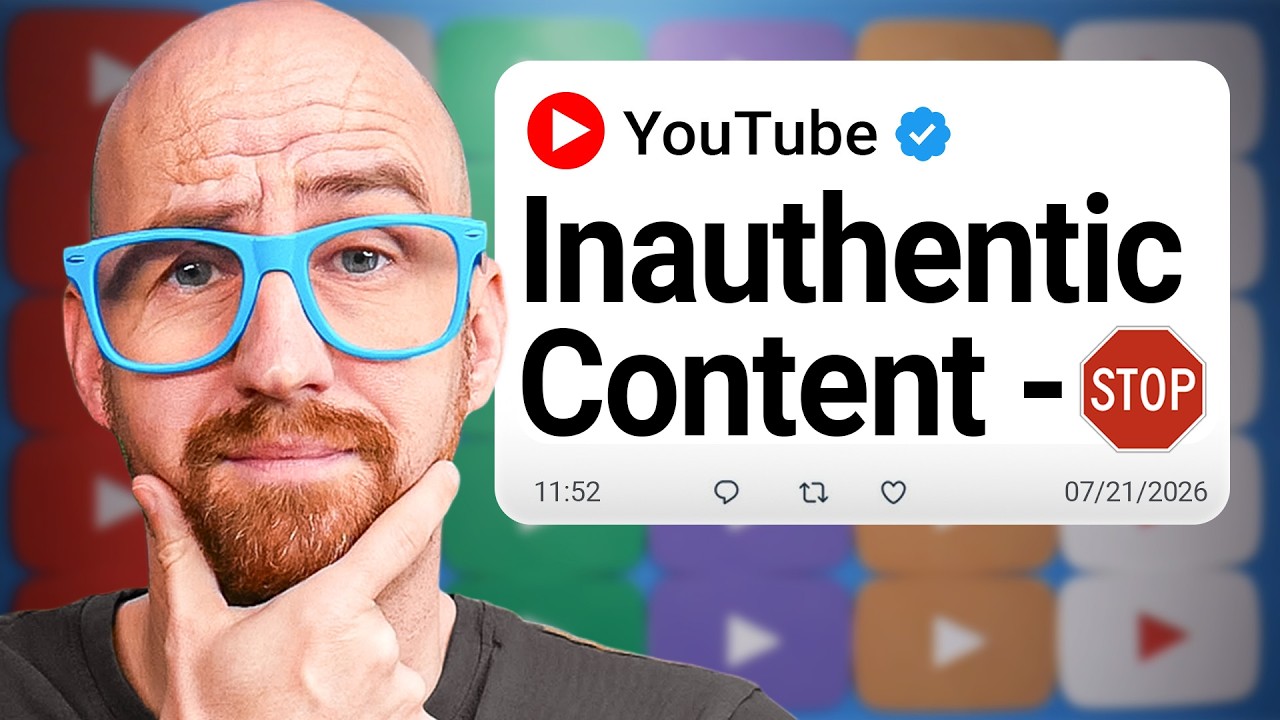
Good news when it comes to demonetization, you're never going to have to worry about inauthentic content ever again. >> [music] >> Unsatisfying or off-putting content? Inauthentic content is being replaced with three brand new categories that should do a better job of explaining what's happened to your channel. So, in this video, we're going to show you what those categories are, how to stay on the right side of them, and make sure to stick around until the end because we're going to show you a real-world example of a channel affected by
94 words, the words spoken in the first 30 seconds at 187 words per minute.
Free, no signup. See how the first 30 seconds hold attention, with rewrites.
Sentence shape
| Measure | This transcript |
|---|---|
| Sentences | 115 |
| Average words per sentence | 16.5 |
| Longest sentence | 52 words |
| Questions asked | 7 |
| Sentences containing a number | 2 |
Most used terms
Filler phrases
28 in total: like 6 · uh 5 · you know 5 · kind of 3 · um 3 · actually 2 · right? 2 · basically 1 · sort of 1.
A literal whole-word count of the same phrase list the Prepublish browser extension uses, so a phrase inside another word is not counted and a phrase used in its ordinary sense still is. It is a count and not a judgement.
Free, no account. See where attention is likely to drop, with a rewrite for each weak line. The free check shows the scores and the one issue costing the most. Or run it on the words above first.
Free · No login · See a sample audit first if you prefer.
What this transcript is
Every word below is the caption track YouTube publishes for this video, pulled from the video itself and reproduced unchanged. It is not Prepublish's writing, not a summary, and not a re-transcription: it is the video's own published captions. English captions, generated automatically by YouTube, in the video’s original language. Source: the video on YouTube. A channel that would rather this page did not exist can ask for its removal through the contact page, and it is removed.
Good news when it comes to demonetization, you're never going to have to worry about inauthentic content ever again. >> [music] >> Unsatisfying or off-putting content? Inauthentic content is being replaced with three brand new categories that should do a better job of explaining what's happened to your channel. So, in this video, we're going to show you what those categories are, how to stay on the right side of them, and make sure to stick around until the end because we're going to show you a real-world example of a channel affected by this, and the reactions may surprise you.
But first, here's what YouTube themselves had to say about inauthentic content. >> Before we had uh the kind of a catch-all phrase inauthentic content. Realistically, that's not very helpful. Um and we recognize that. We got that feedback. >> Introduced exactly a year ago, inauthentic content has been nothing but trouble, confusion, and frustration for creators. And this interview between Renee Ritchie, the creator liaison at YouTube, and Matt Halprin, the VP of trust and safety is very attempt to reclaim the narrative by ditching the phrase completely.
But, that doesn't mean that inauthentic content is going away. >> There's kind of three buckets we'll talk about today. One is generic and repetitive. The second is content that we might call, you know, off-putting um or, you know, uh distressing. And then the third bucket that we'll break it down into is is something called AI personas. >> So, yeah, inauthentic content has transformed, multiplied in fact, into three different categories, which at the very least seem to be more tangible and can be explained better, as Matt did.
And these new categories are outlined in YouTube's monetization policy support pages that I've linked in the video description below. Let's start with generic and repetitive content. >> Content that is sort of the same uh and repetitive. It's made with templates and there's not much variation uh from video to video. Like, that's that is not something that our viewers wish to see a lot of and that we want to provide an incentive for people to make. >> we're all familiar with this type of content, right?
Content farms. And of particular note here at the bottom about AI-generated content made with generic templates. That is some relatively new language in YouTube's guidelines, especially attaching it to AI content. But basically, it's saying if you copy your own homework or anyone else's on YouTube, then it's not likely to get a green icon. >> You know, sometimes we see tutorial videos on YouTube, and they'll say, "Hey, there's this new trend, and it's a banana and it's a strawberry.
Here, let me show you how to make that, and then you'll get in and make a bunch of money in YPP." And there's just too little variation and creativity within the channel, then the channel won't end up staying in YPP or won't get in in the first place. >> And this is why it is so important that you add your own spin, style, voice, experience, or story to an existing idea, format, or topic on YouTube, whether it comes from a tutorial or not.
By the way, Renee and Matt really pushed this copying templates thing hard by dressing up in multiple fruit outfits. Or did they use AI? And then not declare it. Anyway, I want to jump forward now to AI personas. >> So like, AI personas may be fine overall, but if you have AI personas that are talking about finance or legal issues or health care medical issues, we don't want to provide an incentive for that right now either. >> Now, this is just common sense, right?
Don't attempt to mislead viewers with life-impacting advice from realistic AI-generated people in professions of high qualifications, experience, and trust. I came across this channel recently called Dr. Jennifer, Senior Health After 60, and after a few seconds, I could tell that this was an AI-generated persona. >> But there is one mistake that many people make without realizing it. And this mistake can become serious when medications are involved. >> But will the target audience, senior citizens, be able to spot the AI nature of the content that is warning them about taking medications?
Now, by contrast to that, here's a channel called Russ versus Sporting History, where the real human creator has taken an AI persona of himself and transported it into the historical timeline of one of baseball's most famous stadiums, Fenway Park. >> Fenway, as always, arriving fashionably late to the future. >> So, AI-generated, yes, and correctly labeled, thank you very much, creator. But, talking about sensitive topics, no.
This creator is using AI as a means to make the content more immersive. >> We're agnostic to where any tools that are used to create the content. Like, if you make it with GenAI, great. >> Our policies are independent of how the content is made. >> So, now you know, AI in itself does not determine whether or not content is demonetized, but the nature and intent of the content does. Okay, now let's jump over to unsatisfying or off-putting content.
I've left this one till the end because I want to spend a bit more time on it because I think it's the one we know least about. >> Maybe we give an example. Some of these videos you see and they show an animal in distress and maybe there's a little story to it, but the core of the story is an animal in distress and then someone comes and saves the animal. We'll remove that from YPP. >> I guess that means the next installment of Free Willy isn't coming to YouTube anytime soon.
Other examples mentioned disturbing themes such as violence or loss, randomly stitched together AI clips, and celebrities doing things they didn't do, or natural disasters that didn't actually happen. This is a bucket I think represents the traditional inauthentic content concept the most because it feels as if there is a wide net of examples that could potentially catch a lot of channels. And it's also a place where we enter the realm of subjective opinion.
One viewer's emotional trigger might actually be another viewer's emotional therapy. But, as Matt explains, YouTube can measure these feelings and viewer reactions at scale. >> And if you have a channel dedicated to that kind of emotionally distressing, manipulative content, um you know, we've heard from our viewers that that's not something that they like. They find off-putting. They don't want to come back to that channel or maybe even the platform after seeing a number of those videos in the same channel.
We'll remove that from YPP. >> And that's the [clears throat] big red flag, isn't it? If viewers are coming away from videos feeling so unsatisfied that they disappear from the entire platform, obviously YouTube's going to step in and do something about it. But, when it comes to these guidelines and YouTube's official conversations, there is always one critical thing that's missing from all of this, isn't there? You.
And your specific situation, reasons, and understandings of the rules that never quite fit your channel and your videos. And if I'm going to play devil's advocate for a second, you can see YouTube's perspective here. The moment they use concrete examples, everyone will benchmark against them, and then YouTube doesn't have any wiggle room. So, let me take you through a classic example of YouTube's demonetization guidelines versus the reality of what happens right now.
And let me stress, I'm going to give you the facts, but this channel is going through the public court of Reddit. None of this should be taken as official YouTube policy guidance. So, originally this channel got demonetized under the inauthentic content reason, but that has now changed to unsatisfying or off-putting content. And I assume going forward, that's what's going to happen to all creators. They will never again see inauthentic content as a reason for demonetization, and instead will see generic or repetitive content, AI personas on sensitive topics, or what this creator now sees, unsatisfying or off-putting content.
So, now with this additional context of emotionally manipulative, unsatisfying content, they are really questioning the reason YouTube have given. So far, they say demonetization of their channel has cost them $15,000. But of course, no thread on Reddit survives without the scrutiny of the community, and they got to work. Thursday found the channel, which the original poster did not reveal, and then they gave their opinion on it.
It's called H Pad, and the premise seems to be that the creator buys something like a fan or a vacuum cleaner, and then destroys it. They've been doing this for many, many years. Thousands of videos, hundreds of thousands of subscribers, and a quarter of a billion views. >> H Pad here, just a short video to say that the channel's now been demonetized. >> So, yeah. Everything seemed fine for a decade until it, well, wasn't.
I think we can fairly establish here that this isn't an AI channel. This is a real person buying real stuff, and then really destroying it. But, the overall opinion, at least on this Reddit thread, is that they are really put off by the content. One says it's complete garbage and really annoying. Another mentions low-effort content that doesn't add value. There's no narrative of educational value, while another notes the low view-to-like ratio.
Now, this just could be herd mentality in the Reddit thread, with everybody on. And the creator does reply, comparing their channel to other larger channels that do much worse, but are presumably monetized. And it wasn't an exclusively negative reaction in this Reddit thread. One person couldn't see what all of the fuss about, while another offered some really insightful advice about trying to weave a story into their video.
As I said, I'm not trying to be the judge here. The facts say the creator thinks they should not be demonetized, while the majority of opinions in the Reddit thread suggest they should be demonetized. And it's not an AI channel. Let's remember that. There is one more comment that I want to bring up, though, and it's this. "Sorry, dude. I hate your content, but I will at least say I'm in favor of your right to make it." Which is a fair point, to which Matt, back at YouTube, says this. >> And there is a higher bar to be in the YouTube Partner Program.
Anybody can upload a video, uh, but not anybody can be in the YouTube Partner Program. >> So, your YouTube homework seems pretty clear to me. Head on over to that monetization requirement support page and swot up on those new definitions because inauthentic content has gone. YouTube say the application of these policies has not changed, but the language has, which might mean you understand it all just a little bit more.
And if you do want to see even more examples and possible triggers to demonetization back when it was called inauthentic content, but still applies today, then I highly highly recommend you watch this video right now. I'll see you in there.
The words are the caption track's own and nothing is reworded or re-transcribed. Paragraph breaks are placed between sentences so the text reads as prose.
Free tools for your own script: paste a draft and see where it stands before you record it.
Paste your draft and see where viewers are likely to drop off, with a rewrite for each weak line.
Paste the first 30 seconds of your own draft for a hook score and rewrites.
Check your draft against YouTube's advertiser-friendly guidelines before you record it.
Read this channel's public videos and transcripts, and download a writing brief for it.