Getting the transcript
Reading the captions from YouTube. A video nobody has opened here before takes 10 to 30 seconds; this page fills in on its own.
Getting the transcript
Reading the captions from YouTube. A video nobody has opened here before takes 10 to 30 seconds; this page fills in on its own.
Productive Peter · @ProductivePeter
Where viewers went back to watch this video again, from YouTube's public Most replayed graph, lined up with what was said at that moment.
Most replayed moment #1
3:022.6x the video's typical replay level
and your reactions. Everything else, that's life's department, the breakthrough. Focus on your circle of influence. Ignore your circle of concern. Can you control traffic? No. Can you control when you
Said at 2:57
Most replayed moment #2
6:312.4x the video's typical replay level
$100 more than you enjoy gaining $100. You're basically walking around with Instagram filters for reality. Here's the uncomfortable truth. You judge others by their actions, but yourself by your intentions. You remember your successes and forget your failures. You think
Said at 6:26
Most replayed moment #3
14:152.2x the video's typical replay level
ultimate cheat code has three parts. First, accept what you can't control, almost everything. Second, master what you can control, your actions and reactions. Third, compound tiny improvements
Said at 14:15
The graph counts replays. It does not show where viewers stopped watching.
Words
1,957
Runtime
15:10
Speaking pace
129wpm
Reading time
8min
129 words per minute, below the 160 25th percentile of 349 measured videos. That distribution comes from the 349-video hook study.
Opening (first 30 seconds)
All right, I'm about to ruin your entire world view in the best possible way. You think life is complicated? Stock markets, relationships, success, happiness. It's all impossibly complex, right? Wrong. Life is laughably simple. We just hate simple answers. Think about it. Every self-help book is 300 pages saying, "Eat less, move more." Every relationship advice boils down to communicate and care. every success
65 words, the words spoken in the first 30 seconds at 129 words per minute.
Free, no signup. See how the first 30 seconds hold attention, with rewrites.
Sentence shape
| Measure | This transcript |
|---|---|
| Sentences | 315 |
| Average words per sentence | 6.2 |
| Longest sentence | 27 words |
| Questions asked | 22 |
| Sentences containing a number | 39 |
Most used terms
Filler phrases
24 in total: like 14 · actually 4 · basically 2 · you know 2 · literally 1 · right? 1.
A literal whole-word count of the same phrase list the Prepublish browser extension uses, so a phrase inside another word is not counted and a phrase used in its ordinary sense still is. It is a count and not a judgement.
Free, no account. See where attention is likely to drop, with a rewrite for each weak line. The free check shows the scores and the one issue costing the most. Or run it on the words above first.
Free · No login · See a sample audit first if you prefer.
What this transcript is
Every word below is the caption track YouTube publishes for this video, pulled from the video itself and reproduced unchanged. It is not Prepublish's writing, not a summary, and not a re-transcription: it is the video's own published captions. English captions, published by the channel, in the video’s original language. Source: the video on YouTube. A channel that would rather this page did not exist can ask for its removal through the contact page, and it is removed.
All right, I'm about to ruin your entire world view in the best possible way. You think life is complicated? Stock markets, relationships, success, happiness. It's all impossibly complex, right? Wrong. Life is laughably simple. We just hate simple answers. Think about it. Every self-help book is 300 pages saying, "Eat less, move more." Every relationship advice boils down to communicate and care. every success story.
Work consistently on something valuable. But that's boring. So, we create complexity. We need the 47step morning routine. The revolutionary diet with a trademark. The ancient secret they don't want you to know. Here's the joke. While you're searching for complex solutions, life is screaming simple answers. But simple doesn't sell books. Simple doesn't make you feel special. The misdirection. Looking for complexity is the complexity.
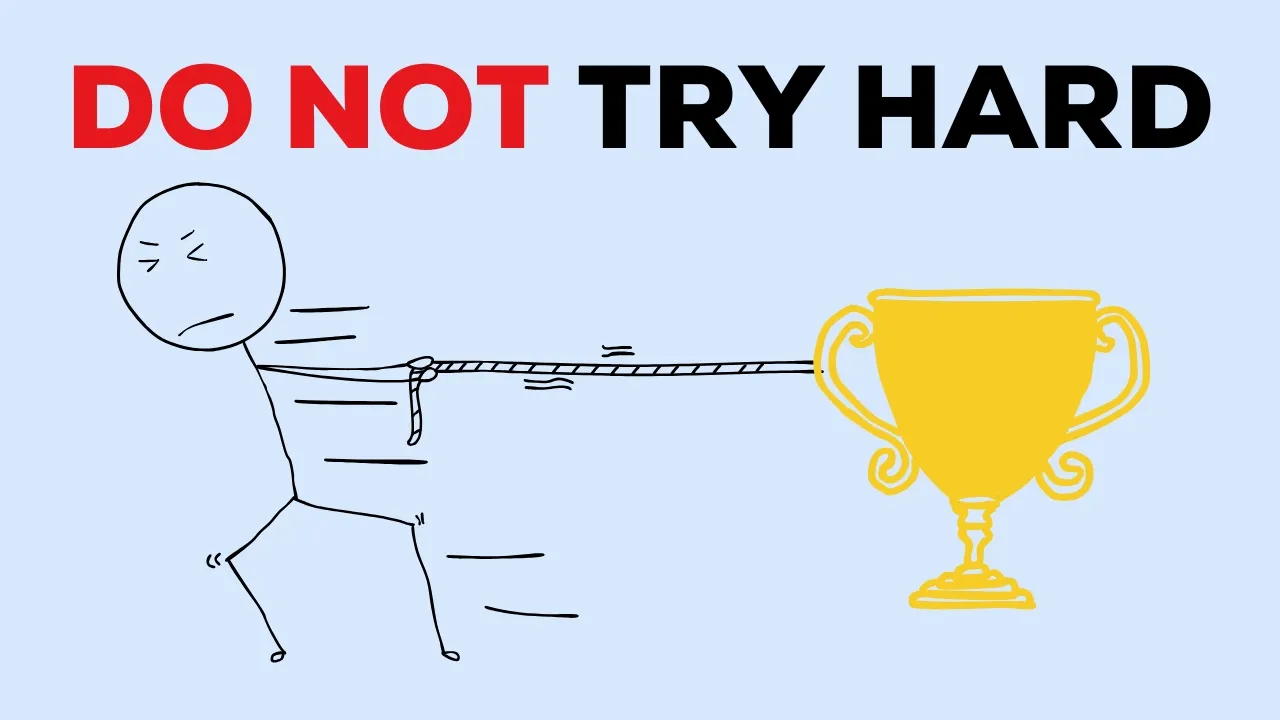
Life was simple all along. We just complicated the search. Chapter one. The effort paradox. Want to hear something that'll break your brain? The harder you try, the more you fail. No, seriously. Sleep. Can't force it. Happiness runs when chased. Love. Try to make someone love you. See how that goes? It's called the backwards law. The more you want something, the more it eludes you. Like trying to float by swimming harder.
You just sink faster. Watch this pattern everywhere. Desperate people repel opportunities. Needy people repel relationships. Stressed people repel peace. The funniest part, we know this. Every athlete knows you perform worse when you overthink. Every artist knows forcing creativity kills it. Yet what do we do? Try harder. So what works? Effort without attachment. Action without desperation. Do the thing, but don't death grip the outcome.
Life rewards the relaxed. Not the lazy, the relaxed. Big difference. Chapter two. The control paradox. Life's biggest joke. The more you try to control everything, the less control you actually have. It's beautifully ironic. Think about it. You plan every minute of your day, organize every detail, try to predict every outcome, and then life laughs and throws you a curveball anyway. We're all control freaks in denial.
Here's what's actually happening. Control is like holding water in your hands. Squeeze tighter and it slips through your fingers faster. The ancient stoics figured this out 2,000 years ago. You can only control two things, your actions and your reactions. Everything else, that's life's department, the breakthrough. Focus on your circle of influence. Ignore your circle of concern. Can you control traffic? No. Can you control when you leave?
Yes. Can you control others opinions? No. Can you control being someone worth respecting? Absolutely. Stop trying to be life's CEO. You're more like a surfer riding waves. Master the ride, not the ocean. Chapter 3. Your brain's secret night shift. Ready for something wild? While you sleep, your brain runs a full cleaning crew. Like janitors working the night shift. Scientists discovered your brain has its own waste removal system.
During deep sleep, cerebral spinal fluid washes through your brain tissue, clearing out toxins that build up during the day. It's like a dishwasher for your thoughts. This process is why you think clear after a good night's sleep. But here's what neuroscientists found. Your brain physically shrinks during sleep to create more space for this cleaning process. The cells actually contract, opening up channels for the fluid to flow through.
The science is wild. Your brain is 60% fat, weighs about 3 lb, and burns 20% of your daily calories just thinking. We're basically walking supercomputers that need nightly maintenance. The research on this is mindblowing. One night of poor sleep leaves metabolic waste in your brain. It's like trying to work in a cluttered office. Everything takes more effort. Scientists are still discovering how this nightly reset affects everything from memory to creativity.
Your brain has a night shift crew you never knew about. Chapter 4. The happiness trap. Here's why you can't catch happiness. It's the only goal that runs away when you chase it. Happiness is like a cat. Ignore it and it jumps in your lap. We've all been there. Chasing the perfect job, relationship, body, thinking, "Then I'll be happy." But neuroscience shows something fascinating. Your brain has a happiness set point.
Win the lottery, you'll be back to baseline in 6 months. Terrible accident, same baseline in 6 months. It's called the hedonic treadmill. Happiness isn't a destination. It's a byproduct. It comes from progress, not achievement. From connection, not possessions. From giving, not getting. We're looking for happiness in all the wrong places. The solution? Stop chasing happiness directly. Focus on meaning, growth, and contribution.
Instead, do things that matter. And happiness shows up uninvited like an unexpected gift. The biggest paradox of all, the less you need happiness, the more it appears. Chapter 5. Your biased brain. Your brain isn't a truth seeeking machine. It's a pattern matching machine with delusions of objectivity. Right now, your brain is running dozens of cognitive biases. Confirmation bias makes you cherrypick evidence that supports your beliefs.
The halo effect makes you think attractive people are smarter. Loss aversion makes you fear losing $100 more than you enjoy gaining $100. You're basically walking around with Instagram filters for reality. Here's the uncomfortable truth. You judge others by their actions, but yourself by your intentions. You remember your successes and forget your failures. You think you're above average at almost everything. It's called illusory superiority.
And yes, you have it, too. The worst part, you can't turn these biases off. They're hardwired survival mechanisms, but you can recognize them. Awareness is your superpower. Next time you're sure about something, pause. Which bias is talking? Your brain is constantly editing reality to match your beliefs. At least now you know the filter exists. Join our YouTube membership for exclusive perks like early access to scripts, input on future topics about productivity, and connect with a like-minded community that gets it.
Click join below and let's build your easier, more intentional life together. Chapter 6. The 9010 emotional rule. Brace yourself for this. 90% of your decisions are emotional. Only 10% are logical. Your rational mind isn't driving. It's just narrating the trip. Think you chose your career logically? Nope. You felt drawn to it, then justified it with logic. That gut feeling about someone, that's your emotional brain processing millions of micro signals faster than consciousness.
Your emotions are smarter than your thoughts. The science is fascinating. Your emotional brain processes information 500,000 times faster than your logical brain. By the time you think about something, your emotions have already decided. You're not making decisions. You're rationalizing what you've already felt. This isn't bad news. It's great news. Your emotions are data, not directives. That pause between feeling and action.
That's where your actual power lives. Use it. Chapter 7. Memory. Your personal fiction writer. Your memories aren't recordings. They're more like Wikipedia pages that anyone can edit. And the main editor is you. Every time you remember something, you literally change it. The act of recall makes memories malleable. Your brain fills gaps with current knowledge, modifies details based on new experiences, and straight up invents things that feel real.
You're not remembering the event. You're remembering the last time you remembered it. Scientists have proven this repeatedly. They can implant false memories so vivid that people swear they're real. Your confident courtroom testimony probably 40% fiction. That childhood trauma might be partially manufactured. Your brain is a unreliable narrator pretending to be a documentary filmmaker. But here's the opportunity. If memories are malleable, you can rewrite your story.
Not by lying, but by choosing which parts to emphasize. You're already editing your past. The lesson? Your memories are stories, not documentaries. Since you're already the editor, you might as well edit consciously. Choose which parts of your story to emphasize. Chapter 8. The 8020 life principle. Want to transform your life? Understand this. 20% of what you do creates 80% of your results. The rest is just expensive noise.
Look at your life right now. 20% of your relationships bring 80% of your joy. 20% of your tasks produce 80% of your value. 20% of your habits create 80% of your problems. We're all majoring in minor things. The math is everywhere. In business, 20% of customers generate 80% of profits. In your closet, you wear 20% of your clothes 80% of the time. Life isn't fair. It's exponential. Identify your vital 20% and double down.
Which activities move the needle? Which relationships energize you? Which habits actually matter. Stop optimizing the 80% that doesn't matter. The brutal truth, most of what you do is waste. But that means you can cut 80% of your efforts and barely notice. Identify your vital 20%. Double down. Ignore everything else. Chapter nine. Habit loops. Your autopilot system. You don't have bad habits. You have perfectly functioning loops with terrible rewards.
Every habit follows the same pattern. Q routine. Reward. Seafhone. Q. Check social media. Routine. Get dopamine hit. Reward. Feel stressed. Q. Eat junk food. Routine. Temporary comfort. Reward. Your brain doesn't care if habits help or hurt you. It just runs the program. Here's the kicker. You can't delete habits. only replace them. The neural pathways are permanent highways in your brain. But you can change the routine while keeping the same cue and reward.
Stressed? Do push-ups instead of eating? Same stress relief, better outcome. The average person runs 40% of their day on autopilot. But here's the power. Design your loops consciously and autopilot becomes your ally. Keep the queue. Keep the reward. Upgrade the routine. Simple. Chapter 10. The compound effect secret. Here's the math that flips your perspective. 1% daily improvement equals 3,778% yearly improvement. Tiny choices create massive destinies.
Think that's insignificant? If you get 1% better daily, you're 37 times better in a year. 1% worse daily. You're down to 3% of where you started. Success isn't a sprint. It's compound interest for your life. The problem? We overestimate what we can do in a day and underestimate what we can do in a year. Read 10 pages daily, that's 12 books a year. Save $5 daily, that's $1,825 plus interest. Exercise 15 minutes daily.
That's a transformed body. But here's what nobody tells you. The compound effect works in reverse, too. Skip one workout, nothing happens. Skip 100, the results speak loudly. Small choices seem meaningless until they suddenly aren't. The secret isn't motivation or willpower. It's math. Focus on systems, not goals. One healthy meal today, one page read, one push-up. The compound effect handles the rest. Here it is. The synthesis of everything.
Life isn't about finding yourself. It's about creating yourself. You're not discovering some predetermined destiny. You're building it choice by choice, habit by habit, day by day. The paradoxes, they teach you balance. Your biased brain. It shows you humility. The compound effect, it gives you power. Every concept connects. The ultimate cheat code has three parts. First, accept what you can't control, almost everything.
Second, master what you can control, your actions and reactions. Third, compound tiny improvements daily. That's it. Everything else is commentary. You now understand how your brain works, why happiness hides, how habits form, and where power lives. You know memory lies, emotions drive, and small actions compound into destiny. You have the manual. And hey, if you like this video, don't forget to subscribe and hit that like button.
Also, let me know your thoughts on what I just shared. Oh, and there's more. I've just started a Patreon to help support these videos and connect with you more directly. Check out the link in the description if you'd like to join.
The words are the caption track's own and nothing is reworded or re-transcribed. Paragraph breaks are placed between sentences so the text reads as prose.
Free tools for your own script: paste a draft and see where it stands before you record it.
Paste your draft and see where viewers are likely to drop off, with a rewrite for each weak line.
Paste the first 30 seconds of your own draft for a hook score and rewrites.
Check your draft against YouTube's advertiser-friendly guidelines before you record it.
Read this channel's public videos and transcripts, and download a writing brief for it.