Getting the transcript
Reading the captions from YouTube. A video nobody has opened here before takes 10 to 30 seconds; this page fills in on its own.
Getting the transcript
Reading the captions from YouTube. A video nobody has opened here before takes 10 to 30 seconds; this page fills in on its own.
Blue Sense Digital · @bluesensedigital
Words
20,707
Runtime
1:38:09
Speaking pace
211wpm
Reading time
86min
211 words per minute, above the 201 75th percentile of 349 measured videos. That distribution comes from the 349-video hook study.
Opening (first 30 seconds)
If you run Meta Ads as an e-commerce brand, this is the only video that you need to watch on Meta Structure. Whether you're just starting a new ad account or you're spending a million dollars a month on Meta, we'll be running through every level of structure, everything you need to know so that you can maximize efficiency on the platform. There's three claims on account structure that are all true at the same time. And by the end of this video, you'll understand why three of these claims all make sense contextual to your ad account. Claim number one, consolidation will always beat segmentation
106 words, the words spoken in the first 30 seconds at 211 words per minute.
Free, no signup. See how the first 30 seconds hold attention, with rewrites.
Sentence shape
| Measure | This transcript |
|---|---|
| Sentences | 1,200 |
| Average words per sentence | 17.3 |
| Longest sentence | 139 words |
| Questions asked | 119 |
| Sentences containing a number | 157 |
Most used terms
Filler phrases
213 in total: like 85 · actually 80 · kind of 27 · right? 7 · uh 5 · um 4 · you know 3 · literally 1 · sort of 1.
A literal whole-word count of the same phrase list the Prepublish browser extension uses, so a phrase inside another word is not counted and a phrase used in its ordinary sense still is. It is a count and not a judgement.
Free, no account. See where attention is likely to drop, with a rewrite for each weak line. The free check shows the scores and the one issue costing the most. Or run it on the words above first.
Free · No login · See a sample audit first if you prefer.
What this transcript is
Every word below is the caption track YouTube publishes for this video, pulled from the video itself and reproduced unchanged. It is not Prepublish's writing, not a summary, and not a re-transcription: it is the video's own published captions. English captions, generated automatically by YouTube, in the video’s original language. Source: the video on YouTube. A channel that would rather this page did not exist can ask for its removal through the contact page, and it is removed.
No Script X-ray for this video: YouTube shows a Most replayed graph only once a video has enough views.
If you run Meta Ads as an e-commerce brand, this is the only video that you need to watch on Meta Structure. Whether you're just starting a new ad account or you're spending a million dollars a month on Meta, we'll be running through every level of structure, everything you need to know so that you can maximize efficiency on the platform. There's three claims on account structure that are all true at the same time. And by the end of this video, you'll understand why three of these claims all make sense contextual to your ad account.
Claim number one, consolidation will always beat segmentation within any meta ad account structure. So if you have fewer campaigns, fewer adsets, you'll generally get better performance, but it's not necessarily the right thing to do. Number two is that media buying actually still matters at higher ad spend levels. Now, if you're spending $100 a day, it's probably not that big of a lever when it comes to growing the account and growing the business.
But if you're spending $100,000, $200,000, $300,000 a month, maybe you're buying is still going to give you a 10 to 20% efficiency lift if you do it correctly. And then third is there is actually no universal perfect account structure that fits every business. The reason why there is a thousand YouTube videos on how to structure better ad campaigns is because there is a thousand different types of businesses. And so dependent on the nuances within your particular business, it will change how you think through structure.
I'm going to be giving you through the way that you should think through the problem so that you yourself can make the structure yourself. Over the next two hours, I'll walk you through how Meta decides where your money is going. The three spend playbooks if you're doing under 50k a month in spend 50 to 250 and 250 plus. The difference between ABOS and CBOS and when you should use each. Three settings that you should be turning off right away as you finish this video.
How to design high performing adsets. How much spend should go towards existing customers and different audiences? What's the testing budget look like? How do you math that out? How do you back propagate from your goals? And then number four is I'm going to give you four diagnostic questions that you should always be asking yourself. Meta is optimizing for one thing in 2026 and honestly forever. It's revenue per user per minute.
Now, there's two ways that Meta can grow this number. Number one is they increase ad inventory. And so they simply put more ads onto their platforms or they'd buy more platforms where more ads can serve. Now you've actually seen this be the case over the course of the last six years. I remember six years ago I would get one ad in every five to six posts. Now sometimes you get triple ads. You're scrolling and you'll get an ad, another ad, and then another ad all in a row.
And that's meta increasing the ad inventory so that they can maximize revenue on the platform. And then the second is if they can't increase ad inventory any further if the platform's starting to get not enjoyable to use because there's just so many ads. Well, the other thing that they can do is they can just increase the cost for the advertisers to serve, which is your CPMs, your cost per thousand impressions. And so the same amount of ad inventory, but let's make it more expensive for everyone.
And you see this in year-to-year CPM inflation. We have over 150 million in ad spend connected to our business manager. and we can go and do an aggregated ad report and look at what CPMs have looked like over the course of the last three years. And it's cyclical with obviously Black Friday, but every year it goes up and what you end up seeing is there's about 20 to 30% inflation in CPMs. Now, obviously there's a little bit of natural inflation to the dollar that you need to factor out of that, but still CPMs are going up faster than inflation is.
And the reason for that is that Meta has to continue to publish good quarterly earnings because they're a publicly traded company. And the way that they do that is they need to increase revenue on their biggest product, which is the ad product. Now, this seems all very doom and gloom and like, "Oh, Meta's against you. Everything's becoming more expensive. It's a terrible platform. Don't spend on it." That's not necessarily true because if Meta increases CPMs, everyone just becomes unprofitable.
So, they can't do that. They can't just make all their advertisers unprofitable or else people will stop spending. And so, what they have to do when they increase CPM is they also have to increase expected conversion rates or ROI of the platform. So they need to effectively more efficiently pull dollars out of users on the platform and transfer them to advertisers so that you get conversion rates that outweigh the CPM increase.
The reason why all this matters and the reason why this context matters is that every time Meta rolls out an update, whether it's Andromedor, whether it's Gemmin, whether it's one of the smaller updates that you've never even heard of, what they are trying to always do is increase the efficiency of ad serving so that then they can make it more expensive for you to actually place. Now, a core principle of setting up structure on the account is understanding that what you see in the platforms is not necessarily what Meta is optimizing.
And that's where you get a lot of poor decision-m being made within account structures or within decisions as to where budget should flow. There's a lot of stuff that you see that's not necessarily reality. And so an example is what you see in the platform is lastclick attribution. Meaning if a user clicks on multiple ads and then buys the purchase the conversion value will just go to the final ad that they touched. But in reality Meta is optimizing across multi-touch attribution.
Meta knows that just optimizing towards the last click is meaningless when there was all of these prior clicks and prior interactions that led up to the conversion. And so what you end up seeing is that if you have three ads here and the clickfunnel looks like this and then they ultimately buy, you on the surface will go, "Ah, this is the ad that's performing killer." But Meta will still be distributing spend here because it sees that a click actually occurs here, click occurs here, and then the final click occurs.
And so in the back end, it's likely allocating one/ird credit to each one, which is why spend's getting distributed in the way that it is. So another example of what you see is that one ad gets all the credit. But the reality is that Meta is optimizing across a chain of impressions. What you see is ad level return on ad spend. So you're going down here and looking at rorowaz on these individual ads, but what met is actually optimizing for is your CPA target at the adset level. because the bidding and optimization actually is inherited from the adset, which is why you don't set cost caps at an ad level.
If you're going to set cost caps or any kind of more complex bidding approach, you're going to do it at the adset level instead. Now, if we go back to this concept of sequencing where a user might pathway through multiple ads, all of the ads, let's say, are spending $5,000, but they're at very different returns. When you look at this on the surface, you make an obvious decision if these are all sitting under the one adset, which is let's turn this ad this ad off.
Let's put all the spend here. Now, besides sequencing, besides the fact that, well, these ads are probably doing a little bit of heavy lifting, we need to think about why is Meta distributing spend to these two ads, well, there's something called the breakdown effect. And this is public documentation by Meta. You can go and Google for it right now and pull up their actual uh page on this. And the idea is that when you use any of the breakdown features in Meta Ads, you can go to breakdown and you can click on age or you can click on gender or you can click on placement type or you can click on region.
Okay, there's all these different options as to how you can segment and break down the data. What you will often see is weird stuff that doesn't make sense. You'll look at a breakdown, for example, on placements, and you'll see that stories are at a 4x rorowaz feed is at a 3x, but the feed is getting all of the spend. It might be holding 80% of all the spend in the account. And you go, why is this happening? Seems pretty easy to fix this, right? we just launch a dedicated campaign that only places on stories because stories perform better.
But it's a flawed assumption because you were looking at blended data that is not counting in the incremental impact of pushing more spend through that particular channel or through that particular placement. And so if we simplify this back to the ad example up here, the reason why this ad is getting the same amount of spend as this ad is because Meta has tried to spend more here. It's tried to push it up past, let's say, $300 a day to 320.
But when it does that, there's zero incremental returns. You don't make any more money. But over here, when this was, let's say, a lot lower down at $200 a day, Meta went, "Oh, we can't put spend here. We're getting no returns." So, let's see. Even though this has a lower base return, do we get any incremental returns here by putting more spent? And it goes on layers 250 in, and we make more revenue. Now, it's not at a great return.
Maybe it's at a 2x or something, but this is at a 0x and so budget goes here. Same thing applies at a story and a feed level. So, Meta will try to put more budget through stories. Obviously, it's got a better return, but when it does it, the incremental ROI is so poor that it would rather just put spend into the feed. So, the distribution of spend majority of the time at a breakdown level is actually accurate and you should trust Meta.
Now, there are cases where that isn't the case, and that's where you have to be a good media buyer and understand what breakdowns matter, what don't, and how you should be thinking through distributing spend. But majority of the time, if you're a beginner and you get too deep into breakdowns, you'll just make a bunch of segmentation decisions that actually aren't commercially aligned with what the platform wants you to do, and you'll get worse performance.
So unless you are like an expert six year, sevenyear in media buyer, you should not be implementing changes based on complex breakdowns or your limited understanding of return on ad spend and ad. Now it wouldn't be a Facebook ads long form video if there wasn't a mention of the buzzword Andromeda. So here's a 30 second explanation which is that previously you would choose interest, you would choose audiences and then you would load up a bunch of creative and that creative would serve to that interest.
Now you load in your creative, you leave everything broad and meta looks at the creative and based on its understanding serves it to a relevant audience. That's effectively the retrieval system chain. Now you might be thinking, well does that mean interests are dead? Does that mean lookalike audiences are dead? We shouldn't use these anymore. Generally speaking, yes, interest targeting is super flawed. And if you actually go down this rabbit hole, you'll learn a bunch of reasons as to why interest targeting is not good.
I'll give you one of them, which is that interests don't take into consideration intent. And so if I said I hate dogs on a Facebook post, Meta would group me into being interested in dogs. And so if you go and target the dogs interest, you would target me. But I actively went out there and said, "I hate dogs." And I commented on a bunch of posts. And so it isn't intent driven. It's simply interested. And so because of that, Meta put out a report or someone put out a report saying that 30% of the people that are inside of an interest group aren't meant to be there.
They were incorrectly assigned. And so interest groups in itself is a poor way of categorizing users. Now, if you really want to go a little bit deeper on this topic, the way that interest targeting worked conceptually is it was effectively labeling. And so you would be interested in a pets post. And once again, that just means an interaction, comment, a like, something. Meta would tag you with pets. And now anyone that wants to target pets would target you.
Very rudimentary. When you think about Meta being a trillion dollar business, you're like, "What? They're just putting labels on people based on the post that they interact with. That doesn't seem very sophisticated and it's not, which is why it doesn't perform as well as targeting broad. What happens when you target broad? Instead, you can think of it as if it's a vector space. Now, I'm just drawing three axes here, but in reality, this is like 10,000 dimensions.
But what happens is that when I go and interact with a pets post, I get plotted on the graph. And then depending on what I interact with in real time, I will get moved around on this chart in a certain direction. So if I interact with cats as an example, I might get moved up in this direction. But if I interact with dog posts, I get moved over in this direction. And then what ends up happening is people will naturally cluster through this threedimensional space.
And then when you go and target broad, instead of targeting people with labels, you're just targeting this big space and like sprinkling your ad out all over the place and going who interacts with it. And there'll be these hotspots. And over here, the people in this area actually start buying from you. and Meta goes, "Okay, well, let's just target this area." And then it will go and target this area right here. And then as you start to scale, what happens is the area increases around this spot.
And so you target colder and colder audiences. And this is why most ads fatigue. This is why most campaigns die when you try to scale them up because you go from a hyperspecific target demographic and you try to scale out of it. And these people out here actually aren't convinced enough to buy your product cuz your ads might not be good enough. Now, the caveat with this whole model is that it isn't three-dimensional. it's like 10,000 dimensions and so it can be much more specific in the actual clustering of users.
So the first core thesis to understand is that consolidation beats segmentation. Really important concept to always be thinking about anytime you're structuring a meta account. Now I want to run you through the timeline of why this used to not be the case. Why it's counterintuitive and why a lot of agencies particularly legacy agencies are still hyper segmenting all over the place and it's probably ruining your performance.
Now, what's also really unfortunate, as a little side note, is that the legacy outdated agencies are typically the very cheap agencies, which means they're the agencies that work with smaller businesses. And so, as a product of that, a lot of smaller businesses that might be watching this video that are just starting or maybe spending $10,000 or $20,000 a month on Meta, if you're with an agency and they're cheap, they're probably running legacy structures.
And so, this is probably relevant for you so that you can push towards what actually works. these days. So 2018 was actually the first time I opened up a Metarat account and I was spending my own money at the time. Now back here you could segment by interest. In fact, it was favorable. Interesting was actually one of the biggest levers in the account back here. Now obviously creative still mattered. Obviously the website like all of these things played a part, but there was an additional lever which is that if you could take a creative and you could find the interest that it performed on, you could achieve scale. and creatives would not perform on some interests and they would perform on others.
In fact, you could duplicate adsets with the same interest, same ads, and sometimes they'll work, sometimes they won't. And so, there was all these different nuances in the account that would actually allow you to exceed performance. And the reason being is that the platform was built around this. How it used to work is every time you would launch a new adset, the adset would go out and it would serve to a thousand random people and based on the initial intent signal, so who would click, who would interact, potentially who would buy.
Meta will then zone in on those types of users within the interest group. And so you might have had that when you launch this adset, for whatever reason, moms age 40 to 50 interact. And so it starts going after that audience. You could launch the exact same ads set a second time, same ads, same interest, but on these thousand people, for whatever reason, men aged 30 to 35 are the ones that interacted because it's a very small sample size.
So, you can have bias in these small sample sizes out of the gates. As a product, this adset starts going off and optimizing towards those types of audiences and you end up with very different results on each and you end up with very different audiences, too. And that was just a product of the way that the ad serving worked at the time. And so you were favored to Seg. It was a good thing to have a ton of adsets where you were constantly doing testing across different interests across different audiences, across lookalike audiences so that you could try to squeeze out more.
Then what ended up happening? Well, Meta improved the ad product, right? We're looking at an 8-year time horizon here. Some stuff happened. So iOS 14 popped up which substantially impacted the ability for Meta to actually do interest groups because of a lot of the interest grouping was done using offsite pixel data from blogs from whatever they were interacting with on the internet. So they had to start to change the way that their retrieval system was working as well as their ranking system for users.
Then AI started to pop up over here and that's when Meta became Meta. Went from Facebook to Meta and Zuckerberg went and made that big play into the metaverse. bought a ton of chips off Nvidia. They ended up not being able to do anything with those chips. So what did they do? They rolled them into inference to be able to better train the actual ad serving platform. And so then the ad serving platform started to improve even further and they started to be able to squeeze more efficiency.
But then as a product of that consolidation was preferred during iOS 14.2. Just a side note, Meta lost they said about 30% of the signal that they were using for targeting at the time, which means that they had to compensate for this by finding better buyers by not relying on interest targeting signals and instead being able to use the creative and go broad. Now, the fundamental reason why the platform now prefers consolidation is because conversion data is siloed at the campaign level.
This doesn't just apply to Facebook. It applies to Google. It applies to Tik Tok. It applies to Pinterest. It applies to all of the ad platforms. They're all structured in the same way if you haven't noticed, which is you have campaigns, you have adsets, and you have ads. On Google, you have campaigns, you have ad groups, and then you have app. This is the same case on all the platforms. And the reason being is it's the way that the platform silos out data in targeting.
I won't go too deep into it, but I think it's important to understand at least the architecture of an ad account, whether you're a beginner or whether you're an expert, because most people never even think through this problem. Um, to be able to better understand structure. So, you should always be challenging everything. Why does this exist? Why are they doing it in this? Why do campaigns and adsets exist? Why are there adsets?
Why aren't they just campaign? In fact, why isn't there just one camp? Why isn't the platform just ads and you just input your ads and there's no structure up here? like why does all of this structure exist? Why have they introduced this additional complexity? And it's because you do need a level of segmentation within the account to better commercially align with the objectives of most businesses. The reason why campaign segmentation exists, the reason why you can make multiple campaigns is because businesses often need to flow budgets through different campaigns over time.
And so you might have a promotion that rolls in that then rolls into something else. Since you need segmentation in the actual KPIing and reporting number one. Number two is different business units exist in a lot of businesses which is that you might have a category for pets and then you have a category for children. As a product of that you don't want the campaign getting confused and not understanding who to target when you have slightly different demographics.
And so as a product was that you want the ability to be able to segment the account based on the actual segmentation of personas within the business and this allows you to do it. Now one of the downsides of that is that conversion data here is not shared at the same level as it is at the adset and ad level. And so is there some conversion data sharing going on here? For sure, campaign one is pulling from some of the signals of campaign two and vice versa, but they're not directly sharing all of the conversion data with each other, which means that if you start to introduce a bunch of campaigns in the account and you have, let's say, four campaigns for a small ad account with not much budget, what you're actually doing is taking all your conversion data, let's say you're getting 100 conversions a month, and you're splitting it up across four campaigns.
So now you have 25 25 25 25 25. You're inherently going to get worse results in the account due to segmentation because now you have less conversion data that these campaigns can optimize. And anytime you have less conversion data, you will see worse results due to small sample size bite which simply means that if you don't have a lot of conversions, meta doesn't have a lot of signal. And so it doesn't really know who to touch.
The more signal you have, the more conversions you have generally actually the better the efficiency is. Which is why you often actually see that when you can crack through 100 or 200 conversions a month, the ad account starts performing better rather than worse. And it's because there's enough signal that Meta now understands who to target properly. And you can get out of that rut of Meta not really understanding who to target because there's not enough conversion data.
So you always generally want to be consolidating up at the campaign level cuz every time you segment, you're chunking out the data. Same thing kind of applies at the adset level, not as much. There is more data sharing that occurs here than at the campaign level. Number one. Number two is that all the data at the campaign level also inherits down. So you don't really have to worry as much about segmentation at the adset level.
You can kind of segment all you want. It's not going to impact performance that heavily. You can consolidate up. It's not going to perform impact performance that heavily. We're talking about really 5 to 10% efficiency swings here based on hyper segmentation versus consolidation. It's noticeable particularly at scale, but it's also going to be context dependent on the actual. Then at the ad level, obviously you're going to have massive segmentation because you can't stack ad.
Now you can technically can stack ads and the name of this always changes. So by the time you're watching this, it might be different. The moment it's called flexible ads, which is where you can load in like five different creative on the same ad. The reason why we generally don't like these is because you don't get visibility into data insights. And so you can go and load five creative up into one ad, which is all well and good.
Nice. It's consolidated. Meta prefers consolidation. So it seems like the right idea. But the issue is when this ad performs well, we don't know what creative is actually performing well. Is it creative 1 2 3 4 5? Which of the creative that we put in here is actually lifting performance? Because we want to do more like that. We want to make more ads like that. But if we don't have the ability to read the insight, well, it's kind of useless.
Yeah, we got performance, but now we don't know what to do with it. There's also a couple other benefits of consolidation over segmentation, and this is mainly letting the machine decide where to distribute spend. Now, this can be a bad thing and it can overweight your account into a heavy degree of risk, but can be a good thing if you're just trying to maximize efficiency in the short term, which is that when we're talking about consolidation, Meta is picking where to distribute your spend.
If you just have everything sitting in a campaign that's a CVO with a bunch of adsets with a bunch of ads, Meta is just going to go and swing budgets around based on what it believes is most efficient. when you have segmentation and let's say an structure. So you're choosing where budgets go at the adset level. Well, you are deciding where the budget goes and inherently meta will always in most cases distribute budget more efficiently than you will.
However, Meta will also therefore distribute budget on an 80/20 Purto sprint, which is that 20% of your ads will get 80% of the spend. Now, kind of annoying if you're making a 100 new ads a month and none of them are getting any spend and they're not getting tested. Also kind of annoying if all the spend goes into just one creative and maybe you're paying influencers for partnership ads that are getting no spend or maybe you know that creative is going to fatigue and now you're like we're in a risky position because we have no backup ads that are doing well.
And so this can be good but it can also hurt you. Whereas on segmentation you're going to be forcing spend across the structure in a way that you want which technically might derisk you might put you in a better position might facilitate better testing. But if you're a novice and you're not doing this thoughtfully and methodically and carefully, well then you can just end up burning a bunch of money here. And so a good way to kind of think through this problem is that if let's say you're an in-house business, $10 million a year and you're making an in-house media buying hire.
If you're hiring someone that is in their first year and they have kind of no idea what they're doing, I would prefer they run this structure cuz I would actually prefer Meta Distributes budgets over them because they don't know what they're doing. If you know what you're doing and you're experienced and you understand weighing risk against profit and efficiency and understanding the changes that need to be made, I would much prefer they run this structure or somewhere in the middle so that we can still have control over where spend's getting forced carefully and thoughtfully, but we're not just burning money.
There's also the extreme of this which is there is a circle on the internet that is focused around consolidate everything. Just run one campaign, one adset, throw all the ads under it. That's all you need. You don't need an agency. You don't need any kind of media buying. You don't need any kind of segmentation. You don't need structure. Just consolidate. Just upload ads into a campaign and you're good. That's a terrible idea for 90% of people.
Now, 10% of brands can get away with that and they'll be okay. But there's three reasons as to why you don't want to just consolidate everything. Number one is different unit economics. And so, if you're a large business with a lot of SKUs, generally the unit economics or the gross margin will change across different categories. you will have 70% gross margin on this particular product range but on this particular product range maybe you have 60%.
Or you will have grade A, grade B, grade C, grade D inventory. So on your grade A inventory you have incredible unit. On your grade C inventory you also have incredible unit. Your gross margin is the same. It's great but it's not selling. And so because of that you generally have to discount it hard which compresses the actual margin post discount. And so if we put both of those products or both of those ads into the one campaign, we would end up with likely a lot of spend getting distributed to the heavy sale items.
But the heavy sale items is not where we want our budget to go because we have compressed margin there. We're probably going to end up with worse contribution margin and it's also just bad branding to be heavy pushing sales messaging through our entire funnel and existing customers. So when you have different unit economics across the product portfolio, you actually want segmentation. Number two is you might have different audiences.
And so an easy example of this means that you might have an activewear brand and the activeware brand sells to both men and women. Now if you go and put all the men and all the women ads into one ads set into one campaign, the adset is likely going to get confused and in fact you see this on ad accounts all the time. This is an easy call out anytime I audit a brand that sells to both men and women through core different product ranges.
So there's a men's range and there's a women's range is that you just go down under the adset level and you just take a look at all the ads. You use the breakdown feature. You look at gender split and what you'll end up seeing is that women ads are going to men and men ads are going to women. Now men ads serving to women isn't as bad of a idea because women do a lot of purchasing for their partners and you end up seeing directional purchase behavior from women to men but you don't see it as much in the other direction dependent on the category and so you generally don't want to be pushing women's active wear ads to men.
Will you get a return? Sure. People will buy. You still get a return on it. Is it the most efficient use of your capital in the business? Absolutely not. You should serve your women's active wear ads to women. And so if you just go and put all of these in the one ad set because targeting primarily exists at the adset level. That is where you choose the targeting. That is where the targeting generally resides for most of what's occurring under it.
It gets confused. It doesn't know where to serve them. So it's just serving them to everyone. Number three is high average order value or low conversion volume accounts. We have some clients that we work with where average order value is $10,000. on a $10,000 average order value. The issue is is that you just don't do much order volume. And so this brand as an example, I think they do 50k a day or something like that.
It's only five orders a day. Not a lot of purchase volume at all. And so what ends up happening in an account like this is that if you have a CBO as an example, and this is a bunch of ad sets. So this is ads set one, set two, etc. is that Meta will distribute budget at the adset level not based on purchases, not based on row, not based on actual signal that we care about. Instead, because there's nowhere near enough signal, there's only like five conversions max getting attributed into the account per day.
What ends up happening is Meta needs to go upstream in its optimization. And so, it goes up and starts looking at CTRs and CPCs and hold rates. And now sure these are pre-intent pre-click signals as to something that might infer future performance. But unfortunately the reality is when you look at very large data sets CPCs are not correlated with returns except for the extremity of bounds. And so if CPCs are super high yes ROI will be super low.
If CPCs are super high that actually doesn't correlate with ROI. So what you end up saying when you graph this out is you just say something like this, which is that cost per click has almost no correlation or a very weak correlation to actual return on the ad. And so if we're optimizing budget distribution based on cost per click or CTR, we're optimizing it towards a metric that has nothing really to do with the actual core objective, which is to drive revenue.
And so in this case, we likely don't want to use a CBO. We likely don't want the campaign to distribute budgets how it is. And we want to think through a structure that's going to look very different from what you would expect in any other account which is sort of getting us towards the position of every account looks different depending on the actual commercial objectives of the business. What do the unit economics look like?
What do the audience profiles and personas look like? What does the average order value and conversion volume look like? Because all of these things will change how we approach consolidation or segmentation. I'll give you a tactical example of where consolidation on an audit I did a few weeks ago was very relevant and not a good idea which was this was a furniture brand about 20 to 30 million they had a cold campaign which was consolidated that's all they had and then it was a CBO and they had a bunch of adsets down here now the issue was 57% of the meta budget was going into the top adset now what was this adset it was just a dynamic product ad now the issue is return on ad spend looks really good on On the surface, it was like a seven rorowaz, but once you break down to 7-day click or you break down to incremental attribution, either one gave the same rate, returns was actually a 1.9.
Everything else was performing better than this on an incremental or a 7-day click rate. And so, this was a good example of where them just consolidating up and putting DPAs in with everything else. Not a good idea, particularly in that industry, cuz you'll always end up with overspend into an ad type that doesn't actually perform that well on cold audiences. But let's talk about what in media buying actually died, what doesn't matter anymore, and then what still matters.
Because there's a lot of stuff that is irrelevant these days. And when I say media buying still matters, I'm talking about a very specific subset of things within the account. There's a lot of stuff that you can push to the side. What 99% of people shouldn't be doing is daily bid tweaks. Going into the account using cost caps or bid caps and just changing bids every single day. Now, that used to be a strategy 4 or 5 years ago that a lot of people did quite well with, but these days, you're really moving the needle on a variable, on a lever that has nowhere near as much leverage as other things that you could be focusing on.
Now, could you technically squeeze 5% more out of an account using daily bid adjustments every single day and dropping an hour a day into this? Sure, probably. Could you spend the same amount of time just making better creative and double the account or triple the account? Definitely. And so if we look at return on capital being time allocation, you're way better off just making better more creative than going in there and just tweaking with bids all day.
Now what still matters is account structure and account architecture. So thoughtfully thinking through how we're segmenting and setting up the account in alignment with the commercial objectives of the business. The next one for smaller accounts, this is applicable on very large accounts, but for smaller accounts, daily budget pacing. So changing budgets every single day in alignment with let's say expected conversion rates across the week or just in alignment with daily performance, not a good idea.
You don't want to be going in and tweaking budgets all the time. You're going to mess around with campaigns. You're probably making these decisions on very limited sample sizes of data. Once again, was this a strategy that you would do back in 2019 2020? Yeah, for sure. Is this something that matters these days? Not at all. What still matters? Concept level segmentation at the adset level. We're going to go into this in a lot more detail later on in this video, but this matters a lot.
What doesn't matter on the other hand is interest targeting. Very strongly of the belief this shouldn't be in your account. You're wasting resources. you're wasting tests on something that doesn't even really work anymore. What's a better use of time is instead of going in and doing interest testing and interest targeting is you can do page testing instead. So split testing different landing pages, split testing CRO on the website.
This matters a lot. You can make an inflection in conversion rates. That's a much better test than going and just messing with interest targeting on the platform. I'm also going to throw in here lookike audiences don't matter anymore. They don't work. I could once again talk for five minutes about all the deficits of lookalike audiences and why you should just be going broad instead. What does matter on the other hand is thinking through and controlling percentage or dollar allocation to existing customers.
This is something that you should really be thinking about and controlling over time. Before I start to give you the actual account structure that you should be using at each level of spend, I want to quickly talk about page strategies. We as an agency only work with eight and nine figure businesses. And so as a product of that, the content is more tailored to very large businesses and people that are in a position to work with us.
If you're small, this is going to be kind of irrelevant. If you're big, this is going to be super relevant, which is that Meta caps the amount of ads that you can have live on a page at about 3 to 500 ad. And so what this means is that if you launch a lot of creative every single week, every single month, you very quickly pass this cap. If you're even a somewhat big account, you then have two options. Option number one is you just start turning ads off because you can't have more than 500 active ads in the account, which is really annoying.
Or option two is you make more pages. And so I'm going to give you three options here that we recommend to all clients when we run into this position. And we run into this position with pretty much like every single client because all of our clients are launching enormous amounts of volume. Number one is you create multiple duplicate pages. So someone that does this quite well, and I've done a reel on this on Instagram, is Gruns.
They have like 15 Guns pages and the only difference is that the logo is a different color and then they're just running ads to a bunch of these different pages. Now, personally, if I was running an e-commerce brand, I would just do this. I would just spin up a bunch of pages for the sake of ads. I'm not really too concerned about consolidation onto a single page, but I know some people are. In which case, your other option is whitelisting or partnership ads.
And so, you just have to lean more into running ads through other people's handles that aren't yours. Now, worth noting, there is a core difference between whitelisting and partnership ads. Partnership ads is where you're using an influencer, a creator, someone that actually exists out there, and you're running the ads through their page. Often, you'll have to pay them to run the ads through their page if they have somewhat of a following and they have leverage.
Whitelisting on the other hand is you are taking a third-party page that you can create and you're running ads to it. So in this case, rather than Grunes making another page called Grunes, instead they might make a page called fiber health magazine or something like that and then they're running the same ads. I personally would change them a little bit to be more advertorial and orientated around this third party framing, but you could run the same ads and instead you're running it through the handle fiber health.
And now the obvious advantage there is that it looks like it's coming from a third party. It looks less like you're being sold to. It's a really good strategy that we use across quite a lot of clients and it's a way that we can decrease the meta ad cap on the primary page. And then lastly, you can also do regional pages. Now, if I was running a brand, I would do all three of these. I would have whitelisting. I would have as many partnership ads as I can.
I would be having multiple different primary pages and I would be going into regional pages, which is that when you sell in multiple countries, you hit the meta ad cap way faster. The reason being is that generally you should segment your campaigns based on country. And so you will have a UK campaign, you will have an Australia campaign, you will have a USA campaign. If each of these has a 100 ads in each, you hit the cap.
Even if they're the same ad, you hit the cap, which is really annoying. And so the way that you fix this is you have a Grun's UK, Gruns Australia, Grun's USA, or whatever your brand is. In that way, you have new caps per country. And so you don't run into this issue. So the third core claim I made at the start of the video was that there is no universal account structure. So, what are the rules and what are the mental models that you should use to be able to think through building your own account structure?
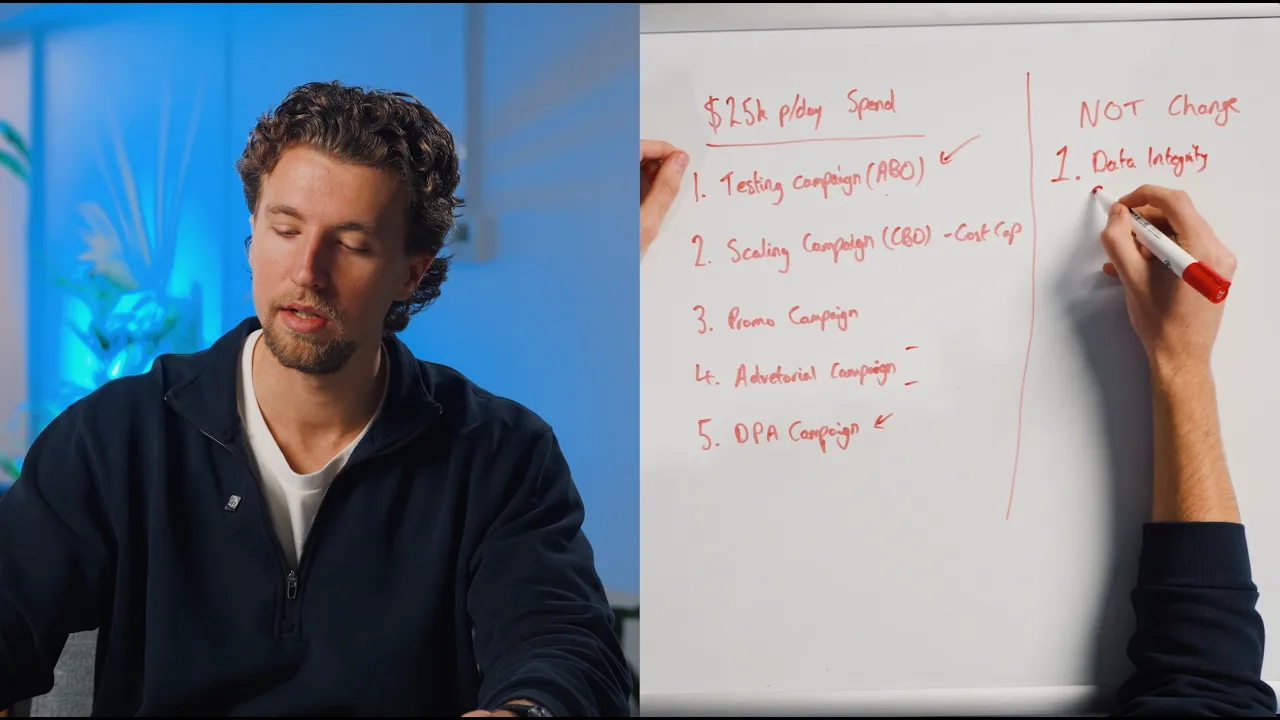
Well, there's two non-negotiables, which is number one, data integrity. Now, what this means is that the structure that you use, more specifically, the structure must be readable and actionable. So, whatever you're running, it needs to produce data that is readable and actionable. Most people create account structures, set up their Meta account, set up their Google account, Tik Tok account in ways that aren't readable and therefore aren't actionable.
And so when we try to make decision loops where we look at the data and then we make a decision and then we make time go by and we make another decision, etc. This isn't a viable option because the account wasn't set up in a way that had data integrity. Sounds really obvious, but you'd be surprised if you don't think through this as a core non-negotiable of the structure. you end up leading yourself into a position where you regret the way that the account's structured and you have to do a restructure.
Then the number two non-negotiable is commercial alignment. The structure needs to actually fit towards what the business sees and thinks about its products margin and goals. If a campaign ends up hiding a product or hiding a category that needs spend or it's going to turn into grade inventory, that needs to be presented within the account structure. If there's a product portfolio with a low margin base that actually can't support paid media acquisition, well, that needs to be reflected within the account structure.
If there's a particular goal across a category that needs rep prioritization or KPIing separately, that also needs to be baked into the account structure. There's five questions you should be asking yourself when you're building out the account structure. Number one is how many product categories do we have? The more product categories, generally the more segmentation will need to be introduced if there's different goals across those categories.
Number two is how wide is the margin spread? Is all the margin relatively to the same across the different product categories or does it vary substantially category to category? Number three, do we have multiple personas that don't overlap? Now, it's fine to have personas that overlap and are kind of the same person, but we're tweaking the audience slightly. But if we're talking about very different personas that don't overlap, that will need to be introduced to some degree into the structure.
How many regions are we selling in? As I said before, when you're selling in multiple regions, you generally want campaign segmentation so that you can control spend distribution and sell through rates. If you're holding inventory in particular countries and they have their own revenue targets, well then you need the ability to be able to distribute spend and the only way to do that is to segment. And then lastly, what's the creative throughput?
If you're putting 10 ads in the account per month, there's honestly not much segmentation that can be done. If you're putting 2,000 ads in the account per month, it's a very different volume of creative that's flowing through. So we need to think about how is that creative actually going to be introduced into the structure methodically have spend allocation and then give us the ability to move it into a scaling structure.
So let's go through two actual examples two different brands very similar in terms of revenue similar in terms of gross margin but the account structure out of the back of it is going to look very different. So we'll build out what the account structure will look like for brand A and brand B. So brand A is in CPG. So they're selling consumables. There's only one product. They're doing 5 million a year. 70% gross margin which is fairly indicative of CPG.
There's only one persona so far, which is actually a good thing. Most people at this revenue level will try to squeeze a bunch of different personas out, but they're only at 5 mil a year, so they only really need one persona, and that's Busy Moms. And they sell an AU in US. In my opinion, they should only be selling an AU at this revenue level, but they've decided to expand. Brand B is in fashion, 50 SKUs, same revenue, slightly lower gross margin, which is likely indicative here of them needing to discount constantly.
Their gross margin shouldn't be this low in fashion, but it's normally a product of the fact that they're taking a lot of product to discount. They've got four personas. This is fairly typical in fashion, having three to four core personas, but they're selling an AU, NZ, and UK. So, how do these end up getting structured differently? On brand A, we likely just want one advantage plus cold campaign. We want to be doing creative testing at the adset level based on concepts.
For a majority of spend should be going into the one concept and the one persona that's actually performing well at the moment. There should be one of these for the US and then we should have another one for AU. We want existing customers excluded from both of these cold campaigns, particularly in CPG where there's hopefully going to be a lot of returning customer revenue that's going to overattribute into cold and the frequency on these campaigns will end up being driven up and it will just retarget.
So we want existing customers excluded. doesn't mean we shouldn't have any spend towards existing customers. There's likely a bit of incrementality here in allocating a little bit of spend to them. And so we're going to throw in a retargeting campaign on existing customers, but it's going to be at a very low spend to the point that we just want to keep frequency at below a seven on a 30-day rolling period. So this will end up at this size of business being a very small campaign probably spending $20 a day.
So that's brand A. What about brand B over here? Due to the higher complexity of SKUs, there's probably multiple categories here. In fact, there's three. And so, we're going to build out campaigns for each different category, particularly because they have different purchase orders, different revenue goals, and they need to sell through all of the categories or else they have to go to sale and a road gross margin. So, they're going to have a pants campaign, campaign, dress campaign.
Now, for AU NZ, we're just going to consolidate this into one campaign. We're going to target Australia and New Zealand together. The nice thing about New Zealand as a pairing country is that it will automatically max out at 7 to 10% of total spend. So we don't have to worry about it overspending and most New Zealand orders will always get fulfilled from an Australian warehouse with relatively fine shipping craze. And so we don't have the need.
Now this is already a lot of segmentation for a brand of this size. And so we also need to be thinking through do we really want the UK in a separate campaign because that's going to mean we have six campaigns now because we have to duplicate the whole structure. We really have two options here. Either option number one is yes, we do that. But rather than having six campaigns because that introduces way too much segmentation in an account of this size, instead we move the segmentation down to the adset level.
So we have one Australia campaign, one UK campaign, but then at the adset level, we have pants adsets, tops adsets, dress adsets, and that's where the segmentation of categories occurs, and we make sure it's an so we can control budgets here. Or option number two is we keep this structure, but we just consolidate all the regions into the campaigns. Now, why or when would you want to do that? It's if we are shipping the UK orders from an Australian fulfillment center because in that case it doesn't matter other than our targets and our goals as a business whether the UK revenue goes up, goes down, goes sideways because we don't have any holding costs of inventory in the UK market.
All of our stock is held in Australia. So we just need to sell through the stock regardless of where we're actually selling to. Now, there is a bit of complexity here because it's fashion, which is that Australia is southern hem, UK is northern hem. And so, they're going to be different seasons. And so, what's selling well in Australia is not going to sell well in the UK and vice versa, unless there's transseal products.
And so, in this case, you are probably making purchase orders for the UK season, in which case you do need to move inventory. So, there's this nuance in understanding what does this region actually look like within the business? Are we holding inventory? Is there risk? do we need to hit particular sales targets? Because that information is then going to infer into the account structure, which is why understanding the business and the complexity and the goals is so important when we're trying to translate into a structure.
I'm likely going to go with consolidating this down having the segmentation at an adset level and we have an Australia cold campaign and then we have the same thing in the UK. The reason being as well is that the UK likely sits on a different subdomain and so we need all of the UK ads driving to different URLs than where the Australian ads are driving. And so because of that, we need the separate campaigns and therefore we're going to move the category segmentation down to the adset level.
Then in fashion, what does do incredibly well is dynamic product ads, particularly in retargeting. So, we're going to throw in a DPA retargeting ad that's going to go to engaged audiences, which is just like your 90-day website visitors. And then we're also going to throw in a final campaign, which is your retargeting on existing customers, which is going to contain two adsets. We're going to have new arrivals in there.
So, we're constantly putting new arrivals in front of the existing customer base. And we're also going to have a DPA. We're going to have it as two separate adsets because if we consolidate all the spend will just go to the DPA and we'll never be able to actually serve new arrivals to existing customers. These campaigns are obviously because they're cold going to have existing customers excluded which is why we need this.
Um targeting existing customers in fashion is also much more incremental than any other category that we've seen. So it actually is worth the spend allocation which is why you have on the surface two brands at the same revenue level. But when it then comes to understanding the business and all the complexities, the gross margin profile, the personas, the countries, the skew count, it then translates into a very different account structure.
All right. So, if you're spending sub 50K a month, I'll give you a generic structure that most people can get away with. Will it be ideal? Will it be custom to the business? No. I've gone through all of the reasons as to why you should ask yourself those five diagnostic questions to be able to better understand how you should structure yourself. But if you just want something generic, if you need to throw something up, here's what you should do.
Number one is a dedicated testing campaign. Now, at this spend level, this is probably all that you need. Now, what this actually looks like is either an or a CBO. And we'll go through later which one you should actually choose with adets sitting under it. Three to five creatives per adset. Now, you can go way more than this if you have the creative volume to support it. Just most people at this spend level probably don't.
And the creatives are being segmented based on concept. Now concept for people that haven't watched any other video of ours is the intersection right here in the middle of an angle, an offer, and a persona. And so you're putting a persona, angle, offer together, and then you're making creatives under that. And that sits in an adset. When you then go and make more creatives for the concept, you have an option. You can either launch it in the existing adset or you can launch it in a new one.
In terms of which you do there, if the adset is not performing, throw it in. Try to get the adset to perform. Throw more creators in. If it is performing, if it's hitting KPI, if it's doing well, don't touch it. Number one rule of meta media buying is never touch something that's working. If it's working, don't touch it. Do something next to it. Don't ruin the thing that's working. So, if it's working, don't touch it.
Launch the concept as another adset. So, you might end up in a position where you have 10 adsets and six of them are for just one concept and it's a bunch of new creative that you've made over time and everything's working because that ends up being the case. This one concept ends up outshining everything else. Now, it's not that important at this scale of business, but you do want existing customers excluded. We don't want our testing getting skewed around based on existing customers coming through a few ads and making something look better than it actually is.
You also want to make sure that your attribution setting is on 7-day click so that you have data integrity in the numbers that you're reading or else you also end up in a position where some things might look better than others just because it's claiming conversions that has nothing to do with it. Then you can layer on a scaling campaign. Now the idea here, the premise of having a scaling campaign is that one of these adsets performs well.
So let's say this adset at the top is performing well above your target return of 5x and all the other soft metrics are really good too. You start scaling this up. You put more spend more spend over time and you're ramping it up and then eventually return on ad spend drops to a point that is unprofitable and so you need to pull back spend. Now, when you do that, you effectively find an equilibrium where you find the daily spend level where that creative can keep sitting there, continue turnurning over results that you're happy with.
You can't push it any further. Anytime you do, results drop. So, you have to come back. And because of that, you're kind of not happy with it. You're like, "Ah, we could only take this creative or this set of creatives to $300 a day." But obviously, I want to spend way more and I want to scale. So, what do you do? It's at this point where people often turn and go, "Well, we can't scale this adset anymore. It's not working.
So, how can we take these creatives and just launch them elsewhere within the account structure to be able to get more spend through them? And that's effectively where scaling campaigns are born, which is you take creatives that have been maxed out, you can't get any more spend through them, and you go and just dump them in a new campaign. And you hope that the new campaign can get even more spend through that ad. And a lot of the case, it can't.
For whatever reason, you take the creative, you launch it in a new campaign, you keep this on, keep this spending, but you go and launch it elsewhere and you can likely get a little bit more spend through that ad. And so rather than the ad within the account holding $300 a day, maybe you go at this point and you layer it in on a scaling campaign and a scaling campaign can get it to hit. And so total spend across the entire account on this asset is now $400 a day because it's being propped up by the scaling campaign.
That's the idea of why you've launched a scaling campaign. There's absolutely no reason to have one if you don't have ads that are working well. Like there's no point in adding this complexity unless you have creatives that are doing well, that have been cranked to their maximum potential, and then you're just trying to squeeze even more out of it. A big mistake I see is that people will have something that works and they get it to like $60 a day.
So like a meaningless amount of ad spend and then they'll go, "Ah, we can't push it any further. Let's roll it into scaling." This is nowhere near enough spend to be able to start trying to scale the ad even further. Good way to conceptualize this is that this media buying move of taking a winning ad and then trying to get more spend into it using an adjacent campaign will get you on a good day an extra 20% daily spend through the app.
So if you have an ad that's spending $60 a day, this kind of move in the account is going to get you like an extra $10 in daily spend. Not worth it. Just make better ad. Fix other things in the business. There's probably a landing page issue. There's probably an offer issue. You still probably haven't found a concept that's working. There's like a million other things to put your effort towards rather than trying to media buy your way to an extra 10% of spend on a really low base.
If you're ad spending $400 a day actually worth just taking it and putting it in a scaling. It's a relatively loweffort move. It doesn't take much time and yeah, you're going to unlock an extra $80 per day in daily spend. If you do this across like 10 ads all at once, you take 10 of your highest performing ads and you dump them in a scaling campaign. It might allow you to unlock an additional $1,000 day in spend. And that actually is worth it.
That's a decent unlock. it's worth having this increased degree of segmentation and complexity in the account. And then lastly, you have the retargeting campaign. This is absolutely an optional campaign. When we talk about retargeting, there's two different types of retargeting. There's website visitor retargeting. So, effectively warm audiences, people that have shown intent, they've taken some kind of action, but they haven't purchased.
And then we have existing customer retargeting. So, this is someone that's actually purchased from us. They're all the way down at most aware in the stages of awareness cuz they're a customer and we're trying to effectively get them to buy a second time or a third time. Now, for most accounts, 90% of them, you don't need a website visitor retargeting campaign. And the reason being is that the testing or the scaling or whatever currently exists will allocate a good amount of spend anyway towards retargeting website visitors.
And you see this by doing an audience segment breakdown within the account. So, if you hit breakdown, you hit audience segments, you'll be able to see as long as this is set up within your advertiser settings in your audience segments. So, make sure that's set up. You'll be able to see spend, rorowaz, etc. on new audiences as well as engaged and then existing. Now, you shouldn't have any spend to existing cuz they should be excluded, but you'll be able to see your spend towards engaged, which is your website visitors.
And there'll likely be enough spend here at a high enough frequency that you don't need dedicated campaign to force more spend through that elites. It's okay on existing purchases cuz you have it excluded here. You probably want some spend towards existing customers. It just depends on the retention dynamics in the business, the category, and the stage of business that you're at. If you're a new business, which at sub 50k a month, you probably are.
You're also probably a small business, you don't have that many existing customers. And then depending on the product portfolio and the retention portfolio, so is this furniture where you're like going to have no repeat purchases really. It's very low. It's very infrequent. or is this supplements low average order value which has super high repeat rates in its subscription model. Okay, well different story. We probably want some spend there.
So you need to contextualize this to the actual business model and the expectations on repeat purchasing. If there's an expectation of high repeat purchasing, put some existing customer spend in there. Keep it low. Keep it controlled. Look at frequency as the measure. If you don't expect repeat purchases, don't have. Now the reason why this structure works at this spend level is number one, it's consolidated. You probably have not a lot of conversion volume at this spend level.
And so a product of that means that you shouldn't have a lot of segmentation. You want all the conversions consolidated up. You need structured creative testing at this spend level because you probably don't have anything that's a very large winner or else you'd be spending more. And so you want an structure where you can force spend through adsets and start to learn stuff. And then number three, at this spend level as well, you probably don't have a large product portfolio.
You probably don't have too much complexity in the business model as it stands. And so we can keep things relatively simple in terms of KPIing this structure on the testing campaign. You want to KPI at the adset level. Did the adset hit our target cost per acquisition or our target return on ad spend over a roll in window which is reasonable. And what window in which you read data is dependent on conversion volume. So you can't look at three-day windows if you're only doing three conversions in a 3-day window.
You can look at two-day windows if you're doing a thousand conversions a day. So, it's all based on contextualizing uh the windows that you're looking at for per for performance based on how much volume the business is actually doing. At this kind of scale, I wouldn't really be reading data on any shorter than a 5day period. And then if the adset is hitting KPI, budgets go up in 20% increments per day. If it's not hitting KPI, we diagnose why.
What do we think was wrong in that creative? Let's then go and make more ads, more concepts, and let's either wind that adset down or turn it off completely. On the scaling campaign, you want to just be KPIing all the way up at the campaign level. there isn't any adset segmentation on a scaling campaign, at least at this level. And then on retargeting, you want to be KPIing based on incremental return on ad spend by doing an attribution breakdown.
And also frequency shouldn't jump to above a seven on a 30-day window. The four common mistakes at this level of spend is that people test inside the scaling campaign. There's no exclusions on the scaling campaign. They kill testing way too fast. So the window in which they're looking at conversion data is way too little. And then they set budgets on the adset level based on the 50 conversions in a 7-day window rule, which ends up with just way too much budget for their particular business.
So you actually need to back propagate budgets at the adset level based on your average order value and expected CPA. So let me quickly break that down for you so you understand what kind of budgets you do need to be setting on the adset level. So when you're looking through adset level spending, there's really two factors that you need to think about. You need to think about time to outcome of the test and then you need to think about total budget required for the test.
So what does that actually mean? Well, let's say that you have a target cost per acquisition. So you want to be getting customers at $50 per customer. You then come up with a new concept. You make 10 ads under it. We then go and launch it at the adset level. What we really want to figure out as quickly as possible is is that concept working or not? Now, we need to set a barrier or a threshold for how much spend are we going to put through those ads, through that concept before we decide yes or no.
Now, the general rule of thumb that almost everyone uses is you take your target cost per acquisition. So, this is our target. You times it by three and that is how much you should spend before you decide whether to keep the ad on or off. If you get three conversions in this time, if you get four, even better. Keep running it. If you get two, uh, yellow light, let it run a little bit longer. Let it run another $50 and then we'll decide.
If you get zero or one, cut it. Now, that as a rule of thumb is pretty decent. Now, I would always let it spend a little bit more. I'm always willing to be a little bit more gracious cuz I know that the initial spend is really trying to learn and figure out who to target. And then once it figures it out, the ball gets rolling and you actually see your efficiency client. And so, I actually prefer this rule if possible.
And if the client's okay with it, they're more of a times five. So, we wait till we spend 250 and then we make a concrete decision. There's no yellow lighting. That's either a yes or a no because we have enough spend volume hand. Okay, cool. So, let's say that $250 is what we want to spend. So, we know the total budget of the test. We're going to spend $250 on these new creatives before we decide whether they're a success or not and whether we turn them off.
Then, we have time. This is how quickly do we want the test outcome? Because technically, we could just set $250 a day as the budget and we'll know whether this adset and this group of creatives has worked today. We'll know by the end of the day. Now the issue with that is that there are a couple components that will play into the time duration that you need to allow a test to run for. Number one is daily seasonality.
The reality is is that there is going to be some days of the week in which you do better and some days of the week in which you do worse as a business. If you go and launch a test on a good day, you will see better results. If you go and launch it on a bad day, you will see worse results irrespective of the actual test variable which is the creative. And so if we run tests too quickly, we don't get the ability to encapture the whole seasonality of the week and therefore we can get a biased view of performance.
The second thing that impacts time is time to purchase. And so for a lot of brands, people don't instantaneously purchase the first time they ever see an ad from. Okay? You don't just serve an ad to someone and they go, "Oh, great. Buy." Normally it takes two impressions, three impressions, four impressions, maybe a couple clicks, and then over the course of a 3 to 4 day period of warming that user up, then they make the purchasing decision.
Now, if we run this test in one day, well, guess what? We're going to show the ads to a bunch of people. They might go, "That's amazing. These ads are great. I'm now interested." But then you kill the ads, you turn the test off, other ads go and target those users in retargeting. They all end up converting through other creative, but you killed the primary top ofunnel ad that you want to test it because you only gave it one day.
And so you need to not only give it a little bit of time because of daily seasonality that might skew the results, but also because people take a little bit of time to buy. True. And this applies not only to Facebook, but Google and all the other platforms as well. So because of that, we need to balance these two variables. We need to figure out what is the budget for the test. And then how much time do we want as a feedback loop?
Ideally, as fast as possible. We want to know the outcome quickly so we can continue to iterate because ultimately the speed of growth in a business is a function of the speed of cycles of feedback and learning and iteration. And so we want to iterate and learn as fast as possible so that we can grow. But we want to give it enough time that it encapsulates daily seasonality and time to purchase. What does that often end up coming out to?
One week. One week is generally a good duration to run a test for. Now if you're a big business with more stability with not a long time to purchase and cut that down to three to four days. If you're a tiny business with tiny budgets with a incredibly long time to purchase and massive daily seasonality, well, okay, maybe we need to extend that to 10 to 14 days. Okay, so once again, always going to be respective to your particular business, which is why in this whole video and all the content that we put out, we talk in frameworks rather than actuals.
Rather than saying this is exactly what you should do, we say here's how you should think through the problem. Here's the two variables that impact it. Now think through the problem yourself in your own context and then come up with your own solution because every solution, every budget, every adset is different for every single business. Now as you jump to 50 to 250k a month in ad spend, if I was to prescribe you with a campaign structure, which once again we don't like doing cuz different based on all the commercial objectives of the business, but if I was to, you still have the retargeting campaign.
This is likely still going to be just existing customers. Very rare you need to layer in website visitors here. You might, probably unlikely. And then in terms of the cold campaigns, this just builds out a little bit further. So you're going to end up with probably more adets at the adset level because you're going to be doing more creative testing and likely have more creative volume which is going to introduce more adset volume and then potentially you're also going to extend out to two maybe three campaigns.
Now if we're looking at this as if it's a CPG brand with one skew, this campaign segmentation is actually going to come from different funnels and different approaches. And so you might have a funnel or a persona or an approach depending on the vernacular that you want to use to explain it. But you might have a funnel that is targeted at old 65 plus year olds for arthritis, right? And this is a supplement that we can pivot for that.
In fact, let's just call it fish oil, right? Fish oil applies for old arthritis. All the ads as well are going to be mirroring this type of style that works with this age demographic, which is going to be VSSLs. It's going to be native statics. It's going to be testimonials from an older demographic. and then actually probably throw on like TV style ads as well that you're chopping into UGC format. Then you might have the product repositioned.
All of the ads are now for young people 25 to 35 focused on like brain health or performance at work or something oriented around that. Now you could also get this funnel working. The landing pages are going to look very different because you want different type of demographics and photos on the landing pages. Um the ads are going to look very different. Probably the profiles that you even run this through might look very different as well.
This might be heavier on whitelisting. This might be on the native page. But because this is almost two different businesses in itself because the funnels look very different as a product. This is two separate campaigns. So that's what that would look like in CPG with one skew. If we're talking about like fashion with a bunch of SKs, this just ends up being some kind of category segmentation. It might be new arrivals segmentation.
So you have your normal existing cold campaign that you had at lower spend, but now you just go and bolt on a new arrivals campaign um for the sake of pushing new arrivals and having higher sellrough rates here. This might be a particular product category when we do an LTV analysis, we find out that this particular product category, let's call it pants, ends up with not only a higher average order value on first purchase, but much better repeat rates and retention.
And so as a product of that, we make a second campaign just for pants where we want to have a higher cost per acquisition KPI. So we can be more aggressive in acquiring customers through here because we know that our pants category acquires really high quality customers. And so as a product of that, we get a second campaign. So generally when you're going from the sub50k range and then bridging into 50 to 250k. What ends up happening if you're a good media buyer or a good performance marketer is additional campaigns will start getting layered in that's has a very specific reason or commercial objective that aligns with the business's fundamentals.
If you're just layering in more campaigns for like the seo you're like ah we're spending 100k a month right now. One campaign seems weird. Let's do two. Let's do three. you're breaking the fundamentals that I went through before, which is that every segmentation decision needs to be done with the ability to read data and make decision loops through an underlying structure that has data integrity. So, if you're just introducing segmentation for the sake of it, you're breaking all the rules that we've gone to in this case.
You want to look at segmentation, but only if it makes sense to better align with the business's objectives. The main key at this campaign level and where the real skill unlock is and where some people just smash straight through this spend level and some people stay here for a very long time is in continuous testing of different concepts so that you can find the 20% of concepts that are going to do really well and are going to be able to hold hundreds of thousands of dollars a month in ad spend.
Now we have a YouTube video called Meta Ads creative strategy in 2026 the full system where we spend literally 30 minutes talking about how to create concepts. So, I strongly recommend you go and watch that video. But if you're unfamiliar with the concept, one minute run through. You want to be building out personas, angles, offers, and then ad types, building this matrix out, and then having your ad sets reflect this structure, and then continue to test ads under each concept.
An example of this, if you're selling teeth whitening, is that a persona could be coffee drinkers. The angle is whitening without sensitivity issues. The offer is just the product. There's nothing special there. And then the ad type is userenerated content. And obviously under this ad set, if it's coffee drinkers, whitening without sensitivity, we can rotate in tons of different ad types. Like the ad type is flexible.
This is infinite. The next angle is brides. And you go, this is very different, right? Coffee drinkers into brides. How do brides relate to teeth whitening? Well, we can frame this around get ready for your wedding in 14 days. We can do a bundle offer that's specifically curated for fast 14-day turnaround to get white teeth for the wedding. And then we can do this to a testimonial of an actual person that just had a wedding in the dress.
They can do a before and after. they can document the whole process. And the real key here and where this really accelerates is that once you get something that's working, let's say this bride idea does well and this ad does really well. Well, you double down. You start making a ton of creative around this concept and you have a custom landing page that has continuity through it. So, we might actually spin this bundle off and call it like the wedding in 14-day bundle. have an own custom landing page, have all these testimonials on the landing page, build the entire funnel around this angle, and then this can scale to 2, 3x the volume, and we can really saturate this market while at the same time continuing to work on other angles and other persona.
And the last one I have here is an obvious one, which is smokers to remove stains. You give them a subscription offer because they're continuing to smoke, so they'll have this issue forever. And so, you want to put them on an offer that's relevant to that. And then this is through founder head talking content because maybe the founder is a smoker and that's why they started the business. So, the reason why concept level testing becomes so important at this tier of spend is because each campaign should be generating enough spend volume, enough conversion volume to be able to support a degree of segmentation of the adset level.
It allows you to then start to KPI based on concept rather than just the campaign as a whole, which allows for better directional feedback in creative. And this is really a core key here, which is that this creates a creative strategy because you have the strategy, you come up with all the creative, but then most people just throw it in the account and then they just make more creative and they throw it in the account and they make more creative.
But they don't actually look at the account and go, "Well, how is stuff performing? How are we reading this data? How are we drawing insights?" And then how is that informing the next batch of creative that we're making? And so the creative refreshes become targeted. The losing concepts get more attention and the winning concepts get more volume. You can also then begin directing resources upstream to landing pages, retention flows, product portfolio expansion based on concept level testing.
As an example, let's say that the bride's persona starts performing incredibly well. What do we do? We increase creative volume. We create a custom landing page. We change the offer accordingly. and potentially as a byproduct of changing the offer, we expand the product categories to meet this audience as we're generating so many existing customers through this funnel. And so we might have a retention win back flow off the back of this that is post wedding.
We send them a free gift saying congrats on getting married. Here is an additional offer for you that pulls them into a different product line that meets them at the stage of life of where they are. So you can start to get really creative in terms of the backend retention, flow, sequencing, and product portfolio based on direct feedback of what type of customers are we acquiring and from where. If you end up keeping your concept targeting super broad and you don't niche down in this way, you don't get accurate persona insights and that then bleeds into inefficiencies in the rest of the business.
So this is really also telling you who your customer is. Who is the customer? Who are we acquiring? And in what percentage allocations are they? Are we getting 40% of our customers because they're smokers? 40% because they're about to get married, etc., etc., and then we can start to craft the entire business strategy around this. The last reason why concept testing becomes critical at this scale is it supports a large volume of ads.
So, at this spend level, you should be launching really between 100 to 300 new ads per month. If you want to grow, if you don't want to grow, don't launch that many ads. But if you do want to grow, you should be launching around about this volume. This volume becomes actually quite sustainable for entering into an account structure if you have built out to let's say two campaigns with 10 adsets within each campaign because that's 20 adets which means on the low end you've got five ads per adset on the high end you've got 15 ads per adset very reasonable in fact you could actually have less campaigns less adsets and you're fine here the ad to adset ratio is completely manageable so what then happens at 250k plus pretty much everything at 50 to 250 just more of it.
And so when we come to campaign segmentation at this budget, and this is a enormous budget range here cuz I'm saying $250 all the way up to $20 million a month in spend. Okay? So it's an enormous range and therefore there's an enormous degree of complexity difference. And so because of that, unlike the other two sections, I'm not going to give you an exact account structure that you should run because it would just be ridiculous.
It won't be applicable to anyone at this spend level. And instead, I'm going to give you a bunch of strategies, a bunch of advice, a bunch of tips, and I'm going to run through an example so that you can get as much value as possible. and how you should be structuring at this spend level. Number one is you do want to potentially consider layering in a second ad account. Now, this strategy changes a lot and what I would have said 6 months ago is different from what I'll say today and what I say today will be different in 6 months.
And so, I don't want to give you too much tactical application here cuz it'll just be outdated. But the idea here is that you run the same pixel, but you run different bid logic. So, if you're running maximize conversions in the main account, you might run maximize conversion value or you might run cost caps or big caps in this account on the same page. It could be different page as well. And the idea is that you'll start winning different auctions from this ad account that the primary account just isn't bidding on.
And so, it will allow you to get more volume through effectively the same creative and the same pixel and the same page, but you're entering different auctions due to it being in a different ad account. The disadvantage that you could argue is it might increase CPMs and ad costs for you because you might be cross bidding against yourself. Now, if you're using the same page and the same pixel, you shouldn't really cross bid that much.
But it's definitely an argument and no one has really been able to prove whether this is the case or not. The main other obvious advantage here is that it derisks the business enormously because if you have a second ad account and the primary ad account gets banned or the billing method goes down for whatever reason, you don't just lose all your new customer acquisition in the business if you're over reliant on meta ads.
Instead, you have two ad accounts. One might only hold 10% of the spend of the other, but if the main one goes down, you can just crank up the second one, and it prevents a doomsday scenario where you might not have any revenue for a week. Number two is that at this spend level, you absolutely need a page strategy. As I said earlier, you're going to hit your ad limit without a doubt. This is a guarantee. And so, what is the strategy to be able to avoid that from happening?
And I gave you the three options earlier in the video. Number three is that you will generally start to get complexity getting introduced in more media buying tactics at this level of spend. And this is the level of spend where it actually does start to make sense to be playing around with the 3 4enters because 3 4% when you're spending a million dollars a month is actually quite mature and it could add an enormous amount to bottom line profit.
And so having someone dedicated on trying to media buy your way to more efficiency is genuinely worth the investment. This is where like bidding complexity will start to be introduced. So you're not just running maximize for conversions in the account across everything, but you might start introducing bid caps or you might start introducing cost caps or you might have maximize conversion value or target rorowaz that's sitting next to these campaigns.
And the reason being is that each different bidding strategy will enter auctions differently with different bids and you will generally win more auctions as you start to diversify the bidding strategies within the account. The reason why I almost never talk about this in any content is because 99.9% of people are not spending over 250k a month and so should not be concerned whatsoever with bidding strategies. Now counter to that 60% of our client portfolio spends more than 250k a month.
So for us internally the bidding mix actually is a big deal and this actually is something that we need to think about and think through but for most people ignore it. What will also be the case at this spend level is you'll generally have some kind of international market expansion in which case you need to start thinking through the complexity that gets introduced into the ad accounts from that international expansion.
Whether you run secondary ad accounts for different regions, how you deal with pages, how you actually deal with the backend on Shopify or however you're hosting the different regions. A general word of advice is that I would advise against segmenting countries out at an ad account level. And the reason being from an agency perspective is that it will increase your costs because working across multiple different ad accounts increases labor dramatically.
And so I would always rather work on one ad account than working across seven ad accounts which we have some clients that have seven ad accounts for seven different regions. And it adds so much additional labor and complexity into the management across it. Now the reason why you would have all those ad accounts is really only one reason and it's that you want to get build in the local currency of that region. So if you have a US web presence, you want the ad account to bill you in USD because maybe you have a US bank.
If you have a UK presence, you want all of your money flowing through in great British pounds and so you need a separate ad account. That's really the only convincing argument I have seen for introducing segmentation. Other than that, everything else is solvable. You could say, "Oh, reporting is better because we can plug these ad accounts into our dashboards and reporting." Yeah, but you can just add filter rules based on country segmentation or you can just add filter rules at a campaign name level and all of that's solved.
Like, you don't need to introduce ad account complexity other than for the reason of just getting build-in local current. Now, let me give you a worked example of an actual real ad account that's spending 25k per day, which is about 750k a month. So, closing up on a million a month. And this performs incredibly well for them. Now, note this will not guarantee results for you because your business has its own complexities and its own differences and you should think through everything that we've gone through so far in terms of how to structure it.
Or you can obviously always click the link in the description, reach out to us, we will do a free audit as long as you're doing at least $5 million a year in revenue and we can walk you through what that account structure might actually look like and we can provide it to you. So, we have a testing campaign at the top. It's an so all tests are still being done at the adset level. I have actually seen accounts that are spending $300,000 a day in budget and they're still running tests.
So, I see a lot of push back, oh, you shouldn't run testing once you're actually a big account and you're spending a lot. That's not true at all. Okay? Like, you can run CBO or It's up to you and there's benefits of each one. It just depends on how you want to manage the account and also what the particular nuances are of that business. ABOS's at this spend level work and you can perform incredibly well and there's reasons why you want to do them because you want to force spend through your tests. and CBOS can also work incredibly well at this spend level.
So this is once again up to you, but this ad account runs a testing campaign as an Number two is then a scaling campaign, which is a CBO, one adset, cost caps. Every one to two weeks, the top performers in the the post IDs are taken and they're launched into the scaling campaign. Now, they're not turned off in the testing campaign. The testing campaign is also used to scale at the adset level. There's adsets in here spending multiple thousands of dollars a day.
You still scale in the testing campaign. It's just this is a strategy to try to squeeze more out of an existing post that's doing well. Third campaign is a promo campaign. This particular account runs promos every three to four weeks. And so as a function of that, we want it segmented out. Why? Because the promos turn over a lot. And so if you're launching promos in the testing and the scaling campaign, it will disrupt the learnings of the campaign because you're constantly just turning stuff off and launching new stuff in it.
You want to leave stuff that's working and you want to add pipes at this level of spend. So we want to add this in separate to not impact the performance over here. This will also generally go after a different customer. So it is a little bit different in prioritizing price sensitive consumers and so as a product of that we do want to optimize a little bit separately. The fourth is an advertorial campaign. So advertorials as an additional funnel for this business started to do very well in the testing.
It started to do so well to the point in which it was consuming about 30% of total spend. And so it actually made sense to just pull it out and have it dedicated here. So it can be KPI on its own and it can be looked at as a completely separate funnel within the account. And then lastly, a DPA campaign. This is primarily for retargeting existing customers as well as a little bit of website visitors. This is running on incremental attribution so that we're attributing correctly based on its actual incrementality.
And this is kept at a relatively low spend in line with frequency. What doesn't change at this spend level? What stays the same? Well, number one is the two non-negotiables. Everything that we introduce, every extra bit of complexity needs to still ensure that we have data integrity so that we can read the data and then make decisions. And it all needs to have commercial alignment. Is this aligning with the products, the margin, the portfolio, the personas, or are we just adding complexity for the sake of it when we don't need it?
Number two is the breakdown effect still applies. Suddenly, just doing breakdowns or looking at the ad level does not become more productive here than it does at a lower spend. It is the same thing. The principle still stays. Number three, the concept framework of launching creatives still remains the same. You can have this framework up at 300k a day in spend. In fact, I would recommend it. Normally, the big accounts that are spending those levels are structuring creative and testing it in this way.
And number four, you want to be KPIing at the adset and campaign level. This doesn't change. The premise really is that you're adding structural layers into the account as spend increases and business complexity increases, but you're not giving away the fundamentals that we spent the first 30 minutes of the video setting in place. And then the question I've alluded to throughout the whole video is versus CBO. It's the wrong question.
It's honestly personal preference. And the reason being is that this is just what your risk portfolio is. Okay? If you want more risk in the account, but you want better efficiency, you go for CBO. The reason being is it's going to distribute more spend to the highest performing ads and the highest performing adsets, which is good, right? You're going to get the highest ROI or return on ad spend in the account. The disadvantage is that all the spend is just going to go to the highest ads and so you can launch new tech, new ads, and all this money on creative production, put it into the account, and it gets no spend.
So, if you just went and spent $20,000 on a new campaign shoot, and then you went put all that content into the account, it's not spending, what do you do? or let's say that you went and just spent $20,000 on a very expensive influencer to run a partnership ad for a 60-day period, put it in the account, isn't getting spent. Now, you can put minimum spend caps in CBOS, of course. So, you can go and put minimum spend limits.
You can also put maximum spend limits as well, but then you're effectively just running an where either you're just increasing the complexity of management because running min and max spend caps is just annoying. It's just a harder management tool within the account. Or you do this with like let's say 60% of budget and then you let 40% of budget get distributed by meta hour one. Now that's actually in my opinion the best structure to run.
Most of the structures that we run these days is that structure which is we're running CBO but we're using minimum spend limits and maximum spend limits but we're allowing about 40% of total budget to just flow wherever it wants and 60% we're tightly controlling and saying you have to go here, you have to go. The reason why I'm not a proponent of this at like lower spend level accounts is that this is just like a lot of management and it requires a lot of oversight, which is fine for us when we're managing very large accounts with large ad spend with large revenue.
It's worth your investment for someone like us to be able to do this kind of degree of management and budget segmentation. But if you're managing like 10k a month in ad spend, this is it's just kind of overkill. Like just run an or just run a CBO. Choose your risk versus efficiency profile and run it. So that's really the thought through of the process. So if you prefer ABS and once again I have seen ABOS's running with majority of ad spend on ad accounts spending a4 million a day and I've also seen CBOS running on ad spends quart million a day.
So it really comes more so down to personal preference as to how you want the testing methodology rolled out in the account. Do you want spend forced through every new creative or do you not? Do you trust that the algorithm is only going to give spend to an ad if it's going to do well? That all comes down to your trust in the algorithm. What you have seen historically subjectively within the account. Has the algorithm not given spend to an ad before and then you went, "Oh, I thought this is a good ad.
Let's put a minimum spend cap." You put a minimum spend cap, it becomes a winner. Immediately, you start losing your trust that the algorithm knows what it's doing cuz it wouldn't have spent on that ad if you didn't force it to spend and now it's the top performing ad in the account. So, it's going to come down to honestly your own bias and subjectivity in relation to how much you trust the platform in whether you're going to go or CBO.
And I honestly don't think there's a right or a wrong answer. You can run whatever. They both perform well. The only caveat I will add is what I said previously, which is that if you have really high AOV and low conversion volume, I wouldn't recommend CBO. And the reason being is that the CBO will prioritize soft higher intent metrics like clickthrough rate and CPCs. And so you'll just end up with spend getting distributed to the best soft metric ads rather than to the best ads that are actually going to drive conversions within the business.
There is also the complexity of we will move out and in of ABOS's and CBOS depending on seasonality which sounds kind of weird but because if you put these names aside and you just think high risk high ROI and then you think low risk slightly lower ROI like the ROI isn't that much lower here but it's a little bit lower. Let's say 10%. Well, I want to pick this during Black Friday and November, December and peak periods where we're just trying to spend as much as possible in a short window.
I don't care what creatives get spend. I just want to maximize efficiency and maximize spend. But then in like Jan Feb in Q1, I kind of want this, right? I want to set Q1 up for a bunch of creative testing. I want to test as much as possible. This is a great environment for testing because you aren't artificially inflating conversion rates, making ads seem like they're doing well when they're actually not. We have a relatively low risk profile during January.
We don't want to increase our risk profile during this part of the year. And so what we will often do is actually rotate into a CBO in Q4 for some accounts and then roll it back to an in Q1. Now regardless of whether you run ABOS's or CBOS's, the ad set composition remains the same, which is that you always want a minimum of three ads in an ad set because it allows the adset to sequence across ads. If you only put one ad in an ad set, it can't sequence across anything.
And so it's just going to serve that one ad to users, which ultimately isn't going to get people to buy because generally people need to see an ad 2, three, four, five, six times before they actually purchase. You want a minimum of three ads. You want a maximum of really infinity depending on spend. And so you can go all the way up to the maxed ad limit at an adset level. That's fine. We have accounts where we run that.
We might have 200 creative in an adset. Generally, for most people watching this, you don't have anywhere near enough creative volume to support 200 ads in an adset level. Like you may as well have a degree of segmentation there. and there's likely going to be different concepts in those 200 ads you don't want to consolidate anywhere. So, as a rule of thumb, you can think about three to 15 ads per adset. Number two is that you want all of your ads resonating with the same audience.
Now, this doesn't mean that you need different stages of awareness or different types of ads. So, there's a really common question I get, which is that if I launch an adset with five ads in it and it's all under one persona, it's talking to moms 40 to 50 who need a rain jacket. Do I put every stage of awareness in there? Do I put my super topunnel VSSL style ads that are trying to sell this weird raincoat through a story line and a 5minute video, but then also just put a static ad that just says here's a raincoat 50% off.
Do I put them in the same ads there? Because they're at very different stages of awareness. So, do I split that at the adset level? And the answer is you can do either. It's just dependent on how you want to read the data in the platform. And so, let me walk you through an exact example. So, option one is you split it out. You have one adset which is the persona, the raincoat, but this is very top offunnel creative. It's high up on the stages of awareness.
And then you have adset two which is going to be very bottom of funnel in the stages of awareness in the way that this creative is designed. That's adset two. Option two is we just consolidate it. This has our top of funnel, it has our middle of funnel, it has our bottom of funnel ads all consolidated under the one adset. Which option is better? My understanding of meta's machine learning and the way that conversion data is split across the account generally pushes me a little bit more towards option.
The reason being is that we want these ads to be able to easily sequence against each other, bring people through the journey and convert. However, I have seen option one also work. The reason why option one is an inferior option. The reason why I'd recommend most people don't do this and they go for option two isn't to do with the actual machine learning and the way that it works. Instead, it is to do with your own human buyer.
This adset down the bottom here will have a 4x row ads. This adset up here will have a two. This will have a six. Now, if you go into this account on option two and you look at this adset and it's a 4x, your conclusion is this concept is doing well. Let's do more like this. Let's also scale budget. Incredible. Now, let's say instead you go into this ad account and you go, okay, we have two adset. This one's not doing well.
This one's doing well. What do we do? Do we blend the numbers and say that overall the concepts at 4x, therefore do more top offunnel creative? Is the top ofunnel creative really performing well? Do we turn this off and just like leave bottom of funnel creative for this cont? Like what do we do off the back of it? Now the answer in terms of what you do is you should just blend the numbers, assume that these two adsets are working together to get the conversion and therefore do more scale it etc.
Exactly what you would do here. But due to your own human bias in the way that you're going to read the data, you're inherently not going to want to do that. You're going to look at this 2x and particularly if you're working with clients that aren't inclined to think of it like this, they're going to go, "No, no way. Don't put more spend into a 2x. That's not a good idea. Put more spend here. Even though this is obviously bottom of funnel and then this traffic is driving into here which is converting and this is getting the last click attribution.
And so this just adds a lot more complexity into the human decision-making process. And the human decision-making process is where this falls apart. And so I would recommend that you just put your middle, bottom, top of funnel ads all together under the one adset. Now this is an underrated topic when it comes to adset structure, which is actually naming adsets correctly. What you'll see in most ad accounts is something like this.
March 7 creatives. So as batches of creatives are made, they're just named, thrown in the adset level, and rap. The issue with this is that there's no ability to easily filter into what concept we're actually testing here. This also infers that we're just batching a bunch of concepts together rather than carefully structuring them so that we can get clear data insight and iterate into the creative team. And so as a product of that, when we pick up accounts like this, it's very annoying and complex.
And often we'll actually go back and do retrospective renaming of old adsets so that we can at least get some kind of clear data structure historically so we can infer what best to double down on moving forward because if you don't have clear naming conventions in place of for example you'd want to rename this into the exact persona angle offer and then content type if you're going to group a content type and then date of launch so that we can start to bundle and KPI different concepts across a campaign.
So what about when it comes to retargeting DPAs and existing customers? Here's three principles you need to keep top of mind. Retargeting is a capped supporting layer. It's absolutely not a growth driver. This is unfortunately a mistake that I see in so many ad account audits that we do, which is that you go in, you do an audience segment breakdown, you pull up from the bottom of the account, there's a little button there, and you can just see total spend distribution across the account, and you just see like 50% of spend going to existing customers and engaged audiences. like 50% of your spend is going towards support spend that's not actually going to drive incremental new customer growth within the business.
It's just supporting existing spend and it's not even that incremental. And so the key premise to keep top of mind here is that you want to be at all times minimizing retargeting spend as much as possible. This is the different thought process between cold and retargeting which is on cold on new customer acquisition. The constant question that we're asking ourselves internally is where can we spend more money? What platform?
What channel? What campaign? more ad. Where can we spend more? We need to spend more to get more incremental lift. As long as it's profitable, as long as we can make a profitable exchange, we can put $1 into this ad and get four out. Or we can put $1 into Tik Tok and we'll get four out. We want to keep putting more money there to grow new customers and grow the business on existing customers and retargeting. It is the opposite frame.
We want to be thinking, how can we spend the least amount of money? Where can I take money out of? Are we spending too much retargeting on TikTok? Take it out. Take it out of Pinterest. take it out of better because often the top end of spend on retargeting is actually not incremental. We're almost always overspending and so we want to be in almost a scarcity mindset on retargeting and then an abundance mindset on cold targeting and new customer growth.
Number two on retargeting is consolidation of audiences. Uh what is very like 2019 and you should not be doing is having a bunch of different adsets segmented by like retargeting different product categories based on what landing page they landed on or retargeting add to cart separate from initiate checkout separate from website visitors. That hyper segmentation and retargeting. All it does is increase CPMs. It just makes it more expensive for you to serve retargeting ads and it has almost no direct upside.
If someone can give me a really strong reason as to why their ad account has six different adsets targeting six different degrees of separation of warmth in the funnel, like I don't know what you're doing. The CPM increase is never outweighed by the conversion rate increase. And then number three is really your core KPI other than obviously incremental revenue on retargeting campaigns should be frequency. You should just be looking at frequency very tightly to understand how many times are we retargeting existing customers, engaged audiences every single month, every single week.
And is this intuitively or subjectively too high or too low? Should we be retargeting existing customers 30 times a month? For most people, probably not. And so intuitively, you know, you're probably overspent. So you can probably pull that down. Now, a big part of retargeting is DPAs, which is dynamic product ads. Uh, DPAs are a pretty critical component of most ad accounts, particularly if we're talking about fashion, particularly if we're talking about large cataloges or SKs within a product portfolio.
DPAs are great because they're going to dynamically retarget a user with a catalog ad that is going to rep prioritize products based on the products that they looked at on the website if everything's working correctly and if the pixel worked and actually fired the correct data back. Amazing. Now, the bad thing about DPAs is that they will pretty much only place right before the moment of purchase as like a bottom offunnel most aware retargeting ad.
And so, because of that, they get way more credit than they should actually get. The rorowaz on these things looks way better than it actually is. And so, people end up naively overspending on them substantially. And so, there's a few rules when it comes to DPAs. Number one is make sure that when you're assessing return on ad spend, you're assessing based on 7-day click or based on incremental attribution. If people don't know what I'm talking about with these attribution settings, just watch our video that was posted on the 18th of May called if your ad account looks good but profit isn't, watch this video.
It's an hour and 2 minutes long. It goes all into attribution models and data integrity so you can better understand that. Number two is that your DPA performance is really just a direct reflection of your top offunnel investment. If you increase budget on top of funnel, if you go harder on top of funnel, DPA row goes up because you just capture more revenue at the bottom. If you decrease top of funnel, your DPA performance will go down.
We actually made an entire video on this like 6 months ago, which was called the DPA death spiral of fashion brand. And the whole idea was that I had seen six fashion brands in a row on six audits I did in the course of like 2 weeks where all of them were spending 80% of their spend on DPAs and the account was just declining over the past 6 months. And the reason being is that they saw the performance on DPAs. The agency just kept bumping budgets cuz it was good.
And then the brand as a function of the agency's advice was like, "Oh, it's DPAs are doing so well. Do we need to make as much creative?" And they were like, "No, you don't because DPAs are holding up performance." So they just started decreasing creative production and creative and top ofunnel spend allocation within the ad account and then the whole business just falls apart because if DPAs sit at the bottom of the funnel and then you just stop spending on top obviously that is not sustainable.
Then when we think about existing customer spend allocation, what happened which was really bad for the entire performance marketing and ecom space in my opinion was that Meta launched advantage plus campaigns like 2 years ago and the first setting that there was on advantage plus campaigns was this little box that you could tick and it was called existing customer spend cap and it was a percentage input. So you would input your percentage that you wanted going towards existing customer.
This framed everyone into the mindset of not only thinking about existing customer spend, which was good, but it got them framed towards, yeah, what percent should we put towards existing customers? What should our percentage be in terms of meta-pend allocation? It's a terrible way to look at it. It's the wrong frame entirely because percentage is irrelevant. Who cares what the percent is towards existing customers? I only really care about two things.
Number one, is it profitable? If we spend another $10 a day or $1,000 a day on existing customers, do we make enough return revenue to be able to pay for that spend and make profit? Number two, which is kind of a softer metric that gives us more realtime visibility, is what is our frequency? Yes, sure, we can have a 20% existing customer spend, but if that means that our frequency on existing customers is a 50 every 30 days, what are we doing?
Why are we targeting people 50 times a month? Vice versa, if our spend is 20%, but we only have a frequency on existing customers of one, we're probably substantially under spending. And so your existing customer spend as a percentage is a bad metric because percentages change based on how big the existing customer pool is and how much budget allocation you currently have to new customer acquisition. Those two variables will just substantially change the spend allocation as a percentage to where it's useless.
So how do you think about it instead? You just think about it as a dollar value. So, how much dollar spend should we have per month to existing customers? And that you can calculate by taking your amount of customers, you times by your CPMs, and then you times by the amount of frequency that you want per month on those customers. And this tells you exactly what your monthly budget should be towards an existing customer audience.
So, here's some settings that you should be turning off and not using. And number one is flexible ads. I explained briefly why before, which is the fact that you can load a bunch of creative into one single ad, but the issue is that that ad performs well or if it doesn't perform well, we don't actually know what creative was driving performance or not. And so the issue here becomes that it doesn't follow the number one foundation that we had for account structure, which is data integrity, which allows feedback loops.
So we can read the data and then we can make decisions. On flexible ads, you can't read the data. So it's fundamentally a bad ad type. Now, the only reason why you would do this is to try to get around the page limit within the account. There's much better ways to get around the page limit. I already gave them to you. If you still can't do that, if you're going to do flexible ads, you need to put a bunch of creative that's very similar.
And so that if it does perform well, we can kind of say that this type of ad does well because it's all similar. If you put any kind of large variation of asset types under a flexible ad, you then no longer know what's actually working and you're just introducing stuff into the account that doesn't facilitate a decision-making feedback loop. why we as an agency really don't like flexible ads. On top of that is that you don't have control over cropping the images and so it can serve the one by ones and story placements.
It'll randomly crop the story placements into feed placements. It's generally terrible for the actual quality of how the ad presents on the feed. What Meta can also do sometimes is if you have a bunch of flexible ads, it will just string them together and create a carousel out of them, which also isn't ideal when a client hasn't approved a carousel. That's a string of random images that have been put in the account. They're generally not a fan.
Next is cost caps or bid caps. I just really wouldn't be concerned with worrying about bidding strategies if you're spending under $200,000 a month in an ad account. It's just not the
The words are the caption track's own and nothing is reworded or re-transcribed. Paragraph breaks are placed between sentences so the text reads as prose.
Free tools for your own script: paste a draft and see where it stands before you record it.
Paste your draft and see where viewers are likely to drop off, with a rewrite for each weak line.
Paste the first 30 seconds of your own draft for a hook score and rewrites.
Check your draft against YouTube's advertiser-friendly guidelines before you record it.
Read this channel's public videos and transcripts, and download a writing brief for it.