Getting the transcript
Reading the captions from YouTube. A video nobody has opened here before takes 10 to 30 seconds; this page fills in on its own.
Getting the transcript
Reading the captions from YouTube. A video nobody has opened here before takes 10 to 30 seconds; this page fills in on its own.
Max Fisher · @maxfisher
Words
6,093
Runtime
35:27
Speaking pace
172wpm
Reading time
25min
172 words per minute, between the 160 25th percentile and the 181 median of 349 measured videos. That distribution comes from the 349-video hook study.
Opening (first 30 seconds)
- Do you remember that oil shock we warned you about a few months ago? Well, it is here. - [Announcer] Gas prices rapidly approaching their highest points since the start of the Iran War. - Record high gas prices. - Gas prices have never been higher. - Pump prices are sky-high all over. - [Max] Here's a gas station in Texas that ran out. (tense piano music) Here's another. (tense piano music) One in Michigan. (tense piano music) Here's a trucker who spent $1,000 filling
86 words, the words spoken in the first 30 seconds at 172 words per minute.
Free, no signup. See how the first 30 seconds hold attention, with rewrites.
Sentence shape
| Measure | This transcript |
|---|---|
| Sentences | 347 |
| Average words per sentence | 17.6 |
| Longest sentence | 80 words |
| Questions asked | 21 |
| Sentences containing a number | 47 |
Most used terms
Filler phrases
61 in total: like 29 · actually 14 · kind of 7 · basically 3 · you know 3 · I mean 2 · literally 1 · right? 1 · sort of 1.
A literal whole-word count of the same phrase list the Prepublish browser extension uses, so a phrase inside another word is not counted and a phrase used in its ordinary sense still is. It is a count and not a judgement.
Free, no account. See where attention is likely to drop, with a rewrite for each weak line. The free check shows the scores and the one issue costing the most. Or run it on the words above first.
Free · No login · See a sample audit first if you prefer.
What this transcript is
Every word below is the caption track YouTube publishes for this video, pulled from the video itself and reproduced unchanged. It is not Prepublish's writing, not a summary, and not a re-transcription: it is the video's own published captions. English captions, published by the channel, in the video’s original language. Source: the video on YouTube. A channel that would rather this page did not exist can ask for its removal through the contact page, and it is removed.
No Script X-ray for this video: YouTube shows a Most replayed graph only once a video has enough views.
- Do you remember that oil shock we warned you about a few months ago? Well, it is here. - [Announcer] Gas prices rapidly approaching their highest points since the start of the Iran War. - Record high gas prices. - Gas prices have never been higher. - Pump prices are sky-high all over. - [Max] Here's a gas station in Texas that ran out. (tense piano music) Here's another. (tense piano music) One in Michigan. (tense piano music) Here's a trucker who spent $1,000 filling one tank. - Oh my God. - This "Simpsons" joke is getting closer and closer. (tense piano music) - Woo-hoo, free gas. - By the way, this was posted by an Iranian political leader.
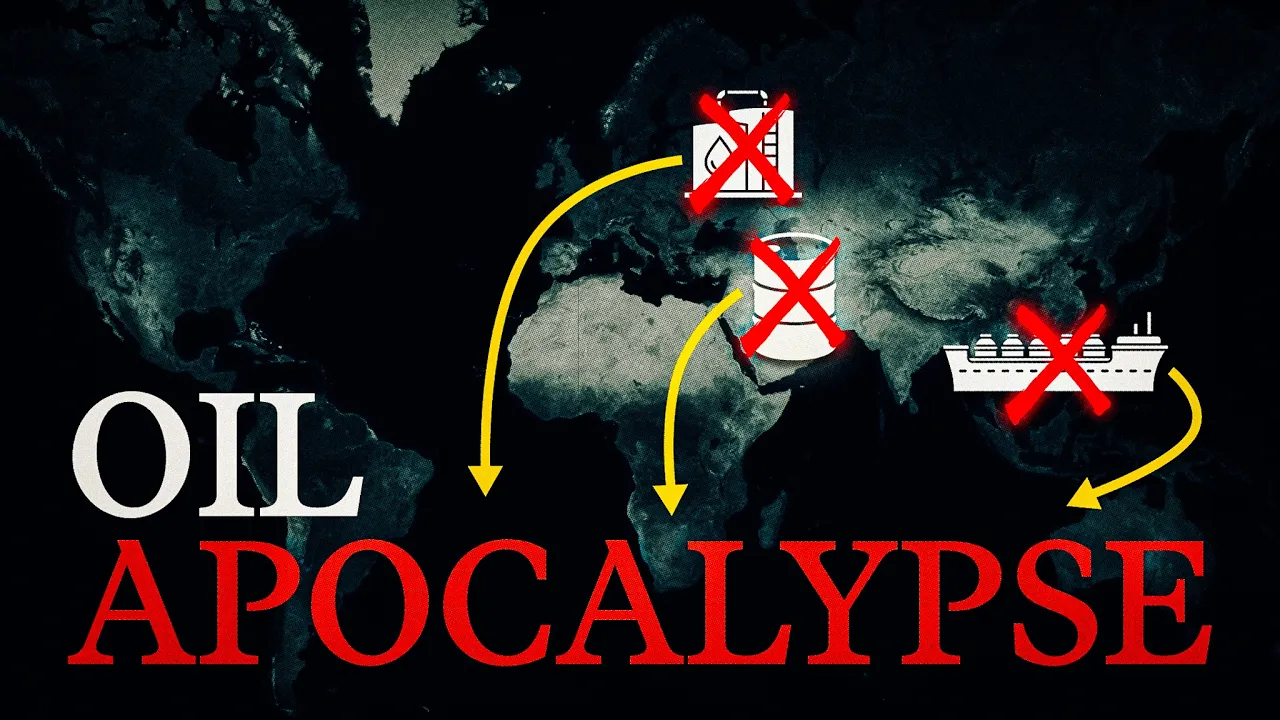
It's a nice bit of trolling. But I have to be honest, this oil shock, it is different from the one that we warned you about, because it's actually, and I can hardly believe this, three oil shocks hitting at once. One is from the Iran war, another from Russia's war with Ukraine, and a third from this war Saudi Arabia is fighting against a bunch of guys in sandals in the desert, and it's actually kind of four oil shocks if you count this whole other thing that I am just gonna come back to.
It has to do with really big boats. (tense piano music) And these are all converging at once. And they're converging on something that honestly is much bigger than gas shortages or gas prices. Gas shortages are really kind of a tiny little distraction, like they're a blip compared to the much scarier, much more dangerous form this thing is taking. It's a kind of devastation that affects truly every person on earth, whether you use a car or not.
And it's not hypothetical. It's not something that's over the horizon. It is here, right now, upending your world in ways that might not be initially apparent, but once you know how to see it, you will realize are absolutely everywhere. So let's get into it. (tense music) All right. What? Did you think I was not gonna use the board for this one? Quick refresher. This is the world oil economy. It's all one unified global market, which means all the world's producers sell into the same big supply, which all the world's consumers buy from.
Any given day, there are about 100 million barrels produced, and 100 million barrels consumed. There's zero slack, every drop gets used, so any disruption affects everyone. If you watched our other videos, you know how the Iran war blew all this up. And if you didn't, I'm gonna try to TLDR you up to today in personal challenge here, 60 seconds. Tamar, go ahad and put the clock on the screen. Tamar, go ahead and put the clock on the screen.
You guys ready? Okay, go. February 2026, Benjamin Netanyahu convinces Donald Trump to do regime change war on Iran. It fails around blockades Straight of Hormuz, depriving the world of the 20 million barrels of oil a day that went through it. The world gets some relief by rerouting oil through these big pipelines that avoid Hormuz, that go around it. And that adds back seven million more barrels to the system. And then add on top of that emergency oil stockpiles that add back another two and a half million barrels.
China magically cuts back its imports by five and a half million barrels a day. Save the world, thank you, China. So altogether, which comes out to a five million barrel a day shortfall in the world's oil needs, which brings us up to like September 1st. Okay, stop the clock. Did we make it? Still got it. Okay, so all of this is not great, you probably noticed it making your power bill more expensive, flights getting canceled, price of gas, but it's not like post-apocalyptic dystopia.
It's bearable. But then mid-September, a few really big things happened and upended all of this. And you know what? It's easier if I flip this around and show you on the map. (piano music) Okay, so this obviously is Canada. No, I'm just kidding, it's the oil producing Middle East. And all of this makes more sense if I show you where the oil is. (tense piano music) It's really clustered right around here. And remember that everything in this region is worth 20 million barrels a day. (tense piano music) So when you see where the oil is clustered, you can see why it makes sense that it normally travels through here, the Strait of Hormuz.
Actually, let me map this out too, it's easier to see. (tense piano music) Mostly this goes to Asia, (tense piano music) or it goes up through here, up the Red Sea, through the Suez Canal to Europe. (tense piano music) Or it used to, until Iran closes it. (tense piano music) And that closure, of course, leads to minus 20 million barrels from the world energy economy. (tense piano music) So it looked like disaster until the UAE here opened up the dial on its 300-mile crude oil pipeline, which I'm gonna map out now.
That's the pipeline, and it pops out here, just past Iran's blockade. Here's what it looks like. (tense piano music) And that pipeline is shipping one and a half million barrels a day. Not bad. (tense piano music) And then Saudi Arabia cranks up the mother of all oil pipelines, the East-West pipeline. (tense piano music) There she is, runs East to West, and that's why it's called "The East-West Pipeline." And that pipeline carries a kind of amazing five and a half million barrels of oil a day across 750 miles, mostly of desert. (tense piano music) And it empties out here in the Red Sea, where it goes up to Suez to Europe, let's map that out. (tense piano music) And it also goes down here through the Red Sea out to Asia. (tense piano music) And this all got opened up even more around July when the world finally figured out how to get a little bit of oil out of Hormuz.
Let me explain. (tense piano music) This is, I swear to you, a real training video for cargo ship captains explaining something called "ship-to-ship transfer." - Okay. - Where in an emergency, one ship can offload its cargo to another without the use of a port. Right now, the really big oil tankers that normally would've gone through Hormuz are instead anchoring out here, where it's safe, and where they load oil using those ship-to-ship transfers that little itty bitty ships bring to them through Hormuz.
And those little ships shuttle back and forth on this sort of safe route right along Oman's coast. And they can do this because being smaller makes it easier to avoid detection, and it makes the risk more palatable, or manageable to ship owners. They also turn off some equipment to be stealthier. And this little game isn't enough to reopen Hormuz, but it does bring through about six and a half million barrels a day, depending on how good the Iranian Navy's eyesight is that day. (tense piano music) So, okay, six and a half million barrels, one and a half million barrels, seven and a half million barrels, all of this together was bringing out about 13 and a half million barrels a day from the supposedly closed Strait of Hormuz. (tense piano music) Honestly, that's pretty good.
That's two-thirds of the normal amount, until these guys showed up. (tense music) "Ansar Allah" or "Helpers of God," better known as the "Houthis," for the Al-Houthi family that leads them. Who are the Houthis, how do they fit into this? TLDR, Yemen has been in a civil war for 12 years now. Saudi Arabia intervened on one side, the Houthis are fighting on the other. (tense music) That has been going on for a very long time, and then all of a sudden in September, the Houthis took a bunch of territory in Yemen, all along the coast. (tense music) This is the Houthi territory, and it includes this spot right here.
I know I covered it with tape, but it is the straight of Bab al-Mandab. (tense music) Here's what it looks like, a really important choke point. The Houthis are fighting Saudi Arabia, and they are allied with Iran, so they closed this straight that had become basically the backup Hormuz. And then they did something even bigger. (tense music) This is Saudi Arabia's main refinery at the end point of that big pipeline, knocked out by Houthi rockets.
So now we gotta X this out. (tense music) So the refinery is out, but the pipeline was still running, until some friendly Iran-backed militias way up here in Iraq sent drones down to three different points in the pipeline, these huge structures called "pumping stations,' and turned them into this, rubble. Here's a closer view. One of the explosions was so big, you could see it from space. (tense music) So three big pumping stations down, which means, (somber music) no more East-West pipeline, at least for now, and the world down five and a half million barrels, including a lot of that oil that would have gone to Europe. (tense somber music) Okay, so East-West Pipeline was the big one, so without that, we are down to just this little UAE pipeline, and this ship-to-ship game at the edge of Hormuz, which means the whole region is down from 20 million barrels a day before the Iran war to now thanks to Iran and especially thanks to the Houthis just wrecking Saudi Arabia, we are down to eight million barrels a day. (tense somber music) That is bad.
That's not good. And it actually gets even worse. But actually, before we get into what happened, there's something I wanna show you. Hold on. (tense ambient music) If you are in any way involved in running a business, you are gonna wanna hear about today's sponsor Odoo, the all-in-one management software. This show is actually kind of a small business, so this speaks to me. And it's easiest to explain if I show you life without Odoo, (tense ambient music) versus life with Odoo. (tense ambient music) Like take the hassle of juggling a zillion apps, each with their own process and formats. (tense ambient music) Well, Odoo puts all that, all those functions on the same platform.
So there's just one cozy ecosystem to build your business in. (tense ambient music) And here's another problem with the zillion apps thing. Every sale or operation has to get routed through the whole maze of them, which takes forever, takes up a bunch of everybody's time and energy. (tense ambient music) But with Odoo, all of those apps and functions are natively integrated to carry tasks or sales across the ecosystem seamlessly. (tense ambient music) Okay, last one, scaling.
And normally that means adding more external apps, which means rebuilding your process, and starting all over again. (tense ambient music) But with Odoo, when you scale, Odoo painlessly scales with you, so you can focus on your business. (tense ambient music) And if you're interested, you can book a free consultation, or just dive in with a 15-day free trial, no credit card required by using the link in the description or the QR code.
So now I'm gonna flip this back over, and get us back to our story. (somber music) Okay, so you'll see that I went ahead and updated this, updated all the numbers with all the stuff that we just went over, and it nets out down four million barrels a day. Might have been survivable if not for one guy, someone we thought was a hero in this story, Xi Jinping. Buddy, I thought we were pals, but after a few months of going without oil, so the rest of us could have enough, China seems to have decided, "Yeah, it's time for oil." (tense ambient music) This chart shows two things.
The blue line here is the price of oil globally, and the red line is the price of oil specifically in China. (tense ambient music) Technically, this actually shows these things called "WTI crude futures" and "Shanghai crude futures," but unless you're watching this video on a Bloomberg terminal, it doesn't matter, don't worry about it. Just wanted to clear that up for the nerds in the audience. Most of the time, you can see these lines run in parallel.
China is buying oil at about the same price as everyone else. Even during the first oil shock, it's pretty similar. China's line is a little smoother, because remember, they're buying less oil, so they can afford to skip the crazy price surges. But then September 1st, something big changes. China starts paying way, way more than everyone else for oil. Look at that gap. The rest of the world is paying about $105 a barrel, but China is paying $135.
And what's happening here is that China, after months of sitting out the global oil market, is going on an oil buying spree, which means it's now cutting just two and a half million barrels a day from its normal imports, not five and a half like it was before. (tense ambient music) Got my big marker. (tense ambient music) That's still helpful to the world for sure, but it is a lot less helpful than what China was doing before.
And it means that the global balance is now at net seven million barrel a day shortfall in global oil supplies. (tense music) Why is China doing this? As usual, they're not saying. But if I had to guess, it's because they know something a lot bigger and a lot worse than a crude oil shortage, like we said at the top of this video, is already starting to hit the world. So now it's time I showed you what that is, which means, we have to rearrange the board here a little bit. (tense music) So yes, you were reading this right.
Everything that we talked about up to this point is actually just the first third of this. It's the first of three interlocking crises that are all hitting once right now. And the second huge global crisis is shipping. (tense music) Just a baseline, forever and ever, getting oil from the place it was pumped to the place it's gonna be consumed costs about $3 a barrel. (tense music) And that is way cheaper than you would think, right?
Well, a lot goes into making that happen. (ambient music) We talked in our first "Oil Shock" video about how oil travels on all these long overseas routes, and it shipped in huge, crazy huge boats that go literally the speed of a bicycle, which means it's really, really important, we have enough of these ships to keep the oil moving. And as of, hmm, last month, we do not. We do not have enough ships anymore, and there are a few reasons for that. (tense ambient music) First off, Iran attacked a few to show it means business in closing Hormuz, and the US in turn sunk a few Iranian tankers.
And a bunch of the tankers that are left are stuck, remember, anchored just outside Hormuz, waiting to do those crazy ship-to-ship transfer maneuvers we talked about. And you can file all of those disruptions, all of which make shipping scarcer under generalized danger in the Hormuz Strait. (tense ambient music) But even that is nothing compared to what happened when these guys showed up, and closed down the Bab al-Mandab Strait.
Let's actually flip this back really quickly, so I can explain why that's such a problem. (tense ambient music) So look, here's why this is a big deal. The only way to reliably get oil out of the Middle East, which what do you associate the Middle East with? With oil, is now to go up through here, through the Suez Canal. And that's fine if it's going to Europe, but look, there is suddenly no direct route to Asia, and Asia is by far the world's largest consumer of oil.
And we saw that China is suddenly snapping up all this oil. So how do you go from here, the Suez Canal, where the oil comes out now, to here, Asia, where the oil ends up? Well, by getting a little Vasco de Gama with it, - Yeah. (chill out pop music) - And rounding the Cape of Good Hope. (tense orchestral music) Here's a map of what changed. The dotted line shows the old route for oil, and it took 19 days to get from the Middle East to say, Taiwan or China.
But now with Bab al-Mandab closed, the new route goes up through Suez, across the Mediterranean, down the coast of Africa, around Good Hope, all the way across here, and back up to Asia, all of which takes 48 days, a full month longer than before. We flip this back. (tense orchestral music) So here again, here's that route, and this is crazy. We are back in like 18th century spice trade routes. (tense orchestral music) And remember, it has to travel both ways like this.
Think about what that means. One ship will now take three or four times as long to complete a single delivery, which means it can only make a third or a quarter as many deliveries in the same period of time, which is effectively the same as if two out of every three oil tankers just straight up disappeared. (tense orchestral music) And you will be shocked at how much this one thing blows up the world economy. (tense music) This is the per day cost of hiring a big supertanker to ship oil.
Before the Iran War, it cost like $30,000 a day. One of the worst days of the pandemic, it peaked to like 250,000, which people thought at the time was Armageddon. Well, now it is up to $1.2 million a day and rising. (tense piano music) And it gets even worse, remember, that you are both paying a million bucks a day for shipping and you need to hire the boat for twice as many days, so it can, I guess, recreate Magellan's voyage round trip every time, which means that the shipping price has exploded from $3 a barrel to now $26 a barrel. (tense piano music) That means that shipping alone now adds another $23 to the price of each barrel of oil.
That is about equivalent to the price shock from the Iran War itself. So it's like the shipping crunch took everything we talked about from the oil shock over here, and then doubled it, doubled the price spike, doubled the shortages, because countries can't get oil in time, or can't find spare ships, and it did something else, it set us up for this third and biggest crisis from the oil mega shock. Let me show you what I mean. (tense music) This is oil as it comes out of the ground, and this is the gas you put in your car, and you're gonna notice something here.
These two images are really, really different. Crude oil on its own is basically useless. All of this is just the first half of how you turn that black goo in the ground into powering the world. And the second half is this, refining. (tense music) This is an oil refinery. It is huge. Hundreds of acres of towers, sophisticated heavy equipment, these are $10 billion facilities, and they exist to process that 100 million barrels a day of global oil supply into something usable, like gasoline. (tense music) Gasoline is the lightest fuel sources in cars, motorcycles, lawn mowers, and the world uses 25 million barrels a day of it. (tense music) And the next thing the refineries turn oil into is jet fuel. (tense music) Jet fuel is also pretty light, goes in airplanes, obviously, and it's actually just a version of kerosene, the thing you put in lanterns, and the world uses eight million barrels a day of it. (tense music) Next up is a bunch of other stuff that we don't need to get into, plastics, asphalt, chemicals, couple other fuel types, all come from oil. (tense music) And that's worth 37 million barrels a day, (tense music) which leaves the big daddy of petroleum products, the world's most used and most important oil-based fuel, diesel. (tense music) And the world appetite for diesel is 30 million barrels a day. (tense music) And these 30 million barrels a day fuel freight trains, farm equipment, construction, commercial shipping, generators, and most of all, trucking. (tense music) If you buy or use a physical product of any kind, diesel brought it to you, and diesel has one great strength and one great weakness.
And the strength is that it's heavier and more energy-dense, so that it can, well, do this. Watch what happens when this guy just puts some diesel in a tube and then compresses the air in that tube. (equipment clanking) Gasoline can't do that. This makes diesel more efficient and effective for a big, heavy engine. That's its strength. Its weakness is that the market for diesel is something that economists call "in elastic." Think about, say, gasoline that goes in cars.
If the price of gasoline goes up a bunch, say, because America starts a war with Iran, and now there's less gasoline available, people can respond by using less of it. They carpool, they take the train, whatever. It's an elastic product, so the market naturally adjusts, but we can't do that with diesel. Remember what it fuels? Trucking, heavy equipment, like farmer John can't turn off his tractor halfway through the harvest, because diesel got too expensive.
He has no choice but to pay that price, which is why as soon as supply tightens up, you get shortages. (tense music) That's what these photos are from at the start of the video. And the people who can find it, they pay. So everything I've shown you so far tracks how the oil shock over there, plus a shipping shock right here leads to crazy prices and shortages by the time it gets to the refinery. But it is so much worse than that, because there is now a refinery shock hitting too. (tense music) This is the massive Moscow Refinery on the outskirts of, you guessed it, Moscow, Russia.
And the reason it's on fire is that Ukrainian drones blew it up. Here's another Russian refinery 600 miles away in Samara, also on fire, also Ukrainian drones. Russia is one of the world's big three oil refiners, along with the US and China. And in the last few months, Ukraine has hit 28 out of 32 of their biggest refineries, which is why Russia looks like this right now, 140 million Russians, every single one of them waiting in line for gas. (tense music) Russia and Ukraine are fighting, and they've been fighting all year, refinery war. (tense music ending) Ukraine is hitting Russia's refineries to pressure them to end their invasion, and it's kind of working.
Refining oil into fuel to sell abroad is one of Russia's biggest industries. It's a huge part of their economy. Ukraine has cut that industry in half, but that means that the world is now down by about one million barrels a day of diesel. (tense music) Trump has said this is why there's a global fuel shortage, but that is not true, this has been going on for like a year or two, and global fuel supplies were mostly fine for most of that, it was Trump and Netanyahu's war on Iran that set off all of this, and triggered the global fuel shortage, which has made supplies so tight that something like Ukraine's refinery war on Russia suddenly has a much wider effect.
I just wanted to clear that up. Anyway, got a lot worse when our old pals, Iran and Saudi Arabia also got into a refinery war. (tense piano music) After the US and Israel attacked Iran, Iran retaliated by attacking oil infrastructure, like refineries in the Gulf states that had helped the US, or host its military bases. And then those countries attacked at least one big refinery in Iran, back and forth on and on, you get the idea, one and a half million barrels a day of diesel, poof, gone from global production. (tense piano music ending) And then enter our old pal, China, another of the big three global refiners, source of a lot of the world's refined petroleum products, like diesel.
Everyone was hoping that Xi Jinping would bail us out again by ramping up fuel exports, after all, he was importing all that oil, but instead, my guy cut exports way back, (somber guitar music) and he did it to the tune of about half a million barrels a day less of diesel. (somber guitar music) Why did he do this? Say it with me, we don't know, they're not saying. You would think with China importing all that additional oil, they would turn it into more fuel to export.
I mean, if only to do what the US has been doing during the crisis, and selling its refined fuels abroad to huge profits, while the price is really high. But China is not doing that. My best guess, they see how bad this is about to get, and they're stocking up. So how bad is it going to get? Well, for starters, that 30 million barrel a day supply of diesel is already down by three million barrels just from this stuff. (somber guitar music) But saying 10% drop does not come close to conveying how badly the global diesel supply is stressed and strained to the breaking point.
Like remember these crazy shipping costs? Well, this hits twice as hard for diesel. Like, let's say, you're Australia, and you have a rich, vibrant economy that exports iron ore and fairy bread to a grateful world, but what you don't have is oil or a big refinery industry. So where does your fuel come from? Well, it starts as oil in the Middle East, and normally, it would leave here through the Strait of Hormuz, but we are not in normally.
So it starts in the Middle East, and now it comes out here, East-West Pipeline, and it comes up here through Suez, cross the Mediterranean, across, across, out the Mediterranean into the Atlantic, and then it comes way down here down the coast of Africa, (Max fast-talking gibberish) all of that to get back to the Middle East, but it doesn't go from here to Australia. No. Instead, it goes through here, past India, through the Strait of Malacca, up here to South Korea, because South Korea has refineries.
Australia does not have refineries. So South Korea turns that oil into diesel, which now finally goes way, way, way down here to the land of Oz. So that is quite a journey, and it takes forever. And if that oil tanker taking that trip is costing a million dollars a day now, then by the time it winds its way to Australia, the price of its cargo will have gone stratospheric. And this isn't just Australia that has to import diesel from someplace else that refines it for them.
This is the same in Europe. It's true in a lot of Latin America, it's true in a bunch of Africa and Asia. These are all places that need to have their oil ping-pong twice across the globe before it comes to them as fuel, (tense music) which drives that cost way, way up. And there's one last thing here that we haven't talked about. It's really important, it's actually kind of the thing that like sums all of this up, and they have a name for this thing in the oil industry, a technical term that they like to use, and that name is "crack spreads." - Crack spreads. - Crack. - Crack, crack, crack spreads. - Okay.
Yes, I know. I have had to listen to so many serious energy analysts say "Crack spreads are widening" while trying to keep a straight face over the last month. - Crack spreads. - I just... Why did they call it that? I don't... Maybe they were bored. Anyway, the crack spread is actually a very important thing. It is the difference between the cost of a barrel of oil and the cost of a barrel of gas or diesel. And that comes from cracking, which is the term for processing oil, and spread, which means the gap between two prices.
And the reason that people care about this is because it measures how much it costs, all told, to turn that useless raw crude oil into usable fuel. And you want the crack spread to be low, because that means fuel is cheap to make and to distribute. But the crack spread right now is, you guessed it, the highest it has ever been in history. (tense ambient music) This is, I promise, the last chart that we will look at, showing the crack spread to make diesel.
It's mostly been below $20 a barrel for a really long time. It hit $100 for a second when Russia first invaded Ukraine, but now it is surging way past that record and still rising. (tense guitar music) And to show you what this is doing, let's look at crack spread, and no, you don't have to blur it. It's not a literal crack spread, it's just a chart. See, it's the chart we just saw. This is a clean show, guys. (tense guitar music) To show you how this normally works, this time last year, the price of oil was about $65 a barrel, (tense guitar music) and the crack spread, ha ha, cost about $20 a barrel, (tense guitar music) which added up to a diesel price of 65 plus 20, $85 a barrel. (tense music) This is normal.
This is a normal market. And now, well, first, the current price of oil is, of course, $100 a barrel. (tense music) And if you thought that was bad, the crack spread today, the price of refining that barrel of oil into diesel has gone from $20 to, and you are gonna wanna sit down when you hear this, $110. (tense music) All of which means, I know some of you are already doing the math, that diesel has gone from $85 a barrel to $210 a barrel.
This is almost triple the price. This is how you go from a 60% rise in the price of oil to a 250% rise in the price of diesel. And this, this is the crisis. It's that both 10% of supply, poof, disappeared overnight, and prices basically tripling at the same time. And I know if you're watching this, you almost certainly don't buy diesel yourself, you've probably never bought diesel, but believe me when I say you, your life, the things you do every day are 100 times more affected by the price of diesel, than they are by the price of oil, or even gasoline.
And to show you how, we need to flip the board one last time, but we run out of board to flip, so hold on. (ambient chime music) Okay. I wanna conclude all of this with a summary of just a few of the many, many things in our world that are getting hit really hard by the diesel apocalypse. I could put truly 100 things up here, and would not scratch the surface, but very basic overview, we gotta start with trucks. (ambient chime music) Trucking is far and away the biggest use of diesel.
It's actually responsible for about half of global diesel use. And because trucking uses so much diesel, it is very vulnerable to price increases, which means if diesel is three times as expensive, then trucking is three times as expensive. (tense music) And this impacts everything, because everything is brought by a truck. So like lumber is gonna get a lot more expensive, which means so is construction. (tense music) All those construction materials are gonna cost a lot more to deliver, which means they're just gonna cost more, period.
And even once they're there, the construction equipment runs on diesel too, so that is another way the price is gonna go up, which means housing is gonna get more expensive to build, so it will be more expensive to rent or buy, and will also be scarcer. And another thing really affected by this is the price of food. (tense music) About 10% of the cost of food comes from the transportation to get it to the store, and transportation just got three times as expensive, which means that all your groceries are, rough math, gonna go up about 20% in price. (tense music) And in fact, it might be even more than that, because diesel also fuels agriculture. (tense music) Farm equipment, big and heavy, runs on diesel.
So that 20% food price hike probably just went up again. And of course, flights, air travel. (tense music) Remember, it doesn't run on diesel, it runs on jet fuel, another refined petroleum product, but it's experiencing the exact same thing, same shortage, price surge, both hitting at once. Most of your airfare is actually to pay for fuel, and airline fuel bills are rising by 40%, which means that your ticket probably also rise by 40%. (tense music) Even with all of the ticket price hikes, a lot of airlines are being pushed by this into or near insolvency, so you can expect more cancellations, worse service, and worse delays.
Okay, last one that we are gonna talk about, although like I said, we could put a million things up here, is shipping. (tense music) These big boys use a lot of fuel, and that fuel is three times expensive, which means it now costs three times as much to ship things overseas. (tense music) And this means that if you work in an industry that relies on selling products overseas, or if you manufacture something that involves importing materials from overseas, you are in trouble.
Or if your country's economy relies on stuff imported from abroad, like say, computers or cars, you are in trouble. And a fun little added irony to this is guess what also just got way more expensive to ship? That's right, oil. The high cost of oil is driving up the cost of oil. It's awesome stuff. So what does all this mean? Look, we are just at the start of something here, but make no mistake, it has started. I'm not gonna say it's irreversible, but like just to be really, really clear about this, this up here, this is not some hypothetical worst case.
I'm not presenting this as a warning that we have to turn things around before it's too late. This is happening now. It's here. And Americans, I know Trump is talking up a diesel export ban to save us from rising fuel costs, but any expert economist in energy or oil whatsoever, left, right or center will tell you the exact same thing, which is that this is going to do worse than nothing. This will drive up global prices, which is going to drive up all of this, including yes, even US fuel prices.
So sorry, this is not gonna fix it. People ask me, "Hey, should I fill up my car while I still can? Should I stock up on fuel?" And I don't know, it probably doesn't matter either way, to be honest. I have a better piece of advice for you. Don't absorb this as the new normal. Don't just get used to it. Every week, every month that we let this stretch on and on, because the leaders who started it are too embarrassed to admit that they screwed up, and to stop, this thing is just gonna get bigger, and it is just gonna get worse. (somber piano music) (somber piano music ending)
The words are the caption track's own and nothing is reworded or re-transcribed. Paragraph breaks are placed between sentences so the text reads as prose.
Free tools for your own script: paste a draft and see where it stands before you record it.
Paste your draft and see where viewers are likely to drop off, with a rewrite for each weak line.
Paste the first 30 seconds of your own draft for a hook score and rewrites.
Check your draft against YouTube's advertiser-friendly guidelines before you record it.
Read this channel's public videos and transcripts, and download a writing brief for it.