Getting the transcript
Reading the captions from YouTube. A video nobody has opened here before takes 10 to 30 seconds; this page fills in on its own.
Getting the transcript
Reading the captions from YouTube. A video nobody has opened here before takes 10 to 30 seconds; this page fills in on its own.
David Epstein · @DavidEpsteinAuthor
Where viewers went back to watch this video again, from YouTube's public Most replayed graph, lined up with what was said at that moment.
Most replayed moment #1
9:239.7x the video's typical replay level
started feeling his heart skip beats. He was light-headed. He had chest pains. He sat out the rest of the season and the playoffs. [music] The team put a $5 million contract on the table with one new [music] condition. Take a genetic test and if it came back
Said at 9:16
Most replayed moment #2
14:155.3x the video's typical replay level
heart back into line. It's not gentle. Patients describe the shock as a 10 out of 10 in many cases, but it works. There's footage of a Belgian soccer player named Anthony Van Loo collapsing on the field. >> [music] >> And a second or two later, you can see his body jerk as the device fires and he
Said at 14:09
Most replayed moment #3
13:534.5x the video's typical replay level
to show you. It's this. The implantable cardioverter defibrillator, an ICD. It's a little titanium-cased computer, about the size of a matchbox, tucked inside the chest and wired into the heart. And it has one
Said at 13:47
The graph counts replays. It does not show where viewers stopped watching.
Words
3,551
Runtime
18:01
Speaking pace
197wpm
Reading time
15min
197 words per minute, between the 181 median and the 201 75th percentile of 349 measured videos. That distribution comes from the 349-video hook study.
Opening (first 30 seconds)
A few Sundays ago, one of the fittest human beings on the planet was jogging across a soccer field in Denmark when his heart stopped. It was the 65th [music] minute in a friendly against Ukraine. Christian Eriksen, 34 years old, a pro athlete in the kind of shape almost none of us will ever be in, reached up, grabbed [music] at his chest, and dropped to the grass. The other players around him went still >> [music] >> because they've seen this before. Five years ago at the European Championship, Eriksen's heart stopped on the field, and he
99 words, the words spoken in the first 30 seconds at 197 words per minute.
Free, no signup. See how the first 30 seconds hold attention, with rewrites.
Sentence shape
| Measure | This transcript |
|---|---|
| Sentences | 234 |
| Average words per sentence | 15.2 |
| Longest sentence | 44 words |
| Questions asked | 6 |
| Sentences containing a number | 24 |
Most used terms
Filler phrases
22 in total: actually 8 · like 7 · uh 4 · kind of 2 · basically 1.
A literal whole-word count of the same phrase list the Prepublish browser extension uses, so a phrase inside another word is not counted and a phrase used in its ordinary sense still is. It is a count and not a judgement.
Free, no account. See where attention is likely to drop, with a rewrite for each weak line. The free check shows the scores and the one issue costing the most. Or run it on the words above first.
Free · No login · See a sample audit first if you prefer.
What this transcript is
Every word below is the caption track YouTube publishes for this video, pulled from the video itself and reproduced unchanged. It is not Prepublish's writing, not a summary, and not a re-transcription: it is the video's own published captions. English captions, generated automatically by YouTube, in the video’s original language. Source: the video on YouTube. A channel that would rather this page did not exist can ask for its removal through the contact page, and it is removed.
A few Sundays ago, one of the fittest human beings on the planet was jogging across a soccer field in Denmark when his heart stopped. It was the 65th [music] minute in a friendly against Ukraine. Christian Eriksen, 34 years old, a pro athlete in the kind of shape almost none of us will ever be in, reached up, grabbed [music] at his chest, and dropped to the grass. The other players around him went still >> [music] >> because they've seen this before.
Five years ago at the European Championship, Eriksen's heart stopped on the field, and he had to be brought back to life in front of a packed stadium and a television audience of millions. As I'm recording this, he's awake, talking, expected to walk out of a hospital. And the reason he's alive is a small device about the size of a matchbox buried in his chest. [music] I'll show you exactly what it does later because it's one of the most quietly astonishing objects in medicine.
But first, a question I've been chasing for decades. [music] How does one of the best conditioned people on Earth essentially drop dead in the middle of doing the thing he's best at? And why does this happen to the fittest among us, the people who on paper have the healthiest hearts of anyone? I'm David Epstein. I've written three New York Times best-selling books about human performance, The Sports Gene, Range, and Inside the Box.
But this particular subject isn't just another topic for me. It's the reason I transitioned from training to be a scientist to becoming a journalist in the first place. When I was in high school in Evanston, Illinois, I ran the 800 meters. One of my training partners, who I became extremely close to, was a kid named Kevin Richards. A precocious freshman when I was a senior, he was the son of Jamaican immigrants, and he was one of the best freshman 800-meter runners in the country.
He was also very bright, delightfully nerdy, >> [music] >> and on his way to becoming the first person in his family to go to college. I remember talking with him on runs about his interest in video game design. One afternoon during an indoor mile race at our high school field house, Kevin finished a close second to one of the best milers in the country. He took a few steps after the finish line to recover, and then he went down to the ground.
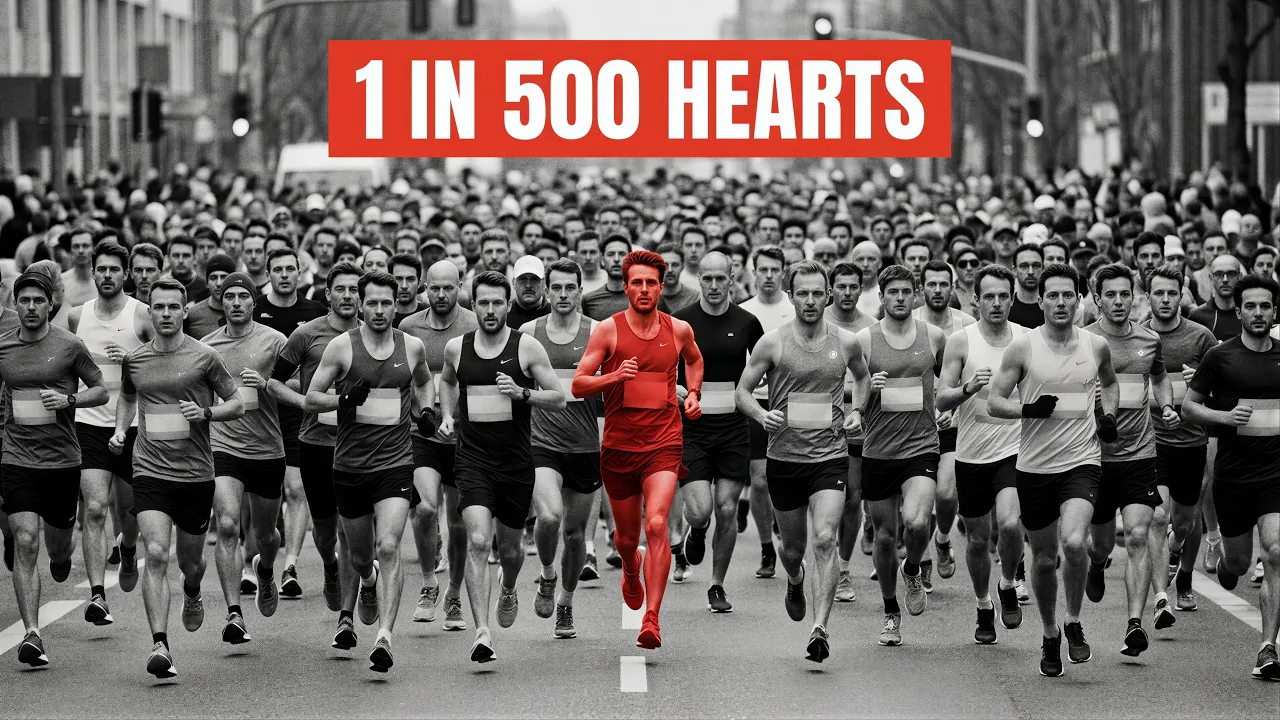
Of course, runners collapse after hard races all the time. >> [music] >> It's completely normal to be wrecked at the finish line of a mile. But this wasn't that. Kevin had gone into cardiac arrest right there on the floor of the indoor track at our high school. Kevin had an undetected condition called hypertrophic cardiomyopathy or HCM for short, and it's hiding in about 1 in 500 people walking around right now, many of whom will never know they have it, thankfully.
[music] But trying to understand what killed my friend is what pulled me into science writing. It's why years later I made my way to Sports Illustrated with the goal of writing about sudden cardiac death in athletes. So I've been living inside this story for a very long time in the hope of raising awareness and hopefully saving a few lives. So let me tell you what HCM actually is, because once you understand the mechanism, you can understand how it can take the people you'd least expect.
Your heart's a muscle with four chambers, and those chambers are involved in pumping blood to the lungs, where the blood picks up oxygen before returning to the heart, and then the heart pumps that blood through the body, where it drops off oxygen. The chamber that does the heaviest work is called the left ventricle. It takes that oxygen-rich blood from your lungs and pumps it out to the rest of your body. >> [music] >> In a healthy heart, the muscle cells in that wall are stacked neatly, kind of like bricks in a chimney.
In the HCM heart, the cells in that wall aren't stacked neatly at all. They sit at odd angles, all askew, as if the bricks had been tossed into a dumpster. That disorder is called myocardial disarray. [music] And it matters because your heartbeat is cued by an electrical signal that travels across those cells. >> [music] >> With every beat, electricity sweeps across the cells in your heart. As it reaches a cell, it cues that cell to contract.
And your ba-bump heartbeat is those cells squeezing in sequence as the wave passes around the heart. For the heart to squeeze cleanly, that signal has to cross the cells in an orderly wave. When the cells sit in disarray, the wave doesn't pass the way [music] it should. It short circuits again and again all over the heart at once until the heart isn't squeezing anymore. It's just trembling [music] like jelly in a shaken jar.
And a heart that's only trembling, it can't push blood out to the body. Within seconds the [music] person goes down. With the pumping stalled, blood starts to back up in a circulatory traffic jam. As it piles up in the lungs capillaries, these are vessels so small that red blood cells have to pass through them in single file. The water in the bloodstream breaks through the capillary walls and settles into the air sacs of the lungs.
Those are the spaces that are supposed to be reserved for oxygen. The person begins to drown in their own body's water. Here's the part that should stop you. Many people with HCM will never feel a single symptom. Many will never even know they have it. But a small number, often teenagers, sometimes the most athletic kids in the school, will drop dead. Never having known they even had the disease. In the US, probably a few thousand people die from it every year.
Back when I was first learning about the disease, Dr. Barry Maron told me that HCM was the most common cause of sudden natural death among young people in the general public. And also among athletes, although that is still a very rare phenomenon. But even so, it was still a little-known disease when I was learning about it. Now, think about what that means. For most of the population, exercise is the best medicine. If you have high blood pressure, high cholesterol, early signs of heart disease, the single best thing you can do is move and move vigorously.
But for someone with HCM, it can sometimes be the opposite. The harder you push that flawed heart, the more you might provoke it into a lethal rhythm. Which means the people at the very highest risk are often the fittest, most driven young athletes on the field. The ones doing everything right. Somewhere in this country, an athlete with HCM dies during or right after exertion about once every 2 weeks or so. That's the answer to the question in the title of this video.
The fittest athletes don't drop dead in spite of their fitness, but sometimes it's because of it. Now I want to talk about where HCM comes from because it derives from something almost unbelievably small. A single genetic typo. That's like one misspelling in an entire shelf of encyclopedias. And it can take a healthy 17-year-old in the middle of a basketball game. When I first learned that, I thought, "Surely we can just find that typo and then screen for it." And researchers used to think that, too.
In the 1990s, they found a typo, a genetic typo that causes HCM. Then they found another and another. Today, there are more than a thousand known genetic typos, any one of which can cause HCM, and two-thirds of those have only been identified in a single family. [music] These are called private mutations. So, you can have many people with the same disease, and yet no two with the same mutation, [music] which makes genetic screening very difficult.
Back when I was writing about this and researching my book, The Sports Gene, [music] I developed a motto about genetics. It's more complicated than we thought. And that's been the case at every turn. So, screening isn't so easy. That said, some mutations are more common than others. So, genetic testing sometimes helps in a family with known disease >> [music] >> to figure out which family members are carriers. And importantly, HCM is not the only disease that can cause sudden death in a young athlete without any obvious prior symptoms.
There's long QT syndrome, another inherited electrical fault. There's myocarditis, usually triggered by a virus, which was linked to the death of Celtic star Reggie Lewis. >> [music] >> And there's commotio cordis, which is genuinely freakish and extremely rare. That's when a blunt blow to the chest at exactly the wrong sliver of the heartbeat can stop a heart that doesn't have any defect at all. It was one of the leading theories when Bills safety Damar Hamlin collapsed back in 2023 right after a hit to the chest.
[music] But, that's extremely rare. So, here's where people often land, especially in community that has lost a kid. Why don't we just screen every young athlete? Run a cheap EKG. That's a test that records the heart's electrical rhythm before you allow a kid to play sports and see if something looks off. Italy actually does exactly that by law for every athlete in the country. If Italy can, why can't we? The honest answer is more uncomfortable than it sounds.
First of all, Italy has far more doctors per citizen than we do and many of them have spent entire careers reading these scans. We have fewer doctors per capita, a far more diverse population, and [music] more than 8 million high school athletes, more kids than Italy has teenagers. Screen all of them and you create two new problems at once. You've [music] terrified thousands of perfectly healthy families with false alarms and there will be way more of those than true positives [music] if you're using EKG.
And that will lead to very costly follow-up testing and you'll still miss a lot of real cases. Lots of false positives and missing some of the true positives. Furthermore, EKGs are cheap, but they aren't really well suited to detect HCM. That's not what they're for. I used to listen to doctors and scientists argue over whether the Italian program for all that effort had actually saved lives. It wasn't clear to everyone.
In preparation for this video, I interviewed a few HCM experts and learned that Florida recently passed a law requiring EKGs for all [music] student athletes. Some of the people I spoke with shared a dim view of lobbying by companies that provide the EKGs. Hospitals and the academic community are largely opposed to this type of screening. To show you how thorny this can get, let me share two stories. In 2005, Chicago Bulls center Eddy Curry started feeling his heart skip beats.
He was light-headed. He had chest pains. He sat out the rest of the season and the playoffs. [music] The team put a $5 million contract on the table with one new [music] condition. Take a genetic test and if it came back positive for a known HCM mutation, you don't play. But we'll pay you $400,000 a year for the next 50 years. Curry refused. The Bulls traded him to New York rather than suit up a man who wouldn't be tested.
Curry never had another heart problem. Nicholas Knapp was a young man who had the opposite problem. In 1994, Knapp, as a high school basketball player, was well on his way to breaking the Illinois career three-point record when his heart actually stopped on the court. He was revived. He earned a basketball scholarship to Northwestern University only for the school's own doctors to rule him too dangerous to play. I interviewed Knapp several times when I was learning about HCM, and he was never even convinced he had the disease. >> [music] >> His scans were ambiguous, so cardiologists were split, and he sued the university for the right to risk his own life.
He won, >> [music] >> and then he lost on appeal when the court agreed that Northwestern could side with its doctors and keep him off the floor. Knapp transferred and played for Ashland University, but his career never really recovered. He also never had another cardiac arrest. So, as you can see with Curry and Knapp, these situations can get incredibly thorny, especially with a condition that isn't always obvious right away. >> [music] >> As I was researching HCM, I learned a lot from a woman named Lisa Salberg.
She has HCM herself, and she founded the Hypertrophic Cardiomyopathy Association. As she once told me, "Somewhere between screening every kid in America for a couple billion dollars and not doing anything at all lies the right answer." So, let me tell you how you can do more than nothing. It starts with one question that costs nothing and has quietly saved lives. Has anyone in your family died before the age of 50 of a heart-related cause?
Or even for unclear reasons in suspicious circumstances? When I first started going to HCM conferences after my friend died, I'd talk to families with members who had died in one-car accidents, [music] or a varsity swimmer who drowned in a pool. They didn't realize until later that these were likely cardiac arrest. HCM is hereditary. It passes from parent to child in what's called autosomal dominant fashion. That's a fancy genetics term that basically means a coin flip.
If a parent has HCM, there's a 50/50 chance each child will have it. When I met those families, it was almost always only after losing more than one person that someone finally sat down and pieced the family tree together. Don't wait [music] for that. Learn your family history. Pass it down through the generations. [music] It's incredibly valuable and not just for HCM. Then there also warning signs and they hide in plain sight.
Fainting, [music] chest discomfort during exercise, breathlessness out of proportion to the effort. These get waved off constantly and here's the dangerous part. In kids, they're often mistaken for asthma and that's not just a harmless mix-up because some asthma inhalers may actually trigger irregular heart rhythms in a person who actually has HCM. My friend Kevin had complained of some discomfort that in retrospect seemed suspicious, but of course we'll never know.
And then finally, there's the thing that almost anyone watching this can do. [music] Get certified in CPR and learn how to use a defibrillator. A defibrillator is that thing you see in movies when a paramedic yells clear [music] and then zap somebody. But these days, there automated defibrillators in many public buildings and sports [music] venues and they're really easy to use. I've been trained on them and really anybody can do it, but in a moment of panic, it'd be a lot better if you're familiar with how to set it up.
The Red Cross offers simple trainings, but honestly, even watching an AED video online for 5 minutes would help and I'll put one in the description. These [music] things are not hard to use and for every minute that defibrillation is delayed, that's that shock that gets the person's heart rhythm back to normal, the person's chance of survival goes down by about 10%. There is one way you can extend that time and that's CPR.
And again, the Red Cross offers trainings all over. You don't have to do mouth-to-mouth if you don't want anymore. It's not the thing. The most important thing is chest compressions, [music] hard and to do it to the beat of the Bee Gees Stayin' Alive. Uh, uh, [music] uh, uh, staying alive. Easy. That keeps the blood pumping until a defibrillator can shock the heart into a normal rhythm. So, when a heart stops, survival is measured in minutes, and the person or people standing closest are often the ones who decide the outcome.
So, for someone who already knows they have HCM or one of the other conditions I mentioned, there's a device I promised to show you. It's this. The implantable cardioverter defibrillator, an ICD. It's a little titanium-cased computer, about the size of a matchbox, tucked inside the chest and wired into the heart. And it has one job. It watches. The instant [music] it detects a lethal rhythm, it delivers a jolt, about 750 volts, to shock the heart back into line.
It's not gentle. Patients describe the shock as a 10 out of 10 in many cases, but it works. There's footage of a Belgian soccer player named Anthony Van Loo collapsing on the field. >> [music] >> And a second or two later, you can see his body jerk as the device fires and he sits right up. Alive. For years, everyone assumed getting one meant the end of serious sports, but athletes being athletes, plenty got the device and then went right back to playing.
So, a Yale cardiologist named Rachel Lampert decided to follow 440 of them over several years, and fortunately, the devices held up. No failures to defibrillate, no injuries from the shocks during sport. Today, whether or not someone can return to sport with an ICD is an open question that depends on their specific disease. [music] But ICDs have done fantastically in the clutch. Better than I ever thought they would when I first started reporting on this, honestly, when the recommendation was, "Once you get one, you can't play anymore." So, that brings us back to Sunday and to Christian Eriksen.
Five years ago, his heart stopped. A medical team brought him back, and afterward, he was fitted with one of these devices. On Sunday, when his heart faltered again, that little machine did exactly what Lampert's research [music] said it would. His team doctor's words were that it responded as it should. And so, a man whose heart has now stopped on a field twice is tonight sitting up in a hospital bed, talking, planning to go home.
This is the thing I most want you to take [music] away. The fittest people on Earth can still drop dead. And sometimes it's their fitness that pulls the trigger. Sounds like a horror story, and for families like Kevin's, my friend, it was. But, it's not a mystery anymore. It's much better recognized, and it's also not hopeless. We cannot yet reasonably scan every heart, but you can know your family's history. You can recognize the warning signs and not just be satisfied with calling them asthma if it seems like something else.
All right, I want to add something important that happened after I recorded most of this video. The day after we filmed this, 39-year-old Jenny Simpson collapsed. If you don't follow running, she won a bronze medal in the 1,500 m at the 2016 Rio Olympics. She's a former world champion at that distance, and she's one of the greatest American distance [music] runners ever. I followed her for more than a decade. She actually retired from professional running in 2024.
This was just a low-key community mile that she was helping [music] pace for fun. She was pacing a group of milers at a community event in Raleigh, North Carolina when she went down and lost her pulse. Now, people around Jenny started CPR, an automated external defibrillator was used, and her heart was restarted right there on the track. Jenny's alive. Within a couple of days, she was actually in a hospital bed reportedly already asking what her mile time had been.
She's a delightful and hilarious person. But, this is exactly why this next part matters. The people standing closest to her are the reason Jenny's still here. If you're suspicious, go to an HCM Center of Excellence to get evaluated, especially if you're thinking about playing sports. I'll put a link to those in the description. >> [music] >> Even if you don't have HCM, you can learn in a single afternoon how to restart a stranger's heart.
And for the people most at risk, a machine the size of a matchbox can sit quietly in the dark, standing [music] sentinel, doing nothing for years, waiting for the one moment it's needed. Kevin took a few steps past a finish line and never got that moment. Christian Eriksen's now gotten it twice. [music] The difference between those two outcomes isn't fitness and it isn't luck. It's what we choose to know and we're ready to do when someone goes down.
If you liked this video, you'll probably like the free one-page summary of my best-selling book, The Sports Gene, Inside the Science of [music] Extraordinary Athletic Performance. You can get that by clicking on the link in the top line of the description. Thanks for watching.
The words are the caption track's own and nothing is reworded or re-transcribed. Paragraph breaks are placed between sentences so the text reads as prose.
Free tools for your own script: paste a draft and see where it stands before you record it.
Paste your draft and see where viewers are likely to drop off, with a rewrite for each weak line.
Paste the first 30 seconds of your own draft for a hook score and rewrites.
Check your draft against YouTube's advertiser-friendly guidelines before you record it.
Read this channel's public videos and transcripts, and download a writing brief for it.