Getting the transcript
Reading the captions from YouTube. A video nobody has opened here before takes 10 to 30 seconds; this page fills in on its own.
Getting the transcript
Reading the captions from YouTube. A video nobody has opened here before takes 10 to 30 seconds; this page fills in on its own.
Ross Cameron - Warrior Trading · @DaytradeWarrior
This video has no Most replayed graph yet: YouTube shows one only once a video has enough views. These are the moments viewers replayed most in Ross Cameron - Warrior Trading's most watched videos.
Most replayed moment at 7:43
3.2x that video's typical replay level
occurred there it is so this is actually in solid but you could have it either either in a solid line or a dotted line whichever one you prefer so this is factoring in the amount of volume that occurs at price and the volume weight moving average um volume weight average
Said at 7:37
Most replayed moment at 14:45
3.5x that video's typical replay level
entries is to find the first pullback so in this case this is a five minute pullback right here we have a five minute pullback and this is a pullback that is right at the volume weighted average price which is our dotted line and it's right at the nine moving average which is this grade
Said at 14:37
Most replayed moment at 11:52
2.7x that video's typical replay level
that have the highest probability of success so let's watch what happens right here macd is against the trade right here so no nothing in here you should be trading no trade no trade no trade and then right here we can get back in now I'm going to do some something kind of cool and I'm going to
Said at 11:45
The graph counts replays. It does not show where viewers stopped watching.
Words
4,523
Runtime
23:31
Speaking pace
192wpm
Reading time
19min
192 words per minute, between the 181 median and the 201 75th percentile of 349 measured videos. That distribution comes from the 349-video hook study.
Opening (first 30 seconds)
What's up everyone? Welcome to day eight of my brand new small account challenge. In the last update, we were on day four and I had just suffered my first loss. It brought my accuracy from what had been 100% accuracy so far on the challenge down to about 89%. Well, as of today, we're on day eight and I've taken a total of 22 trades. Accuracy is hovering in the 82% range right now. So, it's dipped down a little bit more, but the account has started to grow a little bit faster, which is
96 words, the words spoken in the first 30 seconds at 192 words per minute.
Free, no signup. See how the first 30 seconds hold attention, with rewrites.
Sentence shape
| Measure | This transcript |
|---|---|
| Sentences | 328 |
| Average words per sentence | 13.8 |
| Longest sentence | 99 words |
| Questions asked | 15 |
| Sentences containing a number | 92 |
Most used terms
Filler phrases
105 in total: you know 26 · like 21 · uh 21 · um 20 · kind of 6 · sort of 5 · actually 2 · right? 2 · I mean 1 · basically 1.
A literal whole-word count of the same phrase list the Prepublish browser extension uses, so a phrase inside another word is not counted and a phrase used in its ordinary sense still is. It is a count and not a judgement.
Free, no account. See where attention is likely to drop, with a rewrite for each weak line. The free check shows the scores and the one issue costing the most. Or run it on the words above first.
Free · No login · See a sample audit first if you prefer.
What this transcript is
Every word below is the caption track YouTube publishes for this video, pulled from the video itself and reproduced unchanged. It is not Prepublish's writing, not a summary, and not a re-transcription: it is the video's own published captions. English captions, generated automatically by YouTube, in the video’s original language. Source: the video on YouTube. A channel that would rather this page did not exist can ask for its removal through the contact page, and it is removed.
What's up everyone? Welcome to day eight of my brand new small account challenge. In the last update, we were on day four and I had just suffered my first loss. It brought my accuracy from what had been 100% accuracy so far on the challenge down to about 89%. Well, as of today, we're on day eight and I've taken a total of 22 trades. Accuracy is hovering in the 82% range right now. So, it's dipped down a little bit more, but the account has started to grow a little bit faster, which is awesome.
Now, remember, all of the profit from this small account challenge will be donated to charity at the end of the challenge. And right now, I'm just trying to see how quickly I can grow the account, but with one key guard rail in place, which is that I cannot use any leverage. I'm only trading with my available cash balance. So, let's go ahead and jump on the screen share and go through this progress report. Okay, so if we go back to the beginning, you know that on day one, I started with $1,940 in the account.
You can see the balance right there. And on day one, I was green on the two stocks I traded, which was great. It was kind of interesting because we didn't have one really, really strong stock. We had a couple that were moving. In fact, during this challenge and during the previous leg of my first small account challenge, I noticed that I usually do better on days when we have one stock that's really obvious. And on other days, I find that the attention in the market becomes a bit dispersed where there's a couple of stocks that are interesting.
None of them are like fantastic because of course if they were, no one would trade the other ones. It would just be all the focus on one. So when you have dispersed attention, usually you get lower performance out of a number of stocks rather than really good performance from one stock. So it's helpful to be cognizant when you're looking at the market each day to ask yourself today, what is the most obvious stock? So just as an example of that, when I pull up the scanners right now, no doubt QNRX is a pretty obvious stock.
This one is our leading gainer in the market. It's up over 169% and I did trade it today. So, we'll we'll talk about this one in a moment. But this is safe to say an obvious stock. Whereas, you know, a stock down here like YH uh GJ, this one's not as obvious. It's not really moving that much. It's going sideways. Uh but if we didn't have QNRX then likely we would end up having you know three or four maybe even five stocks like YG uh YHGJ that are just sort of sideways.
People are trading them perhaps out of boredom. So Monday uh day one of the small account challenge uh rather I was up 23% traded two stocks. Day two of the small account challenge the market was slow. I got one trade was up $61 and then that was it. But you can see the equity uh here reflected the gains from day one. Going into day three, another day where attention was a bit dispersed but had some good gains up 15%.
Account continues to grow. Day four, this was the last time we checked in. I was red on my first trade down $80 and then on the second trade, the second stock I traded had a nice winner. Finished up 200 bucks. So now day five, this is the first day that you haven't seen yet. ZNB. This is a stock where I made $166 on it at the time. The account um grew 5% based on that, which was good, but not phenomenal. The stock had breaking news.
It was pretty obvious, but it was more expensive. So, remember, with this small account, I had a total of just under $3,000 of equity. So, how many shares could I afford to buy of this? Well, when it started to get a little higher priced, it was less than 500 shares. So, one of the things that you may already know from watching previous episodes is that my average gains right now are 18 cents per share. So, with a 400 share position, that's an average gain of 80 bucks.
So, realistically, for me to end up having, you know, even a modest green day of $200, it's going to take several winners on a stock like this. And on this particular day, I really struggled with it. So, if we go back to this um uh chart right here, when it first started to squeeze up right here down at $2, I actually tried taking my first trade because it was cheaper. So, at that time, I could buy a,000 shares. And I got in and I got out and I made only $50.
I only made five cents a share. So, first winner, I'm up 50 bucks. And I'm like, all right, well, you know, plus 50, that's good. But guess what happens on the second trade? I lose $53 and now I'm down three bucks on the day. Not to mention fees and commissions. So now I've spun my wheels a little bit. One winner, one loser. I'm red on the day. Now it comes back up here. It curls up. It pulls back. It curls up. And I start buying these little dips here.
But in this range, none of these moves were really that substantial. So I end up getting a couple more trades. And then I'm up 80 bucks on the stock. So now I'm green on the day a little bit less after fees and commissions. It ends up pulling back going sideways and then doing this pattern which we would call an inverted head and shoulders pattern right here. This is a pattern that I like and we got a nice breakout on it and I jumped in and jumped out not at the beginning because I wasn't sure it was going to work.
The the problem with this pattern is it can be difficult to time because why did it break out right there and didn't just go sideways for two more candles? It's kind of hard to know. However, once it starts popping up and pulling back, I like to buy the first pullback, which we got right there, and we got another one right here. However, I was a little bit distracted because I was also trying to trade in my main account.
And on this particular day, I took a pretty big loss in my main account. So, it was on a different stock, but nonetheless, my own attention was a little bit dispersed. So, once I was up on this $166, I said, you know what? I'm just going to put this account on the side. I've got to focus on my main account, which is getting beaten up a little bit, and I just don't want to be read in both accounts. So, I'm just going to let this one be.
So, that was day five, $166. So, then we go in, oops, we'll go back to full screen. So, then we go back into uh day six. And on day six, the account's up 12%. But again, you can see this sort of dispersed attention. First trade of the day was red minus 168 bucks. And I was like, well, that gives back everything I made yesterday. That's not great, but it was still within my risk tolerance to take a loss that was that big.
So, it was tolerable. Then I had um the trade on my NZ right here, which was a nice winner. And then I had this loser right here. So, you know, all in all, the day was decent. $379, 12%. Account is still growing, but I wasn't super impressed with it. So NAOV the setup on this was I got in right here for the first candle to make a new high which was oops right there for the break through 750. So I bought there and I was looking for that squeeze up here through the high and it worked but then it immediately rejected and I didn't take profit as quickly as I should have.
So I ended up on that trade letting a winner turn into a loser. So that was NaOV first trade of the day. Then we had my NZ, which was great. Squeezed up right here. Then it pulls back. First candle to make a new high right down here. This one goes from 220 all the way up to 340. That's a fantastic move. That was a nice trade. Best trade of the day. Then the next trade was NXL. And on NXL, this one, it ended up just being a bit of a grinder.
So it was popping up and then dipping down, popping up and dipping down. and it just felt like it wasn't able to sustain these levels, which was kind of frustrating. So, I ended up just jumping in, jumping out. It's a little cheaper. I didn't get a lot for it, and I just said, you know what, it is what it is. So, that was our day uh six. So, then coming into day seven, the account is now at $3,400. And on day seven, we had one stock that was obvious, BJDX.
I ended up trading it in my main account and made about $40,000 on it, but I took a much bigger position in my small account, of course, restricted by uh only trading with a cash balance. I just couldn't buy as many shares. So, sitting with $3,400 in the account, I take a trade on it. And I actually uh in my main account had a number of trades, but in the small account, I had this trade right here where we squeezed up, we pulled back, and then I was buying for this curl right here back up through the high.
And that was a really nice move. So, jumped in, jumped out right there. We pulled back, we popped up again right there, and then we pulled back. And then we came back up again right here. So, these were the three uh really decent setups that I took. Well, this one didn't work out as well, but that's okay. So, I did have a few trades on it. Um, got in, got green, booked the profit, and was out. So, then we have day eight.
All right. So, day eight, as you can see right here, $754.37. Account is up 20%. This is today. Now, came in with $3,700 of equity in the account. And this is a nice nice green day. In fact, the only day that was bigger was day one where I was up 23%. But of course, the profit here is larger because 20% of a larger account is is more money. So, GOV, let's look at this one. First rallies up right here, pops up, pulls back, pops up.
I bought this micro pullback right there. And I bought this micro pullback right here. So, on this micro pullback, it was hitting our scanners. It was starting to pull away. And the way I looked at it was that in that moment, it felt pretty obvious. So GW, it was interesting because it peaked right here at about 7:55 and when GW started dropping, attention shifted to GRV. So this is very common. It's like it's almost it's almost funny because when one stock starts to no longer look good, traders are quick to jump on the next one that's moving.
And so in that moment, it was GW. It was GRV. So GV starts popping up. And so of course I jumped on that quickly right here on this micro pullback that ended up giving me the best trade uh of the day and it was about a 50cent winner on just just over 5,000 shares. So I jumped in it, jumped out of it. Fantastic. It squeezes all the way up here. Then it dips down and then there was that one additional setup right there.
Now as I say all this, I'm seeing out of the corner of my eye QNRX now up 217% on the day. Holy smokes. This is a stock right now that is on my fivepillar scan. One of the leading gainers. It is the leading gainer in the market now. $343 times above average volume today. Really beautiful. And as it shows right now, a resumption of $50 a share. Imagine that. Imagine if this thing resumes at 50. Holy smokes, that would be incredible.
So, you know, this is u this is great to see, but the reality is for a small account, this is a difficult stock to manage risk on. And one of the big lessons that I learned um this week, which I'll share with you, was that uh I I had so I I had already mentioned that I had a difficult day on um it was Tuesday. So, if we go to Tuesday, you could see my main account got beaten up pretty badly. It was not pretty. So, and you can see today I'm up uh 20,000 in the main account. 26 on Wednesday, 42 there.
So, I'll end up being down about 74,000 on the week, which is it's not great. It's it's not a good start to the to the new month here of October. Um I do take solace in the fact that September was a really strong month. And you know, easy come, easy go. This is what I always say about trading. But after a big loss, this is what I do. I first of all you take a loss this big dollar amount set that aside just in perspective your your typical green days are kind of like this and then you get hit with this big loss here it it hurts and so I had to take some time to kind of think about how it happened and one of the things that I was looking at was the fact that this was a more expensive stock the one that I lost on was GLTO and GLTO I didn't trade in the small account because I couldn't afford it.
And so I thought about that. My small account has had much higher accuracy and a much better profit to loss ratio. Knock on wood, I haven't had anything, you know, that's been a loss like that. But GLTO being a little higher price, I traded in the main account. I took some risk and obviously I got smoked. So I thought, well, what if I look at my metrics year-to- date uh just on Well, let's just look total. Year-to date.
Total is $5.9 million. As you could see right here, that's my year-to- date profit. It's pretty good. Oops. Sorry. So, year-to-day profit there. So, I said, "Well, let's just look at year-to-day profit on stocks that are above $20 a share." And when I did that, I noticed that only $130,000 came from stocks above $20 a share. Wow. So, then I looked at my accuracy and I noticed, and we're going to take a couple notes here.
I noticed that my accuracy on these higher price stocks was 61% and this is um 20 and up. And my average winners um are 5,800 and my average losers are 7,400. So that's not good. That's a negative profit to loss ratio. So you can see those average winners right here. You can see the average losers right there. And you could see the accuracy is right here. So then I said, "All right, well, you know, does that tell me that maybe I should leave these higher price stocks alone?" And I wondered that.
So I said,"Well, let's just look again at 2 to 20." And on stocks between 2 and 20, the first thing that stood out to me was the 72% accuracy, which is fantastic. And that's over the course of over 2,800 trades this year. $5.6 million in profit. And then I looked at the average winner and it's 3,300. So, you know, initially you could say, well, so 72% accuracy is great, but your winners are only, you know, 3,300. So they're so they're lower.
But then what are the average losers? And the average losers are $1,600. So now we've got a profit loss ratio of um of 2:1. This is really good. Whereas here our profit loss ratio is one to like one. It's negative. It's a negative profit loss ratio. So we're losing more on the winners than we're making than than we're we're losing more on the losers than we're making on the winners. So this is you know not sustain. I mean, it's sustainable if the accuracy was higher, but the accuracy is not high enough.
So, the total profit on all of this um was plus 130K, and this is on the um the 20 and up. So, now in the 2 to 20, we're talking about $5.6 million plus. And I'm thinking, wow, if there's an area in my strategy where I could try to scale up, it would be right here. So maybe scaling up looks like trading all of these would 10 10% um 10% bigger positions. So increase those positions by 10%. Maybe increase them, who knows, by 20%.
I don't know if I could increase it by 50%. You know, I'm not sure where I'm going to see diminishing returns, right? So every strategy will have a point where you have diminishing returns. If I tried to trade this with 1 million shares, then you know I would certainly have diminishing returns. Some of these just don't have enough volume. If we look for instance at QNRX, this one has only 3.8 million shares. Whereas GRV, which I traded this morning, how much volume does this have? 25 million shares.
So the lower price stocks have more liquidity. GV GW has 153 million shares of volume. So trading stocks that have more liquidity, have more volume, um it will allow me to scale up my trading a little bit more. But the really big wakeup call for me was that um this year trading stocks above $20 has not produced meaningful profit. And yet if we look at um so we're going to take that filter off. Um so we'll just go 2 to 2,000 whatever.
So we'll take that filter off. So now look at how many trades I've taken on stocks that have been above $20. I've taken a good amount of trades but the profit has not been there. So then I questioned if the time I've spent focusing on these stocks, these higher price stocks, has taken away time I could have been focusing on finding the next stock between two and 20 and then therefore had an opportunity cost because I was distracted trading the wrong stuff and missed out on a good opportunity or worse yet like I had on Tuesday, I suffer a big loss trading a higher price stock.
It's a hit to my confidence. I have to put myself into a form of modified trader rehab so I could focus on rebuilding my account. And when you're in trader rehab, you're trading with smaller size because the worst thing that can happen is you take a really big loss, you have a red day, and then on the second day, you take an even bigger loss and you're spiraling. So, I had to stop the bleeding. I had to put myself into trader rehab.
Now, at the end of this episode, I'll put a link to day one of trader rehab so you can see what that looked like. But nonetheless, um the the result is that I think not only is trading stocks above $20 not producing a meaningful amount of profit, I wonder if it's additionally taking away profit that I should have had on stocks between 2 and 20. So now, not only did this red day open my eyes to this realization, it's also a catalyst for me doing what? increasing my positions on stocks that are in this area because if I looked at this as a business right now, I would say this is a business.
You're trading of stocks above $20 where you don't have a you have a very small margin here of of error. Yes, you're making money, but your accuracy is lower, your average losers are bigger. So, you know, if you keep this up and you have a couple more of these black swan losses, it this is no, you're now going to be losing money. You're going to be net negative. So, I would say now, don't focus on this. But this right here, now what if we could just do a marginal improvement increase by 10%.
Right? Would this go up from 5.6 up to 6.2 million? What if we could do by 20%. Could this go up to, you know, nearly 7 million? Could we do 50%, could this go up, you know, we don't know. We don't know where the limit is. And that's what I want to find out. I want to find this sweet spot here where I've hit my peak and I've gone just a little bit over so I can know that I should back it up. And at this point, I don't know if I'm down here and there's still a lot of room to grow.
I don't know if I'm up here. I don't know if I'm already like at times have gone over. I'm not sure. I don't think so because I haven't haven't sensed. I think I would know. But I'm going to be really paying close attention to this curve and on stocks between two and 20. Now, for the sake of the small account challenge, I'm nowhere near the level where I'm hitting a limit based on share size. Right now, the biggest restriction in the small account is not my confidence.
I have the confidence to be more aggressive and to take more trades. The the biggest issue is the actual liquidity or the actual capital in the account. The account is not big enough for me to take more trades. So, I just there even if I wanted to, I I can't take bigger positions until I grow the account more. So, the account's got to keep growing slow and steady. But, I'm going to get to a point in a matter of time, and maybe in a small account challenge like this, it would take months.
But, I'll get to a point where I'm going to start to uh, you know, have these questions. So, do I branch out into other areas of the market or I just do I just try to scale up the current area where I'm doing the best? And I think a mistake that a lot of beginner traders make is they try to be good at everything. And when they try to be good at everything, their total, you know, net P&L number might end up taking a hit.
And it might not be until a day like I had this past week where you really sit down and throw everything on the table that you have this wakeup call and realize, wait a second, I I need to stop doing this thing entirely. anything you know of this price range or whatever the case is for you, I need to stop trading and I need to double down on this area that's working well. Now, another observation that I had made um earlier in the year just as a sort of side comment um was uh days and times.
So, right now my best day of the week is on Mondays and my second best is Tuesdays and the third is Fridays. Slowest days are Wednesdays and Thursdays. Now, there's not a lot of rhyme and well, so usually companies put out good headlines at the beginning of the week, which attributes to more trades and bigger gains at the beginning of the week. And usually if I have a good day on Monday, I'm more aggressive on Tuesday.
So, a bit more trade distribution. And then Wednesday and Thursday, pretty much my distribution of trades are even except they're a little higher on Tuesday and a little higher on Friday. So, higher on Tuesday is in response to having good profit on Monday. Uh although you know you would say maybe I should trade more on Mondays so I make even more profit but that's sort of a se a separate topic and then more trades on Friday.
Friday is the last day of the week trying to kind of squeeze you know the most I can and we often have these wild card moves like we have today on Q&RX. And so then the other thing that I noticed was that my performance by uh hour of the day was predominantly that I was trading the best between the hours of uh well really it's like 6:30 in the morning up to 10:00 a.m. and this was the window where I was making the most money.
So when I started getting into trading in the afternoon, I was realizing hm even this window here of trading from 10 to 11:00 a.m. Look at the trades and look at the profit. The profit's not there. So, what I should do and what I've decided to do is stop basically here and sort of double down on this little window here, which is really from 7 a.m. to 10 a.m. with a couple of trades, you know, sometimes between 6:45, 6:30 and 7.
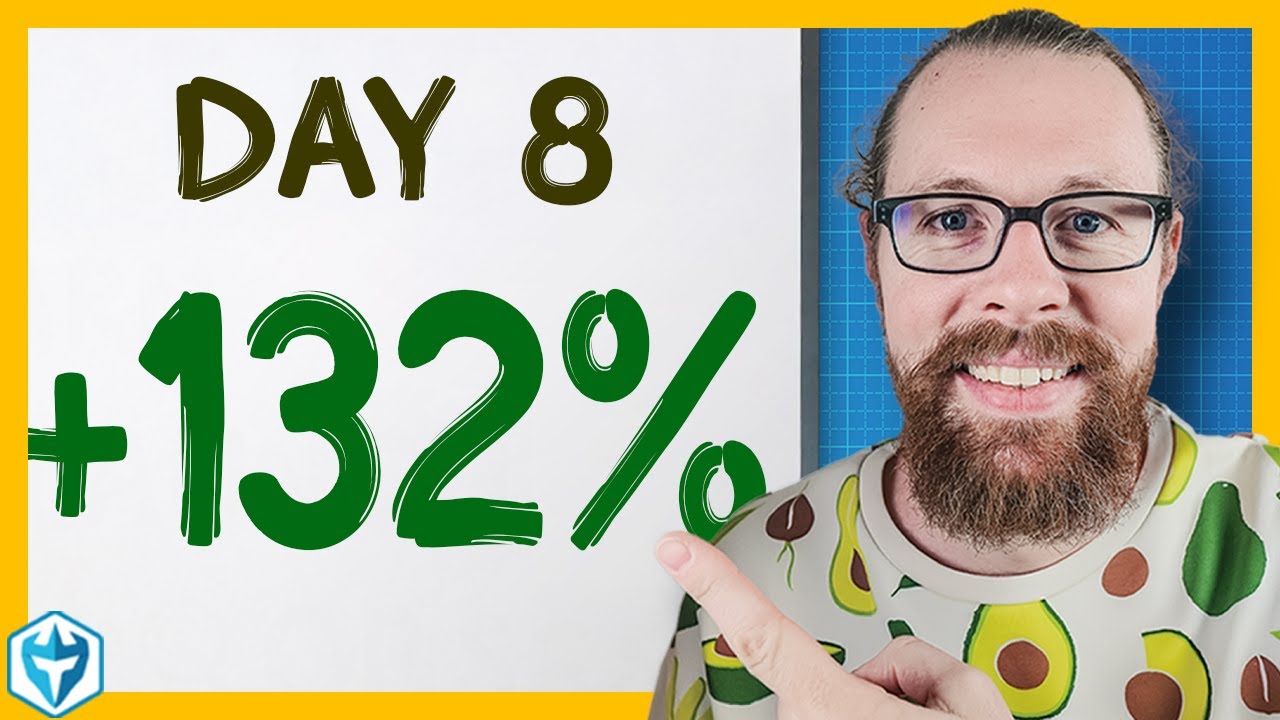
So, that is where we sit as of right now. Big picture, small account challenge is growing. Began with $1,940. Currently have total profit of 2500. Account is at about 4,500 balance. It's up 132% on 22 trades with 82% accuracy. This is solid growth trading the small account growth strategy. As always, I will put a link where you guys can download the PDF resources that accompany this strategy. They'll be pinned at the top comment and in the description.
So, make sure you guys check them out. If you want to watch my episode on trader rehab, I'll put a link to that here. And I'll also put a link to my full master class on the small account growth strategy. So, make sure you guys check those out and I'll see you guys back here for the next episode real soon.
The words are the caption track's own and nothing is reworded or re-transcribed. Paragraph breaks are placed between sentences so the text reads as prose.
Free tools for your own script: paste a draft and see where it stands before you record it.
Paste your draft and see where viewers are likely to drop off, with a rewrite for each weak line.
Paste the first 30 seconds of your own draft for a hook score and rewrites.
Check your draft against YouTube's advertiser-friendly guidelines before you record it.
Read this channel's public videos and transcripts, and download a writing brief for it.