Getting the transcript
Reading the captions from YouTube. A video nobody has opened here before takes 10 to 30 seconds; this page fills in on its own.
Getting the transcript
Reading the captions from YouTube. A video nobody has opened here before takes 10 to 30 seconds; this page fills in on its own.
History Helms · @HistoryHelms
This video has no Most replayed graph yet: YouTube shows one only once a video has enough views. These are the moments viewers replayed most in History Helms's most watched videos.
Most replayed moment at 3:13
2.9x that video's typical replay level
there were more rejected changes than accepted ones. I'll show you a few. I think you'll really like this. He wanted to change tongue to tong. Believe to believe. Machine to machine. Soup to soup.
Said at 3:07
Most replayed moment at 5:27
7.1x that video's typical replay level
forcing schools to spend thousands redesigning everything, a brilliant legal loophole emerged. Many major universities entered into gentlemen's agreements, perhaps gentlemen's loopholes, right, with [music] high schools. For example, some colleges allow high schools to use their trademarked logo
Said at 5:20
Most replayed moment at 6:48
9.6x that video's typical replay level
not some monolith. See, the Seminole Tribe of Florida is different from the Seminole Nation of Oklahoma. And if you've seen some of my previous videos on Native Peoples, you know this [music] has not been the only intertribal conflict. Far from it, actually. Now, because of the Indian Removal Act
Said at 6:40
The graph counts replays. It does not show where viewers stopped watching.
Words
1,965
Runtime
10:30
Speaking pace
187wpm
Reading time
8min
187 words per minute, between the 181 median and the 201 75th percentile of 349 measured videos. That distribution comes from the 349-video hook study.
Opening (first 30 seconds)
At most American college football games, halftime is when you leave your seat to go pee and buy a $9 Chick-fil-A sandwich. But, at an HBCU game, the halftime show is often the main event. What makes them unique, and why are they like this? In simple terms, the bands are like this 100% by design, breaking away from the military style marches and introducing high knees, contemporary music choices, and drum major acrobatics. And it all traces back to one man's controversial decision. You'll see what I mean. But first, let's look at
94 words, the words spoken in the first 30 seconds at 187 words per minute.
Free, no signup. See how the first 30 seconds hold attention, with rewrites.
Sentence shape
| Measure | This transcript |
|---|---|
| Sentences | 109 |
| Average words per sentence | 18.0 |
| Longest sentence | 64 words |
| Questions asked | 14 |
| Sentences containing a number | 13 |
Most used terms
Filler phrases
26 in total: like 15 · right? 4 · I mean 2 · actually 2 · literally 1 · uh 1 · you know 1.
A literal whole-word count of the same phrase list the Prepublish browser extension uses, so a phrase inside another word is not counted and a phrase used in its ordinary sense still is. It is a count and not a judgement.
What this transcript is
Every word below is the caption track YouTube publishes for this video, pulled from the video itself and reproduced unchanged. It is not Prepublish's writing, not a summary, and not a re-transcription: it is the video's own published captions. English captions, generated automatically by YouTube, in the video’s original language. Source: the video on YouTube. A channel that would rather this page did not exist can ask for its removal through the contact page, and it is removed.
At most American college football games, halftime is when you leave your seat to go pee and buy a $9 Chick-fil-A sandwich. But, at an HBCU game, the halftime show is often the main event. What makes them unique, and why are they like this? In simple terms, the bands are like this 100% by design, breaking away from the military style marches and introducing high knees, contemporary music choices, and drum major acrobatics.
And it all traces back to one man's controversial decision. You'll see what I mean. But first, let's look at what this actually is. At halftime, tens of thousands of fans lock into their seats for something closer to a theatrical production than a regular military style marching band show. Each band gets roughly 6 to 8 minutes to command the field, and you'll know the bands have moved down to the field to get ready because the persistent presence of the stand tunes have ended abruptly.
The entry alone sets the tone. They take the field high-stepping with a certain brand of pride, this level of performative arrogance, right? Then the band is announced, and a moment later, a wall of sound consumes you and every other spectator. Unlike most American marching bands, you're likely to hear blends of gospel, contemporary pop, R&B, and even hip-hop, which is already hard enough to produce using wind instruments, but on top of that, it is done while in motion.
You have no idea how much you vibrate when you walk until you try to play a wind instrument while marching. The band kids will know this. Pause. Stop the tape. You see my man right here? Now, thankfully, it's not Eric, but I do want to point out the theme here. Every HBCU band does indeed have a smooth white brother within its ranks. I want you to keep an eye out for him in the rest of this video, okay? And the halftime show, even though it's a show, is still a very high-pressure event, both because bands want to put on a great show, obviously, but also because it is very much a competition between the bands.
And performing well or poorly will be much more heavily discussed after an HBCU football game than what you'd expect at the leaving of a PWI game. Halftime establishes who owns the field for the time being, but the competitive conflict extends well beyond the football game itself. You'll see what I mean in just a minute, but there's a reason we see annual Battle of the Bands events where people show up just to watch the bands.
I'd bet a good number of you are starving for college football and got to see and hear an HBCU band for the first time, and now you're here with questions. Let me know in the comments if that's you. We'll look at why HBCU show bands are the way they are in just a minute, but you should know for now that the stark contrast between this and this was 100% created intentionally. If the band is an army, the drum major is a five-star general mixed with an Olympic gymnast.
In traditional college bands, the drum major stands on a high-up object, usually like a ladder or podium, primarily serving as the band's visual metronome. If you've ever been to a college football stadium, you know that relying on sound alone is comically inconsistent. However, for an HBCU band, the drum major is a dog on the field, usually numbering around three or four with a clear lead. They remain on the field keeping tempo less with conducting and more with movement by way of baton or whistle with help from percussionists and the band's general heartbeat.
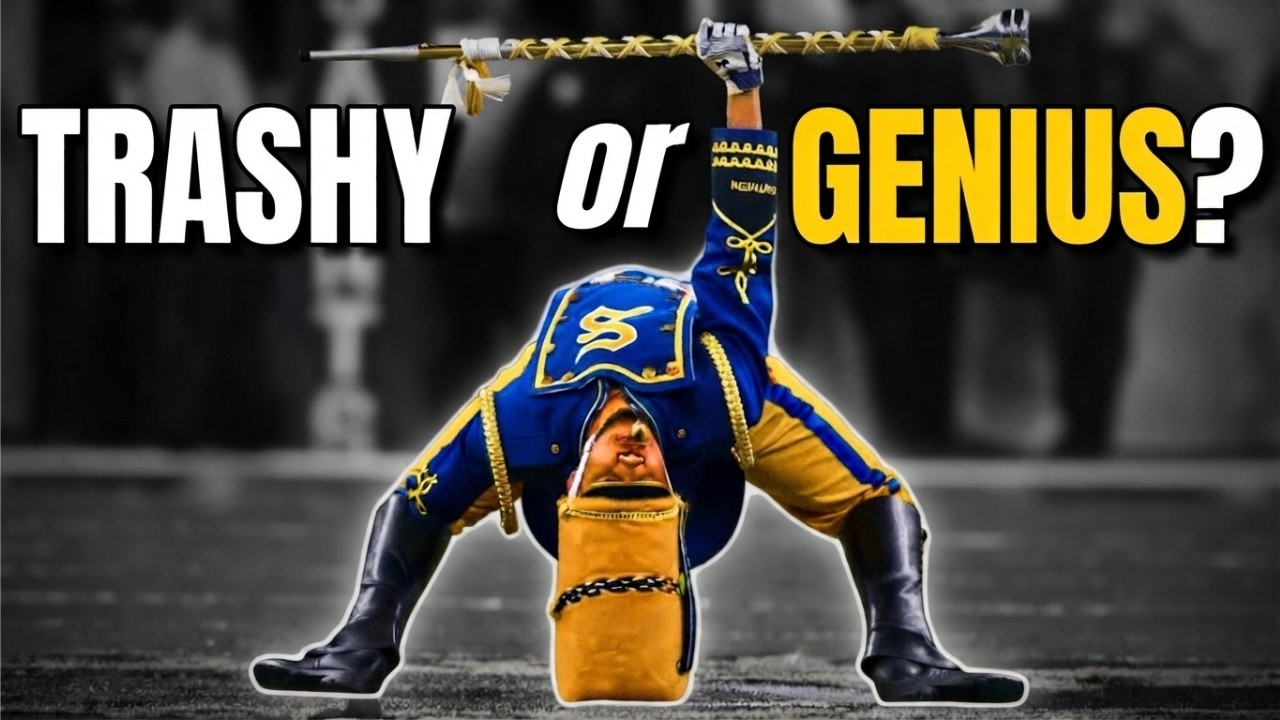
Leaving the drum major's role here though would be an insult. You should know these individuals are genuinely athletes. You'll see them sprint onto the field, leap into the air, land in a split, then get up like it never happened all while wielding a baton. Watch one of these shows and you'll see some things you never thought a halftime show would ever include, like the back bend. I even capitalize back bend in the script.
That's [music] how iconic this movement is. Yeah, you like that, don't you? Isn't that cool? In this display of elite core strength, flexibility, and balance, a lead drum [music] major will bend backwards at the waist until the plume of their shaker hat touches the grass, >> [music] >> and And have to hold it as the crowd goes wacky, goes crazy, right? And the pressure's really on here. Not only can a mistake from a drum major throw off hundreds of other members tempo-wise, [music] but dropping a baton or falling backwards during a backbend, especially in the age of camera phones and social media, is bad news.
By the way, drop me a like if you learned anything at all so far, and hype the video, it really helps. Thank you. Halftime is a party, but where you would usually expect most fans to dip halfway through the fourth to beat traffic, if the game is between two major HBCU programs, people will actually just stay to watch the fifth quarter. History Helms, what's the fifth quarter? I think you'll like this. The fifth quarter is an unscripted head-to-head stand battle.
No field routines, no pre-planned choreography, just powerful sound and endurance. Think of it like trash talk by way of music. Opposing bands stand in their respective bleachers, look across the stadium at each other, and alternate playing songs back and forth until one band gets completely blown out by the crowd's reaction or just gives up. We should note here that getting the last say, the last song that is, in this endeavor is valuable.
And now I said that this was a display of endurance, and I really meant that. It's a war of attrition. For example, for the people who are not band nerds like History Helms, one produces sound through a brass instrument by tightening the corners of the mouth and holding the lips in place while pushing air between them to make a distinct buzzing sound. This combination of vibrating air is how sound is produced on one of these.
Only problem is, after playing a full game and halftime show with volume being valued, which means more vibration, your lips and little mouth muscles, just like any other muscles, get tired of this workout, struggle to stay in the right position, and turn into what feels like jelly. So, by the fifth quarter, it's pretty much psychological warfare. Who will quit first, right? If band A plays a banger, a real flapper as the kids say, band B might immediately counter with a faster, louder, or more complex arrangement of the exact same track just to prove superiority.
And yes, rivalries do run deep between bands as you might expect. When the Southern University Human Jukebox meets the world-famed Tiger Marching Band of Grambling State or Jackson State Sonic Boom of the South meets the Florida A&M Marching 100, the bragging rights are indeed decided both on the field by football players, but also in the bleachers during the fifth quarter. And football games are not at all a requirement for these bands to perform.
At massive annual events like the Honda Battle of the Bands, these legendary programs take over stadiums usually reserved for college football or NFL teams, and people do show up just to watch the bands perform. From the drum majors to the percussion to the brass to the majorettes and the Honey Bees. Woo! Woo boy, if this is the highest retention moment of the video, you and I are going to have some words. And I do want to say as well, what a valuable, really neat, distinct thing we have here, right?
In an era of pop the balloon and team takeover, we still have sitting deep in black American culture this crown jewel, unapologetically unique, smooth choreography, superhumans in the form of drum majors, fat sousaphone tones filling in where eight-a-weights would be, trombones and baritones driving rich chord progressions, giving us that wall of sound feel, and trumpet sections living in the upper register. This distinct, bright, passionate sound that words just can't describe.
If you can't make it to a game to hear the way these bands truly conquer the sound, the atmosphere of a stadium, then you should 100% go down the rabbit hole on YouTube. This is a much deeper niche than you think. But let's answer the question. Where did all this come from? You might have guessed it was no accident. Nobody does this by accident. Instead, the structure and makeup of the HBCU band of performance was a cultural revolution.
Prior to the 1940s, almost all college marching bands followed strict military derived core style. rigid lines marching at moderate tempo to traditional marches with rather stiff postures and little to no expressive dancing. Then came Dr. William P. Foster, who took over the Florida A&M University band, the Marching 100, in 1946. Dr. Foster envisioned something entirely new. He asked, "What if a marching band moved with the energy of contemporary black culture?" After all, if churches, businesses, and even water fountains respected Jim Crow racial lines, we may as well lean into what's already been established and have our own style of performance.
He introduced high knee stepping, lifting the knees to a full 90° angle, faster tempos, high energy dance routines, and popular music arrangements. It was entirely different from the static formations of 1940s band performance, with the band moving dynamically across the field like a choreographed dance troupe. Naturally, there was criticism of the style as gimmicky, too flashy, or disrespectful to tradition by the general public.
But here's the thing, it's hard for anyone to make a valid critique of anything new or different if it's done well. And Dr. Foster was exceptional at this new style, demanding militant absolute physical and musical precision of the Marching 100. This new show style spread like wildfire across black colleges throughout the South, a new display or even triumph of cultural pride and excellence. You even saw, and still see today, predominantly black high schools using the exact same style as it's very much evolved and thrived into the 21st century.
If you think you've seen the easily distinguished HBCU band brand somewhere in the past, uh you probably have. It's everywhere. Over the last two decades, this culture broke out of its regional college band bubble to impact global entertainment. Before Nick Cannon was hosting Wild 'N Out and America's Got Talent or making freaky music with R. Kelly, he played Devon Miles in the hit film Drumline, introducing mainstream audiences to the intense discipline and rivalry of HBCU band culture.
HBCU bands have performed at presidential inaugurations, international parades, and Super Bowl halftime shows. In 2018, Beyoncé showed our topic in question to millions for the first time with her Beychella performance being entirely structured as homage to an HBCU homecoming show featuring a full live marching band and dance line. These performances are living archives of black history, a rich cultural celebration entirely unique in its style.
What's not unique though are some of the logos you saw throughout this video. Grambling State's G is literally the Green Bay Packers and Georgia Bulldogs logo with a color change. This copycat game is insanely common and a huge chunk of schools even share the same four or five animals as mascots. Is somebody stealing ideas? Why does every school have the same exact logo and same exact mascot?
The words are the caption track's own and nothing is reworded or re-transcribed. Paragraph breaks are placed between sentences so the text reads as prose.
Free tools for your own script. No signup, no login.
Paste your draft and see where viewers are likely to drop off, with a rewrite for each weak line.
Paste the first 30 seconds of your own draft for a hook score and rewrites.
Check your draft against YouTube's advertiser-friendly guidelines before you record it.
Read this channel's public videos and transcripts, and download a writing brief for it.