Getting the transcript
Reading the captions from YouTube. A video nobody has opened here before takes 10 to 30 seconds; this page fills in on its own.
Getting the transcript
Reading the captions from YouTube. A video nobody has opened here before takes 10 to 30 seconds; this page fills in on its own.
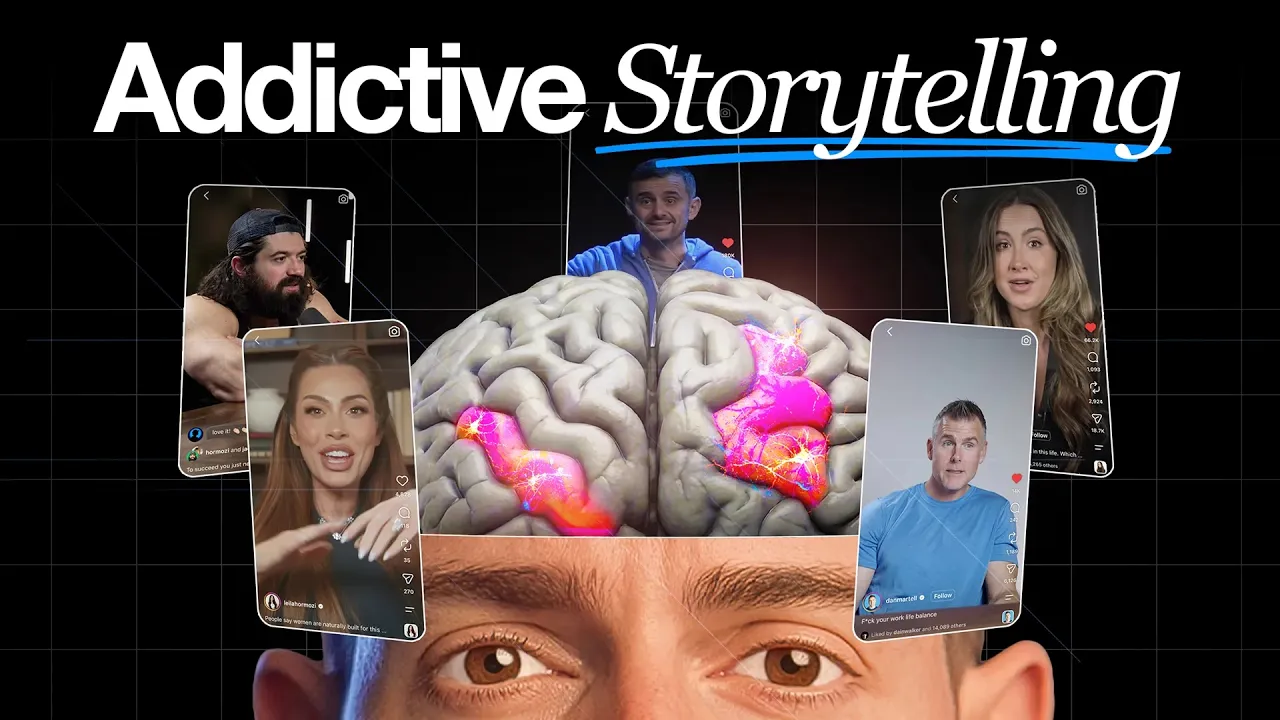
Kallaway · @kallawaymarketing
This video has no Most replayed graph yet: YouTube shows one only once a video has enough views. These are the moments viewers replayed most in Kallaway's most watched videos.
Most replayed moment at 12:50
4.7x that video's typical replay level
sure you're picking the right topics that actually work for your avatar group is to just study the videos that are already working in your niche. It shocks me how few people actually do this, but in sandcastles.ai, you can build a group of competitor channels that are already
Said at 12:43
Most replayed moment at 7:24
3.4x that video's typical replay level
one, you can use contrast, where you compare a known thing to an unknown thing. Or two, you can frame a super shocking or weird premise that they've never seen or heard before. Typically, unknown things pop curiosity better than anything else because curious people want to know what the thing is they've
Said at 7:17
Most replayed moment at 7:51
3.0x that video's typical replay level
each step as we go. And you'll feel the difference immediately. All right, here we go. This is the flat version. A prince's kingdom is in trouble, but he learns there's a valuable resource locked at the top of a tower that's being guarded by a dragon. He realizes he must go. So, he rides to the tower,
Said at 7:44
The graph counts replays. It does not show where viewers stopped watching.
Words
4,508
Runtime
20:36
Speaking pace
219wpm
Reading time
19min
219 words per minute, above the 201 75th percentile of 349 measured videos. That distribution comes from the 349-video hook study.
Opening (first 30 seconds)
Today we're talking about storytelling. If you want your videos to perform better and actually move the needle for your business, you need to learn how to tell better stories. So, in this video, I'm going to walk through my six favorite storytelling techniques specifically designed for conversion. Because there's a big difference between stories that entertain and stories that drive customers to make a purchase. So, this video will focus on how to master storytelling that drives leads and sales. After watching this, I guarantee you will think differently about the way you write scripts and make content. Well, if you don't know me, my name is Callaway. I
110 words, the words spoken in the first 30 seconds at 219 words per minute.
Free, no signup. See how the first 30 seconds hold attention, with rewrites.
Sentence shape
| Measure | This transcript |
|---|---|
| Sentences | 251 |
| Average words per sentence | 18.0 |
| Longest sentence | 61 words |
| Questions asked | 3 |
| Sentences containing a number | 13 |
Most used terms
Filler phrases
46 in total: like 22 · actually 10 · kind of 9 · you know 3 · basically 1 · literally 1.
A literal whole-word count of the same phrase list the Prepublish browser extension uses, so a phrase inside another word is not counted and a phrase used in its ordinary sense still is. It is a count and not a judgement.
Free, no account. See where attention is likely to drop, with a rewrite for each weak line. The free check shows the scores and the one issue costing the most. Or run it on the words above first.
Free · No login · See a sample audit first if you prefer.
What this transcript is
Every word below is the caption track YouTube publishes for this video, pulled from the video itself and reproduced unchanged. It is not Prepublish's writing, not a summary, and not a re-transcription: it is the video's own published captions. English captions, generated automatically by YouTube, in the video’s original language. Source: the video on YouTube. A channel that would rather this page did not exist can ask for its removal through the contact page, and it is removed.
Today we're talking about storytelling. If you want your videos to perform better and actually move the needle for your business, you need to learn how to tell better stories. So, in this video, I'm going to walk through my six favorite storytelling techniques specifically designed for conversion. Because there's a big difference between stories that entertain and stories that drive customers to make a purchase. So, this video will focus on how to master storytelling that drives leads and sales.
After watching this, I guarantee you will think differently about the way you write scripts and make content. Well, if you don't know me, my name is Callaway. I have 2 million followers. I've done billions of views, and content is all I do all day long. All right, the first tip for conversion storytelling is called avatar framing. And this is very critical. Most of the content world is geared towards broad virality. And that means their stories are very sensationalist, aimed at an extremely broad audience TAM, and delivered as compressed as possible.
That's max shock, max reach, and minimum length. And this works really well for getting tons of views. But if you're going for conversions, it's actually not what you want at all. Conversion storytelling works best under the following four conditions. Number one, you design your story around a core pain point or frustration that your ideal customer avatar has. Number two, you use words to signal a match in competency.
If your buyer is advanced, you use advanced terms that they would instantly understand. If your buyer is a beginner, you use only beginner terms. Number three, you embed specific and concrete proof that validates your approach. And number four, you lead the viewer down a path of curiosity to want more information off the video. Said in simpler words, it's pain point driven, aligned messaging, proof forward, and a path for more.
This is what I call avatar framing. You're intentionally framing the story for your specific customer avatar, so it feels like a bull's-eye fit for them. And so it filters out anyone who's not. Imagine a circle of 100 million accounts on Instagram or YouTube. Chances are if you're a business owner, there are probably only a couple hundred thousand to maybe a few million people within that circle that would be your customer avatar.
Maybe even less. So, it's a very small slice of the pie. Avatar framing allows you to capture as much of your slice as possible without spilling over into the other slices. And by approaching your stories in this way, you're able to make them extremely appealing for your specific customer. And that's what drives way more conversion. Now, let me give you a tactical example of how I apply this avatar framing. For me on my channels, my ICP your customer avatar is a business owner who's looking to scale their content to grow their business faster.
They want to get better at content and they want their business to grow more. Let's say I was writing a script for a video about social media growth to try to get [music] that specific ICP targeted so that they convert and buy one of my paid programs. The first thing I would do is try to understand what key pain points or frustration do business owners have in the topic of social media growth that most other people would not.
And in this case, it might be things like they don't have a lot of time to make content each week. They don't know what the right mix of their content strategy should be to drive more conversion. They don't know who to hire or how to run their content team. They don't know which types of other businesses on social media they should model their channel after. Or even, they have intuition that going viral's not the right play for them, but they don't know why or what else they should do.
Things like that are particularly painful or frustrating for a business owner that don't really apply to a solo creator on their own. That means if I'm trying to go for conversion, I'm going to pick one of those angles and hammer it in the first couple sentences. So, I might say something like this in the hook to start a video off. The fastest way to grow your business on social media is not by going viral. Instead, you want to run the 3-2-1 conversion strategy.
This is what I used to go from zero to 100K on my own channel while also driving $100,000 in profit in the first 3 months. So, you get both a ton of conversion without sacrificing the growth. Here's how it works. So, right there I did a few different things to hack your psychology if you're a business owner buyer I'm trying to attract. Number one, I specifically call out business owners by saying grow your business on social media.
So, if you're a business owner that attracts you and if you're not, you scroll away. Number two, I then set up a contrarian take going against what you typically believe that you need to go viral and instead offered an alternative, the 321 conversion strategy. I then gave concrete proof of results that I've had using the alternative strategy to get what you want. I also tried to use mid-level business terms that a business owner would immediately understand but someone who's not may not.
Things like conversion, conversion strategy, profit, or sacrifice growth. And then finally, I tried my best to make it fairly compelling to want to go down the rabbit hole and hear more. The reason this works so well at attracting convertible viewers is because it feels like I'm saying the thing that has been rattling around frustrating them in their head for weeks. And when they hear it, it's almost like they're subconsciously nodding along as they watch.
Now, the places this goes wrong if you're trying to execute this avatar framing are the following. Number one, you're not specific enough in the pain point framing such that it really locks on to a pain they're worried about. Number two, you don't have proof validating your alternative method works or the proof you do have kind of misaligns with your claim. Number three, you don't actually sound like you know what you're talking about.
You're not using the right words or phrases in the right way. And number four, plainly, you don't create enough curiosity to make them want to keep watching. Those are some of the common pitfalls where people try to execute this strategy but fall short. So, that is avatar framing and it's one of the most important storytelling exercises you can use if you're trying to make content that drives more conversion. All right, tip number two is called the broad to narrow framework.
If there was one thing that you could take away from this video and try to apply right now, it would be this. People buy from you when they have an extremely clear understanding of exactly what you're saying. And one of the big reasons why people like my content so much is that I try to make it extremely clear what action they should take next after they watch the video. And I spend almost all of my time in the writing process on this.
I call it clarity purification. I am just constantly rewriting and rewriting and rewriting trying to purify it so that there's 100% clarity on exactly what I'm saying. And that's because when I'm clear, you're clear, and when you're clear, you trust me more, and that's what leads to conversion. Now, one of the secrets to that clarity is the broad to narrow framework. And you can use this when you structure your short-form videos, different segments in YouTube videos, stories, carousels, emails, any kind of content.
Here's how it works. The brain consumes information top down, like a funnel or an upside-down pyramid. It's widest first and then narrowest last. First, at the widest, people need to understand context about what you're talking about. Then, they need to understand the stakes for why it matters for them. Then, they want to hear a strategy, high-level, for how to approach this thing. Then, they want to get into the tactics, the specifics for how to execute that strategy.
Then, they want examples showing how those tactics work, and then finally, they want summarized principles breaking down the core elements from that stack. Context is the broadest, and then you work down as you get narrow: stakes, strategy, tactics, examples, principles. This is the order for how you want to structure your information so that you can maximize clarity and people can follow along. If you start by introducing a point halfway down the information funnel, you just like open with a strategy, people can't follow and they won't buy in because they don't have the context and they don't have the stakes, the reason why they should care.
Typically, when people are bad storytellers, they skip the context and stakes or they start there, but they never go back to examples to actually codify what the tactics mean. And either of those mistakes leaves the viewer unclear, confused, and they won't buy. For example, if you just rewind to the start of this section, I will demonstrate live how I explain things in the broad to narrow framework. First, I started with context.
[music] All right, tip number two is called the broad to narrow framework. And if there was one thing that you could take away from this video and try to apply right now, it would be this. People buy from you when they have have extremely clear understanding of exactly what you're saying. And this was just to orient you on the idea of broad to narrow and really talking about why clarity is so important. Then I added stakes to really crystallize why you should care about clarity in the context of getting more sales.
And that's because when I'm clear, you're clear, and when you're clear, you trust me more, and that's what leads to conversion. And this acts kind of like a re-hook to refocus your attention. If you heard me say broad to narrow and you're like, "Ah, clarity doesn't matter." Now this stakes piece snaps you back on because you want conversion and so you're locked back in. Next, I set up the strategy for how I actually solve this clarity problem, which is explaining how the broad to narrow framework works.
Now, one of the secrets to that clarity is the broad to narrow framework. And you can use this when you structure short-form videos, different segments in YouTube videos, stories, carousels, emails, any kind of content. Next, I shared the tactics for how broad to narrow is executed in the first place, where I went through every single level and kind of broke it down. The brain consumes information top-down, like a funnel or an upside-down pyramid.
It's widest first and then narrowest last. To crystallize those tactics and to really make the strategy come to life, I gave you two quick examples. First, what not to do, starting halfway through, and then literally this example now that we're going through is the example. Typically, when people are bad storytellers, they skip the context and stakes or they start there, but they never go back to examples to actually codify what the tactics mean.
The only thing left to do is go through the summarized principles at the end, so it really sticks into your head. So, here we go. If you really want to increase clarity information stickiness so people buy, you [music] want to explain your points broad to narrow. First, you start with context, then you go stakes, strategy, tactics, examples, and principles in that order. And the reason you want to do this is because by increasing clarity, you increase comprehension, which increases trust, which drives more sales.
All right, now that was a little magic trick to show you the Jedi mind tricks of storytelling and psychology when you know how to use it well. If you're a business owner and and to learn more about how I approach content to grow faster and using all these principles, I've got two things for you. The first is my breakdown of my entire content system. It covers ideas, hooks, storytelling, all the way to monetization. It's completely free.
You can get that shortformsytem.co. It's one of the best things I think we've ever made. And then two, if you run a business or you're building your personal brand and you want to use my content brain to help you scale faster, I've got a link below where you can work with me one-on-one. All right, the third storytelling tip to help optimize for conversion is called the double aha. And if I did my job right, you should have already experienced the double aha before we got to this point.
An aha moment in content is that lightbulb feeling for a viewer when they heard something that crosses their value threshold. Typically, this is when you say something they hadn't thought of before, but when they hear it, they can immediately see how it would help them. Now, one aha in content might earn you a save, a share, or a like, but two ahas in the same video will accrue 10x trust, for sure get you a follow, and usually leads to conversion.
Now, here's why this happens. Potential buyers watch content looking for new things that can help them solve their problems. Delivering one non-obvious insight is good, but delivering two proves that you're a goldmine of information, and that's a pattern in their brain. When the second aha hits, they will immediately follow and subscribe because they're afraid if they don't, they'll miss the next treasure chest of gold that you're going to deliver.
Your goal, if you're trying to enable storytelling for conversion, is to embed two aha moments as early as you can in the video. And right after that second aha hits, that's where you want to put an aligned CTA because this is the point of maximum leverage in the story where, based on the law of reciprocity, they feel like they owe you the most. So, double aha straight into aligned CTA, and that's how you can maximize conversion.
For example, in this video so far, I was pretty sure I was going to get at least one aha somewhere in the avatar framing section, and then I thought the second aha would come from this broad to narrow piece. And just a hedge, in case the actual concept wasn't good enough, that kind of magic trick where I went back and showed you it, I figured that would be a good hedge to get the second aha. And then I CTA'd you right after that.
Now, if you're at this point in the video and you're still watching, you can probably tell I know a lot about storytelling that you haven't heard before. And if storytelling is a problem for you, especially if you're a business owner, then you probably trust me a lot already. This is mostly because I created that double aha in the first 8 to 10 minutes. I'm telling you this stuff is black magic, but it really does work once you learn how to harness the power of psychology and know how to influence trust.
Again, if you want to work with me and have me point my storytelling brain on your content so you can scale, I've got links below. All right, tip number four to improve the conversion in your storytelling is called the emotional transformation response. Now, let's break this down. Passive viewers listen to stories because they're interesting and compelling. But buyers listen to stories because they have a target pain point or problem that they want to solve.
So, if you want to turn a passive viewer into a buyer, you need to use your stories to trigger an emotional transformation response. This is essentially activating their desire to want whatever transformation that you sell. It's pretty obvious. Now, transformations are not exclusive to coaching and info. Every product secretly offers a transformation. SamCast, which is my AI software, offers a transformation to go from no content system to content system.
AG1, Athletic Greens, offers a transformation of no healthy body or unhealthy to a healthy body. Clothing brands promise to turn your fashion or style sense from bad to good. All products are subconsciously offering some shift or change from A to B. And so, what you want to do is create the emotional transformation response from your story so that people want that A to B change. Now, the way you trigger this response in your storytelling is to frame the before and after state.
And the easiest way to do this is with this scriptwriting framework. It's five steps. First, you start by aggravating the base pain point. And this is pretty clear, you just state it up front and try to tie it to the emotion that person is probably feeling. Usually it's negative, fear, frustration, sadness, uncertainty, confusion. Second, you want to frame how you have failed to solve that pain point in the past with traditional methods.
And typically, the traditional method is the conventional way that they're stuck doing things. Now, third, you want to tease some newfound mechanism or solution that you've got to solve the problem. And a bonus tip is to name that mechanism with a name they haven't heard before. Now, fourth, you want to show the real results that you got from using that mechanism. And ideally, those results are exactly what they want.
Fifth and last, give them an offer ramp CTA. If they want to learn more about how to use that mechanism to get the similar results. So, all together, it looks something like this. As a business owner, it's incredibly hard to make content that gets both high views and high sales. I spent months learning how to go viral. And even though I got 25 million views, it didn't translate into meaningful sales. But 2 weeks ago, I finally discovered a new video format that actually worked.
After just two attempts with it, I drove $55,000 in profit off just 14,000 views. It's called the Conversion Method. completely changed how I approach making content. Comment method and I'll send you a full guide breaking down exactly how the process works and why it's so great at driving sales. That framework works super well in all types of stories. Short-form YouTube, carousel, stories, whatever you need, it will work.
All right, tip number five is a little different from the four we've already covered. This is a super helpful framework to help you understand what storytelling psychology influences you. Because throughout our day, we're all being subconsciously influenced through various pieces of content. The fastest way to understand how you should tweak your storytelling is to use this double zoom out method to understand how other storytelling is influencing you.
You should run this on every piece of content you consume. First, as you're watching a piece of content, you want to zoom out a little bit as if you're standing over your own shoulder and ask yourself this. Is this piece of content making me trust this person more such that I want to consider buying whatever it is they're selling. If yes, zoom out again basically to a god's eye view and ask this. What specifically did they say, show, or do that made me start to trust them and want to learn more?
It sounds counterintuitive, but just by doing this, the double zoom out, it will reveal the exact messaging, words, actions, and visuals on the screen that best influence you into trusting them. And then you can mimic that in your own content. Now, not every piece of content is going to make you trust the creator, but when you start noticing this is happening, pause, retrace your steps, zoom out, and ask, "How did I get here?" If they get you to trust them, typically they did one of several things.
They either showed you an example that deeply connected with one of your struggles that you're currently facing. They described an emotional state that you are in or were recently in. Or they articulated their own transformation of pain, their failed attempt at solving it, and then their new novel solution. And I'm telling you, once you understand what they used on you, it's so much easier to flip around and use that in your own stuff.
Here's why this is so helpful. Humans have trouble introspecting on their own work. We can easily see mistakes in others, but we really struggle to look inward and find the mistakes in our own stuff. The double zoom out allows you to catch yourself being persuaded in real time so that you don't have to sit and try to guess what happened. Now, here's an example of this happening to me recently so I can articulate my own experience to show you how this works.
Recently, I was watching a few videos from this guy Jeremy Haynes. He specifically makes content for business owners that are kind of doing a couple hundred K a month trying to grow to a million a month. And this is exactly where I'm at in my entrepreneurial journey, and that's the goal I have is try to get to a million a month. So, I was watching one of his videos and I noticed myself begin to fall down the trust rabbit hole.
So, I double zoomed out and I said, "What is he doing here that's making me trust him and want to potentially buy his products?" And in this case, there were four things that he was doing. Number one, he consistently uses terms that I know, but are not at a beginner level. So, it signaled to me that he serves advanced people like me. Number two, he consistently reiterates the exact target I have, million-dollar months, over and over and over and over, almost like drilling it into your head that that's all he does.
Number three, he dissected several other businesses kind of similar to mine in a way that made me reflect on patterns or roadblocks that I have in my own business. And number four was the consistency of the quality of those first three things over and over and over and over in many videos. Bonus number five, he's also kind of a funny guy and so that just like adds an extra icing layer as well. So as I was sitting there feeling myself be influenced like a magnet was pulling me in, that double zoom allowed me to realize, "Oh, I should just do those things in my content." Now this double zoom exercise is probably the most non-obvious and effective thing you could take from this entire video.
It's a little psychology level, it's not as tactical, but I find it to be extremely helpful. And the reason is because most people are not good at noticing psychology patterns. So this gives you a new perspective to uncover what's working on you. All right, the last tip, number six, is around buyer psychology. If you want to drive more conversion from your storytelling, it's super helpful to understand why people actually buy from certain stories.
So let me break down how I think about this. At the most basic level, people buy because they're willing to risk dollars today in the hopes of returning a multiple on that investment in the future. That's really it. So the job of your story is to derisk that buying decision for them. So it feels like an automatic no-brainer yes that they will get a return. Typically, this is done through three things: client proof, your own proof, or demonstration of aptitude or ability in the content.
For example, in this video, I've tried my best to demonstrate an advanced or mastery level of storytelling and psychology such that you have no doubt that if you paid me and I applied my full force of will on your content, I could help you grow faster. And the way I was able to do that is through a series of very non-obvious, novel, but clearly explained frameworks to show that I have a deeper bag than other people. Now after you watch this video, you can take what I said, implement some of it on your own, and if you see conversions go up, you will immediately come back and want to buy to get more of that.
And this is the content cycle that drives authority, trust, and conversion. Now, the thing that's even stronger than the demonstration of ability and aptitude is the client proof and my own proof from using these methods and actually having the raw data and testimonials. And I left that out on purpose so I can make this point hit harder, but ideally, I would have also included my own proof, the 2 million followers, the billions of views, the three seven-figure businesses, and the client testimonials, the dozens and dozens of business owners that I've helped grow from zero to millions and actually grow their business.
The truth is, information and demonstration can only get you so far on the de-risking spectrum. If you're selling high-ticket offers, you're probably going to need to infuse the proof, whether from clients or yourself. And so, if you know that's how buyer psychology works, you want to try to infuse as much of those three things as you can, given the constraints of the length of the content. All right, guys, that is all I've got on this video.
As always, I'm trying to just push the boundaries for what's available and free on YouTube when it comes to content growth. If you're a business owner, you could probably tell this is going to be one of the best channels you could possibly watch if you're trying to use content to grow your business. That's all I do, that's all I specialize in. If you want to work with me one-on-one, you want me to allocate my content brain towards your content problem to help you grow your business, I've got links below for that.
I also have a bunch of free stuff below, tools, lead magnets, all types of stuff. I'm really trying to help you grow faster. So, make sure to check everything out in the description. All right, we'll see you guys on the next video. Peace.
The words are the caption track's own and nothing is reworded or re-transcribed. Paragraph breaks are placed between sentences so the text reads as prose.
Free tools for your own script: paste a draft and see where it stands before you record it.
Paste your draft and see where viewers are likely to drop off, with a rewrite for each weak line.
Paste the first 30 seconds of your own draft for a hook score and rewrites.
Check your draft against YouTube's advertiser-friendly guidelines before you record it.
Read this channel's public videos and transcripts, and download a writing brief for it.