Getting the transcript
Reading the captions from YouTube. A video nobody has opened here before takes 10 to 30 seconds; this page fills in on its own.
Getting the transcript
Reading the captions from YouTube. A video nobody has opened here before takes 10 to 30 seconds; this page fills in on its own.
Ambition Arc · @TheAmbition-Arc
Words
2,224
Runtime
14:39
Speaking pace
152wpm
Reading time
9min
152 words per minute, below the 160 25th percentile of 349 measured videos. That distribution comes from the 349-video hook study.
Opening (first 30 seconds)
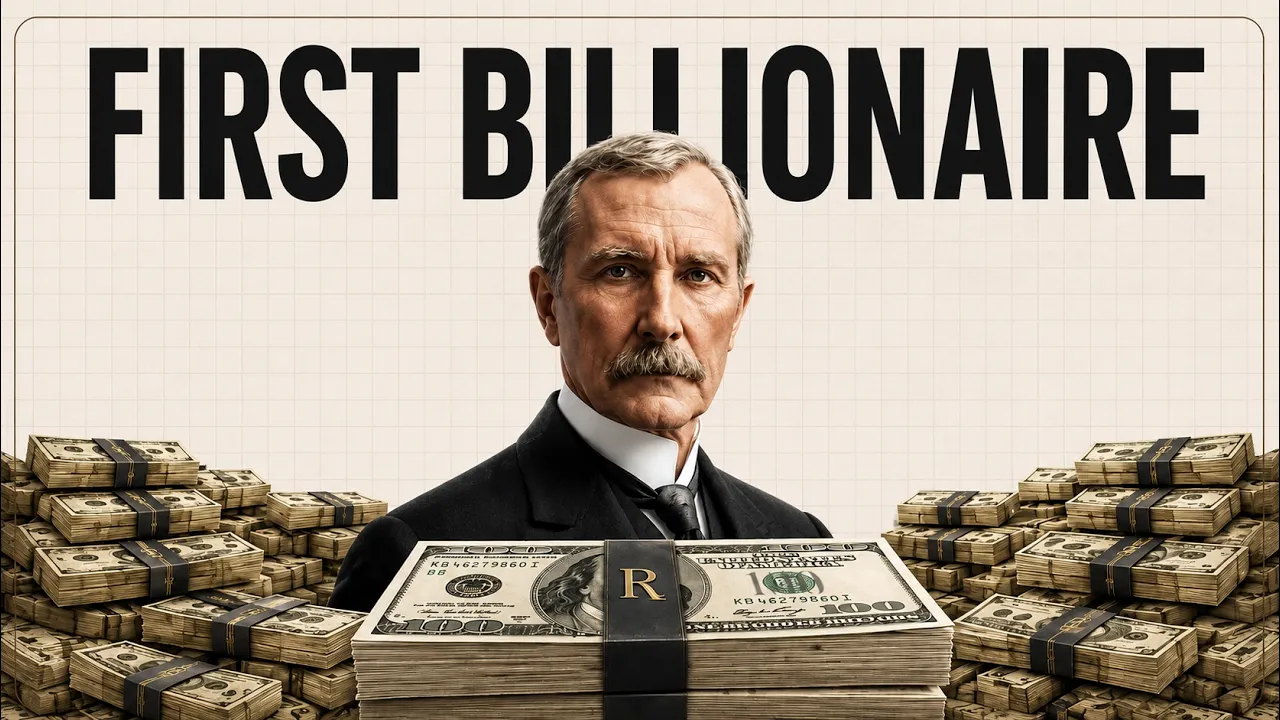
At his peak, John D. Rockefeller controlled more wealth than the United States government. Not comparable to more than. He didn't inherit it. He didn't stumble into it. He engineered it one cold, calculated decision at a time until he had his hands around the throat of an entire industry and refused to let go. But the part that makes this story genuinely disturbing, he started with nothing. Worse than nothing, he started hungry, humiliated, and
76 words, the words spoken in the first 30 seconds at 152 words per minute.
Free, no signup. See how the first 30 seconds hold attention, with rewrites.
Sentence shape
| Measure | This transcript |
|---|---|
| Sentences | 204 |
| Average words per sentence | 10.9 |
| Longest sentence | 35 words |
| Questions asked | 4 |
| Sentences containing a number | 32 |
Most used terms
Filler phrases
2 in total: like 2.
A literal whole-word count of the same phrase list the Prepublish browser extension uses, so a phrase inside another word is not counted and a phrase used in its ordinary sense still is. It is a count and not a judgement.
Free, no account. See where attention is likely to drop, with a rewrite for each weak line. The free check shows the scores and the one issue costing the most. Or run it on the words above first.
Free · No login · See a sample audit first if you prefer.
What this transcript is
Every word below is the caption track YouTube publishes for this video, pulled from the video itself and reproduced unchanged. It is not Prepublish's writing, not a summary, and not a re-transcription: it is the video's own published captions. English captions, generated automatically by YouTube, in the video’s original language. Source: the video on YouTube. A channel that would rather this page did not exist can ask for its removal through the contact page, and it is removed.
No Script X-ray for this video: YouTube shows a Most replayed graph only once a video has enough views.
At his peak, John D. Rockefeller controlled more wealth than the United States government. Not comparable to more than. He didn't inherit it. He didn't stumble into it. He engineered it one cold, calculated decision at a time until he had his hands around the throat of an entire industry and refused to let go. But the part that makes this story genuinely disturbing, he started with nothing. Worse than nothing, he started hungry, humiliated, and invisible with a con artist for a father and a family that depended on him before he was old enough to shave.
And every single morning before he faced the world, he stood in front of a mirror and said the same words to himself. Words that would drive him to the absolute peak of human wealth and nearly tear the country apart getting there. John D. Rockefeller was born in 1839 into a house that was always cold and never quite full. His mother stretched every meal. She patched the same clothes until they couldn't hold another stitch.
She prayed and she worked and she did not complain. His father did none of those things. William Rockefeller, known around town as Devil Bill, was a traveling con man. He moved from village to village under a fake name, selling bottled remedies to sick and desperate people. snake oil, colored water, sold with a smile and a handshake, and gone before anyone realized it didn't work. Then, weeks or months later, he'd reappear at the family home, coat pressed, carriage gleaming, arms piled high with gifts, like a man returning from a long business trip rather than a fraud circuit.
Jon watched this as a child. The gifts, the disappearances, the hunger in between, and it told him something no school ever could. The world is divided into people who take and people who get taken from. John had already decided which one he would be. From the age of seven, he worked the farm before school. He raised turkeys, tracked down the wild ones in the woods, stole their eggs, hatched the chicks himself, sold them at market, and immediately reinvested every penny to do it again.
By the time he was 10, he was already keeping a personal ledger. Every scent in, every scent out. Nothing left unaccounted for. When John was 10, his father was accused of sexually assaulting a young woman in the town. Nothing was proven, but the shame was enough. The family packed everything they owned and left in the middle of the night. They did it again 2 years later and again after that. Each time, Devil Bill was less present.
Each time, Jon was more of the man of the house. By 16, college was already out of reach. His mother had five children and almost no income. John was the only one who could do anything about it. So 2 months before graduation, he dropped out, walked into Cleveland, and started knocking on doors. He knocked for 6 weeks. Every bank, every merchant, every firm that would take a meeting, and every single one of them laughed when they heard he was 16.
Six weeks of rejection, no income, a family depending on him, the humiliation of being turned away again and again by men who didn't even look up from their desks. Then a small accounting firm needed a bookkeeper. They glanced at his penmanship, precise, controlled, almost mechanical, and told him to start immediately. They didn't even mention what they'd pay him. Jon didn't ask. At the end of that first year, they handed him his wages, $50, barely 50 cents a day.
But here is what John did that night. He went home. He opened his ledger. He wrote down the number and he closed it. Then he stood in front of the mirror. I am bound to be rich. Not hoping, not wishing, bound. And what John D. Rockefeller did next, nobody in Cleveland saw coming. Within two years, Jon knew more about the firm's finances than the founders did. He had watched the business slow during the recession. He had tracked the numbers long before anyone else admitted what they meant, and he had made a decision quietly, without telling a single soul that his time here was finished.
At 18 years old, John walked out and started his own company. He partnered with a merchant named Maurice Clark, older, more experienced, better connected, and together they began trading grain, meat, fish, and dry goods across Cleveland. John was quiet in meetings, but devastating in a negotiation. He had a quality that unnerved people. He never seemed to need anything. He could sit in silence longer than anyone in the room and simply wait for the other side to fill it.
They grew. Clients came. Money followed. Then in 1859, something happened in Pennsylvania that changed everything. A man drilled a wooden derek into the ground and pulled up crude oil. Not a trickle, industrial quantities. Within months, an entirely new economy erupted around it. Men who had been nobody became wealthy overnight. The newspapers called it black gold, and the whole country went mad for it. John watched.
He didn't rush. He never rushed. A chemist named Samuel Andrews came to him with something remarkable. A process using sulfuric acid that could purify crude oil into kerosene, cleaner than anything on the market, brighter, longer burning, and only a handful of people in the world knew how to do it. John and Maurice loaned Andrews $4,000 to build a refinery, a side bet, nothing serious. Within a year, it was making more money than their entire produce business combined.
John looked at those numbers for a long time. Then he told Maurice he wanted to go allin. Maurice said no. The oil market was too volatile, too unpredictable. Barrels that sold for $14 one month crashed to 10 cents the next. Entire boon towns formed around a single oil field and vanished when it ran dry. It was a gamblers market and Maurice was not a gambler. So John bought him out. $72,000. Everything he had, leveraged to the absolute edge.
Maurice shook his hand, took the money, and walked away convinced he was the smart one. He wasn't. John renamed the company Standard Oil. And what he built next was not a business. It was a machine designed to make competition impossible, and it was only just getting started. The oil market of the 1860s was organized chaos. And John used that chaos like a weapon. He understood something his competitors didn't. The product didn't matter as much as the cost of moving it.
Oil traveled by railroad, and railroads were desperate for business. The Pennsylvania Railroad had abandoned Cleveland. The Eerie and New York Central lines were bleeding customers. John walked in with a proposition. guaranteed massive consistent shipments in exchange for secret discounts his competitors would never know existed. The railroads agreed. His rivals paid the full rate. Jon paid a fraction. And then with his cost slashed below everyone else's, he started a price war.
He dropped his prices. Competitors matched him to survive, but their costs were too high. They bled money on every single barrel they sold. Jon didn't. he could hold those prices indefinitely. They couldn't. One by one, they went under. And every time one did, John was already at the door, ready to buy the wreckage for almost nothing. Systematic, methodical, and utterly without mercy. By the early 1870s, Standard Oil dominated Cleveland's refining industry.
John controlled more capacity than his next 10 competitors combined. But Cleveland was only the beginning. And the move John was about to make next, the most audacious of his entire career, was going to blow up in his face in a way he never saw coming. By 1872, the oil industry was threatening to destroy itself. Too many refiners, too much supply. Prices had collapsed. 90% of refiners in the country were losing money.
John feared that no matter how dominant Standard Oil became, a total collapse would take him down with everyone else. So he engineered something radical, a secret alliance, Standard Oil and all three major railroads under the deliberately boring name of the South Improvement Company. Secret rebates for Standard, detailed intelligence on every competitor's shipments, and most brutally, a cut of what rivals paid to ship their own oil.
Jon's enemies would be unknowingly funding him with every barrel they moved. It was not a business arrangement. It was a surveillance network disguised as a shipping contract. Then someone talked. Within weeks, the story was in the newspapers. The public erupted. Protesters ripped up railroad tracks. Oil miners boycotted standards refineries. Politicians who had taken J's money suddenly couldn't distance themselves fast enough.
The alliance collapsed in 2 months. Jon had lost publicly, humiliatingly. The whole country was watching and his great secret scheme had been torn apart before it ever ran properly. Most men would have retreated, regrouped, waited for the noise to die down. John did none of that. He had noticed something in the chaos. Even after the alliance fell apart, the fear of it hadn't gone anywhere. Refiners across Cleveland still whispered, "Did Standard still have a secret deal?
Could Jon see their books? Were they already losing a war they didn't even know they were in? John didn't confirm or deny a single word. He let the fear do the work. In 6 weeks, a period that would later be known as the Cleveland massacre, John acquired 22 of the 26 remaining oil refining companies in the city. Not through a secret deal, not through a court order, through fear alone. Some sold for a fraction of what their businesses were worth.
Most were simply relieved to have a way out. And the brightest minds, the engineers, the chemists, the operators, Jon absorbed directly into standard oil. The public thought he had been stopped. He had just shifted to a higher gear. They called it the octopus. Standard Oil's pipeline network spread across the entire eastern United States, pulling crude oil in, pushing refined kerosene out, touching every corner of the market.
By the late 1870s, Standard controlled 90% of all oil refining in America. In some regions, 100%. John was barely 40 years old, but the list of people who wanted to destroy him had become very long. ruined families, bankrupt rivals, politicians who had taken his money and now needed to pretend they hadn't. And one journalist, a woman named Ida Tarbell, whose father's refinery had been swallowed by Standard Oils tactics, whose father's business partner had taken his own life in the aftermath.
Tarbell spent years carefully dismantling every layer of Jon's secrecy. The railroad deals, the political bribes, the intimidation tactics, all of it published monthly in exhaustive detail for a nation that read every single word. John never responded publicly, not once. His silence was calculated, but it made the public angrier than any denial could have. President Theodore Roosevelt, who needed a villain the public already despised, chose Standard Oil as his target.
The federal government launched the largest antirust case in American history. 12,000 pages of evidence, 444 witnesses, charges of monopolization, predatory pricing, bribery, and corporate espionage. In 1911, the verdict came. Standard Oil was to be dissolved, broken into 34 separate companies. Ida Tarbell celebrated. Roosevelt declared victory. Every man Jon had ever crushed felt the satisfaction of watching his empire ordered to pieces.
They believed they had finally won. They were wrong. Here is what nobody expected. When Standard Oil's 34 successor companies were open to public trading, investors poured in. The combined market value of all 34 was nearly three times what Standard Oil had been worth before the dissolution. Three times. John owned shares in every single one of them. He became richer the day his empire was legally destroyed than on any single day he had ever run it.
By the end of 1911, John D. Rockefeller became the world's first billionaire. He spent the next three decades giving it away. Schools, universities, medical laboratories, the Rockefeller Foundation still operating today, over a century later. More than half a billion dollars from John personally. hundreds of millions more through his son and his foundation after him. He lived to 97. And here is the part that makes his story impossible to simply condemn or celebrate.
The same cold obsession that drove him to destroy competitors, manipulate governments, and terrorize an entire industry. That exact same force funded the laboratories that eliminated disease from the American South. built the research institutions that trained generations of doctors, saved hundreds of thousands of lives. Both things are completely true. Every decision he ever made, the ruthless ones and the generous ones, came from the exact same place, that voice in the mirror every morning for 80 years.
I am bound to be rich. What happens when a man holds that promise so tightly that nothing, not rivals, not governments, not the law itself can make him let go? You get the most powerful, most controversial, most complicated businessman who ever lives. You get John D. Rockefeller. Thank you for watching till this point. See you in the next video.
The words are the caption track's own and nothing is reworded or re-transcribed. Paragraph breaks are placed between sentences so the text reads as prose.
Free tools for your own script: paste a draft and see where it stands before you record it.
Paste your draft and see where viewers are likely to drop off, with a rewrite for each weak line.
Paste the first 30 seconds of your own draft for a hook score and rewrites.
Check your draft against YouTube's advertiser-friendly guidelines before you record it.
Read this channel's public videos and transcripts, and download a writing brief for it.