Getting the transcript
Reading the captions from YouTube. A video nobody has opened here before takes 10 to 30 seconds; this page fills in on its own.
Getting the transcript
Reading the captions from YouTube. A video nobody has opened here before takes 10 to 30 seconds; this page fills in on its own.
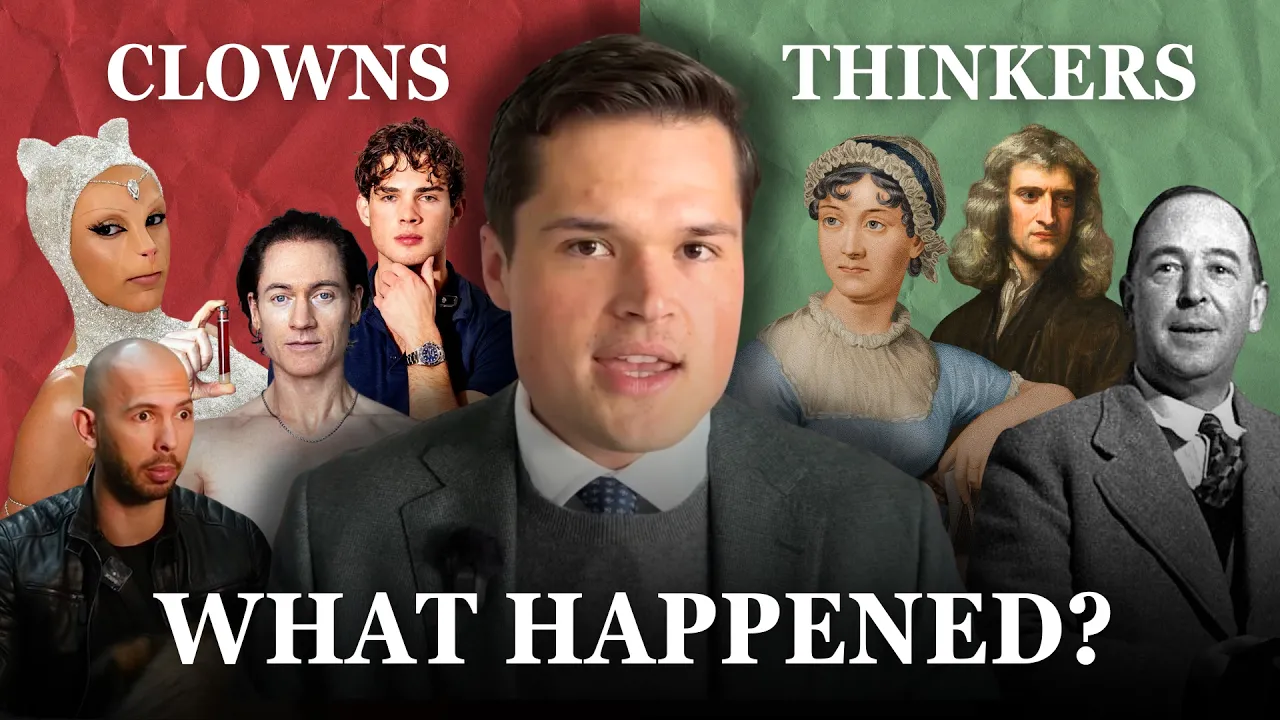
Five Minutes Late with Jesse Grant · @fiveminuteslatepod
Where viewers went back to watch this video again, from YouTube's public Most replayed graph, lined up with what was said at that moment.
Most replayed moment #1
5:1511.2x the video's typical replay level
watching this right now, proves that there is some sort of thread that you're unraveling, and that you will follow down the line. Which leads us to the second pillar of the intellectual life, which is that only a few books are
Said at 5:08
Most replayed moment #2
8:484.5x the video's typical replay level
leads us to the third pillar of the intellectual life outlined in this book, which is to simplify your life. Now, what this means is that you can't be across everything in the world. And that is one of the biggest mistakes that we
Said at 8:43
Most replayed moment #3
0:563.3x the video's typical replay level
someone who had such an abundance of information that they ended up becoming so intellectually lazy that they no longer had the capability to create any new ideas. He was starting to see that more and more art was just a critique of
Said at 0:49
The graph counts replays. It does not show where viewers stopped watching.
Words
2,692
Runtime
15:26
Speaking pace
174wpm
Reading time
11min
174 words per minute, between the 160 25th percentile and the 181 median of 349 measured videos. That distribution comes from the 349-video hook study.
Opening (first 30 seconds)
We live in one of the most informationally rich societies in history, yet we are also somehow one of the most intellectually poor societies in history. And it doesn't quite make sense because you would think that the more access and easier access to high-level information that you have, then the better the intellectual quality will be, the better ideas you will have, and the better output you will have as well. However, that doesn't seem to be the case. And this was actually predicted by Friedrich
87 words, the words spoken in the first 30 seconds at 174 words per minute.
Free, no signup. See how the first 30 seconds hold attention, with rewrites.
Sentence shape
| Measure | This transcript |
|---|---|
| Sentences | 121 |
| Average words per sentence | 22.2 |
| Longest sentence | 73 words |
| Questions asked | 1 |
| Sentences containing a number | 9 |
Most used terms
Filler phrases
15 in total: actually 7 · like 3 · sort of 2 · I mean 1 · kind of 1 · you know 1.
A literal whole-word count of the same phrase list the Prepublish browser extension uses, so a phrase inside another word is not counted and a phrase used in its ordinary sense still is. It is a count and not a judgement.
Free, no account. See where attention is likely to drop, with a rewrite for each weak line. The free check shows the scores and the one issue costing the most. Or run it on the words above first.
Free · No login · See a sample audit first if you prefer.
What this transcript is
Every word below is the caption track YouTube publishes for this video, pulled from the video itself and reproduced unchanged. It is not Prepublish's writing, not a summary, and not a re-transcription: it is the video's own published captions. English captions, generated automatically by YouTube, in the video’s original language. Source: the video on YouTube. A channel that would rather this page did not exist can ask for its removal through the contact page, and it is removed.
We live in one of the most informationally rich societies in history, yet we are also somehow one of the most intellectually poor societies in history. And it doesn't quite make sense because you would think that the more access and easier access to high-level information that you have, then the better the intellectual quality will be, the better ideas you will have, and the better output you will have as well. However, that doesn't seem to be the case.
And this was actually predicted by Friedrich Nietzsche himself as he was noticing that the more information we were having as a society, the lazier people were getting in their ability to think and craft new great ideas. He coined this term the last man theory. And what the last man was was someone who had such an abundance of information that they ended up becoming so intellectually lazy that they no longer had the capability to create any new ideas.
He was starting to see that more and more art was just a critique of art created previously and more and more philosophies were just a critique of philosophies that were created previously. And that you were having these philosophy students from university or art students from university who were growing up just critiquing other philosophies or other art and weren't producing any real original work, which is why in today's video I want to talk about possibly the greatest book ever written about the intellectual life, and that is this book here called The Intellectual Life written by I'm going to butcher this name here.
It's a French name. I don't speak French. I'm sorry. A. G. Sertillanges. And in this book he backs up Friedrich Nietzsche's original hypothesis, which was that the more information you have, the higher risk of your intellectual ability being stunted. But, he does outline in this book a way to regain the intellectual life and a way when applied to your own life for you to start coming up with better ideas, more unique ideas, and thinking more clearly.
And so, in this video, I'm going to break down the three main pillars of the intellectual life outlined in this book and then also provide some practical advice that I was able to take from this book and apply in my own life and saw a really big impact. But, with that said, let's get into the first element of the intellectual life, which is to actually find your key interest. Now, this is one of the biggest problems about having so much information and so many competing ideas and industries in your mind because of social media, it can be hard to find what you truly love, to find what you truly want to do because you're being pulled in so many different directions online.
But, what of this book in regards to how to find the one interest you want to specialize in is that if you tell me what you love, I will tell you what you are. As love is the beginning of everything in us and that starting point which is common to knowledge and practice cannot fail to make the right path. And what he's saying there is that in order to cultivate an intellectual life, you have to love it. You have to be interested in it.
And this is why school derails the path of the intellectual life so often because you're forced to study things that you're not interested in and then you're turned off by the intellectual life. You're turned off by academia. But, what he's saying here is to just follow whatever you love and what you're interested in as that is the right path for you. But, when you don't fully know what you love, when you're pulled in so many directions, how do you find what you love?
But, the key here is that you don't have to. Clearly, you're watching this video because the idea of an intellectual life has enticed you. You're enticed by that idea. Therefore, just keep following that thread. You don't have to land on the industry you want to specialize in, or the the topic, or philosophy, or art, whatever it is you're interested in. You don't have to find that straight away. You can just follow the thread of common knowledge.
If you found this video interesting, then maybe you'll be enticed to go out and buy this book. You'll read this book, and then maybe you'll be enticed to read a different book, or to follow a different path. And eventually, you'll stumble across something which you truly do love. Something that entices you so much that you have to go down that road and that path. But, don't rush yourself. If you just follow your love and follow the fun, you will start to cultivate the intellectual life without meaning to, without having to stress, without having to work too hard.
Because at the end of the day, knowledge is meant to be something that you're curious about. And so, if you're not curious about something, don't follow that thread. But, the fact that you clicked this video, the fact that you're watching this right now, proves that there is some sort of thread that you're unraveling, and that you will follow down the line. Which leads us to the second pillar of the intellectual life, which is that only a few books are necessary.
Once you've found what you want to specialize in, once you've found the thread you want to follow, don't be inundated with the hundreds, or thousands, or tens of thousands of books out there for you to read in regard to this industry. As Sertar Lange says that only three or four books are truly necessary when it comes to building the foundation of that interest. And what he's saying here is that if you are, let's say, getting into existential philosophy, in order to build the foundation and follow that path of existential philosophy, you don't need to read 25 different books.
You perhaps just need to read one book from Nietzsche, a book from Dostoevsky, then maybe read a Hemingway book, and then you round it out by something written by Saint Thomas Aquinas. And that those three or four books will lay a sort of intellectual foundation that you can then move forward with. And then all the other books and ideas and pieces of content around existential philosophy will just be more information that you can pull from and attach to this foundation that you're building.
Because the idea that you can sit there and just read every single word ever written about one specific topic is just impossible. But that's not necessary to live the intellectual life and to come up with unique insights in that specific field. What is necessary is that you build the proper foundation through following your curiosity, through following your love, and then you apply it in your life. You go out and you start crafting your own work.
You think about it and you start to apply it in a practical sense as well. Cuz you can't just sit down and read 24/7. That's not the intellectual life. It is a life. Therefore, it's a lifestyle. Therefore, it it requires action. It requires producing something. And you can't do that if you're trying to read everything ever written. But what he's saying here is that the greats of intellectual pursuits, the greats of academia, the greats of history, philosophy, art, science, they didn't do that.
They couldn't do that. They didn't have an iPhone that we have today. But what they did do was build the proper foundations on the proper classical texts and then went out and applied it. And any other book they read, any other piece of information they got, they just took what what they felt they were missing, or took what they felt was necessary and was good to add to this foundation that they had. And the best thing about a foundation is that you constantly return to it.
You don't read Beyond Good and Evil by Nietzsche once, you read it time and time again for the rest of your life because you will always, after applying some of those ideas, after after practically living, you will then be able to return as a different person with a different mindset, and find something else from that foundation, proving that only three or four books are truly necessary. And you don't want to be so overwhelmed by reading a lot and information that you never put it into action.
And most crucially, you never have the silence in your own mind to actually contemplate these ideas and have proper thoughts yourself. Which leads us to the third pillar of the intellectual life outlined in this book, which is to simplify your life. Now, what this means is that you can't be across everything in the world. And that is one of the biggest mistakes that we all make today, and we can't help because of social media, because of technology, we're pulled in so many different directions.
But if you want to live a truly significant life, if you want to live the intellectual life, if you want to have clear thoughts, ideas around a specific topic, you just can't do that. And so you need to be very much aware of what you're ignoring, of what you're leaving out of your life, just as much as what you're bringing in. It can be easy today to watch 25 YouTube videos in a single day, but that's too much. It's more important to choose what videos you don't watch.
Even if all those videos are educational, even if all those videos provide some kind of value, when you have too many of them, you're actually diminishing the effect that each of those videos could have. And so, what he's saying here is to simplify your daily routine. Don't read five books at once, read one book. Meaning that if you only read for 30 minutes, you have multiple hours throughout the day to content plate those 30 minutes.
And through those hours of contemplation, you will come up with deeper insights, clearer insights, and more profound insights from what you read than if you were trying to read multiple books at a single time, and then you're attaching videos on top, and then you're attaching your work and life commitments. You can't do that. You also have to be very honest about when you read and when you work. Maybe some people work better at 5:00 a.m. in the morning, some people work better at 8:00 p.m. at night.
But if you understand that, then you can simplify your life, and you know whether you read before bed or read first thing in the morning, or read on a lunch break, or read in the afternoon, whichever time suits you best. And then you can figure out the time that you like to work as well. Now, of course, we have jobs as well, and you can't decide your entire day because you have commitments, you have work, you have life commitments.
But what you can do is come up with a simple formula, like read for 30 minutes or an hour each morning, and then do your work in that field for 30 minutes or an hour at night, or you can flip it. But by knowing yourself, you simplify your life and streamline your intellectual productivity. It's also important to allow yourself to have that silence. When you simplify your life, when you cut out so many other distractions or so many other things fighting for your attention, you gain back some silence in your mind and Ser Alunge says that that silence is where the best insights come.
It's where the best analysis of the information that you're bringing in from a book or a video comes into play when you're sitting there in silence, when you're embracing boredom, and you can only do that when you simplify your life. And this leads me to the last part of this video, which is some practical advice as to how you can actually apply these lessons from this book in your life in order to cultivate a better intellectual life.
Now, I know a lot of you guys would have work that's outside of perhaps what you're interested in or outside of what your main curiosity is. Luckily for me, I do get to work online. I do get to do this for a living, but that still requires editing time and email admin and all sorts of things which aren't as fun as reading and talking about these books online. And so, I still have majority of my work being boring tasks that I don't enjoy that I don't enjoy either.
And so, with that said, what I found that's helped me is by setting an actionable assignment once a week or once a fortnight or once a month that you can work to in your own time. What I mean by this is that to live the intellectual life, you have to absorb information and then produce your own information. And so, whether that is producing a YouTube video a week like I'm doing now or that's producing an essay a week to put on Substack or to or to keep private even just for yourself, it's about setting an assignment.
This could also be an artwork. This could be building something if you're into architecture or woodwork. Whatever it is, there are so many different projects and assignments that you can set yourself and you can do one a week or an assignment a fortnight or an assignment a month or even an assignment every 3 months. And so, what this does is it gives you a deadline and a task for you to read and absorb information in this topic that you're curious about and then actively apply it.
And by having that deadline and sticking to it ruthlessly, it's the perfect balance to stay focused and to keep that intellectual curiosity alive and thriving and enticing and most importantly fun because it should never cease to be fun. And so that's what I found has helped me and what I do is privately I actually write an essay a month just for myself just to help my cognitive ability, to help my thinking, to to cultivate better intellectual curiosity.
And what I do is I just designate 30 minutes each morning or some weeks 30 minutes before bed to stick to that essay and write that essay. And what that does is it just keeps my life moving forward and ticking forward in a fun, enriching, intellectually cultivating way. And it can be something just as simple as that. It's just one task, one assignment and you work to it in your own time, but you keep that deadline strict so that you have to meet it because a little bit of that friction, a little bit of that stress actually makes it more enjoyable when you look back on that assignment when you have finally completed it.
But with that said, I hope you guys enjoyed this video. Let me know your thoughts on it down below in the comments. I do want to quickly say that if you are enjoying these videos, I have a weekly book club on Substack, the Five Minutes Late Book Club and it's me and my father who's worked in media for decades as a professional published writer and as a professor at university. We sit down each week and discuss a book.
If you are interested in that, you can go to the link in the bio and subscribe to the Substack. The weekly book club is completely free, but then there also is a paid newsletter once a week as well. I hope you guys enjoyed this video and until next time, take care.
The words are the caption track's own and nothing is reworded or re-transcribed. Paragraph breaks are placed between sentences so the text reads as prose.
Free tools for your own script: paste a draft and see where it stands before you record it.
Paste your draft and see where viewers are likely to drop off, with a rewrite for each weak line.
Paste the first 30 seconds of your own draft for a hook score and rewrites.
Check your draft against YouTube's advertiser-friendly guidelines before you record it.
Read this channel's public videos and transcripts, and download a writing brief for it.