Getting the transcript
Reading the captions from YouTube. A video nobody has opened here before takes 10 to 30 seconds; this page fills in on its own.
Getting the transcript
Reading the captions from YouTube. A video nobody has opened here before takes 10 to 30 seconds; this page fills in on its own.
The Passive House Files · @griffithselijah7018
This video has no Most replayed graph yet: YouTube shows one only once a video has enough views. These are the moments viewers replayed most in The Passive House Files's most watched videos.
Most replayed moment at 18:23
6.0x that video's typical replay level
current US retail prices. Dig 10 holes in moist ground spaced about 12 in apart. In each hole, push one copper section and one galvanized nail about 6 to 8 in deep, keeping the two electrodes 3 to 4
Said at 18:17
Most replayed moment at 22:09
11.9x that video's typical replay level
event for recurring revenue. And an industry built on recurring revenue does not help you find the thing that would end it. But you do not need their permission to build it. Here is how you build one in a single weekend. Friday evening is your parts run. You need 36
Said at 22:04
The graph counts replays. It does not show where viewers stopped watching.
Words
5,252
Runtime
33:58
Speaking pace
155wpm
Reading time
22min
155 words per minute, below the 160 25th percentile of 349 measured videos. That distribution comes from the 349-video hook study.
Opening (first 30 seconds)
In 2011, a retired Honda electrical engineer named Teeshi Morita bolted an 18,800 watt pure sinewave inverter to the floor of his Toyota High van, ran a 12 gauge extension cord through the kitchen window of his damaged home in Sendai, and kept a chest freezer, two LED lamps, and a phone charger running for 4 days and three nights without a single gram of frozen fish going to waste. His neighbors thought he was desperate. His grandchildren
78 words, the words spoken in the first 30 seconds at 155 words per minute.
Free, no signup. See how the first 30 seconds hold attention, with rewrites.
Sentence shape
| Measure | This transcript |
|---|---|
| Sentences | 383 |
| Average words per sentence | 13.7 |
| Longest sentence | 70 words |
| Questions asked | 1 |
| Sentences containing a number | 146 |
Most used terms
Filler phrases
9 in total: actually 5 · I mean 1 · kind of 1 · like 1 · you know 1.
A literal whole-word count of the same phrase list the Prepublish browser extension uses, so a phrase inside another word is not counted and a phrase used in its ordinary sense still is. It is a count and not a judgement.
What this transcript is
Every word below is the caption track YouTube publishes for this video, pulled from the video itself and reproduced unchanged. It is not Prepublish's writing, not a summary, and not a re-transcription: it is the video's own published captions. English captions, generated automatically by YouTube, in the video’s original language. Source: the video on YouTube. A channel that would rather this page did not exist can ask for its removal through the contact page, and it is removed.
In 2011, a retired Honda electrical engineer named Teeshi Morita bolted an 18,800 watt pure sinewave inverter to the floor of his Toyota High van, ran a 12 gauge extension cord through the kitchen window of his damaged home in Sendai, and kept a chest freezer, two LED lamps, and a phone charger running for 4 days and three nights without a single gram of frozen fish going to waste. His neighbors thought he was desperate.
His grandchildren thought he was a genius. The To<unk>hoku Electric Power Company, when they finally restored service 9 days after the earthquake, measured his freezer temperature at 22° F on a morning when homes across the district had been dark since March 11. No generator, no propane, no pull cord, no monthly service contract from any dealer. Just a metal box, a car battery, and a principle of electrical conversion so simple that the portable generator industry has spent the better part of 50 years pretending it does not exist.
Because if you understood what Teeshi Marita understood, you would never spend another $2,200 on a machine you start twice a year for as long as you live. And that is exactly what owners of work trucks and farm vans in Nagoya, in Osaka, in Saporro, and across rural Japan have been quietly doing for over 30 years. They call it the vehicle to home inverter. If you wired the same setup under the hood of your car this Saturday, you would keep every gram of food in your freezer frozen through a 5-day blackout and never once walk outside at 3:00 in the morning to refuel a screaming engine in the rain.
The total cost is under $100. An inverter, a fuse, and a length of cable from any auto parts store you can drive to before lunch. Compare that to the machine the industry wants you to buy. A name brand portable generator runs you north of $2,000 before you even pull it out of the box. And then you feed it gasoline, oil changes, carburetor kits, and spark plugs for as long as you own it. Every company in that supply chain, from the manufacturer to the dealer to the extended warranty desk has a very strong financial interest in making sure you never learn how simple the physics actually are.
Let me show you why this works, why it has always worked, and why almost nobody in the portable generator industry will ever mention it to you. The physics is so simple you could scratch it onto a napkin with a crayon. Your car battery stores electricity as direct current 12 V give or take. Your chest freezer runs on alternating current 120 volts 60 cycles per second. That is the entire gap. The inverter is nothing more than a translator sitting between them.
It takes 12 volts of DC power from your battery terminals, chops it into a precise waveform that rises and falls 60 times every second, boosts the voltage to 120, and sends it down the extension cord as clean alternating current your freezer compressor cannot distinguish from the power that comes out of your wall. That is the whole trick. No combustion inside the box, no moving parts, no exhaust, a slab of circuit board, a transformer, and a cooling fan the size of your palm.
Now, here is where the numbers matter, and I want you to actually follow these because they are going to change the way you think about every blackout for the rest of your life. Your chest freezer does not draw power constantly. The compressor kicks on, runs for a few minutes, shuts off, and waits. Over a full hour of cycling, the average draw lands between 60 and 80 watts. Oakidge National Laboratory published a report in 2023 with a title so boring you would never open the file.
It is called idle fuel consumption of lightduty vehicles. Buried inside that document is the number that makes the entire generator industry nervous. A typical six-cylinder gasoline engine idling in park consumes between 0.2 2 and 0.3 gall of fuel per hour. At the same time, your alternator is spinning. A stock alternator on a modern truck or SUV puts out somewhere between 80 and 150 amps at 14.2 V. That is more than enough current to run your inverter, power your freezer, charge your battery back up, and still have headroom left over.
Do the arithmetic on the AC side. 80 watts divided by 120 volt is 0.67 amp. Less current than a nightlight pulls. On the 12vt DC side, the inverter draws roughly 7 to 8 amps to produce that same 80 W once you account for conversion losses. Your alternator is making 80 amps at idle. You are using less than a tenth of its output to keep your food frozen. And stick with me because the battery math is only the first of three things I want to show you.
The third one is the piece that almost no contractor or clerk in America will ever mention. Now suppose the engine is off and you are running on the battery alone. A standard automotive battery holds about 65 amp hours. Multiply that by 12 V and you get 780W hours of stored energy. You should never drain a starting battery below 50% state of charge. So, your usable reserve is roughly 390 W hours. At 80 W of freezer draw, that gives you just under 5 hours of run time before you need to start the engine and let the alternator refill the battery for 20 minutes.
The compressor cycles off more than it cycles on. So, real world run time stretches closer to 6 or 7 hours between idle sessions. Virginia Tech Center for Vehicle Systems and Safety published test data confirming a 20inut idle recovers approximately 18 to 22 amp hours in a partially depleted group 65 battery. That is enough to buy you another 5hour window. There is one detail that separates the inverter on Marita's van floor from the cheap one hanging on the peg at a truck stop and it is the waveform.
A pure sinewave inverter produces a smooth, continuous wave identical to utility power. A modified sinewave inverter produces a choppy staircase approximation. Your phone charger will not care. Your freezer compressor will. A compressor motor fed a modified sine wave runs hotter, draws more current, and burns out faster. Triplight published a technical bulletin specifying that inductive loads, including refrigeration compressors, require pure sinewave input for rated lifespan and efficiency.
The difference in retail price between the two types is about $15. The difference in whether your freezer survives a 4-day outage or dies on night two is everything. And none of this is new science. The engineering has been sitting in plain sight for longer than you might expect. In postwar Japan, gasoline was expensive and electricity in rural areas was unreliable. By the early 1950s, farmers in the Kanto plane and fishermen along the Sanriku coast had already figured out that a 12volt battery pulled from a scrapped military truck could run a light, a radio, and a small cooling box if you wired a crude rotary converter between the battery and the appliance.
A fishing cooperative in Kessanuma documented in 1954 that its members were preserving catch using nothing but truck batteries and handwound converters that cost less than a single day's diesel ration. That was 70 years ago. The core idea is older than the interstate highway system. And that idea did not stay in Japan. It crossed the Pacific and landed in the one American market that actually needed it. and then it vanished from sight.
In 1978, a company called Hart Interface opened its doors in Kent, Washington. The founder was an electrical engineer named David Hart, who had spent years building custom power systems for commercial fishing boats in the San Juan Islands. His inverters were 12vt to 120 volt pure sinewave units designed to run marine refrigeration, navigation instruments, and cabin lights off a boat's battery bank without shore power.
By 1983, Hart Interface had become the dominant inverter supplier for the American bluewater sailing community and had begun selling into the RV market. The product existed. The price was under $400. The engineering was proven. But here is what never happened. No one at Hart Interface, no one at any RV dealer, and no one at any automotive retailer ever package that same inverter with a set of battery cables pointed at your family car and said, "This is your emergency backup generator for $300." The gap between your car battery and your freezer was exactly one product and one cable away from being closed.
And the portable generator industry, which by the mid1 1980s was selling over 900,000 units a year, according to the portable generator manufacturers association, had absolutely no incentive to close it. Fast forward to 2012, one year after Marita kept his freezer alive in Sai, Toyota launched a factory system called vehicle to home, offered exclusively in Japan on the plug-in Prius. Toyota published the spec. The plug-in Prius could deliver 1,500 watts of continuous AC power and sustain an average Japanese household for 4.5 days on a single tank of gasoline.
That same year, Nissan partnered with Nichcon, an industrial capacitor manufacturer based in Kyoto to release the Leaf to home system. It pulled stored energy from the Leaf's 24 kWh battery pack and fed it back into the house at 6 kwatt hours per day. Both systems were installed in thousands of homes in the Tohoku region and treated as a standard option in post Fukushima emergency planning documents. Neither system was offered to a single American buyer.
You had to wait until 2022 for an American manufacturer to prove the same concept on your soil. Ford built a 9.6 kW onboard inverter into the F-150 Lightning and called it Pro Power on board. The truck could run a full house panel during an outage, but the truck cost $52,000 and the inverter was not available as a standalone product. Ford proved that your vehicle can power your home. Ford did not give you a way to do it for under $100.
That part you have to do yourself. The technology worked. The market did not want you to have it for $78. If you are thinking this still sounds like something that could go wrong in three or four obvious ways, you are right. There are exactly three mistakes that kill this setup before its first night. Every one of them is avoidable, and every one of them is something the instruction sheet inside your inverter box will never warn you about.
The first mistake is buying the wrong inverter. You will search online. You will see two boxes that look almost identical. And you will notice that one costs $40 and the other costs 58. You will buy the cheaper one. And that cheaper one is a modified sinewave inverter that will destroy your freezer compressor. The instruction sheet inside that box will say safe for most household appliances. It will not define most. It will not tell you that the choppy staircase waveform forces the motor windings to absorb energy in sharp uneven pulses that generate excess heat on every cycle.
Your compressor does not burn out on the first night. It burns out on the third night after you have already trusted it with $400 of frozen meat. The fix is four words on the box. Pure sinewave output. The second mistake is the cable between your battery and the inverter. You will grab whatever wire you have in the garage, maybe a set of jumper cables, maybe a length of 10 gauge extension cord with the ends stripped.
Within 90 minutes, you will smell melting plastic. At steady state, your inverter pulls 7 to 8 amps on the 12vt side. But the moment the compressor kicks on, the surge draw spikes to 18 to 20 amps for 2 to 3 seconds. If your cable is 10 gauge or thinner and your run is longer than 3 ft, resistance builds heat at every connection point. The American Boat and Yacht Council standard E11 specifies a minimum of 4 gauge cable for any 12vt circuit carrying 20 or more amps over a 6 ft roundtrip distance.
Use 4 gauge cable with crimped ring terminals, not alligator clips, not stripped wire twisted around a bolt. You can buy a pre-made set with an inline fuse holder for under $20 at any auto parts counter. The third mistake is the one that strands you at 2 in the morning with a dead engine. You run the battery with the engine off and you forget to start the car before the voltage drops too far. A starting battery that falls below 11.8 volts may not have enough reserve to crank your engine.
Now you have no freezer power and no car. The fix is a schedule you follow without exception. Run the engine for 20 minutes. Shut it off. Check the battery voltage with a $9 multimeter. Set a timer for 3.5 hours. When that timer goes off, start the engine again. No negotiation. No, it seems fine. I will wait another hour. and write down the voltage every single time because that log is what tells you whether your particular battery holds four hours or 6 hours between idle sessions.
Your battery is not my battery. Your alternator is not my alternator. The log is how you learn your own system. Those are the three mistakes. Every one of them costs less than $20 to prevent. So, let me walk you through five places in this country where the grid fails on a schedule and show you exactly what your car inverter does in each one. Start with Phoenix, July. Your neighborhood transformer blows at 4 in the afternoon.
Outside air temperature is 115°. Your central air is gone. Nothing you plug into your car is going to cool your house. And I am not going to pretend otherwise. But the $400 of beef, chicken, and frozen vegetables in your chest freezer is what you are actually losing. The Arizona Department of Emergency Management published guidance after the 2023 heat dome event that a chest freezer in ambient temperatures above 110° loses its safe food preservation window in under 14 hours without power.
Your inverter keeps that compressor cycling. Your loss on day three of a Phoenix blackout is about a gallon and a half of gasoline. Your neighbor's loss is a chest freezer full of spoiled meat and a frantic drive to a grocery store that has already been cleaned out. Now go to Fairbanks. The more dangerous blackout in interior Alaska is not winter. It is the one that hits in June when insulin and antibiotics need refrigeration and the nearest pharmacy is a 90minute drive on a two-lane road.
Your car is sitting in the driveway with a full tank. Your inverter keeps a compact refrigerator running at 45 watts average draw for over a week on the idle schedule you already learned. Houston hurricane barrel hit in July 2024. Centerpoint Energy reported 2.7 million customers without power. The average outage lasted 5 days. Local news stations documented generator sellouts at every Home Depot and Lowe's within 4 hours of landfall.
But every single one of those 2.7 million customers had a car with a battery and an alternator and a tank of gasoline already in the driveway. The only thing missing was a box smaller than a shoe box and a cable the thickness of your index finger. Boseman, Montana, January ice storm. Rural roads are impassible. No utility crew is reaching your road for 48 hours, maybe 72. Your diesel pickup is sitting in the barn with a full tank.
And a diesel engine at idle sips 0.1 gall hour. That is 40 cents an hour of backup power. You will spend less than $10 keeping your freezer alive for a full day. The coast of the Carolas hurricane season runs June through November. FEMA's own published response benchmark is 72 hours before federal assets reach a residential area. Your car is already parked 30 ft from your kitchen. If you live in a mild climate, this saves you money.
If you live in a climate extreme, this saves you money. And it actually works when the $2,000 machine beside it has run out of fuel or never showed up in the first place. And knowing all of that, knowing the physics, knowing the proof, knowing the price, knowing that it works in every climate zone from the Sonoran Desert to the Tanana Valley, you have to ask yourself one very specific question. Why has nobody sold you this?
The answer is not a conspiracy. The answer is a business model. Follow the money from the moment a portable generator leaves the factory floor. The manufacturer sells to a distributor at wholesale. The distributor sells to a retailer at markup. The retailer sells to you at full price. That is the first cut. But the moment you pull that generator out of the box, you enter a recurring revenue chain that touches a different cash register on every link.
Gasoline every time you run it. A quart of SAE10W30 every 50 hours. A spark plug once a season. A carburetor rebuild kit when the ethanol in last year's fuel turns the float bowl into a science experiment. Fuel stabilizer. An annual maintenance visit. And if you bought the extended warranty, a finance company collecting a monthly premium on a machine that sits in your garage 362 days a year doing absolutely nothing. Every single one of those transactions disappears the moment you bolt an inverter to your battery terminals.
No oil changes, no carburetor, no spark plug, no maintenance contract, no warranty upsell. A pure sinewave inverter has no moving parts except a cooling fan. It does its job and asks for nothing in return. And that is exactly why no one in the supply chain has any reason to tell you it exists. Now look at the structural barriers because these are not accidental. The National Electrical Code has no provision for a vehicle-tome connection using a portable inverter.
There is no UL listing category for a consumer car battery to household load product. No manufacturer has submitted one for certification because the process costs between $50,000 and $150,000 and the product it would certify retails for less than a decent pair of work boots. A generator qualifies for UL2201. A transfer switch qualifies for UL 1008. both create installation fees, permit fees, and inspection fees that feed the next company in line.
Your inverter feeds no one. It just works. And here is the part no one in this chain will ever say out loud. Honda's power equipment division sold an estimated 1.2 million portable generators in the United States between 2020 and 2023. Honda's automotive division, which built the alternator under your hood, could have packaged a factory inverter and a set of cables into every Accord, Pilot, and RGEL line for less than $80 per vehicle.
They did it in Japan in the 1990s. They chose not to do it here. The two divisions sit inside the same parent company, and one of them sells a product that the other one would make obsolete overnight. A $58 box that runs on a fuel tank you already pay for requires no maintenance, no permits, no service contract, and no replacement cycle is an extinction event for a $2 billion portable generator industry. And extinct products do not get shelf space.
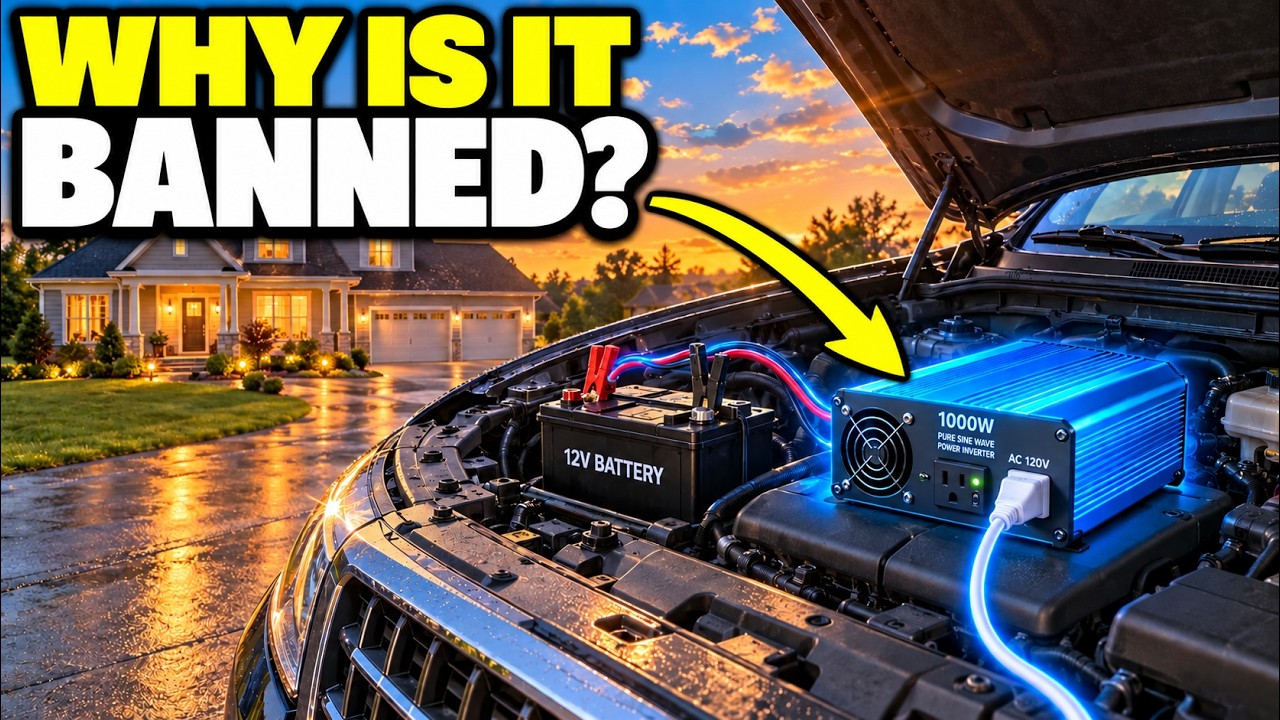
So, let me show you the wiring. Here is how you build this in a single weekend. And I mean a real weekend where you still sleep in and drink your coffee before you touch a single tool. Friday evening, you do one thing. You order your parts or you drive to the store and pick them up. You need a pure sinewave inverter rated at 1,000 watts continuous. The Besttech 1000 W unit is $58 with 2-day shipping and has been tested by more off-grid truck campers than any other inverter in its price class.
You need a 4 gauge cable set with crimped ring terminals sold as battery relocation kits at any O'Reilly location for between $18 and $22. Get the 6 ft set. You need a 150 amp inline ANL fuse and holder for $8. You need a 12 gauge outdoor rated extension cord 25 ft, which you probably already own. And you need a kilowatt meter for $22. Total parts cost starting from zero is $18. If you already own the extension cord, you are under 90.
Saturday morning, you pop the hood. The inverter stays outside the engine bay on a stable surface next to the fender or on a workbench beside the car. The fuse holder goes in line on the positive cable within 12 in of the positive battery terminal that is not flexible. 12 in. Connect the positive ring terminal first, then the negative. Torque each battery post nut to between 50 and 70 inch pounds. If you do not own a torque wrench, tighten until the terminal does not rotate by hand, then one/4 turn more.
Route the cables along the inner fender away from the exhaust manifold and serpentine belt and secure them every 8 in with heavy zip ties rated for under hood temperatures. This takes 25 minutes. Saturday afternoon is when you learn your system. Run your extension cord from the inverter through a window or a cracked garage door to the chest freezer. Plug the kilowatt meter between the cord and the freezer plug. Turn on the inverter.
Watch the compressor surge for about 2 seconds, then settle into its running draw. Write down the cycling average after 30 minutes. That number is the foundation of everything that follows. Now start the car and let it idle for 20 minutes. Shut the engine off. Set a repeating timer for 3.5 hours. Check the battery voltage. Write it down. Go inside. When the timer goes off, walk back out, check the voltage again, log it, and start the engine for another 20 minute idle.
You are training yourself on the rhythm before you ever need it. Sunday morning, you run the full protocol. Start the engine at 7. Idle for 20 minutes. Shut it off. Check voltage. Log it. Walk away. Come back at 10:30. Check. Log. Start. Idle. Shut off. Do this four times across the day. And by late afternoon, you will have a handwritten log showing exactly how your battery behaves under this load with your alternator in your car.
That number is your baseline. Write it on a piece of tape and stick it to the side of the inverter because when the power goes out at midnight in a January ice storm, you are not going to remember it otherwise. I put together the complete build manual for this setup, including the wiring diagram, the parts list with direct links, the voltage log template, and the idle schedule chart. The link is in the description below.
It is free. Before you pop the hood and start bolting things down, here are the details. I deliberately held back until now because they only matter once you have already decided to build this. And if you have made it this far, you have decided. I can [music] tell. The first detail is the one that could kill someone. Never connect your inverter to your home's breaker panel. Not with a male to-male cord. Not with a suicide plug from some forum.
Not by flipping the main breaker off first. The moment you back feed 120 volts into your panel, that voltage travels out through your meter, up the service drop, through the transformer, and onto the utility line. A lineman working on what he believes is a dead wire three blocks away touches that line and it kills him. The National Institute for Occupational Safety and Health documented 12 electrocution fatalities between 2005 and 2018 directly caused by improper back feed into residential panels.
Your setup is extension cord only, inverter to cord to appliance. There is no version of this where you wire into your breaker box without a licensed transfer switch. The second detail is brand selection. I named the Best Deck unit because it has the widest field testing record, but Ames Power out of Reno makes a 1,000W pure sinewave inverter with a 200 W surge rating for $72. Giandelle makes one with a hardwired remote switch for $65.
What you need on the spec sheet is three things. pure sinewave output, a continuous rating at or above 1,00 watts, not just a peak or surge rating, and FCC Part 15 compliance, which means the unit has been tested for electromagnetic interference. If the label does not say FCC Part 15 class B, put it back on the shelf. The third detail is what happens when a 48hour outage turns into 96 hours and your starting battery shows its age.
A starting battery is designed to deliver a massive burst for 3 to 5 seconds and then immediately recharge. Draining it to 50% twice a day for 4 days will shorten its calendar life. You are borrowing lifespan from a $140 battery to save $400 of frozen food. That is a trade most people would take. But to eliminate it, add a group 31 AGM deep cycle battery for $110 to $130. Wire it in parallel through a $30 battery isolator that lets your alternator charge both batteries, but prevents the inverter from dragging down your starting battery.
Total upgrade cost is about $150, and it roughly doubles your run time between idle sessions. The fourth detail is carbon monoxide. Your car must be outside. Not in the garage with the door cracked. Not in the carport with a fan running. Outside. Exhaust pointing away from any window, door, or intake vent. Route the extension cord through a cracked window or a purpose cut hole in a piece of plywood wedged into the frame.
Place a battery operated carbon monoxide detector inside the house within 15 feet of where the cord enters. A KDA battery CO detector costs $19. That is not optional. The fifth detail is knowing what you can run and what you cannot. At 1,00 watts continuous, your inverter handles two LED bulbs at 8 W each, a phone charger at 5 to 15 watt, and a CPAP machine at 30 to 60 W. You can run your freezer, four lights, two chargers, and a CPAP simultaneously and still be under 250 watts total.
What you cannot run is a well pump. A standard half horsepower submersible surges to 1,500 W on startup and runs at 750 steady. That exceeds your inverter's rating. A window air conditioner is the same story. Even a small 5,000 BTU unit surges past 1,800 W. This setup keeps your food frozen, your lights on, your devices charged, and your medical equipment running. It does not replace your entire panel. And I am not going to pretend it does.
The sixth detail is diesel. If you drive a diesel truck, your economics improve sharply. A diesel at idle consumes roughly 0.1 gall hour, half the fuel burn of a comparable gasoline engine. Over a 72-hour outage, your total fuel cost is under $7. Your Cumins or Duramax or Power Stroke was already sitting in the driveway already paid for. The fuel was already in the tank. The only thing it was missing was a $58 translator.
The seventh detail is inverter placement. Heat is the enemy. Your cooling fan needs air flow on all six sides. Do not set the inverter on carpet, upholstery, or inside a closed toolbox. Mount it on a scrap of 3/4in plywood with rubber feet. Keep at least 4 in of clearance above and on each side. If the inverter overheats, it shuts itself down. That is a safety feature, not a flaw. but your freezer stops cycling until the unit cools.
The eighth detail is the voltage floor. A fully charged 12vt lead acid battery reads 12.6 to 12.8 volt with no load. At 50% state of charge, it reads 12.0 volt. Interstate Batteries publishes a state of charge chart in their technical reference guide that maps voltage to remaining capacity at 77° F. When your multimeter reads 12.0, you start the engine. Not 11.9. Not close enough. Going deeper reduces the number of charge cycles the battery can survive from roughly 500 down to under 200.
Write 12.0 on the tape next to your baseline runtime number. Those two numbers are your entire operating system. If you want to power, heat, and cool your home off-rid, the passive house files show you how. Full plans, exact materials, and the honest numbers nobody else gives you. It's not too late to start lowering your bill. Scan the QR code and see for yourself. The 12vt lead acid battery has been under the hood of every American car since 1920.
The physics of converting direct current into alternating current was textbook science before your grandfather learned to drive. This is not a breakthrough. This is the elimination of the one excuse that stood between you and a power source you have owned your entire adult life. Go out to your driveway tonight. Stand next to your car. Put your hand on the hood and feel the engine heat still ticking out of the metal. Picture the next time every house on your street goes dark.
Every porch light dead, every refrigerator falling silent behind every locked door. Now picture yours. Your freezer humming. Your lights on. Your phone charging. Your family asleep because there is nothing to worry about. A $58 box doing the work of a machine that costs 38 times more. Running on fuel you were already going to burn. asking nothing from you but 20 minutes of idle and a glance at a voltmeter. That is not a fantasy.
That is a Tuesday night after you finish this build. A lot of what this channel covers disappeared from the mainstream, not because it stopped working, but because a sell it and service it industry decided that simplicity was not profitable enough to sell. A box with no moving parts, no maintenance schedule, and no recurring revenue stream never had a chance on a shelf controlled by companies that earn more from your second purchase than your first.
If this is the kind of knowledge that matters to you, subscribing and sharing is the simplest way to make sure it keeps being found. And I want you to do something for me tonight. Plug a kilowatt meter into your chest freezer. Let it run for one full hour and tell me in the comments exactly what the cycling average reads in watts. Not what the label on the back of the freezer says, not what the manual estimates, the actual measured number from your actual freezer in your actual garage.
I read every single one. And that number is the first line of your outage plan, whether you know it yet or
The words are the caption track's own and nothing is reworded or re-transcribed. Paragraph breaks are placed between sentences so the text reads as prose.
Free tools for your own script. No signup, no login.
Paste your draft and see where viewers are likely to drop off, with a rewrite for each weak line.
Paste the first 30 seconds of your own draft for a hook score and rewrites.
Check your draft against YouTube's advertiser-friendly guidelines before you record it.
Read this channel's public videos and transcripts, and download a writing brief for it.