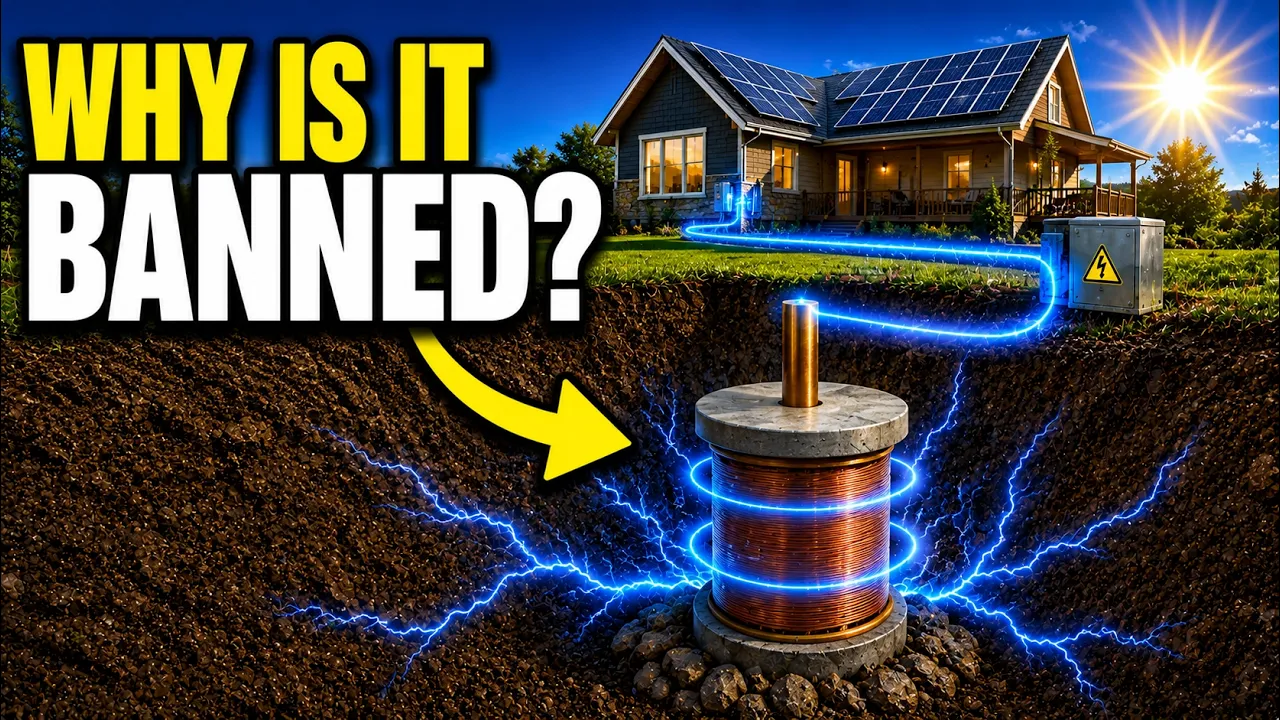
This $8 EARTH BATTERY Pulls FREE Power Straight from Dirt (No Wiring NEEDED!!) transcript
The Passive House Files · @griffithselijah7018
Words
3,437
Runtime
22:58
Speaking pace
150wpm
Reading time
14min
150 words per minute, below the 160 25th percentile of 349 measured videos. That distribution comes from the 349-video hook study.
Opening (first 30 seconds)
This $8 device pulls electricity straight from dirt. It needs no solar panel, no lithium battery, and no grid connection. Yet, it generates a continuous current day and night using nothing but two metals and wet soil. Despite being proven for nearly 200 years, it doesn't appear on a single federal incentive list. It's called an earth battery. By the end, you'll know what it is, how it works, and how to build your own.
75 words, the words spoken in the first 30 seconds at 150 words per minute.
Sentence shape
| Measure | This transcript |
|---|---|
| Sentences | 242 |
| Average words per sentence | 14.2 |
| Longest sentence | 42 words |
| Questions asked | 3 |
| Sentences containing a number | 77 |
Most used terms
- earth29
- battery26
- copper23
- soil18
- cell16
- earth battery16
- zinc16
- current14
- ground14
- energy13
- wire12
- power11
Filler phrases
7 in total: like 4 · actually 2 · kind of 1.
A literal whole-word count of the same phrase list the Prepublish browser extension uses, so a phrase inside another word is not counted and a phrase used in its ordinary sense still is. It is a count and not a judgement.
What this transcript is
Every word below is the caption track YouTube publishes for this video, pulled from the video itself and reproduced unchanged. It is not Prepublish's writing, not a summary, and not a re-transcription: it is the video's own published captions. English captions, generated automatically by YouTube, in the video’s original language. Source: the video on YouTube. A channel that would rather this page did not exist can ask for its removal through the contact page, and it is removed.
Transcript
This $8 device pulls electricity straight from dirt. It needs no solar panel, no lithium battery, and no grid connection. Yet, it generates a continuous current day and night using nothing but two metals and wet soil. Despite being proven for nearly 200 years, it doesn't appear on a single federal incentive list. It's called an earth battery. By the end, you'll know what it is, how it works, and how to build your own.
Let's dive in. Right now, the average American household spends roughly $150 a month on electricity. That is over $1,800 a year sent to a utility company for the privilege of keeping the lights on. And if you have looked into going off-grid, you already know the alternatives are not cheap, either. A basic rooftop solar system with battery backup runs between $15,000 and $30,000 after installation. The lithium batteries alone, the ones every installer pushes as the heart of the system, cost between $5,000 and $15,000, depending on capacity.
And here is the part nobody puts in the sales brochure. Those lithium cells lose roughly 20 to 30% of their storage capacity within the first five to seven years. They are rated for a finite number of charge and discharge cycles. When they degrade past a certain point, you replace them at full retail. Again, that is not energy independence. That is a subscription plan dressed up in different packaging. And the grid itself is not exactly getting more reliable.
The Department of Energy's own data shows that the average American experienced over 7 hours of power interruptions in 2022, the highest figure in decades. You are paying more than ever for a system that fails more often than it used to. And when you see what it costs to build a full earth battery array, you will understand why no energy company has ever sold one. The dirt beneath your feet has been generating a measurable electrical current since before you were born.
It does not degrade. It does not require a service contract, and it does not care whether the sun is shining or the wind [music] is blowing. But, the real question is not whether an earth battery works. The science on that was settled in 1841. The real question is, what happens when you wire 20 of them together and point that current at something useful? And that is where this technology stops being a curiosity and starts being a threat to a 400 billion dollar industry.
But, to see why, you need to understand the mechanism. Because once you see how simple the physics actually is, you will never look at a patch of wet ground the same way again. An earth battery is a galvanic cell. That term sounds like a textbook, but the principle is one you already know. If you have ever pushed a copper penny and a zinc nail into a lemon and watched a small LED blink to life, you have built a galvanic cell.
The lemon juice is the electrolyte, meaning it is a liquid with dissolved ions that can carry a charge. The copper and zinc are the electrodes, and the voltage you measured came from a difference in how eagerly each metal gives up its electrons. This is called the electrochemical series. Alessandro Volta demonstrated it in 1800 by stacking alternating discs of zinc and copper separated by brine soaked cloth. That stack became the first true battery in history.
Zinc is what chemists call a more reactive metal. It wants to shed electrons. Copper is less reactive. It wants to collect them. Put both metals into a conductive medium that carries ions between them. The electrons have no choice but to flow through the external wire from the zinc to the copper. That flow of electrons is your electrical current. In an earth battery, the lemon is replaced by wet soil. Soil is full of dissolved minerals, [music] salts, organic acids, and billions of bacteria.
When it is moist, it becomes an electrolyte. Not as efficient as sulfuric acid in a car battery, but it is free. It is everywhere, and it does not expire. A single copper and zinc cell buried in moist ground produces between half a volt and 1 volt, depending on soil composition, moisture content, and electrode surface area. The current is low, typically between 1 and 5 milliamps per cell. That is not enough to run your refrigerator.
But here is where the engineering starts. Wire 10 cells in series, meaning you connect the copper electrode of one cell to the zinc electrode of the next, and you get 5 to 10 volts. Wire 20 cells, and you reach 10 to 20 volts. That is enough to trickle charge a 12-V lead-acid battery. That is enough to run an LED light strip around the clock. That is enough to power a soil moisture sensor, a wireless weather station, or a low-draw security camera.
And none of it requires a single product from the companies that dominate the renewable energy market. That fact alone tells you why you have never been told about it. And unlike solar, an earth battery does not shut off when the sun sets. The electrochemical reaction runs continuously as long as the soil holds moisture. In a region with normal rainfall, that means your power source is functionally permanent. Now, there is a second source of electrical energy in the ground that most people have never heard of.
They are called telluric currents. These are natural electrical flows that move through the Earth's crust, driven by interactions between the solar wind and Earth's magnetic field. They are not theoretical. They have been measured by geophysicists since 1847, when an English telegraph engineer named W. H. Barlow detected them running through the wires of the English Telegraph network. Barlow proved that the currents were not coming from the Telegraph equipment.
They were coming from the earth itself, and they were always present. When earth battery electrodes are spaced far enough apart, and oriented along the north to south magnetic meridian, they can tap into these telluric currents. The result is output well beyond what the galvanic reaction alone would produce. That is not fringe science. That is documented electrical behavior, observed repeatedly across more than a century and a half of geophysical research.
But if you think this is new, you are off by about 2,000 years. >> [music] >> In 1841, a Scottish clockmaker named Alexander Bain, buried a pair of zinc and copper plates in the ground about 1 m apart outside his workshop in London. He connected them with a wire, and measured approximately 1 V of continuous output. That was enough to drive the electromagnetic pendulum of his newly patented electric clock. Bain filed his first patent on January 11th, 1841.
He went on to invent the chemical telegraph, and the earliest precursor to the fax machine. Much of his work was powered in part by earth batteries. He was not the only one. Karl August von Steinheil in Munich had discovered something even bigger in 1838. The earth itself could serve as a return conductor for telegraph signals, eliminating the need for a second wire. That single discovery cut the copper requirements for every telegraph line in half.
Telegraph companies across Europe, Britain, and the United States quietly adopted earth return wiring as standard practice, and saved millions of dollars in materials and labor. By the 1850s, nearly every major telegraph network on the planet was using the ground as half of its electrical circuit. The Earth was already part of the grid. It just never got the credit. But Bain was not even close to the first civilization to put dissimilar metals in contact with a wet medium and draw current from the reaction.
In 1936, workers excavating a Parthian era site called Khujut Rabu'a, a few miles outside Baghdad, uncovered a set of small terracotta jars. They dated to between roughly 250 BCE and 224 CE. Each jar was about 5 in tall and contained a rolled copper cylinder housing a single iron rod sealed at the top with bitumen. In 1940, Wilhelm König, the German director of the National Museum of Iraq, published a paper on the jars.
He argued they were primitive galvanic cells possibly used to electroplate gold onto silver. Modern recreations filled with vinegar produced between half a volt and 1.4 volts per jar. In 2005, the Discovery Channel program MythBusters confirmed that 10 of these jars wired together could successfully electroplate a silver object. That means a civilization more than 2,000 years ago may have been harnessing the same copper and iron electrochemistry.
You can replicate it in your backyard for $8 in hardware store materials. And yet almost none of this appears in any mainstream energy conversation today. Now, fast forward to the man who took the Earth battery further than anyone before or since and was nearly erased from history for it. In 1892, a self-taught inventor named Nathan Beverly Stubblefield walked into the town square of Murray, Kentucky. The demonstration he gave that day should have changed the course of telecommunications.
He drove metal rods into the ground and connected them to a device he called a ground telephone. He transmitted clear human speech through the soil over distances of 3,500 to 6,000 ft. No wires between the stations, no external power source, just the earth battery and the ground itself acting as the transmission medium. Witnesses described the audio as clear, loud, and startling. On May 8th, 1898, Stubblefield was issued US patent number 600,457.
It described an electrical battery made from an electrolytic coil of iron and insulated copper wire buried in the ground. In 1902, he demonstrated the first ship-to-shore wireless telephone transmission from the steamer Bartoldi on the Potomac River. In 1991, the governor of Kentucky issued a proclamation declaring Stubblefield the true inventor of radio. But by that time, Stubblefield had died in 1928 in self-imposed isolation, having destroyed every prototype he built.
His name does not appear in any standard history of electricity. >> [music] >> Now, if you were thinking this sounds like a science project that could never power anything practical, a team of engineers at Northwestern University thought the same thing. And what they found changes the calculation entirely. In January of 2024, Northwestern alumnus Bill Yen led a team that published a peer-reviewed study. The subject was a soil-powered microbial fuel cell, roughly the size of a paperback book.
The device used naturally occurring electrogenic bacteria, species like Shewanella and Geobacter, to break down organic matter in dirt and donate electrons to a buried conductor. In field tests, the fuel cell generated 68 times more power than its attached sensors required. It powered soil moisture detectors and motion-sensing touchpads used for tracking wildlife. It operated reliably across conditions ranging from 41% soil moisture all the way to complete submersion.
And every component was purchasable at a local hardware store. The research was funded by the National Science Foundation, the USDA, the Sloan Foundation, and 3M. The team has since published the full design as open source with complete schematics and build tutorials. Separately, at the University of California, Santa Cruz, assistant professor Colleen Josephson has been field testing what her team calls mud batteries on working farms since 2022.
Her site at UCSC is one of the only locations in the world testing soil-powered electricity outdoors at real agricultural scale. In Lopburi, Thailand, researchers at Rajamangala University of Technology placed copper and zinc rods in the region's mineral-rich marl soil. They measured 1.09 volts per cell at 3 milliamps. They wired enough cells to charge a mobile phone at 12.72 volts and 140 milliamps in 4 and 1/2 hours using dirt.
And then there is the event that proved the Earth's electrical potential more dramatically than any lab ever could. On the night of September 2nd, 1859, the largest geomagnetic storm in recorded history struck the planet. >> [music] >> Telluric currents surged through the ground so powerfully that telegraph stations caught fire across North America. Operators received shocks from their equipment. Two operators on the line between Boston and Portland, Maine disconnected their batteries entirely.
They held a 2-hour conversation using nothing but the current flowing through the Earth. It remains one of the most extraordinary episodes in the history of electrical engineering. On the Western Union line between New York and Buffalo, during a similar disturbance in 1891, earth currents reached 768 volts. Normal operating current on that line was 35 milliamps. The earth current measured 300, nearly 10 times the standard.
Every one of these examples is documented, published, and verifiable. And yet the total number of earth battery installations recognized by any US energy authority remains at zero. So, if this technology predates the light bulb and was confirmed by a top 10 US research university in 2024, why isn't it on a single incentive list? Because the system was never designed to accommodate something you can build for $8. The residential clean energy credit was the most generous federal renewable energy incentive in US history until 2025.
It covered photovoltaic solar panels, lithium battery storage of 3 kilowatt hours or more, geothermal heat pumps, fuel cells, and small wind turbines. Earth batteries are not on that list. Not because they were tested and rejected, because no one with a lobbying budget asked for them to be included. There is no earth battery industry. There is no trade association. There is no manufacturer sending representatives to congressional hearings.
There is no Underwriters Laboratories listing for a pair of metal rods buried in your garden. And without a UL listing, no building inspector will approve it. No homeowners insurance policy will cover it. And no mortgage appraiser will assign it value. This is not a ban. It is something more effective than a ban. It is structural invisibility. The American electricity market generates over $400 billion a year in revenue.
That revenue depends on centralized generation, long-distance transmission infrastructure, and metered consumption at the point of use. Every dollar that flows through that system passes through equipment that someone owns, maintains, and invoices for. An Earth battery generates no invoice. It requires no meter. It needs no transmission line. It creates no recurring revenue stream for any party at any point in the supply chain.
From the perspective of the utility model, the Earth battery is not a competitor. It is a non-entity. It does not fit into the financial architecture, and therefore, it does not exist within the regulatory architecture. No one conspired to suppress it. The frameworks that govern American energy were simply written for products that scale, products that can be manufactured, shipped, installed by certified technicians, and financed through approved lending structures.
A device you build from scrap copper and galvanized nails does not clear a single one of those gates, and so, it vanishes. Not suppressed, just [music] never seen. Now, if you are thinking the output is too low to matter in your life, stop and consider what you actually need to power. A 12-V LED light strip running at 5 W draws about 417 mA. A wireless soil moisture sensor draws under 1 mA. A low-power microcontroller with a wireless transmitter pulls between 10 and 50 mA.
A trickle charger maintaining a 12-V lead-acid battery needs between 50 and 200 mA. None of these require a $15,000 solar array. All of them can be served by an earth battery array that costs less than lunch. If you want to start lowering your energy and storage costs today, we put together a full manual that covers everything in this video and more. The link is in the description below. Here is how you build one. You need three materials.
First, [music] copper. A 2-ft length of 1/2-in type M copper pipe costs between $3 and $4 at any hardware store. Cut it into sections of 4 to 6 in. These are your cathodes. Second, zinc. A box of galvanized steel nails, which are coated in zinc, or a length of galvanized steel pipe costs between $2 and $3. These are your anodes. Third, wire. A small roll of insulated copper wire, 18 gauge, costs about $1 to $2. Total for a 10-cell array comes in under $8 at current US retail prices.
Dig 10 holes in moist ground spaced about 12 in apart. In each hole, push one copper section and one galvanized nail about 6 to 8 in deep, keeping the two electrodes 3 to 4 in apart within the same hole. Connect the copper electrode of the first cell to the zinc electrode of the second cell using a short length of wire. Continue this series connection through all 10 cells. The exposed zinc of your first cell is your negative terminal.
The exposed copper of your last cell is your positive terminal. Test with a basic multimeter. You should read between 5 and 10 V. If your soil is dry, water it. If it is sandy and mineral poor, dissolving a tablespoon of non-iodized salt in a cup of water and pouring it near each cell will increase conductivity. Adding compost or aged manure introduces organic acids and microbial activity that can improve both voltage and current.
To trickle charge a 12-V battery, wire at least 14 cells in series. Add a $1 blocking diode to prevent current from flowing backwards from the battery into the cells. For a more permanent installation, use 3/4-in copper pipe driven 12 in into the ground alongside galvanized steel rods of equal length. Bury them in clay-rich or loamy soil if possible. Clay holds moisture longer than sand and contains more dissolved minerals, which means higher conductivity and more stable voltage output over time.
These will produce measurable current for years before corrosion reduces output significantly. The single best resource for anyone who wants to go deeper is the open-source documentation published by Bill Yen's team at Northwestern. Their schematics, build guides, and soil analysis protocols are free and available online. For a pre-made starting point, the MudWatt kit from Science Education Suppliers provides a lab-tested microbial fuel cell platform for about $30.
You can also build a comparable device from the same hardware store parts for a fraction of that. One critical warning. Do not substitute stainless steel for galvanized zinc. Stainless steel is engineered to resist corrosion, which means it will not participate in the electrochemical reaction. You need active zinc and active copper. Corrosion-resistant metals defeat the purpose entirely. There are real limits, and you should know them.
Earth batteries produce low voltage and low current. >> [music] >> They will not run your air conditioner, your well pump, or your electric stove. They are suited for LED lighting, sensors, trickle charging, and small low draw electronics. Performance depends heavily on soil moisture. In arid climates or extended drought, output drops. If your ground dries out, your voltage drops with it. The zinc electrodes are consumed in the reaction and will need replacing over time, typically within 1 to 3 years, depending on soil chemistry and electrode size.
And this is not a plug-and-play product. There is no instruction manual, no app, no customer support line. You are building a power source from raw materials. That requires basic comfort with a multimeter, a pair of wire strippers, and a willingness to experiment. The Earth battery is a 200-year-old answer to a question the modern energy system was never designed to ask. It does not replace your grid connection or compete with rooftop solar for raw wattage, but for the cost of two galvanized nails and a scrap of copper pipe, it gives you a continuous power source.
It runs on dirt, rain, and the same electrochemistry that Volta demonstrated in 1800. A lot of what this channel covers was nearly lost, not because it stopped working, but because the system was never designed to accommodate something that does not generate a monthly invoice. If discovering the lost science of energy self-sufficiency matters to you, subscribing and sharing is the simplest way to make sure this kind of knowledge keeps being found.
If you had a patch of moist ground and $10 to spend, would you build an Earth battery array for passive sensor power, or would you still reach for a lithium cell that costs 10 times more and dies in 3 years? I genuinely like to know. Drop it in the comments.
The words are the caption track's own and nothing is reworded or re-transcribed. Paragraph breaks are placed between sentences so the text reads as prose.
Use this transcript
Three free tools that work on the material around a video like this one. No signup, no login.
Hook Analyzer
Paste the first 30 seconds of your own draft for a hook score and rewrites.
Policy Pre-Flight
Check your draft against YouTube's advertiser-friendly guidelines before you record it.
Channel Skill Generator
Read this channel's public videos and transcripts, and download a writing brief for it.