Getting the transcript
Reading the captions from YouTube. A video nobody has opened here before takes 10 to 30 seconds; this page fills in on its own.
Getting the transcript
Reading the captions from YouTube. A video nobody has opened here before takes 10 to 30 seconds; this page fills in on its own.
Neuralink · @neuralink
Words
849
Runtime
6:56
Speaking pace
122wpm
Reading time
4min
122 words per minute, below the 160 25th percentile of 349 measured videos. That distribution comes from the 349-video hook study.
Opening (first 30 seconds)
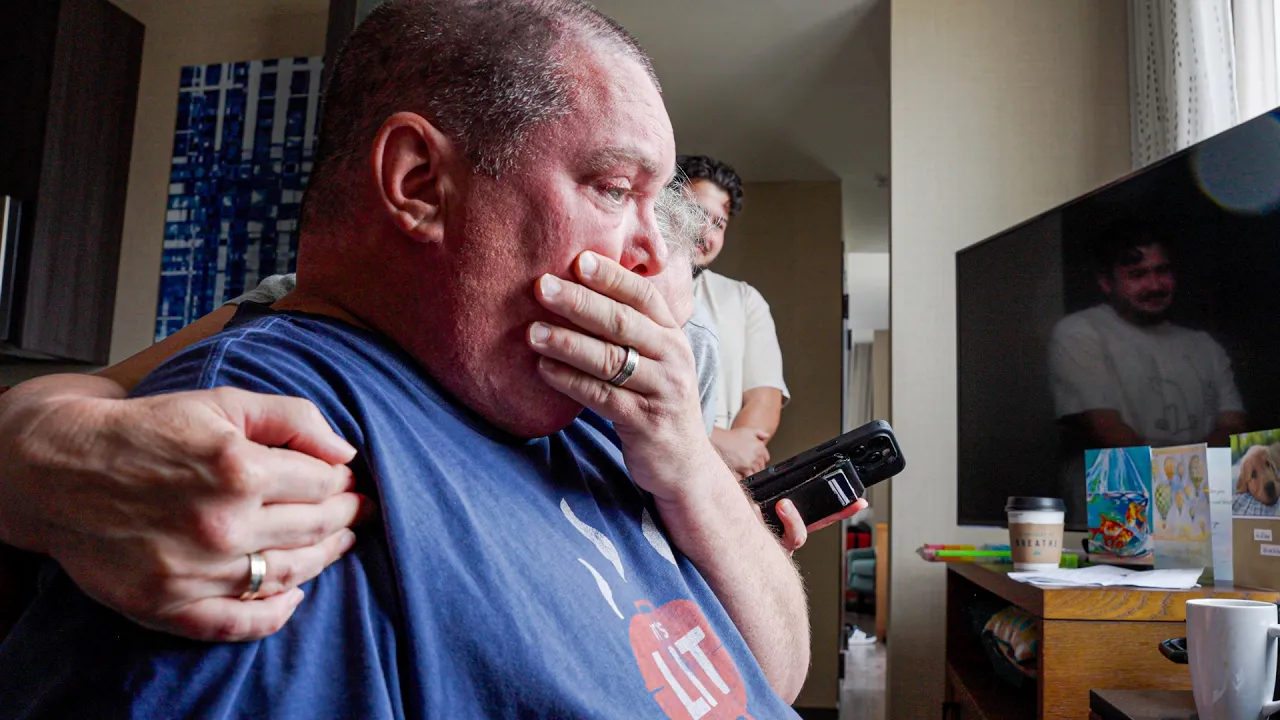
In a few words, tell me what you're calling about. [speech impaired by ALS] I need help with a claim. I didn't quite catch that. Can you try asking in a different way? Terry is an extrovert. He loves to talk, and it is heartbreaking to see what he's going through. and it is heartbreaking to see what he's going through.
61 words, the words spoken in the first 30 seconds at 122 words per minute.
Free, no signup. See how the first 30 seconds hold attention, with rewrites.
Sentence shape
| Measure | This transcript |
|---|---|
| Sentences | 74 |
| Average words per sentence | 11.5 |
| Longest sentence | 41 words |
| Questions asked | 14 |
| Sentences containing a number | 1 |
Most used terms
Filler phrases
8 in total: like 3 · kind of 2 · you know 2 · actually 1.
A literal whole-word count of the same phrase list the Prepublish browser extension uses, so a phrase inside another word is not counted and a phrase used in its ordinary sense still is. It is a count and not a judgement.
Free, no account. See where attention is likely to drop, with a rewrite for each weak line. The free check shows the scores and the one issue costing the most. Or run it on the words above first.
Free · No login · See a sample audit first if you prefer.
What this transcript is
Every word below is the caption track YouTube publishes for this video, pulled from the video itself and reproduced unchanged. It is not Prepublish's writing, not a summary, and not a re-transcription: it is the video's own published captions. English captions, published by the channel, in the video’s original language. Source: the video on YouTube. A channel that would rather this page did not exist can ask for its removal through the contact page, and it is removed.
No Script X-ray for this video: YouTube shows a Most replayed graph only once a video has enough views.
In a few words, tell me what you're calling about. [speech impaired by ALS] I need help with a claim. I didn't quite catch that. Can you try asking in a different way? Terry is an extrovert. He loves to talk, and it is heartbreaking to see what he's going through. and it is heartbreaking to see what he's going through. We also thought, you know what? With change comes opportunity. So we wanted to make sure that today you walked away with an understanding of opportunity and the opportunities that are out there.
That’s part of his identity that now is no longer there because of the ALS. He had made partner relatively recently at his company and was really enjoying kind of the apex of his career, It was becoming difficult to communicate with his clients as well as with his peers at work. He would come home from a business dinner and his speech would get slurred. And at first I would joke with him, I'm like, Oh, how much wine did you have with dinner?
And he would look at me and go, I didn't have any wine. He unfortunately was placed on long-term disability and retired from his career that he was enjoying. He's getting to a point where I'm having trouble understanding more and more of what he's saying on a regular basis. That's one of my biggest fears, is that I'll lose that ability to communicate with him and know instinctively what he's needing. It takes a while to digest that, and learning more about the condition, and we finally hit a point where, okay, you know, we've kind of made peace.
This is the diagnosis. What can we still do? And how can we still be happy, and thrive? [speech impaired by ALS] Losing my voice has affected me in a lot of ways. I hope this will allow me to be a part of the conversation again. Terry will be the third participant in the Neuralink voice study. The more we learned about the study, and what this would mean to him, It just seems like it's a no brainer. He needs to have his voice, and this can give him that.
At that point, I was all in, and said, sure, let's go for it. First, we're going to connect to your implant, and use this to look at some of the signals that it's producing. And we'll see if there's any modulation when you try and think about doing different actions. Every row on this view is one channel on the implant. And so there's 3000 of those channels in this implant. And so as this thing sweeps across its populating new data in each column, and so this is a real time view of the neural signals.
One thing you can try to do, is we can try and get these to light up a little bit. Since we implanted this in the speech motor region, if you try and think or attempt speaking, we might be able to see some modulation. So now, do you want to try and give this a “hello world”? Hello world. Okay, that's pretty colorful. Yeah. This is already super exciting to see, like how much activity lights up when you try and do different things.
The next thing we want to do is collect data. And we'll actually build a decoder, taking your neural signals and translating them into your intended speech. You'll see a sentence on the screen, and you'll attempt the best you can, to speak that sentence. Our understanding doesn't matter. All that matters are your brain signals and your intention. Make sense? I think so. OK, let’s do this. “A leather handbag would be a suitable gift.” “Employee layoffs coincided with the company’s reorganization.” You'll start with this, it’ll turn blue, you'll say what you want to say.
Then you'll press this button And that will say it out loud, through the computer speakers. Sound good? I don't know. And press that top button. Hello, how are you doing today? You just got your voice back. That impact of giving him his speech back has been remarkable giving him a piece of his life back that is just such an integral part of him. Neuralink has given me back my voice. Do you have more information about that?
Great, thank you. This works really, really well. With ALS, you start learning about what your priorities are, and it does put a lot of things into perspective. What this means for him and for us something that I know I took for granted to just be able to have a conversation with my husband, this means the world to us, to be able to have that communication back. That was total game changer for me. Is that all your brain waves?
Oh, my gosh, that is so cool. Watch this. What? You're thinking the words? And they're popping up? I, I love you. Oh God. Getting back to normal life is what having Neuralink is all about.
The words are the caption track's own and nothing is reworded or re-transcribed. Paragraph breaks are placed between sentences so the text reads as prose.
Free tools for your own script: paste a draft and see where it stands before you record it.
Paste your draft and see where viewers are likely to drop off, with a rewrite for each weak line.
Paste the first 30 seconds of your own draft for a hook score and rewrites.
Check your draft against YouTube's advertiser-friendly guidelines before you record it.
Read this channel's public videos and transcripts, and download a writing brief for it.