Getting the transcript
Reading the captions from YouTube. A video nobody has opened here before takes 10 to 30 seconds; this page fills in on its own.
Getting the transcript
Reading the captions from YouTube. A video nobody has opened here before takes 10 to 30 seconds; this page fills in on its own.
Ambition Arc · @TheAmbition-Arc
Words
1,495
Runtime
9:11
Speaking pace
163wpm
Reading time
6min
163 words per minute, between the 160 25th percentile and the 181 median of 349 measured videos. That distribution comes from the 349-video hook study.
Opening (first 30 seconds)
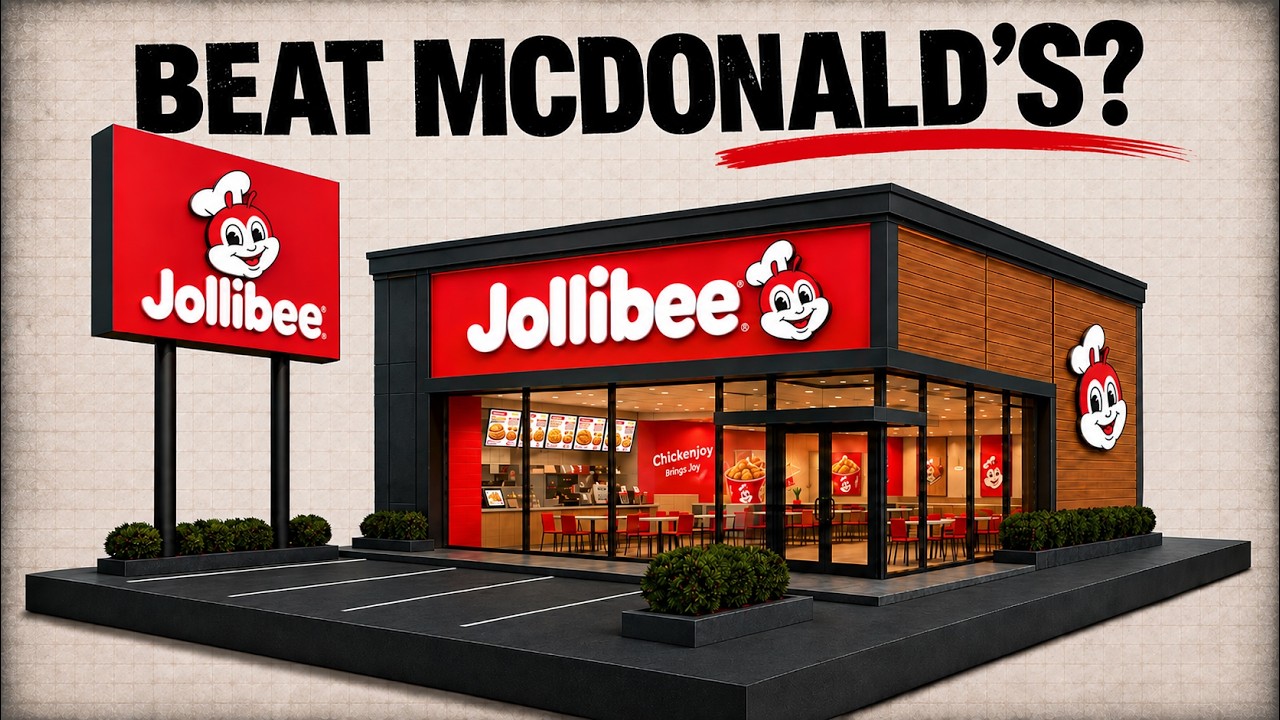
There's a fast-food chain people will line up an hour for, a chain that oversees workers [music] seek out the moment one opens in a new country. Some of them tearing up at the sight of the logo because it tastes like home. It's not McDonald's, [music] it's Jollibee. And in the Philippines, it did something McDonald's has almost never let happen anywhere on Earth. It beat them on their own turf, 56% of the market while the golden arches play [music]
82 words, the words spoken in the first 30 seconds at 163 words per minute.
Free, no signup. See how the first 30 seconds hold attention, with rewrites.
Sentence shape
| Measure | This transcript |
|---|---|
| Sentences | 104 |
| Average words per sentence | 14.4 |
| Longest sentence | 54 words |
| Questions asked | 1 |
| Sentences containing a number | 26 |
Most used terms
Filler phrases
6 in total: actually 4 · like 2.
A literal whole-word count of the same phrase list the Prepublish browser extension uses, so a phrase inside another word is not counted and a phrase used in its ordinary sense still is. It is a count and not a judgement.
Free, no account. See where attention is likely to drop, with a rewrite for each weak line. The free check shows the scores and the one issue costing the most. Or run it on the words above first.
Free · No login · See a sample audit first if you prefer.
What this transcript is
Every word below is the caption track YouTube publishes for this video, pulled from the video itself and reproduced unchanged. It is not Prepublish's writing, not a summary, and not a re-transcription: it is the video's own published captions. English captions, generated automatically by YouTube, in the video’s original language. Source: the video on YouTube. A channel that would rather this page did not exist can ask for its removal through the contact page, and it is removed.
No Script X-ray for this video: YouTube shows a Most replayed graph only once a video has enough views.
There's a fast-food chain people will line up an hour for, a chain that oversees workers [music] seek out the moment one opens in a new country. Some of them tearing up at the sight of the logo because it tastes like home. It's not McDonald's, [music] it's Jollibee. And in the Philippines, it did something McDonald's has almost never let happen anywhere on Earth. It beat them on their own turf, 56% of the market while the golden arches play [music] catch-up.
So, here's the strange part. In 2026, the company that [music] pulled off maybe the greatest home-field win in fast-food history watched its stock fall, got downgraded by Wall Street, and quietly admitted it had overreached. Not because it lost at home, it's still winning there, but because it couldn't stop chasing a number. This is the story of how beating McDonald's wasn't enough. To understand the mistake, you first have to understand how good Jollibee actually was because this isn't a story about a weak company, it's a story about a great one.
It started in 1978 as a two-location [music] ice cream parlor in Quezon City run by a Chinese-Filipino businessman named [music] Tony Tan Caktiong. When he noticed customers were more excited by the [music] hot sandwiches than the ice cream, he pivoted the whole business to fast food. Then, in 1981, McDonald's arrived. Global marketing machine, decades of franchising muscle, every [music] advantage money can buy. Everyone assumed the little local chain would be swallowed in a few years.
Instead, Jollibee did the opposite of what everyone expected. It didn't try to out-American the Americans, it leaned harder into being Filipino. Sweet spaghetti [music] with hot dog slices, garlic rice, a fried chicken recipe, Chickenjoy, engineered crispier and juicier than anything the golden arches served. And [music] that's the thing McDonald's couldn't buy its way around. Jollibee wasn't selling food, it was selling belonging.
It became the place Filipino families held [music] birthday parties, the taste of childhood, the first stop for a worker coming home. You cannot out-advertise [music] that. McDonald's had the bigger budget. Jollibee owned the emotional real estate, [music] and no marketing spend on Earth could dislodge it. By the 2010s, Jollibee controlled 56% of its home market and had become one of the largest Asian restaurant companies in the world.
It had done the impossible. It had won. And winning, it turned out, was the start [music] of the problem. Because here's what happens when you dominate one country. Eventually, you run out of country. The Philippines has over 100 million people, and Jollibee owned it. So, leadership set a new goal. [music] And notice, it wasn't serve Filipinos better. It was a number on a global scoreboard. Become one of the top five restaurant companies on Earth.
And [music] rather than build that the patient way it had built everything else, Jollibee decided to buy its way there. >> [music] >> So, it went shopping in America. Smashburger, a Denver burger chain, starting in 2015. Coffee Bean [music] and Tea Leaf in 2019 for around $350 million. Across its US acquisitions, Jollibee spent roughly $540 million, [music] betting the playbook that worked flipping Chicken Joy in Manila would work flipping burgers in Colorado strip malls.
It didn't. And the warning signs [music] were there before the ink dried. Coffee Bean was already losing $21 million a year on $313 [music] million in revenue when Jollibee bought it. Jollibee acknowledged [music] that itself. Smashburger, stuck with locations chosen for cheap rent instead of foot traffic, bled quarter after quarter. These weren't problems Jollibee [music] discovered later. It bought struggling chains and bet it could fix them.
It couldn't, at least not on [music] schedule. And by 2020, the damage from these acquisitions, compounded by [music] the pandemic, had wiped roughly 2.9 billion dollars off Jollibee's market value. Meanwhile, back home, the customers who'd made Jollibee what it was were watching a Chickenjoy meal creep up in price year [music] after year. The everyday affordability that once felt like a birthright getting quietly renegotiated one menu reprint at [music] a time, even as the company shipped hundreds of millions overseas.
The brand [music] that spent 40 years building trust at home was spending it abroad. And instead of pulling back, it doubled down. [music] This is where a mistake becomes a pattern. Rather than fix what it had, Jollibee kept buying, pouring hundreds of millions into a Korean coffee chain, a Hong Kong dim sum brand, each purchase pitched as the one that would finally justify the last. And the company quietly transformed.
In 2014, about two in 10 Jollibee [music] stores sat outside the Philippines. By 2026, that had flipped. Seven in 10 were overseas. [music] In a single decade, a Filipino chain with a few foreign outlets had become a sprawling global operator, carrying all the exposure that brings. Long-term debt more than doubled, [music] past 33 billion pesos to fund it all. And here's the hidden cost. The more foreign [music] Jollibee became, the more its fate rode on things that had nothing to do with the chicken.
In early 2026, [music] quarterly profit fell sharply, not because Filipinos stopped buying Chickenjoy, but because of surging global commodity costs and volatility tied to conflict in the Middle East, thousands of miles from any Jollibee kitchen. That's the trap of chasing the leaderboard. You stop being judged on the thing you're brilliant at, and start being judged on the things you aren't. By 2026, [music] the market had seen enough.
Jollibee stock fell around 17% through the year, underperforming the wider Philippine market. JP Morgan, which had rated it a buy, downgraded [music] the stock to underweight, its most negative rating, and cut its price target [music] from 300 pesos to under 200. Their reasoning was blunt. [music] The Coffee Bean and Smashburger turnarounds weren't coming, and the risks were stacking up. And Jollibee itself blinked, cutting its store expansion target and lowering its profit [music] forecast.
Here's the honest part, though. This was never a collapse. Jollibee never stopped dominating at home. It kept posting record system-wide sales. A second [music] quarter profit in 2026 actually hit a record high. This is not a company dying. It's a great company that spent a decade and billions proving that the hardest part of building a restaurant empire was never opening more locations. It was making people want to walk into the ones you already have.
Jollibee did that once, brilliantly, for 100 million loyal fans. Then it went looking for that same feeling [music] somewhere it didn't understand, and paid for the lesson in cash. So, how does [music] a company admit an overreach that big without saying it out loud? In January 2026, Jollibee announced it [music] would take the entire international business, the foreign empire it had spent a decade and billions assembling, and spin it off, listing it separately on a US exchange by 2027, [music] effectively carving the global ambition away from the Filipino core that had been quietly subsidizing it.
And here's the tell, the single most revealing number in this whole story. When Jollibee announced it would separate out the international [music] bets, the stock jumped 14 and 1/2% in a day, its biggest single-day gain since 2008. Sit with that. For years, investors watched Jollibee pour money into foreign chains chasing a top-five ranking. And the moment [music] the company signaled it might wall that ambition off from the business that actually works, the market cheered.
The clearest verdict on the entire global gamble wasn't in an earnings call or an analyst note. It was in that 14 [music] and a half percent. The best day Jollibee's stock had had in over 15 years came not from a new conquest, but from the promise of undoing one. Jollibee [music] did something almost no company ever does. It looked a global giant in the eye on its own turf and won. Not [music] with a bigger budget, but by understanding its customer better than anyone on Earth.
And [music] then it decided that wasn't enough. That greatness was a rank on a list, the leaderboard, instead of a relationship with the people actually buying the food. It went chasing growth in places it didn't understand, spending money that could have deepened the thing that already worked, while the loyal customers who built it paid a little more each year for the privilege. The irony is that Jollibee already knew the answer.
It had proven at home that you [music] don't win by opening the most stores. You win by being the one people choose. It just forgot for about a decade and three billion dollars that the leaderboard was never the point. If you want the rest of these, the brands that [music] were winning right up until they overreached, that's the whole channel. Stick around.
The words are the caption track's own and nothing is reworded or re-transcribed. Paragraph breaks are placed between sentences so the text reads as prose.
Free tools for your own script: paste a draft and see where it stands before you record it.
Paste your draft and see where viewers are likely to drop off, with a rewrite for each weak line.
Paste the first 30 seconds of your own draft for a hook score and rewrites.
Check your draft against YouTube's advertiser-friendly guidelines before you record it.
Read this channel's public videos and transcripts, and download a writing brief for it.