Getting the transcript
Reading the captions from YouTube. A video nobody has opened here before takes 10 to 30 seconds; this page fills in on its own.
Getting the transcript
Reading the captions from YouTube. A video nobody has opened here before takes 10 to 30 seconds; this page fills in on its own.
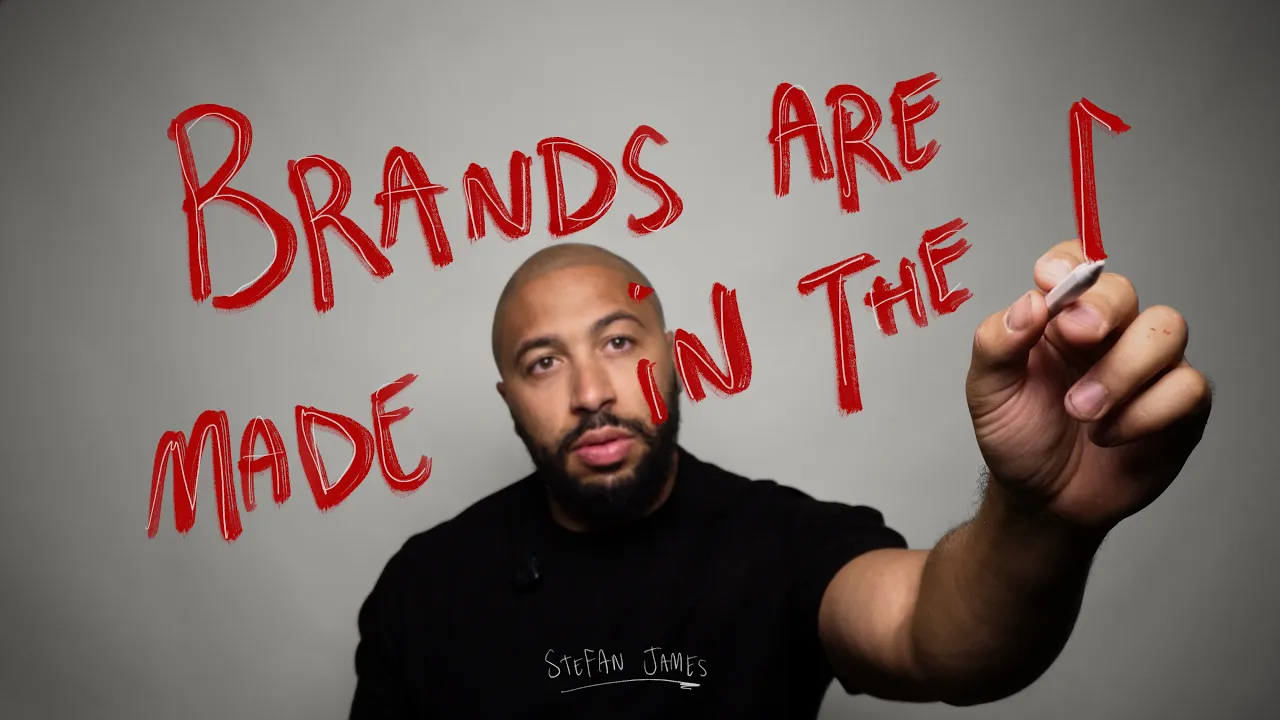
Stefan James · @stefanjames.brandbuilding
Words
4,103
Runtime
21:53
Speaking pace
187wpm
Reading time
17min
187 words per minute, between the 181 median and the 201 75th percentile of 349 measured videos. That distribution comes from the 349-video hook study.
Opening (first 30 seconds)
If you're building a brand, listen up. Products are made in a factory, but brands are made in the mind. They are built in the mind of the consumer, of your target consumer. See the most successful brands right now, say Bloom, Road, Poppy, Cadence, Newtonic, Salt, Represent, Huda Beauty, they didn't just have a great product. They built a cult-like following, and they found a way to hold a specific position in people's minds, ahead of every competitor sitting right next to them on the shelf. They didn't do this by accident. They
94 words, the words spoken in the first 30 seconds at 187 words per minute.
Free, no signup. See how the first 30 seconds hold attention, with rewrites.
Sentence shape
| Measure | This transcript |
|---|---|
| Sentences | 264 |
| Average words per sentence | 15.5 |
| Longest sentence | 137 words |
| Questions asked | 15 |
| Sentences containing a number | 16 |
Most used terms
Filler phrases
67 in total: like 31 · you know 22 · actually 5 · kind of 3 · literally 2 · I mean 1 · right? 1 · sort of 1 · uh 1.
A literal whole-word count of the same phrase list the Prepublish browser extension uses, so a phrase inside another word is not counted and a phrase used in its ordinary sense still is. It is a count and not a judgement.
Free, no account. See where attention is likely to drop, with a rewrite for each weak line. The free check shows the scores and the one issue costing the most. Or run it on the words above first.
Free · No login · See a sample audit first if you prefer.
What this transcript is
Every word below is the caption track YouTube publishes for this video, pulled from the video itself and reproduced unchanged. It is not Prepublish's writing, not a summary, and not a re-transcription: it is the video's own published captions. English captions, generated automatically by YouTube, in the video’s original language. Source: the video on YouTube. A channel that would rather this page did not exist can ask for its removal through the contact page, and it is removed.
No Script X-ray for this video: YouTube shows a Most replayed graph only once a video has enough views.
If you're building a brand, listen up. Products are made in a factory, but brands are made in the mind. They are built in the mind of the consumer, of your target consumer. See the most successful brands right now, say Bloom, Road, Poppy, Cadence, Newtonic, Salt, Represent, Huda Beauty, they didn't just have a great product. They built a cult-like following, and they found a way to hold a specific position in people's minds, ahead of every competitor sitting right next to them on the shelf.
They didn't do this by accident. They figured out how to tap into a handful of mental shortcuts your brain already runs on automatically without you noticing. This is the essence of brand psychology and brand positioning. So, if you're trying to build a brand, whether you're just starting out, whether you're 2 or 3 years in and you're struggling, or you've already got an audience, you're a creator, and you want to launch a product, today I'm going to show you what those shortcuts are and exactly how you build your brand around them so you can take your existing brand to another level or launch one of the next biggest creator brands out there.
You see, a brand is really just a collection of associations all building toward one particular perception. It's not something you can reach out and touch. It's not tangible. That perception lives in the mind. Stick with me. I'll see you in the next part. Number one, owning one concept. The strongest brands don't try to own everything. They pick one word, one idea, and they own it completely. So that word becomes theirs in the customer's mind before a competitor gets there.
Newtonic owns the word focus. Not energy, not caffeine, focus. And it's not an arbitrary word that they've landed on. It came directly from the founders who built the brand. Whether it's Chris Williamson and his obsession to detail, who runs one of the biggest interview platforms in the world, built entirely around conversations with elite thinkers and performers, his whole career is about sustained attention to detail and focus.
His co-founder James Smith manages multiple businesses, successful businesses person himself, successful coach. He comes from more the nutrition and fitness side of things to lend it that credibility. And his whole thing is about being locked in and focus and how he struggles with it because of his ADHD brain. These are two people whose actual working lives are built around focus and precision. And they made a drink about exactly that.
Even the color choices tie back to the conversations they've had publicly about attention to detail, mental clarity, reinforcing the same idea visually that the name already says out loud. You see the same instinct elsewhere too, whether it's in, you know, luxury street wear or high-end performance wear represent 24/7. They don't just own, you know, fitness apparel or men's leggings, for example. It owns a phrase and that phrase is on a mission.
See, that whole brand represents someone on a mission. On a mission to achieve something, achieve a goal, beat a goal, whatever it is. Cole Buckston, a great luxury clothing brand out of the UK. They don't just make gymwear. They own the phrase luxury British sportsware. Three words that tell you everything before you've read anything else. So, if you're building a brand, what's the one word or one idea you can actually own?
Not five things you're good at, one thing. and said so consistently that it becomes automatically yours. Something that no one else is doing or owns at the moment. Number two, the enemy effect. See, every strong brand has something it's positioned against. Whether it's a competitor or more often an entire category norm it refuses to accept. A brand like Poppy, their enemy is an arrival soda brand. It's the guilt built into soda itself or drinking fizzy drinks cuz you know you just feel crap.
So, the founder, Allison Ellsworth, started experimenting in her own kitchen after struggling with gut issues, trying to make apple cider vinegar taste good enough to actually drink. If you've ever drank apple cider vinegar, you know it's it's rough. What she built kept the nostalgia of soda. It was the fizz, the format, the childhood association, while removing the main reason you weren't supposed to still be drinking it as an adult.
The enemy is the old guilt, not a competitor's logo. I mean it could have well been Coke or Dr. Pepper. They made the expectation of the category the enemy. Cadence they run a version of this too. Their enemy is dehydration itself and specifically the miseducation around salt. The decades old idea that salt is something to avoid. Now if you're someone who sweats a lot or you train harder or you're an elite performer, you need more salt.
The average person probably doesn't. It's probably going to give you high blood pressure later down the line. But the founders George Heaton and Ross McKay built cadence around the opposite claim. If you train or perform at a high level, you need more salt, not less. There's so much imagery and and the art direction is built around more salt, not less. And that's a direct stand against public health messaging. Most people have never ever questioned their life.
And it's also worth noting that quietly underneath Newton's focus positioning, there's an enemy there, too. whether it's Red Bull or Monster, the sugar spike and crash model of energy drinks in that category. See, Newtonic never attacks them directly. It just built something that works completely differently. So, what's the norm in your category that you genuinely disagree with? Not a competitor's name, but the actual belief or the practice everyone's just accepted as normal.
Number three, the halo effect. See, one strong credible signal can color judgment over an entire brand. Even the parts nobody actually checked yet. A brand like Road, they didn't need to build trust from nothing. Okay, they leveraged that from Haley Bieber and her own aesthetic and her own celebrity. Minimal, glazed, considered, already existed as a fully formed idea in millions of people's minds long before the brand launched a single product.
That existing authority transferred straight into the skincare line. It was like a shortcut. So people naturally felt like the formulas would be as thoughtful as her personal style, often before they'd read a single ingredient. And you look at another beast of a beauty brand, Huda Beauty runs on the same mechanic from a different angle, though. Huda Katan had already built genuine credibility as a makeup artist and an educator for years before her brand existed.
So the halo wasn't a borrowed frame. It was earned expertise that was almost transferred into a product line. So, what's the one existing signal, whether it's your own background, a piece of credibility you already have that could cast a halo over a product before anyone's even tried it? If you follow the channel, you know I talk a lot about, you know, working with agencies and the kind of stuff that I've done branding wise. that is to one stamp some authority so you you can kind of trust in what I'm speaking about that it's coming from an authentic space but also an authoritative space where I actually know what I'm talking about unlike some of these YouTubers who just jump online and talk a load of [ __ ] or they talk about stuff that's branding that's taught in universities or brand strategy that's designed for clients who have hundreds of thousands of pounds or millions of pounds worth of budget big massive companies and they're not speaking to small brands that are trying to get going or brands doing 10K, 20K, 30K, 50K a month or the content creator that's already got a brand who wants to leverage their audience to then launch products off the back of it.
So, you'll hear me talk a lot about, you know, working on big campaigns for for top London agencies from, you know, top brands like LVMH, Tiffany and Co., Marks and Spencer, Metro Bank, Suzuki. So many campaigns I've been involved with. Not only that, Google released a flagship digital marketing program where they taught the industry. So that's again top brands to small brands to founders, CEOs, marketers, marketing directors.
We created a program that helped them do digital strategy better. So every day I was speaking to these people. Every day we were developing the cohort to make it more helpful to them so they can roll it out to their teams. Also I've worked on branding projects, PR projects, social media projects for you know big brands. But what I started to understand is a lot of these things weren't really in reach for people who are starting their own brand.
And I've come to realize that a lot after studying brand psychology, brand building for years, just some of the books I have laying around that I love to read. So I jacked all of that in to build my own brand. I didn't know what it was going to be, but I knew I had to one become an entrepreneur because I hate working for someone and I'm got to use my creativity in some sort of way that's going to make it very lucrative and profitable and just give me a happy life.
So you know, I tried so many different things. I I launched products on Amazon. Some did really well, some bombed. Everything from sportsear brands, gum shields to air conditioner hoses to drill attachments. You know the Amazon hustle. But I created premium brands in that category and I was able to jump in, manufacture a product, give it a point of difference, find a target market for it, then create a brand around it and then roll it out and sell through units.
But I kind of found that a bit soulless and it was just a hard slog trying to keep ranking your stuff on Amazon every day. So then I launched a couple of e-commerce brands and you know a variety of different stuff from supplements to like pocket squares. They did okay. Some some didn't get that far. Some did well. But my most successful brand is a fine art brand which I started from a broken table with no experience, no connections.
Didn't even know how to paint. I just understood that the landscape looked really boring. I hated what was out there, you know. I hated what was in galleries. It was just so boring. There was no one speaking to someone like me who, you know, when I moved into my new place, I really wanted a piece of art that spoke to me. And I managed to carve out an alternative brand, a disruptive brand in in the fine art world. And over the last 5 years, if you know anything about fine art, it's absolutely impenetrable and so difficult to break into, let alone make any money.
To this date, I've produced and sold over2 million pounds worth of fine art through my distribution and network of galleries to my own collectors, through art investment floors who, you know, because my prices been going like that, a lot of investors are now jumping in to buy my work. And I did that all through brand psychology, brand positioning, creative direction, you know, having a great creative eye and being able to execute on creative ideas.
I did that work. I, you know, I got involved in luxury collaborations with private members clubs. I did a launch with Porsche to launch a new 911. I've done loads of stuff over these last 5 years. And I did that not knowing what the [ __ ] I was doing, just understanding brand psychology, brand positioning, creative direction, and having so much hustle and and determination to just make something successful. So, it's been a really rough ride.
It's been a lot more downs than ups. I still have down days. I still have tough days, but I feel like I've got to the point now over the last decade of of just experimenting and and just [ __ ] around and finding out and having a lot of losses, but a few wins to to know that I'm credible enough to talk about this stuff. So, look, I might not had a million pound, multi-million pound exit. I'll leave that to the other YouTube gurus who, you know, have built these massive e e-commerce brands.
I've built these small brands that have really resonated with the target market and I've seen brand campaigns rolled out across millions of people. I've been part of those conversations. I've been part of those executions. I've been part of those rollouts. So, the halo from all of that stuff I just mentioned should now make you jump into the link in my bio. Click the link and sign up for my 33-day email course. It's literally a a nugget of information every day uh based on all the stuff that I've learned to help you elevate your brand and really understand brand psychology and how it works.
So, it's free an email every day for 33 days. And at some point, I'm putting together a live cohort. I only want to take on like 15 to 17 founders. No matter whether you're you're just starting out, no matter whether you're doing 10K, 20K a month, or if you're a content creator and you've got an audience already and you're ready to launch a product, but you just don't know what, or you've got an idea for a product and you want to take it to the next level.
I'm going to be teaching this stuff because I feel like I need to up the level of branding education that's on YouTube. So, the halo from all of that should make you feel good about the information that I'm going to continue to deliver on this video, on this channel, and right in your inbox. So jump into the link, grab that before I remove it. Number four, authentic scarcity. See, real scarcity passes one test. I talk about scarcity on the channel.
I've got another video deep dive on this. I can go on about it for ages, but go and watch the video if you're interested. So the one test is, would it still be true if zero customers are watching? See, a lot of people put like fake countdown timers or say, "Oh, we're about to sell out." and then a week later they just released 500 more hoodies or something like that. It's [ __ ] People see through it and it ruins the integrity of your brand.
It ruins the whole perception of your brand. See, a countdown timer that refreshes, it just fails to hold up to scrutiny and it lets you down. However, a genuine supply constraint doesn't. One of the reasons my fine art brand is so successful is because there was a genuine constraint. Number one, these things are limited by design. I will never ever create the same piece ever again. And if we launch prints, they're very small additions and once it's sold out, the screen is destroyed and we chuck it away, never to be made again.
So, there's real FOMO there. But not only that, a lot of that stuff before I brought in my production team, it was tied to my own time. And look, I'm a family man. I've got hobbies. I like to train. I want to be in the studio all day, all night. I was doing that for the first year. After that, I said, "Fuck this. I'm only going to paint two days a week, and I'm only going to paint when I want to." So naturally I could only produce a certain amount of original works and what happens is with supply and demand in the market if there's less supply and the demand is still going up the price point moves up.
Okay. So when I was saying that this is the last one left or you know this collection is only this amount of pieces and it releases on this date through these galleries and through my social media channels that was a genuine scarcity tactic. See and it was also what I like to call a genuine supply constraint. So, if you take an ecom brand like Salt, an influencer brand, that's blowing up at the moment. It's a really clean example of this.
See, the co-founders Millie Goldsmith and Henry Propora, I think his name was, is built over 6,000 people onto a wait list before they even launched product. And their first production run sold out in hours, not because of a manufacturer drop, but because real demand outpaced what they could actually produce. If you're used to producing or manufacturing anything, I've been there quite a few times. It's painful. You only have a certain amount of money and you want to get as many units as you can without compromising on quality.
With a brand like this, they only had a little bit of money and they had a little bit of stock, but they managed to create so much demand in the leadup to that. That was a genuine supply constraint. And that's the difference between real and fake scarcity. The scarcity wasn't designed, it was discovered. And that's the difference between fake and real scarcity. Another brand, Bloom, they had a similar moment early on in their journey.
Their greens powder wasn't even meant to be the hero product of their range, and it sold out almost by accident on a small initial order before a restock did over a million dollars in a single day. Neither brand needed to fake anything. The constraint was already real. So ask yourself, where in your business is a genuine constraint already sitting? Is it a production capacity, your own time? Is it sourcing? Is it the specific fabrics you use that are really hard to come by or really expensive that you can't buy in bulk?
Instead of hiding that stuff, bring it to light because it's authentic. It's real. It's part of your founder journey and your brand's journey. What we're seeing now is a consumer shift from mass- prodduced goods to goods that people really want to feel are limited in supply and are very considered. Let's take a brand like Odd Muse or Man Devoir. It's affordable fashion, but they're at the higher tier. So, they would rather you buy one or two statement pieces, whether it's a blazer or a jacket or a specific tailored pair of trousers, over buying 30 different products at fast fashion places like ASOS or like Ooly or something like that.
They're literally saying, "We're not that type of fashion brand. We're not a fast fashion brand. We're more of a considered fashion brand." And they are absolutely killing it at the moment. They're two of the most successful UK fashion brands going. Number five, creative direction and owning a word or a color or an aesthetic. So, if you follow this channel, you know I talk about creative direction and the and the aesthetic, the vibe and the visual language of the brand, brand psychology, brand positioning, and founder mindset, right?
Creative direction, visual and verbal identity work in the same way. So, the goal isn't to look nice in general. is to own one specific repeatable signal that speaks directly to the exact community that you're building for. So Cole Buckston, founded by Cole Buckston and Johnny Wilson, was built as a direct reaction against loud, overbranded sportsear. Heavyweight, minimal, understated, premium fabrics aimed at people who wanted gym wear, but they're not the ones to shout.
See, that restraint became the whole visual language, and luxury British sportsear became a phrase that they own outright. Now take those same two founders for another clothing brand that they've either part own or really entangled with. UVU amazing brand. They claim something even simpler. One bright pink instantly recognizable logo represent one of the hottest clothing brands at the moment. George Heaton's clothing brand built its identity around the phrase on a mission.
Verbal ownership that and that's verbal ownership working exactly like a color or a shape does. And then you have Cadence with their own minimal considered packaging and the packaging design which carries the same restraint from represents world directly into completely different category. So we've never really seen a sports drink that looks like Cadence. So ask yourself, is there one visual or verbal element in your brand right now that's genuinely unmistakably yours?
Or does everything you make still look like it could belong to someone else? Number six, the contrast effect. This is really powerful because we notice things by how sharply they differ from what surrounds them, not in isolation. So sometimes the strongest move a brand can make is simply refusing to look like everything else on the shelf. So Bloom is the clearest example here. Preworkout culture and products at that time were red, black, chrome, loaded with caffeine, very masculine, aimed squarely at an aggressive gym bro aesthetic.
So the founder Greg Le and his wife Mari, they didn't try to make a slightly nicer version of that. They built the opposite. Softer colors, lower caffeine, natural ingredients, and that contrast against everything else in the category is what separate it apart. And it's exactly what made it stand out on site. A brand like Salt does something similar from a different angle by refusing to sit at either extreme of hydration.
Whether it's, you know, not being for the hardcore athlete and not being for a hangover cure, standing out precisely by occupying a space that nobody else is building for the casual person that just wants to feel hydrated. So, what does everyone else in your category look and sound like right now? And where's the obvious uncomfortable opposite you haven't tried yet? Think about how you can integrate the contrast effect into what you do and your brand and what you want to build.
Number seven, tribe identity. The unity principle. See, one of us is stronger and a stronger bond than a customer. The strongest brands don't just sell to an audience. They give that audience an identity to belong to. So, Huda Beauty built this sequence out almost perfectly. Huda Katan spent years building a genuinely engaged following who loved her tutorials, honest reviews, real expertise long before Huda Beauty existed as a product line.
And when it finally launched, it wasn't just a stranger's product asking for trust. It was something the audience felt they'd already had in hand for years or months before because they've been part of the journey the whole way through. So represents on a mission and that language that they use about chasing stuff, ambition, goal orientated, digging in, going after it. That language does similar work. It's not just a tagline.
It's an invitation to be part of something, not just a purchase. And you look at Bloom, their earlier days, they built a 100,000 person Facebook community before the product even existed. It's the same mechanic again. The tribe came first and the product came second. So ask yourself, does your audience currently feel like customers or do they feel like they're becoming part of something? And what would need to change for it to feel like more of an identity alignment and and more of a journey, not just a transaction?
See, none of these eight brands work because the product alone was good enough. Each one found a different mental shortcut, owning one concept, one enemy, one halo, real scarcity, a distinctive visual or verbal signal, contrast against everything else in the category and or a tribe built before the product even existed and then built the entire brand around it. If you want to go into any more of these details, this is exactly what the course goes into module by module.
I'm going to be doing master classes and a live cohort. I'm going to take 15 to 17 founders or content creators and we're going to build your brand together and make it elevated, more premium.
The words are the caption track's own and nothing is reworded or re-transcribed. Paragraph breaks are placed between sentences so the text reads as prose.
Free tools for your own script: paste a draft and see where it stands before you record it.
Paste your draft and see where viewers are likely to drop off, with a rewrite for each weak line.
Paste the first 30 seconds of your own draft for a hook score and rewrites.
Check your draft against YouTube's advertiser-friendly guidelines before you record it.
Read this channel's public videos and transcripts, and download a writing brief for it.