Getting the transcript
Reading the captions from YouTube. A video nobody has opened here before takes 10 to 30 seconds; this page fills in on its own.
Getting the transcript
Reading the captions from YouTube. A video nobody has opened here before takes 10 to 30 seconds; this page fills in on its own.
The Andrew Faris Podcast · @andrewfarispodcast
Words
5,651
Runtime
23:29
Speaking pace
241wpm
Reading time
24min
241 words per minute, above the 201 75th percentile of 349 measured videos. That distribution comes from the 349-video hook study.
Opening (first 30 seconds)
If you are the kind of person who's paying any attention right now to the public conversation around D2C media buying in this moment, then you have certainly come across the issue of CPMR, which is really a shorthand, an acronym, because we love acronyms in D2C. It's really a shorthand way of talking about the reach of your meta ads and the cost of that reach. How many people are you reaching for the dollars that you are spending, and are there ways that that is hurting or helping your business uniquely? CPMR, just to be clear about it, right? CPM just refers refers to cost for a thousand, uh M M, the Roman numeral thousand, cost for 1,000. And
121 words, the words spoken in the first 30 seconds at 241 words per minute.
Free, no signup. See how the first 30 seconds hold attention, with rewrites.
Sentence shape
| Measure | This transcript |
|---|---|
| Sentences | 295 |
| Average words per sentence | 19.2 |
| Longest sentence | 91 words |
| Questions asked | 41 |
| Sentences containing a number | 9 |
Most used terms
Filler phrases
112 in total: like 36 · you know 17 · sort of 16 · actually 11 · uh 8 · right? 7 · kind of 5 · literally 4 · um 4 · I mean 2 · basically 2.
A literal whole-word count of the same phrase list the Prepublish browser extension uses, so a phrase inside another word is not counted and a phrase used in its ordinary sense still is. It is a count and not a judgement.
Free, no account. See where attention is likely to drop, with a rewrite for each weak line. The free check shows the scores and the one issue costing the most. Or run it on the words above first.
Free · No login · See a sample audit first if you prefer.
What this transcript is
Every word below is the caption track YouTube publishes for this video, pulled from the video itself and reproduced unchanged. It is not Prepublish's writing, not a summary, and not a re-transcription: it is the video's own published captions. English captions, generated automatically by YouTube, in the video’s original language. Source: the video on YouTube. A channel that would rather this page did not exist can ask for its removal through the contact page, and it is removed.
No Script X-ray for this video: YouTube shows a Most replayed graph only once a video has enough views.
If you are the kind of person who's paying any attention right now to the public conversation around D2C media buying in this moment, then you have certainly come across the issue of CPMR, which is really a shorthand, an acronym, because we love acronyms in D2C. It's really a shorthand way of talking about the reach of your meta ads and the cost of that reach. How many people are you reaching for the dollars that you are spending, and are there ways that that is hurting or helping your business uniquely?
CPMR, just to be clear about it, right? CPM just refers refers to cost for a thousand, uh M M, the Roman numeral thousand, cost for 1,000. And typically, when people refer to CPMs, they're referring to a thousand impressions. So, just ads served, okay? But, actually, but but when you go to CPMR, what you're saying is not just number of ads served, but number of actual people reached. The R stands for reach. So, the cost to reach a thousand people, and this is significant because if you're reaching the same people over and over again, then your cost to reach more people goes up, no matter what CPM is, okay?
So, no matter what the actual impressions cost. So, so, the point is that over and over, what people are talking about right now, this is very live conversation on X. Um I've had an episode with Cody Plafka, who's talked about this a bunch at Jones Road, and what they've been trying to do to solve this problem. Recently, the Marketing Operators had an episode where Connor McDonald talked about the the issue of signal engineering to affect the reach of Ridge's ads, and had some very helpful things to say about that.
And in all of this, the point is there's this issue where meta seems to get stuck in a loop in its ability to to serve your ads to the right people, and so you need to do something to solve that problem. Basically, how do you reach the maximum number of people? And uh and my I've sort of not said too much about this conversation necessarily. With Cody, I talked about it a little bit. Cody's a really smart guy, and so when I had him on the podcast, I wanted to hear his take on this.
I I believe he's seeing something real there. Connor McDonald, really smart guy. I believe he's seeing something real there, you know, when when they're talking about this. Phil Kael on X has been seen this in a bunch of accounts. He's talked about I'm trying to get Phil on the podcast as well to talk about sort of what he's doing with his clients. I think he's seeing something real and Taylor Holiday and CCC have posted sort of like the contrary case on this as Taylor's want to do, talking about how they are not looking very much at this metric because maybe it doesn't do some of the things that people say it does for a whole bunch of reasons.
In any case, that's been the the the the discussion or surrounding that discussion about how do you get your ads to reach the the most number of people and where I've gotten to most recently is an approach to that problem that I think um has sort of clarified my thinking on this. And by the way, before I go any further, I would love for you to leave me a comment on this video to tell me if you are actively thinking about this issue or even if you have questions about this particular issue in your brand, I'd love to know who is actively thinking about it, what you're doing about it, how you're engaging with this issue with your brand, you know, any of your thoughts.
I'm really curious what the broader community is saying. I see some comments on X in here and there, but I'm curious about it. So, leave a comment on this video saying those things. And hey, while you're at it, subscribe cuz, you know, that's what I'm supposed to tell you right now. But you know to do that, subscribe. All right, here is my overview take on CPMR right now and on this issue of reaching more people with your ads and whether or not that's important.
If the problem that people are saying is that there's this loop problem with your ads where you're getting the same people over and over again, what I want to say is CPMR or just reaching more people with your ads is definitely important. It matters a lot, okay? And yet, it also doesn't matter because really what CPMR is is just another way of saying that if you want to spend more money on ads effectively, you need to reach more people.
Now, that's somewhat oversimplified, okay? But it's also sort of intuitively true that it's the case that if you want to spend more money, you want to grow your spend, you have to reach more people. It's very unlikely or at least it it is it is certainly is likely the case there are diminishing returns on reaching the same people over over and over again. This is sort of always been obviously true that if you just run up your frequency for forever, there's diminishing returns on that ad spend and that that spend is less incremental.
Now, people can overstate this and I want to get this out of the way right now. People regularly will say you must reach more people all the time and there's a way in which that's clearly not true. I'll just tell you if you want to reach the most people with your ads, you should run reach campaigns or link clicks campaigns or video views campaigns because the CPM are on those campaigns on meta ads is dramatically cheaper than running conversion optimized campaigns.
But the reason you don't do that is because you understand that there's a level of shopping intent inherent in what we call a purchases audience or in purchase optimization that makes the click more valuable to you, that makes the reach more valuable to you. And if you extract that same principle forward, then you should also realize that it is also more valuable to serve people ads sometimes when they're lower in the funnel.
People have been retargeting with digital ads forever. Like I'm I heard the word retargeting in the first week I learned anything about ads probably, you know, back in 2014 or whatever when I was literally brand new to the space. People It was one of the first things I learned was this idea of retargeting people. It's always been seen as a good thing. You want to hit people with ads when they have intent to buy and that's the same principle as the purchase conversion audience, right?
The the purchase audience. Like the notion that you want to serve ads to people who are more likely to buy is as intuitive as the notion that you need to reach more people if you want to spend more money. Those are both true, okay? And so, what you then have to do is to find a way to combine both of those at once. And this is why it's overstated to say that the entire or that, you know, reaching more people is sort of the only goal.
As Taylor and CPC have recently put out, in fact, you often get a higher incremental ROAS or at least an equal incremental ROAS on your ad spend by serving ads to people who are sort of let's just call them lower funnel than than you do on people who are higher funnel. And therefore, it is often worth it to do that. So, so sort of blindly saying you need more reach is too much. But that said, I want to repeat my earlier statement that I think is sort of intuitively and obviously true and in fact has always been true before people started talking about CPMR.
And the statement is this, CPMR is important because it's just another way really of saying to spend more money you need to reach more people. This is what it means to try to grow your brand, okay? Is to reach more people with your ads and get them to convert. If you are hiring to grow your team, if you want to make a bigger impact across the things that you're doing and you don't want it to cost you an arm and a leg, but you do want great people, you should look in the Philippines with my friends at More Staffing.
More Staffing is keeping all the time a pipeline of high-quality Filipino talent, people with e-commerce resumes, who've been in the game for a while, who know what they're doing, who are accessible for your brands that you can get all the advantages of growing your team without having to do all of the legwork of finding somebody new and also all the advantages of growing your team in the Philippines. Those advantages are incredibly [music] high-quality talent, native English speakers, pretty much everybody grows up in the Philippines speaking English, and uh people with real resumes, and yet you can do that at a price that is affordable, especially relative relative to local talent in the US.
And More Staffing, because they're built on the back end originally of an e-commerce business in the US, they really understand the game of what it means to build a successful e-commerce business and how Filipino talent fits into that, including even questions around workflows and culture fit and things like that. They can actually help you with a whole system of onboarding, even AI integration, things like that as part of their services these days.
It's really awesome. On top of all of those things, More Staffing will give you a one-year guarantee on a hire you make so that if you have to replace that hire within a year, they will help you to do that without any additional headhunting fees. So one-year guarantee is amazing. It's way more than what most people will give in the headhunting space, in the recruiting space, if you know that. So uh go to morestaffing.co/af.
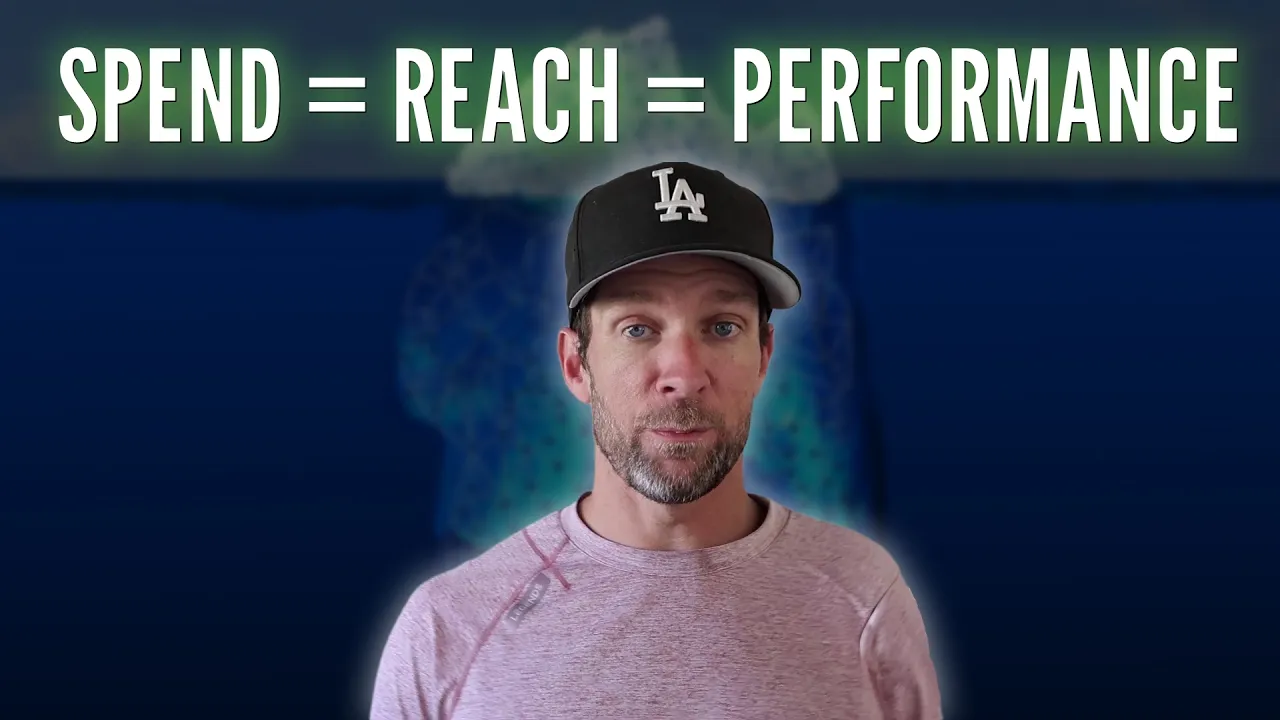
I just hired again from More Staffing. I've built the majority of my team with More Staffing. Everything I do at some point More Staffing is going to touch. I'm just a huge fan. Go check it out for yourself today. morestaffing.co/af. No-brainer in your business. Go do it today. You could put it another way. Performance equals spend, which equals reach. And like I said, that is literally always been true. We are all on Meta Ads trying to spend more money.
There is just some cost of acquiring customer at which we don't want to spend the money, and some cost at which we do want to spend the money. So, we're trying to spend more money within the constraint of some amount of cost that makes a conversion go from a value center in the business to a cost center in the business, okay? So, we need to reach more people to spend more. We have some cost constraint on how much we can we can pay to reach those people, and maybe some other business constraints depending on a bunch of factors, but that's always been the case.
So, if you want to reach more people with your ads, if you want to, you know, the word we would use for this forever is scale your ad spend, okay? Then, you need to have a great ad account, right? The mistake, I think, that many people make in this conversation right now with this idea of CPMR, is they look at something like, "Okay, we need to lower our CPMR or we need to extend our reach." If that's the case, then the mistake is to say, "We need to solve that primarily with media buying tactics." Like, there's this metric you have to optimize for called CPMR.
You have to go do all of this stuff. In fact, in in a recent Marketing Operators episode, and I'll link it in the show notes, okay? Cuz it's a really good conversation. There was a Q&A episode that the two Connors on that show did, and the first question that they answered was something like, "What's most important for extending the reach of your ads or for driving down your CPMR?" I don't remember how it was phrased exactly, but something like that, okay?
Is it creative? Is it landers? Or is it signal engineering? And signal engineering would be sort of how you handle your data that you send back to Meta via work with pixels and account setups and things like that. Is there some way to engineer with media buying practices? And we'll just kind of use that. Instead of saying signal engineering, we'll say media buying practices. Cuz like that would include signal engineering.
Which of those is the best of those two to do, okay? And, you know, the guys on that show the first thing they said was was probably the most important is creative. Landers is probably the least important. There's maybe some some ways in which it could be true. Signal engineering can matter. Connor McDonald gives a great example of that that I want to talk about a little bit more later as a caveat on this, but creative and creative diversity is the key to doing that.
In fact, what got me thinking about this podcast episode was that I wanted to do an episode about creative diversity. And again, I'll tell you to subscribe because there's going to be a part two of this episode where I talk about how creative diversity relates to this question. So, um that'll come out uh probably in about a week after this one. But, the thing is if what those guys said on the episode and what I think is is true is that creative is the path to maximizing your reach, okay?
In particular, creative diversity. A high volume of good quality, highly diverse creative. That's the way to do that. And you know what's so striking about that to me in all this conversation about CPM R and everything else? That has always been true. Like literally from the first day that I was running Facebook ads, it has always been the case that the that the way we all conceptualized maximizing the reach of our ads and maximizing performance of our ads was by having more and better high-quality creative.
And by high-quality, what I mean is high-performing, okay? More creative that is better wins. And that's how you do that. And when you do that, what happens? You're able to spend more money at your target cost. And the way you're able to do that is because you convert more customers. And there's a bunch of mechanisms for converting more customers. It might be reaching deeper into an existing audience. It might be reaching new people that you weren't reaching before with different kinds of creative and angles, messages, and blah blah blah.
But, in any case, some creative mechanism like that reaches more people with your ads and it grows your ad spend. And that's why we've had creative agencies for forever. And that's why we've had performance marketing agencies for forever. And that's why people have been doing this for forever. And when somebody comes and wants to sign up with AJF Growth, they want to know what kind of creative we make and how good of a job we're going to do.
And is it going to make their ad account perform and spend and all those things? Because we have all known that reaching more people comes via better and more diverse creative. And that is why, as I thought about this question about what is my take on CPMR, how do I evaluate this conversation, what I've come to think what I've really come to realize is that at AJF Growth, we've almost never had an internal conversation about CPMR.
We've basically never talked about that issue. I've never once, literally ever, showed somebody a report that said, "Here is your CPMR. Here is your reach in a different way than before." Occasionally I have referenced it while I'm looking at different strategies and tactics for different things for a brand. There's one brand in particular that's really seasonal and has a big holiday moment and that we were kind of looking at, "Okay, well, how much How many more people are we reaching with our best ads?" At one point somebody was talking about some similar thing, you know, one of the critiques I've gotten about manual bids, bid caps, that kind of thing is like, "You're going to limit your audience reach by running bid caps because you're not going to be able to extend as far." But then I would look and see these brands where it's like you go from reaching 2 million people in a seasonal down moment to like 20 million million people in a in a higher demand moment and you realize I my bid cap ads were having zero problem reaching additional people as long as those people as long as the demand side grew, the bid caps were actually incredibly good at extending the reach of my ads to go reach where there was more demand as the moment got created.
And so that's like the closest I've come to looking at reach like this. But when I did that, do you know what I was actually looking at, what I was actually measuring? I was looking at spend, I was looking at revenue, I was looking at ROAS, I was looking at CAC, all of the normal metrics to do this because ultimately, if you're spending a bunch more money, guess what? When you spend a bunch more money, it's because you're probably reaching more people with really good creative and the way you do that is with better creative.
And then, as as the story I just alluded to implies, seasonal moments matter a lot. Product matters a lot. Marketing moments matter a lot. All the normal stuff that I talk about all the time and that you should be thinking about all the time in your brand. Great creative, highly diverse creative, great marketing calendar, great products, a brand that resonates deeply with really with real people. Those are the things that really matter and that really move the needle for your brand, and those are the things that really move the needle for your performance of your ads and ultimately the reach of your ads.
Well, I should say the reach of your ads and ultimately the performance of your ads. They're reverse the order of those two, okay? You'll do that by doing all of the stuff that brands do really well. So, the way that we have extended the reach of our ads has been Well, I mean, let me put it like this. We've always been trying to extend the reach of our ads. We've been trying to attack CPMR forever. We just never called it that.
What we called it was spend. And what we called it was revenue, and what we called it was ROAS, and what we called it was contribution margin. And the way we've done that is with great, high-performing creative delivered to broad audiences with the volume of distribution controlled by my CAC and ROAS targets using manual bids. The same media buying playbook that we've been talking about forever, which is also why I think when I saw this conversation come up, I would say, "I don't understand why I'm not seeing this problem that other people are seeing.
They're all talking about the CPMR issue." I don't get it. Like, I don't know. We just don't really see this issue. We do it all the time. We create a high volume of high-quality, highly diverse for our clients. We distribute it with manual bids, and in point of fact, we see accounts spend more money and reach more people as we do it. And that's what we do, and that's why we keep doing it, and that's why we keep building a system to sell more of this this service to other people because it keeps working.
And our service is good, and like our brands work, you know, mostly. Not every time, of course, but like we deliver a great service, and it and it does that by focusing on those things without tracking CPMR because we track spend and revenue. It is time to add IntelliGems to your tool set in your Shopify store. You should be testing all of the ways that customers interact with your brand and with [music] your store and the the site experience that they have.
You should be testing the price of your products. You should be testing your shipping threshold. You should be testing how much you're charging for shipping. You should be testing your first order offer. All these things that you do that your customers interact with all the time that you probably pulled out of thin air, you should test them and optimize them and make them better and make it a better experience for your customers and get more value out of the customers that come to you at the same time.
That's what Intellgems helps you do at the core and they do that or reporting the outcome of every CRO test. I'm calling it CRO. They don't even like it when I call it CRO cuz it's way beyond just basic CRO. But the basic idea of split testing on your website, they do that way beyond the basics and they measure the outcome of every test as I was saying down to the level of profit per visitor. They tie into your cog data on Shopify so you know not just did your test convert more did you change the AOV, did you see [music] traffic perform better at those top level metrics, but did you actually get more profit per visitor?
You can even have reference there to how many subscribers that you got if you're testing subscription type offers. So, see what the subscription subscription take rate is on your offers. You can also see LTV implications. Those are coming. You can test [music] things at checkout now, which is awesome because that obviously has a huge impact on your business. It's just a great tool. [music] It's easy to install. You don't need a developer and if you're running into any trouble, their their customer support is second to none.
They're really good at helping you do that. Go to Intellgems.io. Use the code Ferris20, f a r i s 20, to get started with your testing today and get 20% off your first 3 months. Ferris20, get 20% off your first 3 months with Intellgems. Get testing now. Build it into your operational process. Be testing all the time. Make a better website all the time. Grow your AOV, grow your conversion rate, get more profit per visitor.
Make it part of your operational process and hammer away at that for years with Intellgems as the core tool doing it. That's what you should be doing. That's what many of my clients are doing. Intellgems.io. Ferris20 for 20% off your first 3 months. Go do it. Now, here's the thing. I also don't want to strong arm anybody else here. There's a caveat here. There are certain accounts where I can see the case for what I might call more signal engineering, focusing on CPMR, focusing on the reach of your ads, focusing on really looking and honing in on this metric as something else.
Let me tell you a couple of them. I can imagine that stalled out accounts may need to look at this look at this. And when I read some of Phil Kiels posts about this, about CPMR, this is what I see him doing, which is he's using the reach of his ads in the CPMR as a leading indicator of the decline in performance, okay? So, in that case, it's not that CPMR is magical or something like that. It's just that he when he sees that the reach of ads is going down, he knows, "Oh, something is really wrong here and I need to use that to go do a bunch of things." Now, he I don't I don't want to state Phil's position that that may be slightly wrong what I just said.
Like I said, I'm going to try and have him on the podcast here soon. He's been writing a bunch about this. And I'm And what I'm really going to ask him about when he comes on, again, you should subscribe so you don't miss this conversation cuz I think he's going to have a lot to offer here. I've liked a lot of what he said about this. What I'm going to do is is really try to talk to him practically about how he's using these tools to extend reach and then is he doing something at the media buying level that is sort of helping to solve this problem that you might call a signal engineering or media buying or campaign structure or whatever, okay?
Another place where I could really see this mattering a lot is very large ad accounts, right? This is this is I think what's part of what's going on with Cody Parkey and his team. I look at Cody and his team and and his team and what they're doing with those marketing operators guys with a spending gobs of money on nine-figure businesses, right? And I say like, "Okay, I could imagine that you are just tapping out audiences much faster than other people." And it's it's hard if you're doing that.
Like so, how do you go and make sure that you don't get stuck on the same people over again and keep extending your reach and keep expanding the reach of your ads when you're spending so much money already. Essentially like one way to think about this is I'm pretty sure Cody at Jones Road was never tracking this metric on his way to building a nine-figure business. I think what happened probably And Cody, if you're listening to this or watching this I I don't expect you to watch or listen to every episode of mine.
Correct me if I'm wrong. Well, I'll be happy to happy to talk about it. My guess is the way he got to the world that he got to now where this becomes a problem is by being so successful at the level of creative and all these things that he's spending so much money that now you have to think a little bit more carefully about things like the total reach and the total lift of your ads in ways that are different, okay? Again, it's similar to Connor Connor McDonald and and and Connor Rowland, there's running really large ad accounts, really big businesses where this becomes a little bit different.
The other place where I think is probably the most notable place where I can imagine this. And And this is one of Cody Plothker's points on this issue. Cody said Cody says, one of the problems is that Meta will reach will just sort of go towards the highest converting customer with your spend even if it's actually not where you want to direct it because of a bunch of issues. And Connor McDonald gave a great example of this particularly around the idea of spending trying to grow categories that don't have natural customer overlap with your current categories.
So, the example Connor Mac gave on Marketing Operators was that for Ridge, they have this wallet business that they've had forever. Ridge wants to grow their travel business and when they would run travel ads, you know, like suitcases and stuff, right? Luggage. When they run those those ads, if they didn't do some signal engineering, if they didn't do some media buying stuff, and I'll let you go listen to that episode to to talk about what he did exactly, but then what would happen was he said 40% of clicks on their luggage ads would be people buying wallets.
So, that would tell you that they're serving to sort of warm audiences and for wallets because wallets have been their biggest and most dominant category. But that when he did the signal engineering stuff he did, he got that number down to 6% because otherwise Meta was going to retarget people and and again, they have such a big pool of customers who are spending so much money that it's sort of hard to get out from under that.
So, spending across categories for brands already spending a whole bunch of money makes this a a bigger deal for someone like that. That's reasonable to me to think that that would be a problem for a brand like that and partly just, you know, I trust that my guy is smart and he's he's he's telling us what's going on. I have a customer for example that sells toothpaste. They also sell some dog tooth teeth cleaning products.
It's possible that we would want to think about different things there. I'm actually going to tell them probably you want different brands for for this, you know, to really think about setting these up. But from But those are the the caveats I see. Stalled out accounts, I can imagine this being an issue where you're sort of reach the natural TAM limit and you've got to try to reach beyond those people. Very large accounts and then across categories with less natural customer overlap.
Now, I still if I'm running ads across categories with less natural customer customer overlap, right? Where the those customers just don't shop across categories. That's the key point point that Connor said about Ridge that travel customers are pretty different than their wallet customers, okay? So, there's reaching those different people is hard. You you have to actually reach different people, okay? In those cases, I might consider some media buying and signal engineering things to do this even if it's just as a leading indicator.
But, that's that's the challenge. For most brands though, you should go back to the basics. Make a high volume of highly diverse creative and let that be the engine of growing your spend and growing your reach and growing your performance. That's the approach we take with our clients and I sincerely think it's the reason we don't see a persistent reach problem because we already have built a process. The whole process on the foundation is built on a high volume of creatively diverse ads, okay?
Um our approach to creative diversity is not as simple as make ads that look different. In fact, it's much more complex than that and that's why I'm going to do a part two of this episode to separately have a conversation about what that looks like for us. So, like I said, subscribe wherever you're watching or listening. That episode will come out next week and I'll tell you how we build a process to create diverse creative and what creative diversity actually means in a way that will extend your reach.
Otherwise, carry on trying to reach the most people with the best possible ads you can. That's the number one thing you need to do if you want to drive down your CPMR and drive up your performance. All right, thanks for watching and for listening. Like I said, the link to the Marketing Operators episode I was referencing, which is great. You should go listen to that, is in the show notes. So is the link to the previous episode I did with Cody.
If you're wondering what we talked about there and subscribe to not miss the future follow-ups on this with Phil with uh myself doing the creative diversity breakdown. And uh everything else that I'm doing is at ajfgrowth.com. If you want to tell me about your brand so I can see if I can be some help to you uh and what you're trying to accomplish, whether that's coaching or taking you on as a client at some point or or even referring you to somebody who who might be a great fit to help your brand do the things that you need to do.
You should go to ajfgrowth.com, fill out the intake form, and tell me a little bit about your business and that That I can understand what's going on and we can get a conversation started. I'd love to do that. You can email me podcast@ajgrows.com with any questions, any thoughts. You can also leave comments. That is actually the best way a lot of times to get a hold of me with any thoughts that you have because it is the place where I will respond the quickest.
So, go do that. And then big thanks to More Staffing in this episode as always as well as IntelliGems. Two great sponsors who I love. Links for them are also in the show notes and description. I think that's it for today. Subscribe. Do all the usual stuff. I'll see you soon.
The words are the caption track's own and nothing is reworded or re-transcribed. Paragraph breaks are placed between sentences so the text reads as prose.
Free tools for your own script: paste a draft and see where it stands before you record it.
Paste your draft and see where viewers are likely to drop off, with a rewrite for each weak line.
Paste the first 30 seconds of your own draft for a hook score and rewrites.
Check your draft against YouTube's advertiser-friendly guidelines before you record it.
Read this channel's public videos and transcripts, and download a writing brief for it.