Getting the transcript
Reading the captions from YouTube. A video nobody has opened here before takes 10 to 30 seconds; this page fills in on its own.
Getting the transcript
Reading the captions from YouTube. A video nobody has opened here before takes 10 to 30 seconds; this page fills in on its own.
Stephen Petro · @stephenpetro411
Words
2,310
Runtime
14:05
Speaking pace
164wpm
Reading time
10min
164 words per minute, between the 160 25th percentile and the 181 median of 349 measured videos. That distribution comes from the 349-video hook study.
Opening (first 30 seconds)
There's an education machine so demanding that children can begin training at age four or five and by high school study more than 70 hours a week. And that machine is China's Gaokao system. And buried inside it is one of the most powerful skill-building curricula ever created. Over my more than 13 years as a peer-reviewed scholar and educator, I've studied what separates genuine learning from its mere appearance. And so drawing upon the book The Highest Exam: How the Gaokao
82 words, the words spoken in the first 30 seconds at 164 words per minute.
Free, no signup. See how the first 30 seconds hold attention, with rewrites.
Sentence shape
| Measure | This transcript |
|---|---|
| Sentences | 131 |
| Average words per sentence | 17.6 |
| Longest sentence | 47 words |
| Questions asked | 6 |
| Sentences containing a number | 16 |
Most used terms
Filler phrases
14 in total: actually 9 · like 2 · sort of 2 · kind of 1.
A literal whole-word count of the same phrase list the Prepublish browser extension uses, so a phrase inside another word is not counted and a phrase used in its ordinary sense still is. It is a count and not a judgement.
Free, no account. See where attention is likely to drop, with a rewrite for each weak line. The free check shows the scores and the one issue costing the most. Or run it on the words above first.
Free · No login · See a sample audit first if you prefer.
What this transcript is
Every word below is the caption track YouTube publishes for this video, pulled from the video itself and reproduced unchanged. It is not Prepublish's writing, not a summary, and not a re-transcription: it is the video's own published captions. English captions, generated automatically by YouTube, in the video’s original language. Source: the video on YouTube. A channel that would rather this page did not exist can ask for its removal through the contact page, and it is removed.
No Script X-ray for this video: YouTube shows a Most replayed graph only once a video has enough views.
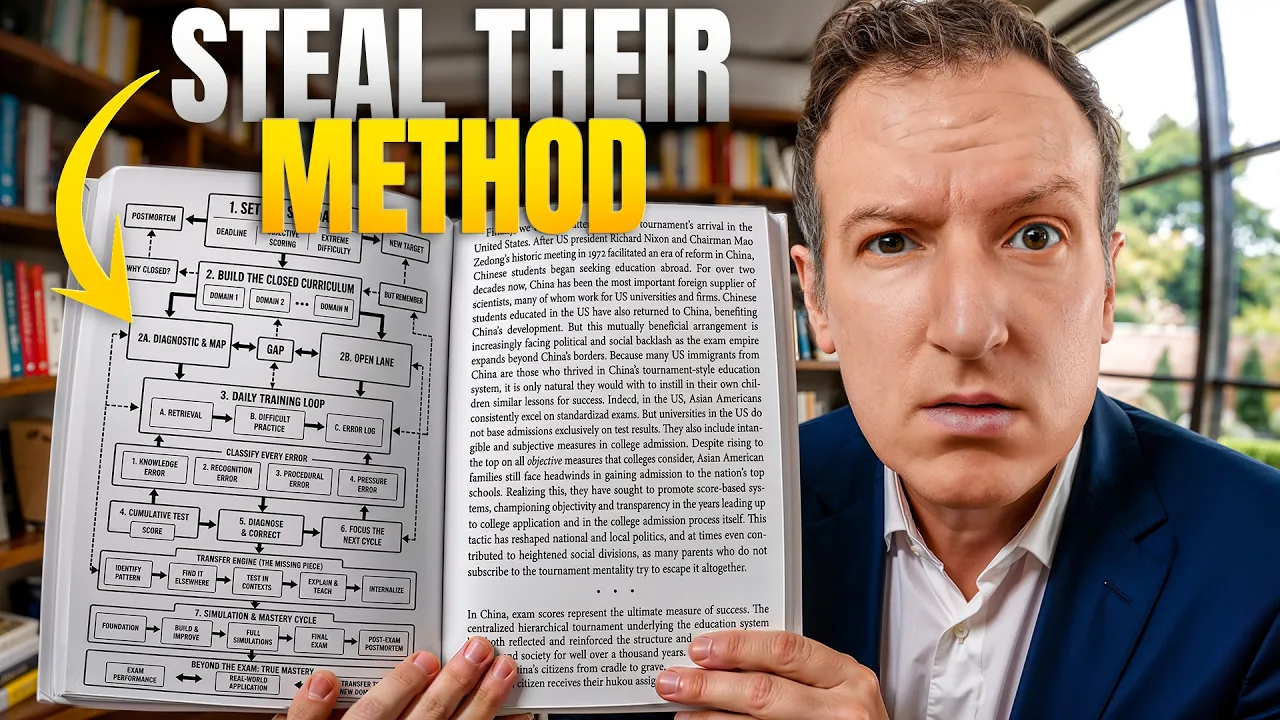
There's an education machine so demanding that children can begin training at age four or five and by high school study more than 70 hours a week. And that machine is China's Gaokao system. And buried inside it is one of the most powerful skill-building curricula ever created. Over my more than 13 years as a peer-reviewed scholar and educator, I've studied what separates genuine learning from its mere appearance. And so drawing upon the book The Highest Exam: How the Gaokao Shapes China by Yuchao Jia and Hongbin Li, I'll reconstruct this curriculum, show you how to use it to master almost any skill, and reveal the crucial ability it also fails miserably to teach.
Which brings us to the first principle of this curriculum. Set a standard that initially feels unreasonable. You see, in much of Western education, we ask what seems realistic for the average child and then build expectations around that average. However, the Gaokao system often works in reverse. It defines an extraordinarily difficult finish line and then completely reorganizes a child's life around teaching it. According to the authors of The Highest Exam, admission to Peking or Tsinghua University is close to impossible unless a student attends one of the top 10% of high schools in a province.
But reaching those schools can require testing into strong middle and elementary schools, which is why some tutoring begins as early as age four or five. Now, I'm not arguing that a five-year-old should actually be subjected to all this, but there's a lesson here that many of us in the Western world never learn. Namely, that the standard you accept determines the training you believe is necessary. The research of Edwin Locke and Gary Latham has repeatedly found that specific difficult goals tend to outperform vague instructions to, quote unquote, do your best, provided that people have the necessary ability, commitment, and feedback.
For instance, become fluent in Spanish is a really vague goal, but pass a C1 exam with an 80% score in 12 months forces you to reverse engineer what that kind of fluency requires. And so, here's how you begin building your own Gaokao style curriculum. Pick one skill and create a final examination for it. If you're learning statistics, that might be a difficult closed-book exam plus a complete analysis of a real data set.
If you're learning a language, it could be a timed proficiency test and a 30-minute conversation with a native speaker. If you're learning programming, it might be building and debugging an application within 48 hours without following a tutorial. Essentially, what it boils down to is that your target requires three things. One, a deadline. Two, an objective scoring system. And three, a difficulty high enough that your current habits and abilities cannot possibly reach it.
And once you actually create that standard, you then apply principle number two, convert the goal into a closed curriculum. You see, the Gaokao system defines a finite field of material students have to master. Chinese, mathematics, a foreign language, and additional subjects varying by pathway and province. And so, students can work backward from these goals. Identify what might appear in these courses and exams along the way, and therefore gradually and systematically eliminate all the unknowns.
And you see, that's why most self-education fails. Because the learner consumes material indefinitely without defining what mastery actually looks like from the get-go. A closed curriculum, by contrast, forces you to decide what you need to know and what you need to do. But the very feature that makes a closed curriculum so efficient can also make an entire education system dangerously narrow. You see, as the authors of the book Gaokao top achievers themselves note, the Gaokao is not primarily an education system.
It's an exam system. And the authors make this distinction explicitly. You see, in many parts of China's system, exams are not merely one part of selection. They're virtually the only recognized route from one educational stage to the next. Once a test becomes the gatekeeper to virtually everything, whatever the test does not measure begins to become irrelevant. Students become extremely good at solving the problems the system rewards, while the curiosity they may have that wanders outside the syllabus simply becomes an inefficient waste of time.
And so, you need to preserve the power of a closed curriculum without allowing the curriculum to close your mind. During weeks one and two, build what I call an examination roadmap. Find the hardest legitimate assessment in your field, collect its syllabus, and divide the required knowledge into three columns. I can explain this, I recognize this but cannot use it, and I don't know this. Then take a complete diagnostic test before studying.
It'll probably feel terrible, and you'll probably fail. That's the point, because this diagnostic test reveals the distance between your present ability and the actual standard you're looking to achieve. But I would also reserve around 20% of your curriculum for what we might call an open lane. Questions the examination doesn't ask, projects with no single correct answer, and ideas that interest you even when they won't improve your score.
If you're studying statistics, find a dubious claim in the news and determine whether the evidence supports it. If you're studying programming, then build something that solves a problem you personally care about. Use this closed curriculum for depth and discipline, and the open lane for curiosity, creativity, and independent judgment. Because competence on a defined test is not the same thing as education. Which then brings us to principle number three.
Organize every day around retrieval, correction, and repetition. You see, a Chinese student's entire life essentially revolves around the Gaokao. As such, they may move through lessons, problem sets, tutoring, supervised self-study, and repeated examinations for most of their day. No fun, no social life, just study. The authors of this book cite estimates of at least 45 hours a week in school and another 27 hours studying.
And here's the thing, do I actually recommend you live like this? No, and that's not my point at all here. In fact, past a point, sleep deprivation and chronic stress begin destroying the learning you want, which is why the authors describe the gakkou system itself as a tournament or exam system rather than as an education system. As only the ones who can push past even these physical extremes will make it to the top while the rest fall between the cracks.
And so, instead, what you should copy here is the overall architecture. For instance, for weeks 3 through 8 of your self-study plan, use a 2 and 1/2 hour daily schedule. Spend the first 45 minutes retrieving foundational knowledge without notes. Formulas, vocabulary, definitions, dates, conceptual relationships, and so on. Spend the next 75 minutes solving problems just beyond your current level under a certain time constraint.
And then, and this part is crucial, spend the final 30 minutes constructing an error log documenting where you actually made mistakes. For every mistake, record four [music] things: the question, the wrong answer you produced, the reason it failed, and the rule or method that would prevent the failure next time. Then, classify the error. Was it a knowledge error, i.e. you never learned the concept at all? A recognition error, where you knew the concept but failed to notice it applied?
Was it a procedural error, meaning you chose the right method but executed it poorly? Or was it a pressure error, in which you could solve it with unlimited time but not under timed conditions? And you see, these are different problems that require different solutions. Keeping an error log transforms your failure from a judgment of your intelligence into actual data that you can use to improve. And in fact, I actually do this with all my test prep students, and I've helped countless of them achieve top scores on American entrance exams.
On any free day you have, take a 90-minute cumulative test containing material from the entire curriculum, not merely what you studied that week. On the following day, review everything you missed and rewrite the following week's plan so that your weakest category receives the most practice. And you see, no matter what you're working on, whether it's an academic skill or a professional skill, this creates the same sort of feedback loop that Gaokao preparation imposes on students relentlessly.
Perform, score, diagnose, correct, and perform again. But, there's a deeper problem here. Repetition can make you extremely good at correcting errors with respect to a familiar task without actually teaching you to recognize the same exact reasoning structure when it appears somewhere else. And this brings us to the most complicated issue in the Gaokao system. Although students clearly develop analytical abilities, the system neglects to teach critical thinking explicitly.
You see, the authors point to a study led by Prashant Loyalka that used the Educational Testing Service's HiSET assessment, which is designed to measure sound argumentation, evidence evaluation, implications, and the distinction between causation and explanation. The sample Chinese computer science and electrical engineering freshmen performed at approximately the same level as sampled American STEM freshmen and substantially above those in India and Russia.
And so, here's the thing. That is real evidence that students who survived China's pre-college tournament develop substantial analytical abilities, but it is not evidence that the system explicitly taught critical thinking. And you see, the key question here is whether these skills are actually transferable. The psychologist Diane Halpern draws a crucial distinction between possessing a critical thinking skill and having the disposition to use it.
Her work shows that this sort of real-life transfer requires explicit instruction in the thinking skill, practice recognizing the deeper structure across different contexts, and metacognitive reflection about when to deploy it. And research by Lisa Marin and Halpern found much larger gains when critical thinking was taught explicitly than when it was merely embedded inside ordinary subject instruction. Difficult mathematics and reading problems can develop reasoning implicitly, but if students are not taught to name the reasoning process, recognize it in a new domain, and then deliberately transfer it, then this high-level test performance often remains trapped inside the context in which it was learned.
And so, add a fifth item to your error log. Where else could this reasoning pattern appear? If you confuse correlation with causation in a statistics problem, find the same mistake in a news headline, a business claim, or somewhere else in ordinary life. If you miss a hidden assumption in a reading passage, look for hidden assumptions in an advertisement, a political argument, and even one of your own beliefs. Practice recognizing the same intellectual structure when it's completely in different contexts, because that is actually how you turn repeated performance into transferable thinking.
Which brings us to principle number four. Aim for the goal, but don't turn the finish line into the end of your learning. During weeks nine through 11, stop practicing skills in isolation and begin taking full simulations. Determine the appropriate time limit, permitted resources, task order, and performance conditions of the final exam. For instance, if your goal is public speaking, deliver the complete talk on camera without stopping.
If it's programming, build something under a deadline. If it's writing, produce the entire essay without looking anything up. Then [music] use week 12 for one final examination and a complete postmortem. Because you see, the Galkal reveals what happens when the entire learning system depends upon one single finish line. You see, the Loyalko study also found something even more revealing. Chinese students entered university with critical thinking scores comparable to American students, but during the final two years of college, the Chinese sample declined by nearly half a standard deviation, while the American comparison groups showed substantial gains.
The authors of the highest exam connect this to what is sometimes called strict entry, easy exit. You see, once students cross the Galkal finish line, graduation is relatively secure, and the external pressure which drove them to exert years of extraordinary effort suddenly disappears. In fact, their survey evidence showed that college students spent about half as much time studying outside class as they had in high school.
And you see, this is the weakness of motivation built entirely around a single examination. If your reason for learning disappears when the score arrives, your curriculum may produce an extraordinary performance without producing a durable intellectual life. So, your final simulation should not merely tell you that you're finished. Instead, it should reveal what you're now capable of tackling next. To this end, after your week 12 examination, add one final transfer phase.
Teach the central ideas to another person without notes. Apply the skill to a problem that never appeared in your original curriculum. Create something original with what you learned. And evaluate yourself using three standards, not just one as in the Galkal system. One, your examination score. Two, your ability to use the skill in a real situation. And three, your ability to recognize when it applies in an unfamiliar domain.
You see, the exam will tell you whether you've mastered the defined game, but these additional tasks tell you whether your actual learning survived outside of that game. And that's the curriculum, an reasonable but difficult standard, a closed map of the domain that still preserves an open lane for curiosity, daily retrieval, difficult practice, and error correction redesigned to produce transfer, and repeated full simulations followed by genuine application.
If you want to keep leveling up your critical thinking to make a massive impact not only on your own life, but also on the lives of countless others, then be sure to watch this next video.
The words are the caption track's own and nothing is reworded or re-transcribed. Paragraph breaks are placed between sentences so the text reads as prose.
Free tools for your own script: paste a draft and see where it stands before you record it.
Paste your draft and see where viewers are likely to drop off, with a rewrite for each weak line.
Paste the first 30 seconds of your own draft for a hook score and rewrites.
Check your draft against YouTube's advertiser-friendly guidelines before you record it.
Read this channel's public videos and transcripts, and download a writing brief for it.