Getting the transcript
Reading the captions from YouTube. A video nobody has opened here before takes 10 to 30 seconds; this page fills in on its own.
Getting the transcript
Reading the captions from YouTube. A video nobody has opened here before takes 10 to 30 seconds; this page fills in on its own.
Ross Cameron - Warrior Trading · @DaytradeWarrior
Where viewers went back to watch this video again, from YouTube's public Most replayed graph, lined up with what was said at that moment.
Most replayed moment #1
10:393.1x the video's typical replay level
ability to grow an account. We'll get into more depth in that in a minute, but let's look at the second small account challenge I did. So the second small account challenge was the one right here in the middle. I was using settlement margin so I could day trade as much as I wanted to but I had no leverage. So this
Said at 10:33
Most replayed moment #2
6:202.7x the video's typical replay level
had $25,000 of equity in the account. Your account now is in the red minus 25,000. You have what's called a margin call. Now, a margin call is bad for you because you owe money to the broker, but it's also bad for the broker because the broker's on the hook until you can pay.
Said at 6:13
Most replayed moment #3
12:062.2x the video's typical replay level
With $2,000, you don't get settlement margin. Even though it doesn't have leverage and even though in theory you have no risk of a margin call and it is not as risky, this is the only type of account you could use. And as you could see in this account style, I was making
Said at 11:58
The graph counts replays. It does not show where viewers stopped watching.
Words
5,427
Runtime
28:48
Speaking pace
188wpm
Reading time
23min
188 words per minute, between the 181 median and the 201 75th percentile of 349 measured videos. That distribution comes from the 349-video hook study.
Opening (first 30 seconds)
Over the past six months, I did three different small account challenges. The premise of these challenges were basically the same. I would fund an account with $2,000 and I would try to actively trade the US equities market and to see how quickly I could grow this small account. The difference between these three challenges was not the amount of money and not what I was trading, but the type of account. a seemingly very small check of a box that it's either a cash account, a margin account, or an account that
94 words, the words spoken in the first 30 seconds at 188 words per minute.
Free, no signup. See how the first 30 seconds hold attention, with rewrites.
Sentence shape
| Measure | This transcript |
|---|---|
| Sentences | 322 |
| Average words per sentence | 16.9 |
| Longest sentence | 99 words |
| Questions asked | 12 |
| Sentences containing a number | 96 |
Most used terms
Filler phrases
71 in total: uh 30 · um 15 · like 10 · you know 7 · actually 3 · basically 3 · I mean 1 · kind of 1 · right? 1.
A literal whole-word count of the same phrase list the Prepublish browser extension uses, so a phrase inside another word is not counted and a phrase used in its ordinary sense still is. It is a count and not a judgement.
Free, no account. See where attention is likely to drop, with a rewrite for each weak line. The free check shows the scores and the one issue costing the most. Or run it on the words above first.
Free · No login · See a sample audit first if you prefer.
What this transcript is
Every word below is the caption track YouTube publishes for this video, pulled from the video itself and reproduced unchanged. It is not Prepublish's writing, not a summary, and not a re-transcription: it is the video's own published captions. English captions, generated automatically by YouTube, in the video’s original language. Source: the video on YouTube. A channel that would rather this page did not exist can ask for its removal through the contact page, and it is removed.
Over the past six months, I did three different small account challenges. The premise of these challenges were basically the same. I would fund an account with $2,000 and I would try to actively trade the US equities market and to see how quickly I could grow this small account. The difference between these three challenges was not the amount of money and not what I was trading, but the type of account. a seemingly very small check of a box that it's either a cash account, a margin account, or an account that offers not just margin, but also leverage.
The reason I did these three different challenges and the reason I used $2,000 as the starting balance for each of them is because in September, FINRA, the regulator of the US equities market, announced a proposed rule change to the pattern day trader rule that was first put into place on February 27th, 2001, nearly 25 years ago. This pattern day trader rule, also known as the PDT rule, states that in order to day trade in a margin account and to get access to up to four times leverage here in the United States, you need to maintain a minimum balance of $25,000.
This rule change came after the boom and the bust of the dot bubble. Brokers lost money. Many traders were trading on leveraged. They lost money. They got margin calls. They couldn't meet those margin calls. So the brokers were on the hook and regulators came in and created this pattern day trader rule to protect in theory both novice investors and traders and to protect broker dealers. Now this paternal instinct of regulators came from a good place.
But as we've seen over the past 25 years and as you'll see from these three small account challenges, the pattern day trader rule is doing more harm than it is good. Let's go ahead and jump onto the screen share. I've got a slide deck for you today and I'm going to give you the update of where I stand on these three separate small account challenges. We're going to look at the analytics here. For those of you guys tuning in perhaps for the first time, my name is Ross Cameron.
I am a full-time trader. I funded my first account in 2001 after the PDT rule was enacted. So during my entire time experience in the market, I have been subject to this pattern day trader rule. But now for the first time, FINRA has proposed a rule change. They have sent an application to the SEC and it is now time for brokers, for individuals, institutions to provide comment on this potential rule change and then for the SEC to ultimately make their decision.
So my hope here is that this episode adds to discussion of whether or not this rule change should take effect. And I'm going to share with you four compelling arguments in favor of the PDT rule being either amended to $2,000 or outright abolished. I'm going to share with you why I think it's harmful for US traders, why it's harmful for market participants in general, and why it's certainly harmful for US broker dealers, which I know many people aren't going to be um you know, playing the violin for these big broker dealers that make billions of dollars, but nonetheless, it is harmful for them and their US businesses.
And um I'd like to see them succeed as well. So, uh, if we jump onto the screen share here again, uh, FINRA did propose this rule change in September 2025. And so, it is now, um, in progress, which is great. And the timeline of when the SEC will ultimately make their decision, um, is a bit unknown, although uh, hopefully it will be uh, sooner rather than later. So, here are my four compelling reasons, and I'm going to back these up as we go through today's episode, that the PDT rule should be abolished.
Uh the first is that the pattern day trader rule unfairly limits access to the market to only those with robust financial resources. Number two is that the pattern day trader rule makes it harder for traders with less than $25,000 to profit in the market because they are limited in how often they can trade. Number three, the pattern day trader rule limits liquidity in the market by reducing trading volumes across the board.
And number four, the pattern day trader rule encourages US traders to leave regulated and insured US brokers in order to trade with international brokers that don't enforce the pattern day trader rule. We know that these are the offshore brokers that many active traders like myself are using. So, let's talk first about these last three small account challenges that I've done. The latest small account challenge was utilizing what's called a cash account.
This was using a US broker dealer. In this case, it was Weeble, but it could have been any US broker dealer. Robin Hood, Charles Schwab, doesn't matter. With these brokers, you do not have the ability to day trade with margin or leverage if you have less than $25,000. The use of leverage, for those that are new perhaps to this episode or new to this topic, leverage allows you to trade on borrowed money. It's not new.
It's been around for hundred years, more than 100 years here in the US equities market. Uh what it does is it allows you to trade on borrowed money. So if you fund an account right now with $25,000 with Charles Schwab, for example, you will have if it's a margin account, you will have not only margin, you'll also have leverage. And your leverage ratio is four, which means you could buy $100,000 worth of stock during the day.
This is your day trading leverage. So leverage gives you a multiple on your cash deposit essentially the cash that you've put in and it allows you to trade on borrowed money. Now you might naturally observe that this sounds very risky and it is it is risky and in fact during uh the 1920s there was a as we know now a great deal of uh participation in the market that was on leverage which was borrowed money and it essentially propped up the entire market artificially with all this borrowed money and that was all good while the market was going up but when the market turned around and started to drop well just think about it if you're in a stock with $100,000 and it drops by 50%.
Well, all of a sudden you're down 50 grand. You only had $25,000 of equity in the account. Your account now is in the red minus 25,000. You have what's called a margin call. Now, a margin call is bad for you because you owe money to the broker, but it's also bad for the broker because the broker's on the hook until you can pay. And if you're completely unable to pay, then the broker's stuck with it. So this is of course what happened during the the um the the great depression, the stock market crash in 1929, but it's also what happened uh to a lesser extent during the dotcom bubble, especially with the advent of online trading that really became popular in the late 1980s, but really in the 1990s.
So here today in the US, we really have two types of accounts. you either have a cash account um and in a cash account you have your cash balance and that's it. You have no leverage. So you don't have borrowed money. You can't borrow money at all. Uh but you also don't have um settlement margin. So, what that means is that if you buy $25,000 worth of stock and sell it in a day trade, you have to wait overnight, it's T1, for all of those tra that one trade to settle and then you can trade with that money again tomorrow.
Whereas in a margin account, the trade still takes overnight to settle, but you're borrowing money from the bank to continue to trade because they know that the trade will settle. This isn't like a check that's going to bounce. They know the trade will settle. So they basically extend you margin, the ability to keep trading uh on borrowed money but using only your cash balance in in this instance. So a margin account allows unlimited trading and there's no settlement period or you don't have to wait for settlement.
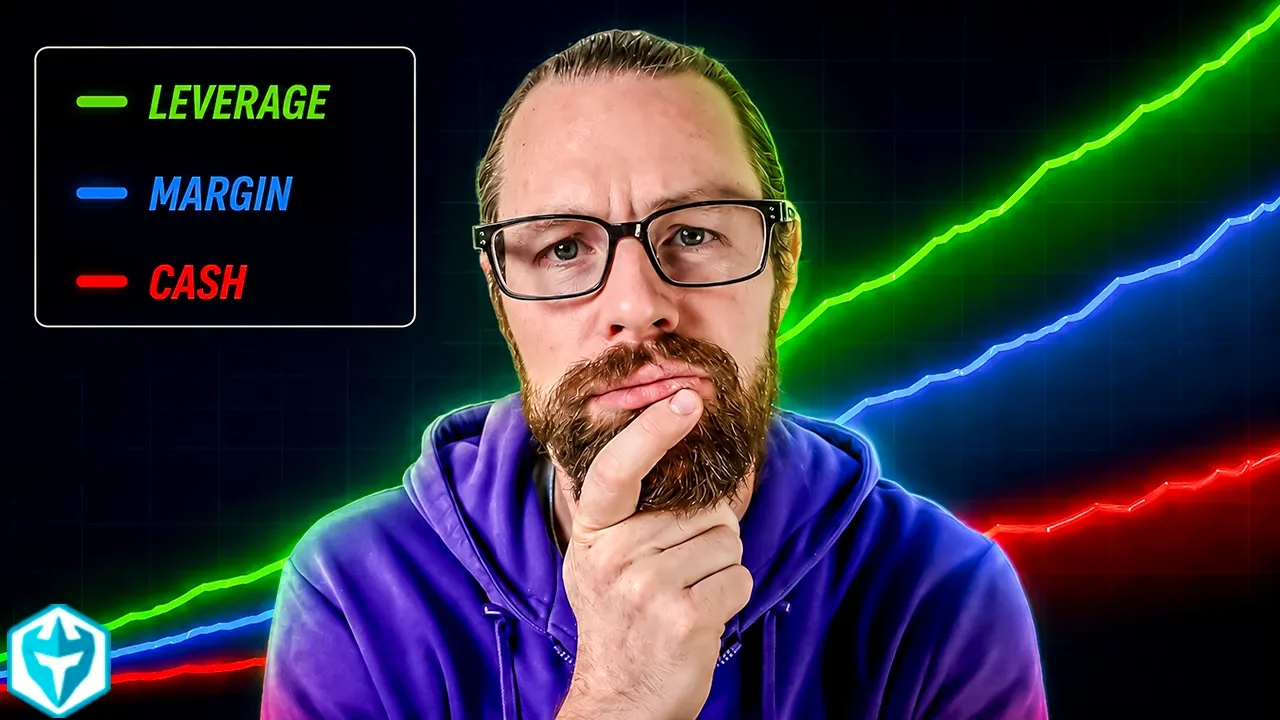
In other words, you don't wait have to wait for it. While with a cash account, you are subject to waiting for settlement. So essentially during these small account challenges, the three that I did was the first one is a cash account, the second one was a margin account with just 1x leverage and the third was a margin account with six times leverage. And so then if we compare the um the total profit and the growth between these three accounts, I'm I'm pretty certain you could make a safe guess at which one performed the best.
Ding, ding, ding. right here. And which one was the slowest right here? Well, this is the account that most US traders are forced to use if they have less than $25,000. They have no choice but to use this account. Which means that it's almost institutionalized that they are set up to not perform as well as traders who are from more um uh from from more adequate or or more substantial financial um have more financial resources, which is unfair by its very nature.
So, using a cash account, focusing on just one trade a day, using the entire cash balance, I funded an account with Weeble with $2,000. And over the course of 10 trades, which was 10 days, I made $1,760. I had uh nine winners and one loser, which was good accuracy, 90% accuracy. And my average daily gain was $176. This is pretty good. So now, if we extrapolated this to how much I would have made if I had traded 20 days out of the month and then 12 months out of the year, I would have averaged about $3,500 that month and $42,000 over the course of the year.
Now, my trades actually didn't add up to this because I only did the 10 trades and my attention was split between my primary trading accounts and and this small account challenge. But nonetheless, I took these 10 trades and and this really demonstrated to me the challenge of trading in a cash account, which was that I was obviously severely limited in how many trades I could took and so I took fewer trades and the account grew at as a result a much slower rate.
So I was thinking about all the traders in the US that are choosing to use the US broker dealer because they want the insurance. They want to be, you know, using an insured regulated broker. They want commission free trading which is currently not available with these international brokers, but then they end up subjecting themselves to these restrictions that greatly reduce their ability to grow an account. We'll get into more depth in that in a minute, but let's look at the second small account challenge I did.
So the second small account challenge was the one right here in the middle. I was using settlement margin so I could day trade as much as I wanted to but I had no leverage. So this feels like the safer method because here I was not exposing myself to the risk of uh a margin call because I wasn't trading with borrowed money. I was just trading with the amount of money that was in my account. I started uh with $1,940 in the account and by the end of day 12 I had taken 31 trades.
So I was able to take almost three trades a day. That would have been 36 trades, but almost three trades a day. And I uh had total profit of $4,167.98. So my account grew from about just under 2,000 to just over $6,000. So 3x in 12 days. That's phenomenal. and I made $347 daily average. That was approximately my daily average over those 12 days. So, if I had traded that way over the course of a month, 20 trading days, it's close to $7,000 in a month.
Over the course of a year, close to $83,000 in a year. I would say that's pretty phenomenal. And this right here highlights the type of account that is not currently available in the United States. This is not available in the United States unless you have $25,000. With $2,000, you don't get settlement margin. Even though it doesn't have leverage and even though in theory you have no risk of a margin call and it is not as risky, this is the only type of account you could use.
And as you could see in this account style, I was making less than half as much. Now, the third type of account, that's this one uh right here where I had six times leverage. Okay, so with that account, well, that was pretty crazy. So, I funded the account with just under $2,000. And my total profit as of day six, also with just 31 trades, was 57,1767. I was averaging nearly $10,000 a day. That would have me averaging 190,000 a month and $2.2 million by the end of the year.
Well, here's the reality. The only day that was really difficult was the first day because on day one, how much money did I have in the account? $2,000, right? And how much buying power did I have? 2 * 6 is 12. $12,000 of buying power. So on day one, I was able to buy $12,000 worth of stock. Now granted, 10,000 of it was borrowed money, which is what clearly presents an incredible risk that if I had made a mistake, I' I'd lose a lot of money.
Now, this small account challenge that I had that I had done, uh the whole idea with it was that all of the profit that I was making was getting donated to charity. And so I actually ended up uh donating uh a little over $200,000 to various charities as part of these small account challenges that I was doing. So it was for a good cause. I was trying to see how quickly I could make the money, raise the money, and then donate it, which was uh has already been now donated.
Uh but uh the fact is during this challenge, I was basically able to trade the way I trade in my regular account after like day three and day four. And if we look at uh this was just over the course of as it turned out six days and it was a it was very strong those six days of trading. But if we look at uh the year as a whole I ended up finishing with um right around $6.5 million in trading profits. So it it's not unreasonable to think that uh I could have started the year with $2,000 in the account.
I've got $57,000 over the course of six days and then I just continually actively trade in the US equities market. Um, and very quickly I'm trading with a two $300,000 account. I've got more than enough buying power, especially with six times leverage to trade very aggressively. Now, this is an area where I have to acknowledge that of course my results are not typical. I have been trading for a long time. So, there's no guarantee that you would have a similar result as me.
Just be to be very, very clear about that. But I wanted to demonstrate what it's like for a seasoned trader like myself to use these three different account types. And there is just absolutely no question that when you look at the profits, now granted, if I had taken a total of 31 trades here, 31 trades here, and 31 trades here, this was $57,000. This was about $4,000. And over the course of 10 trades here, I was at uh $1,700.
So, if we if we go and, you know, all the way up to 30 trades, you know, would I be up to $4,000 here? Maybe I would. It's both of them are cash accounts essentially, except this one I was able to do in 12 days, and this one would take 31 days to take 31 trades with the same amount of money because I have to wait overnight. So, this allows me to trade three times faster. And this allows me to trade not only three times faster, but with six times more money.
So, three times, six times, and then that's how all of a sudden we get up here to $57,000. But here's the reality. These two types of accounts are not available in the United States. Now, I think you could be safe to say that this maybe shouldn't be available. Maybe it's not safe certainly for a beginner trader to have six times leverage. I can agree with that. Six times leverage is very aggressive. But what about this? just simply settlement margin.
Why is this not available? And this doesn't make sense to me. Unfortunately, what it's doing is it's setting up traders in a lot of ways to fail because they're forced to use if they're trading in the US, they're forced to use a cash account. So, I would argue that cash accounts are actually risky for beginners. I know this seems um completely contrary to the whole idea of a cash account, but what I've learned is that while it's possible to grow a small cash a small cash account, using a cash account creates unnecessary obstacles.
Number one, you're more likely to hold your losers longer so you don't waste your buying power. You hesitate on your trades. And I'm speaking personally from my own experience as a seasoned trader. I hesitate because on the one hand, I don't want to waste my buying power. Remember how I only have the cash buying power? So if I take a trade and that trade doesn't work immediately on the one hand, I could sell it, but then I can't take another trade till tomorrow.
So then what I'm going to do is I'm going to hold my losers longer because I don't want to waste that one trade. And on the other hand, I'm also going to hesitate to get in something that might end up working, but I'm going to hesitate because if I waste that one trade, I'm going to be really frustrated. But then as we get closer to the end of the day, if I haven't used all my buying power, I also feel like I'm not growing my account as efficiently as necessary.
So the limit of running out of cash and no longer being able to trade and on the other hand, not utilizing all your cash creates unnecessary pressure on what is really I mean it's it's it's proven that this is a very difficult task of profitably trading the equity markets. So the unnecessary pressure that comes with trading in a cash account only makes it harder. And now we have this additional interesting challenge which is that on days when the market is hot.
Usually what I found is that when it's hot, I want to trade a lot on that day. And then if the next day is cold, I don't want to take any trades. Well, you can't really do that in a cash account. You just take the same number of trades every day. If it's hot, you still take your one trade. If it's cold, you don't have to trade, but you weren't able to make up for it when it was hot. So now you're dealing with this psychological challenge and it is the direct result of the type of account that you're using which I think is very interesting.
Using a cash account today is a choice. It's a choice that traders are affirmatively making. Now some traders are making the choice because they don't know about the other options. They don't know about using international broker dealers. International broker dealers are not allowed to advertise to US residents. That's a rule. So you only find out about them really through word of mouth, but they're very well known in trading communities.
So most traders will know about them, but it's certainly possible that a beginner trader who's not in any trading communities wouldn't be aware of these offshore brokers. And then what do they do? They have less than $25,000. So they open an account with Erade or Schwab or Fidelity, Trade Station, doesn't matter what broker, and they realize, oh, I can only trade cash amount, you know, in my it's a cash account. And so they they can't trade hardly at all.
And so now what ends up happening is they are I feel like unfairly discriminated against in the fact that they cannot actively participate in the market. And another trader who gets a check from 25 of $25,000 from their dad all of a sudden has an unfair advantage that now they can actively trade as much as they want. And so there's that old expression, it takes money to make money. And we talk a lot about how we want to democratize investing and the market.
We hear about this all the time. And yet with the PDT rule, we're not doing that. With the PDT rule, we're only allowing people that already have money to trade and participate in the market. So using a cash account is a choice. What I need in order to actively trade is at the the bare minimum, I need settlement margin, instant settlement. I don't need the leverage. And I don't think a beginner trader should use leverage.
I really don't. Unfortunately, in the United States, you get leverage at the same time that you get margin. They don't separate them. So now, in a way, they should have three tiers. Cash, I suppose, margin, and then margin with leverage. And if you had this one in the middle, this is the place that everyone really should be, unless you're a more experienced trader. Again, I'm not trying to create more restrictions to get leverage, but just in theory, what is most logical is that anyone could have a settlement margin.
Settlement margin allows unlimited trading, but it protects traders from taking positions on margin and making a big mistake on leverage. that is now not to get into the weeds but short selling is another kind of can of worms because if you short a stock on margin then you have to buy back and if it goes significantly higher you could end up taking a really big loss. So I also think that shorting should be reserved for you know higher risk um traders traders who are comfortable with that level of risk.
Now, if I feel confident in my strategy and I have a proven track record of success, I definitely want the full margin um or the full leverage. So, a margin account with six times leverage or four times leverage that allows traders with small accounts to trade on borrowed money. But it does create this risk. But because the US does not allow settlement margin or leverage accounts under 25,000, the only choice as of today, as of right now, is to use an offshore broker.
These brokers can limit your leverage to 1x if you ask them to, but by default they give between 3x and six times leverage depending on which broker you end up choosing. So, as we sit right now, the short-term solution for most traders is either wait till the PDT rule hopefully changes or use an offshore broker. But we do know this long-term solution is on the horizon. And I'm hopeful that the SEC does approve FINRA's proposed rule change.
I think if they do approve this rule change, it's going to be a big win for US broker dealers and we'll likely see increased liquidity in the market which allows traders to buy and sell larger positions and that means better uh price improvement and less slippage for all market participants. So number one, I said at the beginning that the PAT rule unfairly limits access to the market to only those with robust financial resources.
Traders who may possess the aptitude, the interest, and the time to become active traders in the market are restricted by the arbitrary requirement to have $25,000 in order to begin trading. This has led some traders to make the following decisions, each of which are detrimental in different ways. Number one, borrow money to fund a $25,000 account. I've heard of traders who have taken out uh title loans on their car to do this.
This allow this allows greater risk because all of a sudden now they've got $25,000. it's borrowed money. Plus, they have four times borrowed money from the broker. They could trade on $100,000 and they could make a huge mistake and it could result essentially in them becoming uh bankrupt. And not to mention the fact that they could be paying interest on the loan. Number two, they use an offshore broker. Offshore brokers have higher fees.
They have greater risks. They're not regulated in the same way and insured in the same way as US broker dealers. Not to say that there aren't international brokers that are regulated and insured, but it's not the same if you're a US resident. If something goes wrong, you don't have the same recourse. Number three, they use a cash account, and that greatly limits their ability to actively trade and grow their account, which means likely they're going to give up.
They might give up as another failed trader. Because here's something interesting. When we look at my profits from last year, $6.5 million, you might think, "Wow, Ross must be hitting these huge winners." That's not true. I took thousands and thousands of trades and my average winners were only about 18 cents per share. 18 cents per share. That's not a lot. So, think about having a $2,000 account. You've got a $2,000 account and you want to take a trade on a $20 stock. $2,000 account, $20 stock.
How many shares can you afford? You could afford if you bought if you went all in, you could afford 100 shares. So, you've got a 100 shares of this stock here. Now, unfortunately, the reality is if this thing goes up plus $18 cents a share, you're up $18. Is that enough for you to take profit? You might say to yourself, it's not. Now, I might take the same trade. On that same trade, I might take just for the sake of argument, 10,000 shares.
And yes, 10,000 shares of a $20 stock is a lot of money in the trade, but I might go ahead and do it. And I'm up $1,800. I do that five or six times in the day on that same stock actively buying and selling. I'm up $10,000 easily. You take the same trade, you can only take one trade and you're up $18. And you say, Ross, it's not worth it. 18 isn't enough. So you get in at $20 and you say, "I'm not selling when it goes to $208.
I take profit. I'm happy with that." But you say, "No, I I'm not going to sell unless it goes to 21." Now you're trying to make a full dollar a share. You're trying to make five times what I make on average. I've been doing this for a really long time and and that doesn't make sense. But you're not content with the small base hits because $18 it doesn't really work. So then what do you end up doing? You say, "Well, I can't trade $20 stocks now because I can't afford them." So then you don't trade $20 stocks.
You end up trading penny stocks, cheap stocks, OTC stocks. Those are going to have a higher risk of squeezing up and then coming all the way back down. Then you end up seeing some big losses, huge extreme moves, 50% drops in one day. So now you're moving to an area of the market that's going to be more subject to those big swings and once again you're going to struggle. Whereas a trader like myself is happily trading a $20 stock getting 18 cents a share again and again and again.
And if you had settlement margin at least you could make $18. You do that five times in a day you got $100. $100 a day. That's pretty good if you've got a $2,000 trading account. So, the PDT rule is unfairly limiting access to the market to only those with robust financial resources. It also makes it harder for traders with less than $25,000 to profit in the market because they are limited and how often they could trade.
A trader with under $25,000 can only trade with settle settled cash. This reduces their ability to capitalize on opportunities as they present themselves in the market. A trader with a cash account is more likely to hold losers longer so they don't waste their limited buying power. That same trader is more likely to sell their winner sooner to avoid a winner turning into a loser. So cash accounts influence a trader psychology in ways that are harmful to them.
I know because I've been doing it and you see my trading is totally different in the cash account even though I know that I shouldn't be holding these losers. The pattern day trader rule limits liquidity in the market by reducing trading volumes. By restricting traders below $25,000 from actively and freely participating in the market, trading volumes are greatly reduced. So this in turn results in naturally less liquidity in the market.
That means all market participants pay the price when they try to buy or sell a position and they have fewer counterparties to match their orders. That means more slippage on your executions, a worse execution price, losing money because of the pattern day trader rule. Number four, the pattern day trader rule encourages US traders to leave regulated and insured US brokers in order to trade with international broker dealers that don't have the PDT rule.
It's a logical solution for an individual determined to actively trade in under $25,000. I get it. I've used those offshore brokers myself, but it's bad for US broker dealers as they lose business and it creates more risk for the US traders as they're trading with an international broker dealer where if something goes wrong now you've got to hire a lawyer down in, you know, in Bermuda or Bahamas or somewhere you don't know that that's just going to be a lot more difficult.
The bottom line is that the pattern day trader rule is bad for us traders. It's bad for market participants in general and it's bad for US broker dealers. and the rule at the very least should be amended. I'm really eager to hear your thoughts, your comments. Please feel free to leave them down below. I'll remind you as always, everything I share with you, this is educational. This is just my opinion. And as I want to reiterate, my results in trading are not typical.
I shared with you some of my profits here in this episode. I don't want you to assume that's a typical result. I've been doing this for a long time. So, please manage your risk. Always practice in a simulator before putting real money on the line. And remember, there's no guarantee you'll find success in the market, whether you trade with me or you learn on your own. So, manage your risk, take it slow, and I'll see you guys here for the next episode real soon.
The words are the caption track's own and nothing is reworded or re-transcribed. Paragraph breaks are placed between sentences so the text reads as prose.
Free tools for your own script: paste a draft and see where it stands before you record it.
Paste your draft and see where viewers are likely to drop off, with a rewrite for each weak line.
Paste the first 30 seconds of your own draft for a hook score and rewrites.
Check your draft against YouTube's advertiser-friendly guidelines before you record it.
Read this channel's public videos and transcripts, and download a writing brief for it.