Getting the transcript
Reading the captions from YouTube. A video nobody has opened here before takes 10 to 30 seconds; this page fills in on its own.
Getting the transcript
Reading the captions from YouTube. A video nobody has opened here before takes 10 to 30 seconds; this page fills in on its own.
vidIQ · @vidIQ
Where viewers went back to watch this video again, from YouTube's public Most replayed graph, lined up with what was said at that moment.
Most replayed moment #1
7:195.7x the video's typical replay level
tried a whole bunch of different things, meditation, uh gone to the doctor, medications, uh all sorts of things, and nothing really works. And so, I was on YouTube watching some physics lectures, and I was learning so much, and I was loving it, but I noticed that I kept falling
Said at 7:12
Most replayed moment #2
4:553.5x the video's typical replay level
mass-produced same-ness. The first one, and probably the fastest to fix, is >> your voice. >> Well, maybe not that one. The vast majority of these channels use the same handful of default AI voices. You know the ones I'm talking about. You go onto
Said at 4:49
Most replayed moment #3
7:573.4x the video's typical replay level
like this will build a tremendous amount of trust and credibility both with your audience and YouTube. And you don't need to publish this trailer to the entirety of YouTube. What you can do is set it to unlisted when you upload it. To set a
Said at 7:51
The graph counts replays. It does not show where viewers stopped watching.
Words
2,271
Runtime
12:37
Speaking pace
180wpm
Reading time
9min
180 words per minute, just under the 181 median of 349 measured videos. That distribution comes from the 349-video hook study.
Opening (first 30 seconds)
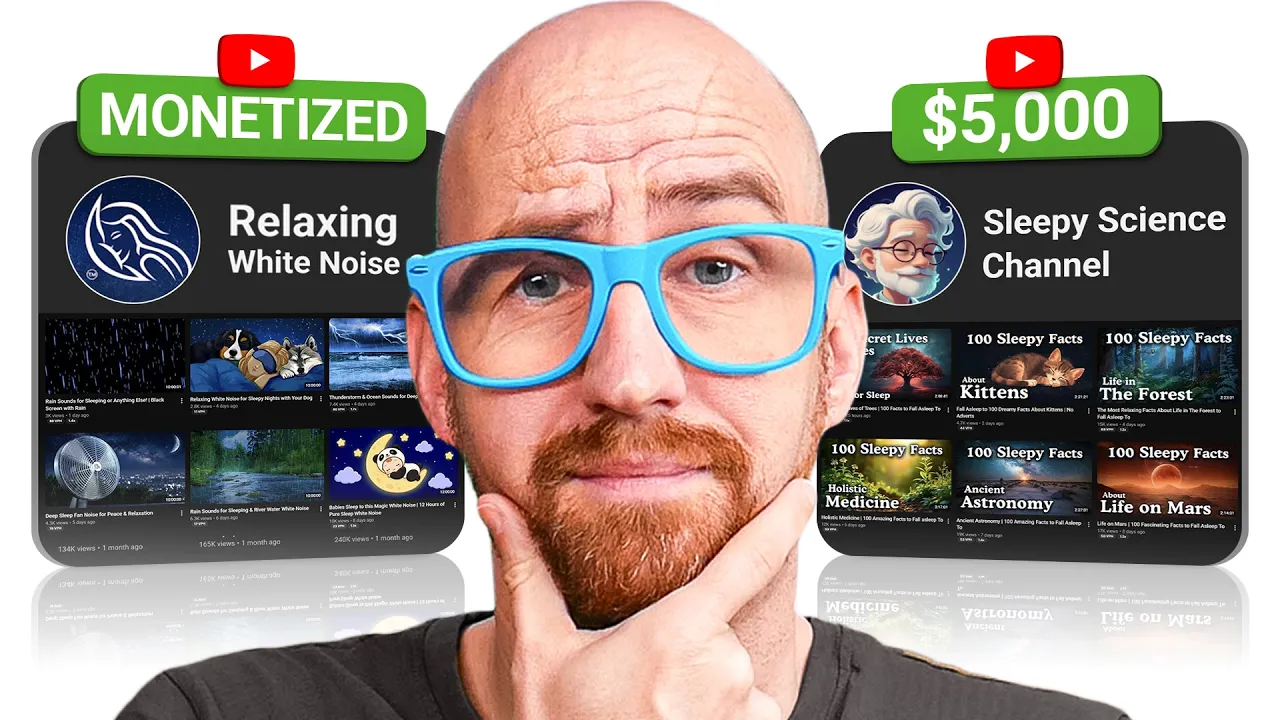
You've probably seen these types of posts already, haven't you? Start a faceless AI sleeping channel, barely do any work, and wake up the following morning considerably richer. Which is usually internet code for a man beside a rented Lamborghini offering you a course asking for your credit card. And typically, there is but one inevitable outcome from all of this, demonetization. But here's the crazy part, this niche is legit. And there are channels out there that are genuine, following the rules, fully monetized, and they are making some
90 words, the words spoken in the first 30 seconds at 180 words per minute.
Free, no signup. See how the first 30 seconds hold attention, with rewrites.
Sentence shape
| Measure | This transcript |
|---|---|
| Sentences | 155 |
| Average words per sentence | 14.7 |
| Longest sentence | 36 words |
| Questions asked | 4 |
| Sentences containing a number | 12 |
Most used terms
Filler phrases
20 in total: like 9 · uh 3 · um 2 · you know 2 · I mean 1 · actually 1 · basically 1 · kind of 1.
A literal whole-word count of the same phrase list the Prepublish browser extension uses, so a phrase inside another word is not counted and a phrase used in its ordinary sense still is. It is a count and not a judgement.
Free, no account. See where attention is likely to drop, with a rewrite for each weak line. The free check shows the scores and the one issue costing the most. Or run it on the words above first.
Free · No login · See a sample audit first if you prefer.
What this transcript is
Every word below is the caption track YouTube publishes for this video, pulled from the video itself and reproduced unchanged. It is not Prepublish's writing, not a summary, and not a re-transcription: it is the video's own published captions. English captions, generated automatically by YouTube, in the video’s original language. Source: the video on YouTube. A channel that would rather this page did not exist can ask for its removal through the contact page, and it is removed.
You've probably seen these types of posts already, haven't you? Start a faceless AI sleeping channel, barely do any work, and wake up the following morning considerably richer. Which is usually internet code for a man beside a rented Lamborghini offering you a course asking for your credit card. And typically, there is but one inevitable outcome from all of this, demonetization. But here's the crazy part, this niche is legit.
And there are channels out there that are genuine, following the rules, fully monetized, and they are making some serious coin. So in this video, I'm going to share with you the four principles that separate the YouTube channels in this niche that continue to earn money from the AI copies that YouTube is targeting for demonetization. And I'm going to do it all before you fall asleep. Now we're going to start with the easiest way to make your channel harder to copy, which in YouTube's eyes is really important.
Think about what a sleep video even is. It's 1 2 3, sometimes even 8 hours long. And viewers, when they start these videos, don't have the intent of watching the whole thing. They're going to fall asleep to them. It's a bit like watching the director's cut of Lord of the Rings Two Towers. 4 hours. Anyway, these fall asleep with me videos will continue to play all night. And they'll be generating watch time that most creators would trade their left kidney for.
I need to keep the right one. It's got my Wi-Fi password on it. And from a financial perspective, this niche is absolutely massive. The biggest sleep channels on the platform pull anywhere up to six figures a month. And that is why everybody came sleep running into that niche. Now usually, you'll watch a YouTube video once, maybe a favorite one twice, before you're moving on to the next thing. But like gym workouts and cooking recipes, sleep videos become a habit. and people will often fall into a gentle slumber from the same sleep video night after night after night.
As a result, you are building a back catalog of content that is paying you long after you pressed upload on the video. It is a creator's dream. I didn't even say that thinking it was a pun, but that is the ultimate goal here, passive income from what you might describe as passive views and passive watch time. And just like the very best evergreen videos on the platform, these can continue to earn for months, years, possibly decades.
And when it comes to cost, these videos are relatively cheap to make. You don't need a camera, and let's be honest, AI is going to do a lot of the heavy lifting. And so, with all of these desirable qualities, every faceless YouTube automation entrepreneur has given this a shot. And that is when the gatekeeper decided to step in. In July of 2025, YouTube added a new phrase to their monetization policy that has pursued faceless channels from the shadows ever since. >> Inauthentic content. >> I did tell you I wasn't going to let you fall asleep.
If you had one templated, mass-produced pattern across all of your videos, you ran the risk of demonetization. And most creators running these types of channels never realized the impact of this update until it was far too late. By late 2025, major AI channels were disappearing from the platform. And then, in January of this year, 2026, YouTube's CEO publicly acknowledged the term AI slop and their priority to tackle it.
That resulted in one of the biggest purges we've ever seen on the platform. 16 of the biggest AI channels were just wiped off of the map. 35 million subscribers, almost 5 billion views, gone. Now, this is where a lot of people are seeing how the situation has developed and saying to themselves, "The gold rush is over. Let's not bother. I'm going home." Which is their loss and your gain. Because what a lot of people aren't really understanding is that YouTube hasn't banned faceless channels or AI assisted channels.
What they have done is banned lazy channels. A clear dividing line has been drawn between a human made real decisions here and a robot generated this while nobody was watching. So, the opportunity is still there and it's less crowded, meaning it's yours to take. If you know how to stand firmly on the right line of this demonetization policy. So, let me show you. So, in my research here, I found four patterns that can make these types of channels, including sleeping channels, more distinctive and protected.
Now, I should say none of these guarantee monetization, but each one moves you further and further away from that mass-produced same-ness. The first one, and probably the fastest to fix, is >> your voice. >> Well, maybe not that one. The vast majority of these channels use the same handful of default AI voices. You know the ones I'm talking about. You go onto a video, you hear something like this. >> Hey YouTube, like and subscribe. >> And you immediately think to yourself, "Yeah, that's an AI farm.
Don't want to watch that." So, what the clear winners in this space do is not resort to the pre-made AI voices that come out of the box. They clone a voice or they pay a real voice actor to train a custom model. And when you do that, the channel actually sounds fresh and unique. And let me show you how this can be easily done with some of our tools. So, head on over to vidIQ.com and start a new chat with the AI coach.
Tell the AI coach to clone your voice and it will be done straight from an uploaded audio file or YouTube link and it'll do it right there for you in about a minute. So, in this example, I'm linking an 8-minute video and my voice was cloned in a little under a minute. Now, the next thing you want to do is upload your script to the AI coach and tell it how you want it to be delivered. You can direct the tone, the pacing, and the energy.
Now, I've kept it super simple here, and I've just told it to make it sleepy and soothing. And if I hit generate, the voiceover comes back in your cloned voice reading your script delivered the way you asked it to be. >> I am showing this as a test. Now, you can hear my dulcet British tones drift you off to sleep. Like and subscribe. >> subscribe who? Now, this is not just a nice to have. A copycat can steal your format, your topic, and your thumbnail in an afternoon.
But, using your own voice, whether it is cloned or not, makes your channel more recognizable and harder to imitate. It is what you might call an important extra layer that protects your channel from copycats, but also prevents you from blending in with all of those other AI bad actors. Now, the next move kind [music] of breaks the faceless promise, so brace yourself. The YouTube channels that are surviving and thriving aren't 100% faceless.
They are 99.99% faceless. And what I mean by that is that some creators have a short video trailer to introduce who is behind the channel and why it exists. >> Hey guys. Uh my name is Michael. I am the founder and creator of the Sleepy Science channel. Basically, my whole life I've struggled with sleep, and I've tried a whole bunch of different things, meditation, uh gone to the doctor, medications, uh all sorts of things, and nothing really works.
And so, I was on YouTube watching some physics lectures, and I was learning so much, and I was loving it, but I noticed that I kept falling asleep. And um that's when the idea um kind of sparked in my mind to create this channel, the the the Sleepy Science channel. >> So, what this trailer does in an instant is prove that the channel is run by a real creator. It humanizes the reason it exists and shows the value it brings to the audience.
So, if you do run a faceless channel, recording a trailer like this will build a tremendous amount of trust and credibility both with your audience and YouTube. And you don't need to publish this trailer to the entirety of YouTube. What you can do is set it to unlisted when you upload it. To set a trailer, go to your channel homepage and then click on the customize channel button. Next, you want to click on home tab and then over on the right-hand side you want to add a section called channel trailer where you'll be able to pick a video from your YouTube library.
Just hit publish and that should be done. And because the video is unlisted, it won't appear anywhere else on YouTube. But, I must add that this is not your automatic get out of demonetization jail card. The videos themselves still need original value. Okay, we're on to the third principle now, which is taste. And I know that sounds a little bit fluffy. So, let me make it concrete for you. There are hundreds, if not thousands of History for Sleep channels already on YouTube.
And what most of these channels are likely doing is feeding a Wikipedia page into ChatGPT and then feeding that into an AI voice, sticking some AI art over it, and calling it a day. Every video is a carbon copy of the previous one in a sea of low-effort content. And this is the exact thing YouTube identified as inauthentic content. So, here is what taste looks like on a script page. First, you want to go past the one source that everybody else has used.
If every single channel is sourcing the fall of the Roman Empire from Wikipedia, then you need to go somewhere else. So, do your own reading from well-known authors on the topic and academic papers. If you do discover rare information that viewers have never heard of before, it turns a rerun into something completely new. And then we have to think about the lens, not just the topic. So, don't just tell us the history of the Titanic.
That has been done a million times before. How about telling it through the lens of the string quartet that continued to play as the ship was sinking? Or the guy who thought his future was over because he missed the boarding call. What you end up with is the same event told through a very different story that nobody has heard before. And also, consider this. Take a side. Was the protagonist of your story really a hero, or did they have a shady side to them?
The majority of AI scripts stay neutral because it's safe ground. However, a real point of view with some potential bias is a telltale sign that there was an editorial decision made. So, now you have different information, different structure, different point of view, a reason the story beats all of those auto-generated ones. And all of this is accomplished through human >> [music] >> judgment, an input that doesn't come with a subscription.
That is how you stand out against the rest of the field. What we need to do now is take all of those principles and put them into a niche nobody else owns. Like a lot of automation-heavy topics, Sleep History is a blood bath. But, Sleep History on one weirdly odd thing that nobody else has touched so far on YouTube is Open Water. So, on the one axis, we have a proven format, something that we know to work. And on the other axis, every single market or topic you could point that format at.
But, here's the challenge. Most of those squares on this grid are already filled. So, you need to go hunting for the empty squares. You've essentially got to slide that format sideways. And there, you will find opportunities such as sleep stories for naval history, sleep stories built from the history of a single industry. Take that proven format and find an empty square. Now, here's the gut check for this principle.
If your channel could be swapped out for any other channel in the niche and nobody would notice the difference, that's where you've got a problem. So, here's the truth of it. You can make money with a mostly faceless sleep channel. But, the content itself can't be made with little to no effort, and it can't be easily replaceable. Clone or use your own voice. Inject your humanity somewhere into the channel. Bring your own point of view and find that empty square.
Do all of those things, and not only do you set yourself up for success, but you also separate yourself from 99% of the competition. That is what's going to help you get monetized, stay monetized, and potentially earn thousands of dollars from it. But, even a channel built the right way doesn't get discovered in the old way anymore. In 2026, there is a brand new way to find success on the platform, especially if you're a small channel, and it all depends on one magical number.
I'm going to break it all down in this video over here, right now. I'll see you there. If you haven't fallen asleep.
The words are the caption track's own and nothing is reworded or re-transcribed. Paragraph breaks are placed between sentences so the text reads as prose.
Free tools for your own script: paste a draft and see where it stands before you record it.
Paste your draft and see where viewers are likely to drop off, with a rewrite for each weak line.
Paste the first 30 seconds of your own draft for a hook score and rewrites.
Check your draft against YouTube's advertiser-friendly guidelines before you record it.
Read this channel's public videos and transcripts, and download a writing brief for it.