Getting the transcript
Reading the captions from YouTube. A video nobody has opened here before takes 10 to 30 seconds; this page fills in on its own.
Getting the transcript
Reading the captions from YouTube. A video nobody has opened here before takes 10 to 30 seconds; this page fills in on its own.
My Chaotic Stories · @mychaoticstories
Where viewers went back to watch this video again, from YouTube's public Most replayed graph, lined up with what was said at that moment.
Most replayed moment #1
0:1910.1x the video's typical replay level
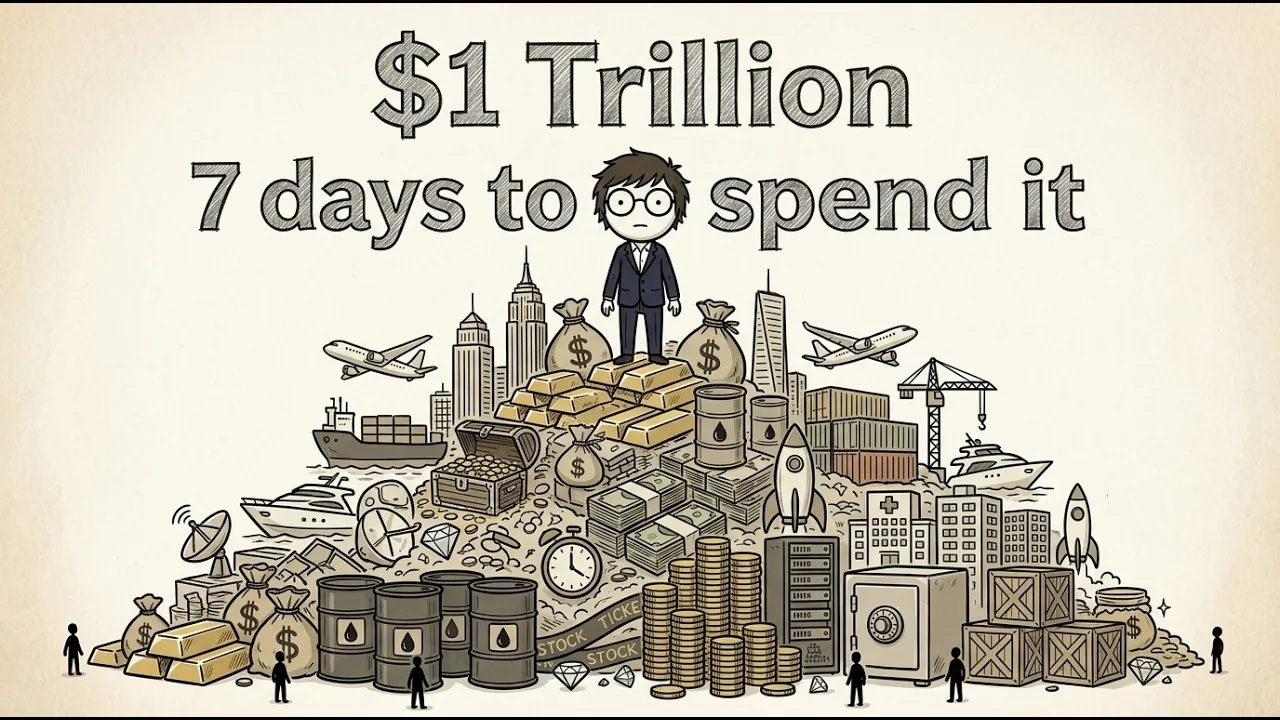
open the app. The number is real. $1 trillion sitting in an account registered to your name earning $136 million in interest for every day you don't move it. The rules, no donations, no gifts, no financial instruments. Legal ownership of actual goods, assets,
Said at 0:12
Most replayed moment #2
5:188.5x the video's typical replay level
those, too. Same answer, different country. World hunger isn't a shortage of food. It was never a shortage of food. It's a shortage of functional roads, stable governments, and supply chains not being disrupted by conflict. None of that has a price tag. None of it closes in seven days. You didn't end
Said at 5:11
Most replayed moment #3
2:265.2x the video's typical replay level
That problem is for next week. End of day two, 25 billion dollars spent. 975 billion dollars remaining. Interest accrued while you were buying, 272 million dollars. Two full days, less than 3% of the money moved. You stop buying things people want. You start
Said at 2:19
The graph counts replays. It does not show where viewers stopped watching.
Words
1,786
Runtime
10:35
Speaking pace
169wpm
Reading time
7min
169 words per minute, between the 160 25th percentile and the 181 median of 349 measured videos. That distribution comes from the 349-video hook study.
Opening (first 30 seconds)
Monday morning, bank transfer confirmation. No sender, no explanation, just a number with 12 zeros in one sentence. Spend it all within 7 days or lose everything. You read it twice. You open the app. The number is real. $1 trillion sitting in an account registered to your name earning $136 million in interest for every day you don't move it. The rules, no donations, no gifts, no financial instruments. Legal ownership of actual goods, assets, services. Every dollar leaves in exchange for something you
85 words, the words spoken in the first 30 seconds at 169 words per minute.
Free, no signup. See how the first 30 seconds hold attention, with rewrites.
Sentence shape
| Measure | This transcript |
|---|---|
| Sentences | 204 |
| Average words per sentence | 8.8 |
| Longest sentence | 34 words |
| Questions asked | 0 |
| Sentences containing a number | 51 |
Most used terms
Filler phrases
2 in total: like 2.
A literal whole-word count of the same phrase list the Prepublish browser extension uses, so a phrase inside another word is not counted and a phrase used in its ordinary sense still is. It is a count and not a judgement.
Free, no account. See where attention is likely to drop, with a rewrite for each weak line. The free check shows the scores and the one issue costing the most. Or run it on the words above first.
Free · No login · See a sample audit first if you prefer.
What this transcript is
Every word below is the caption track YouTube publishes for this video, pulled from the video itself and reproduced unchanged. It is not Prepublish's writing, not a summary, and not a re-transcription: it is the video's own published captions. English captions, generated automatically by YouTube, in the video’s original language. Source: the video on YouTube. A channel that would rather this page did not exist can ask for its removal through the contact page, and it is removed.
Monday morning, bank transfer confirmation. No sender, no explanation, just a number with 12 zeros in one sentence. Spend it all within 7 days or lose everything. You read it twice. You open the app. The number is real. $1 trillion sitting in an account registered to your name earning $136 million in interest for every day you don't move it. The rules, no donations, no gifts, no financial instruments. Legal ownership of actual goods, assets, services.
Every dollar leaves in exchange for something you now own. By 8:00 a.m. a man in a suit is at your door. Account liaison. Briefcase. He'll be there every morning. You'll stop noticing him by day three. First instinct, property. Always property. A $300 million ranch in Aspen, a waterfront compound in Palm Beach, a villa on the French Riviera that hasn't changed hands since it belonged to a Belgian king. You call the agents.
Everyone answers on the first ring. That's the first thing you notice about having a trillion dollars. Not the number, the ring count. By noon you've signed on 80 properties across 12 countries. By the time you finish the last contract, you can't remember what the first three looked like. The desensitization takes about 6 hours. Luxury goods. Patek Philippe's private sales team, Audemars Piguet, a Christie's specialist who moves pieces that never reach public auction.
By midday Tuesday, you own more Patek Philippe complications than Patek Philippe's own museum. The watches are in a vault. You haven't asked which vault. You own every Bugatti La Voiture Noire in existence. One car, [music] $18 million done in 11 minutes. Every Koenigsegg Jesko Absolute currently available. You are buying entire annual production runs. By the end of the day, you own more rare hypercars than any private collection in recorded history.
Jewelry, rare wine, whiskey, entire categories you didn't know existed 8 hours earlier. Private jets. Every top-tier G700 and Global 7500 available globally gone. Brokers in Fort Lauderdale, Geneva, Singapore, Dubai working simultaneously. By mid-morning you own more private jets than the three largest charter companies combined. You note that fact. You move on. 43 super yachts, Monaco, Miami, the Maldives. Three Mediterranean ports your assistant reads from a list.
Combined crew requirement, roughly 4,000 people. You have become a maritime employer. That problem is for next week. End of day two, 25 billion dollars spent. 975 billion dollars remaining. Interest accrued while you were buying, 272 million dollars. Two full days, less than 3% of the money moved. You stop buying things people want. You start buying things the world runs on. Farmland, [music] Iowa, Nebraska, Kansas. Institutional grade holdings that trade like financial assets.
So cash transactions close fast. By early afternoon you're the effective owner of farmland the size of a small European nation. Water rights follow, California, Arizona, Colorado. Agricultural operations across three states now depend on whoever manages your estate. Your assistant reads that sentence aloud. You don't respond. Gold. You tell the commodities desk you want 50 billion dollars in physical bars. The desk goes quiet.
Then, that's roughly 15% of annual global production. You tell them to proceed. The price moves 8% while your orders execute. Every person on Earth who already owned gold got slightly wealthier because you decided to buy that afternoon. Art. Private viewing, not an auction. 47 major works. No visible price tags until you ask. You buy 26 of them. Not because the others are inferior, but because your advisor says these 26 have the fastest transfer times.
You're not collecting. You're clearing inventory. Then all 800 private islands listed globally. You sign for an unnamed 42 acre rock off Norway. No fresh water, accessible only by boat. [music] With the same signature and the same speed as a Fijian island with its own airstrip. The price difference is $40 million. The signature is the same. An assistant runs the numbers on island management. Combined, you now require roughly 6,000 staff to maintain the properties, crew the yachts, and keep the lights on.
You don't have 6,000 staff. You don't have any staff. That is a problem that costs money to solve, which technically helps. You tell someone to start hiring. End of day four, $120 billion spent, $880 billion left. The gap is not closing. Someone on your team says it, you could end world hunger. You can't donate, but you can buy. The big four grain traders, ADM, Bunge, Cargill, Louis Dreyfus, move roughly 90% of everything the world eats.
Wheat, corn, soy. You make cash offers for all four simultaneously. Your team contacts every major fertilizer producer and every company holding significant seed patents. Within 48 hours, you are, on paper, the sole landlord of the global calorie. Then you try to move the food. You own the grain. You don't own the trucks, the roads, or the ports. You try to route supply into regions with active food insecurity and hit a wall.
The largest ports can't absorb the volume. Shipping coordinators talk about backlogs measured in months. State-owned ports go under national security review the moment your name appears on a filing. You try to buy those, too. Same answer, different country. World hunger isn't a shortage of food. It was never a shortage of food. It's a shortage of functional roads, stable governments, and supply chains not being disrupted by conflict.
None of that has a price tag. None of it closes in seven days. You didn't end hunger. You made grain more expensive for a week. The food is sitting in silos. The problem was never the food. End of day five, $200 billion spent, $800 billion left. You try to buy a country. Argentina is carrying roughly $400 billion in national debt, IMF obligations, restructured bonds, renegotiated so many times the paperwork fills rooms.
You put a cash offer on the table, full debt clearance in exchange for special economic zone authority over the port of Buenos Aires. The government signals it wants the deal. Of course it does. The IMF calls within 4 hours. The US State Department calls within 6. Not to negotiate, to make clear this isn't happening. Money can buy a government's attention. It cannot buy sovereignty because sovereignty isn't something governments control alone.
Other nations get a vote. Those nations will not allow a private individual to hold port authority over a major South American trade hub. You try three smaller nations. The wall is the same each time, just different [music] accents on the other end. Every offer gets blocked before the paperwork reaches anyone with a pen. The interest kept running during those calls. Another $136 million right on schedule. End of day 6, $210 billion spent, $790 billion remaining. $790 billion left. are blocked.
You stop trying to own things that require diplomats. Public companies don't need a government's approval, they just need a buyer. Your team begins executing block trades across the S&P 500. Not one company, all of them. The strategy is mechanical. Start with the largest by market cap, work down. Apple, Microsoft, Nvidia. You aren't doing hostile takeovers through the normal process. You're buying enough shares in a single session to force a majority position before anyone can convene a board meeting.
Securities law requires a 20 business day window for a formal tender offer. You don't have 20 days, you have hours. So you don't file, you just buy. The first $50 billion moves cleanly. The market absorbs it the way a river absorbs a stone. A ripple, then nothing. Then the pattern becomes visible to the algorithms. Every major trading desk on Earth is watching the same tape. Someone is buying everything. Not rotating, not hedging, buying.
All of it, at any price. The S&P 500 rises 4% in 40 minutes, then 9%, then 14%, you're not buying stocks, you're becoming the price. Every share you purchase costs more than the last because your own orders are the [music] news the market is pricing in. The trillionaire premium. You spend $100 billion and acquire less than you would have if you'd spent $40 billion an hour earlier. The math is running in reverse. [music] By mid-morning the NYSE circuit breakers trip.
Trading halts for 15 minutes. It resumes. You keep buying. It halts again. The SEC issues an emergency statement. Unusual coordinated acquisition activity across multiple sectors. They don't name you. They don't need to. Your team's lawyers are already on a call with the commission before the statement finishes loading. The EU follows within 90 minutes. Euronext suspends trading across Paris, Amsterdam, Brussels, [music] and Lisbon.
The Frankfurt Exchange goes next. The Tokyo Stock Exchange issues a precautionary pause citing an anomalous cross-border capital flows. You have broken four stock exchanges before noon on the last day. The SEC doesn't freeze your account. They freeze the markets. There's a legal difference and it matters. They can't stop you from having money, but they can stop the venues where that money moves. Every exchange you haven't reached yet goes on preemptive halt.
The London Stock Exchange, Hong Kong, Sydney. Regulators on six continents are on the same call and the word they keep using is systemic, not illegal. Systemic. You are a weather event and they are closing the airports. By the time trading resumes, partially with per account acquisition caps written into emergency session rule changes that will take years to formally codify, you've moved $680 billion into equity positions across 340 companies.
You own controlling stakes in 14 of the 30 largest corporations on Earth. The combined market cap of your holdings at the inflated prices your own buying created is listed at over $1.1 trillion. On paper, you are worth more than when you started. The number is meaningless. You can't sell without collapsing the price you created. End of day seven, $920 [music] spent, $80 remaining. The markets are closed. The interest never stopped.
Roughly $720 million earned across the full seven days. You ran out of open exchanges before you ran out of money. You failed. Not because you ran out of ideas, but because the world ran out of things it could sell you fast enough. Physical goods with immediate title transfer capped out somewhere around $100 to $110. Everything above that either takes time you didn't have, doesn't exist as private property, or moves in price so fast when you buy it that the purchase undercuts itself.
The richest people alive don't spend their money because the supply runs out long before the money does. And the money that can't be spent earns while you sleep. The earning is faster than the spending.
The words are the caption track's own and nothing is reworded or re-transcribed. Paragraph breaks are placed between sentences so the text reads as prose.
Free tools for your own script: paste a draft and see where it stands before you record it.
Paste your draft and see where viewers are likely to drop off, with a rewrite for each weak line.
Paste the first 30 seconds of your own draft for a hook score and rewrites.
Check your draft against YouTube's advertiser-friendly guidelines before you record it.
Read this channel's public videos and transcripts, and download a writing brief for it.