Getting the transcript
Reading the captions from YouTube. A video nobody has opened here before takes 10 to 30 seconds; this page fills in on its own.
Getting the transcript
Reading the captions from YouTube. A video nobody has opened here before takes 10 to 30 seconds; this page fills in on its own.
Ambition Arc · @TheAmbition-Arc
Words
1,917
Runtime
11:37
Speaking pace
165wpm
Reading time
8min
165 words per minute, between the 160 25th percentile and the 181 median of 349 measured videos. That distribution comes from the 349-video hook study.
Opening (first 30 seconds)
Last quarter, McDonald's did something that shouldn't be possible. Revenue up, traffic down. More money out of fewer people. In the United States, fewer customers walked through the doors than the year before, and the company made more money anyway. Somebody is paying for that, and it isn't the shareholders. This is the story of how the cheapest meal in America got too expensive for the people it was built to feed, and how McDonald's [music] called that a good quarter. McDonald's never
83 words, the words spoken in the first 30 seconds at 165 words per minute.
Free, no signup. See how the first 30 seconds hold attention, with rewrites.
Sentence shape
| Measure | This transcript |
|---|---|
| Sentences | 137 |
| Average words per sentence | 14.0 |
| Longest sentence | 44 words |
| Questions asked | 1 |
| Sentences containing a number | 25 |
Most used terms
Filler phrases
3 in total: actually 3.
A literal whole-word count of the same phrase list the Prepublish browser extension uses, so a phrase inside another word is not counted and a phrase used in its ordinary sense still is. It is a count and not a judgement.
Free, no account. See where attention is likely to drop, with a rewrite for each weak line. The free check shows the scores and the one issue costing the most. Or run it on the words above first.
Free · No login · See a sample audit first if you prefer.
What this transcript is
Every word below is the caption track YouTube publishes for this video, pulled from the video itself and reproduced unchanged. It is not Prepublish's writing, not a summary, and not a re-transcription: it is the video's own published captions. English captions, generated automatically by YouTube, in the video’s original language. Source: the video on YouTube. A channel that would rather this page did not exist can ask for its removal through the contact page, and it is removed.
No Script X-ray for this video: YouTube shows a Most replayed graph only once a video has enough views.
Last quarter, McDonald's did something that shouldn't be possible. Revenue up, traffic down. More money out of fewer people. In the United States, fewer customers walked through the doors than the year before, and the company made more money anyway. Somebody is paying for that, and it isn't the shareholders. This is the story of how the cheapest meal in America got too expensive for the people it was built to feed, and how McDonald's [music] called that a good quarter.
McDonald's never won because the food was good. You already know that. It won because it was certain. The same burger, the same fries, the same low price in a highway town in Nebraska >> [music] >> or a side street in Osaka. For 70 years, that was the entire product. Not the taste, the certainty. Cheap, fast, everywhere, every single time. Then McDonald's spent [music] that promise, and it spent it faster than almost anyone noticed.
Understand how big this company actually is before we talk about what's cracking [music] underneath it. As of the middle of 2026, McDonald's runs more than 46,000 restaurants across 114 countries. [music] In a single 3-month stretch, $37 billion in sales flow through its system. Nearly 220 [music] million people are active in its loyalty app. By every measure of raw scale, it is the [music] most dominant fast food company that has ever existed.
Nothing else is close. But its real product was never the Big Mac. a promise so simple most people never said it out loud. A family with $40 could feed four people and drive home. Predictability was the product. The arches, the clown, the playgrounds, all of it was decoration on top of one guarantee. Cheap, reliable, [music] everywhere. That guarantee is what built the empire, and it built it in a specific way. A working parent didn't pull into a McDonald's because it was the best food in [music] town.
They pulled in because it was the meal they could count on at a price they could count on at the end of a long day when there wasn't much left in the account. [music] For decades, McDonald's owned that customer completely. Here's the scale of it. McDonald's says one in eight Americans have worked under [music] its arches at some point, more than 40 million people. And every single day, it serves over [music] 70 million customers worldwide.
The low-income diner, the family stretching a paycheck, the shift worker on a 30-minute break, that was the foundation the entire pyramid stood on. And then, quarter by quarter, McDonald's made a decision that would push [music] that exact customer out the door. And for a long time, that decision looked brilliant. Between 2014 and 2024, the price of popular McDonald's [music] menu items rose on average 100%. Let that number sit because it's the whole story compressed into one figure.
That is not inflation. Over that same decade, general prices in the United States went up by roughly a third. McDonald's went up by double that. The steepest increase of any major fast-food chain anyone measured. A McChicken that cost a dollar in 2014 [music] climbed toward three. A McDouble that ran a dollar 19 crossed four. The dollar menu, the thing that was practically McDonald's identity, quietly stopped meaning anything at all.
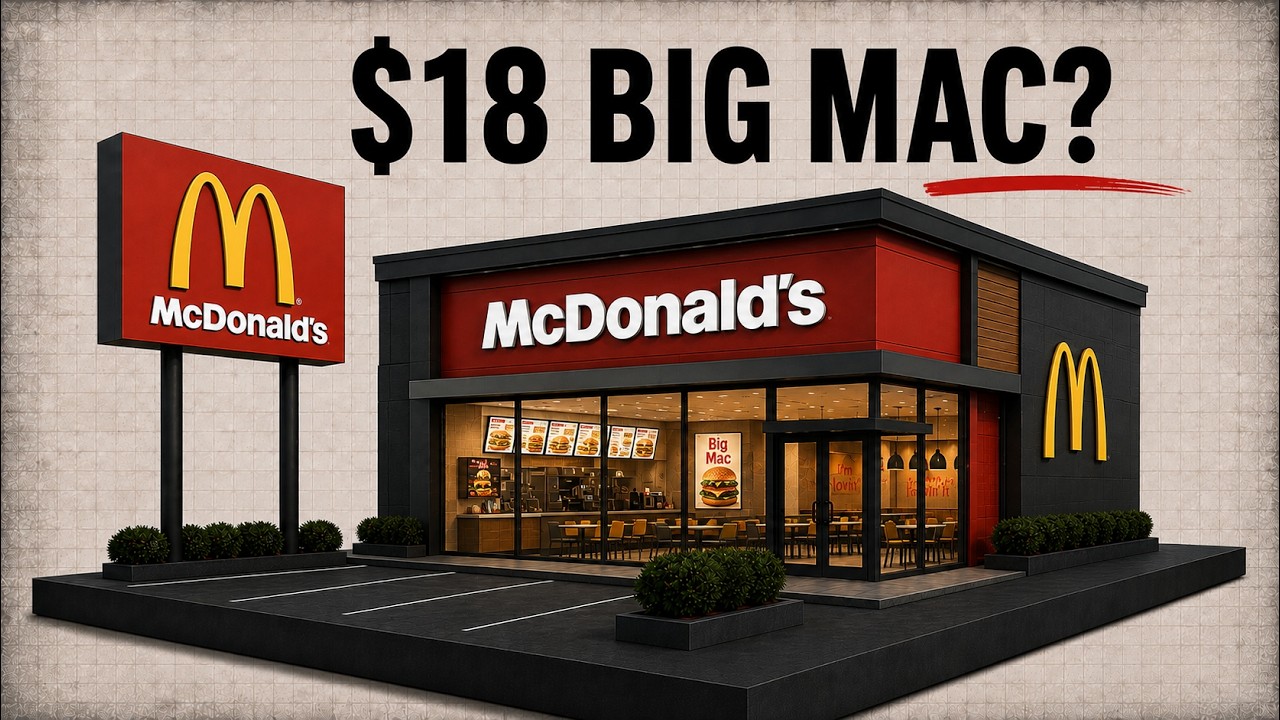
For a while, this worked. Higher prices meant more revenue per customer, [music] and the customers kept coming out of pure habit. The slides looked great. Every quarter, the average check [music] climbed, and Wall Street nodded. Then, in 2024, a photo of an $18 Big Mac meal at a single Connecticut rest stop went viral. And McDonald's did something a company [music] that size almost never does. It wrote an open letter.
The president of McDonald's [music] USA pushed back, insisting the real increase was closer to 40% since 2019, not 100. But sit with that defense [music] for a second. 40% was the number they chose to reassure people with. 40% was the good version. And here's what the whole exchange missed about the customer standing at the actual [music] counter. They were never running the math. They weren't comparing percentages against a 2019 baseline.
[music] They were looking up at the menu board, seeing the total, feeling the number in their gut, and quietly deciding to go somewhere [music] else. And here's the part that makes this a decision, not just bad luck. McDonald's could see the traffic falling. Quarter after quarter, the guest counts told them the core customer was leaving. And quarter after quarter, they chose the check over the customer. Higher prices, higher margins, a better number today, because the number kept working.
[music] Until it became exactly what the data shows now, which is where this stops being a story about a price chart [music] and becomes something colder. For nearly 2 years now, traffic from lower-income customers [music] has been falling at close to double-digit rates. Over that same period, traffic [music] from higher-income customers has been rising at close to double-digit rates. McDonald's' own chief executive has a name for this split.
He calls it a two-tier economy. Read what that actually describes. [music] McDonald's, the company built specifically to feed the people who can't [music] afford to eat anywhere else, is now growing because wealthier people are trading down [music] into it, while the people it was built for are being priced out of a hamburger. The foundation customer, the one the whole empire was poured on top of, is walking away. And a richer customer is [music] walking in to replace them.
The golden arches didn't lose their core customers to a competitor. There was no better deal that stole them away. McDonald's evicted them with its own menu board. So, here's the question that breaks most people's understanding of this story. If the core customers are leaving, how does revenue keep going up? This is the trick, and once you see it, you cannot unsee it in their numbers again. In the most recent quarter reported in August of 2026, [music] McDonald's brought in over $7 billion in revenue.
US same-store sales rose. On the earning slide, it [music] reads as growth, clean and simple. But, read the company's own explanation of why that number went up, and the whole thing turns inside out. The growth came from higher checks, not more visits. In plain language, the average bill went up while the number of people paying it went down. US traffic [music] fell. Guest counts dropped. The chain isn't feeding more of America, it's charging the Americans who remain a good deal more >> [music] >> and reporting the result as momentum.
This is the number nobody says out loud on the earnings call. Every quarter of positive check growth is, underneath the language, two things happening at once. Someone deciding a Big Mac is no longer [music] worth it and leaving, and the people who stayed quietly covering that absence by spending more. Fewer customers, bigger bills, and the two roughly cancel out on the slide. You can run that play [music] for a surprisingly long time.
The revenue holds, the stock behaves, the press [music] release writes itself, but you are not growing. You are hollowing, losing the base while the people who remain paper over the hole, and every quarter that hole gets a little wider and a little more expensive to [music] hide. And the fix McDonald's reached for created a brand new problem, one that doesn't land on corporate at all. It lands on the people who actually run the restaurants.
Roughly 95% of McDonald's restaurants in America are not run by McDonald's. They're run by independent operators, franchisees, families who bought into [music] the golden arches and mortgaged everything to do it. And here's the structure that makes this brutal. McDonald's owns the real estate under most of those restaurants. The franchisees [music] don't pay a fixed rent. They pay a percentage of their sales. Sell more, owe more, automatically, every month, forever.
McDonald's is, in many ways, a real estate company that happens to sell burgers. Now, watch what the value strategy does to the operator caught inside [music] that structure. To win back the customers it priced out, corporate is pushing discounts, value meals, and under $3 [music] menu deal after deal. But a discount is a very different thing depending on which side [music] of the counter you're on. For corporate, a discount that grows total sales is a win because their cut [music] is a percentage of that top line number.
For the operator, a discount that grows sales while shrinking the profit on every item can be a slow bleed. As of the most recent quarter, only about 60 to 65% of the system had even fully implemented the under $3 menu. Executives stood up and called the US [music] performance disappointing and pointed at inconsistent execution by franchisees. But look hard at what's being asked. Corporate wants [music] operators to cut prices to fix a traffic problem that corporate created by raising prices, while those same operators pay rent as a percentage of sales, absorb [music] record beef and energy costs, and watch their margins thin from both ends.
The company that designed the discounts [music] is not the company that bleeds for them. Here's the part that keeps this honest. Nobody is going to bankrupt McDonald's. 46,000 restaurants, 114 countries, $37 billion a quarter moving through the system. That machine does not collapse. Anyone telling you McDonald's is about to fail is selling you a thumbnail, [music] but it can hollow out, and that is the real danger. Not a crash you can see, a slow emptying of the exact thing that made McDonald's [music] matter in the first place.
Because here's the tell buried in the numbers. This is overwhelmingly an American problem. Across McDonald's international markets, the same brand, the same arches, the same model, sales kept posting positive through the same stretch the US was sliding. The struggle isn't McDonald's the global [music] corporation failing, it's McDonald's the American promise breaking [music] in the one market where it was supposed to be untouchable, among the exact people it was built to feed.
The moat was never the beef or the branding or the arches or the app. The moat was that a family with $40 could feed four people and drive home without thinking about it. That was the whole thing. 70 years of dominance in one sentence, and McDonald's traded [music] it for check growth, for margin, for one more quarter of a number that looked good on a slide. When the most recent [music] quarter's numbers came out, traffic down, checks up, the same story with the same missing person in it, McDonald's chief executive stood in front of investors and said five words, "We don't have a strategy problem." And here's the unsettling thing, he might be right.
Maybe it isn't a strategy [music] problem at all. Maybe the strategy worked exactly as designed. Grow the revenue, lift the check, protect the margin, quarter after [music] quarter. And everything we just walked through is simply what that strategy costs when you follow it all the way down. An empty drive-thru at 6:00 in the morning isn't a market condition, it's a receipt, and the [music] name printed on it is the customer McDonald's used to be built for.
The words are the caption track's own and nothing is reworded or re-transcribed. Paragraph breaks are placed between sentences so the text reads as prose.
Free tools for your own script: paste a draft and see where it stands before you record it.
Paste your draft and see where viewers are likely to drop off, with a rewrite for each weak line.
Paste the first 30 seconds of your own draft for a hook score and rewrites.
Check your draft against YouTube's advertiser-friendly guidelines before you record it.
Read this channel's public videos and transcripts, and download a writing brief for it.