Getting the transcript
Reading the captions from YouTube. A video nobody has opened here before takes 10 to 30 seconds; this page fills in on its own.
Getting the transcript
Reading the captions from YouTube. A video nobody has opened here before takes 10 to 30 seconds; this page fills in on its own.
Lume · @lume-channel
Words
3,082
Runtime
19:22
Speaking pace
159wpm
Reading time
13min
159 words per minute, below the 160 25th percentile of 349 measured videos. That distribution comes from the 349-video hook study.
Opening (first 30 seconds)
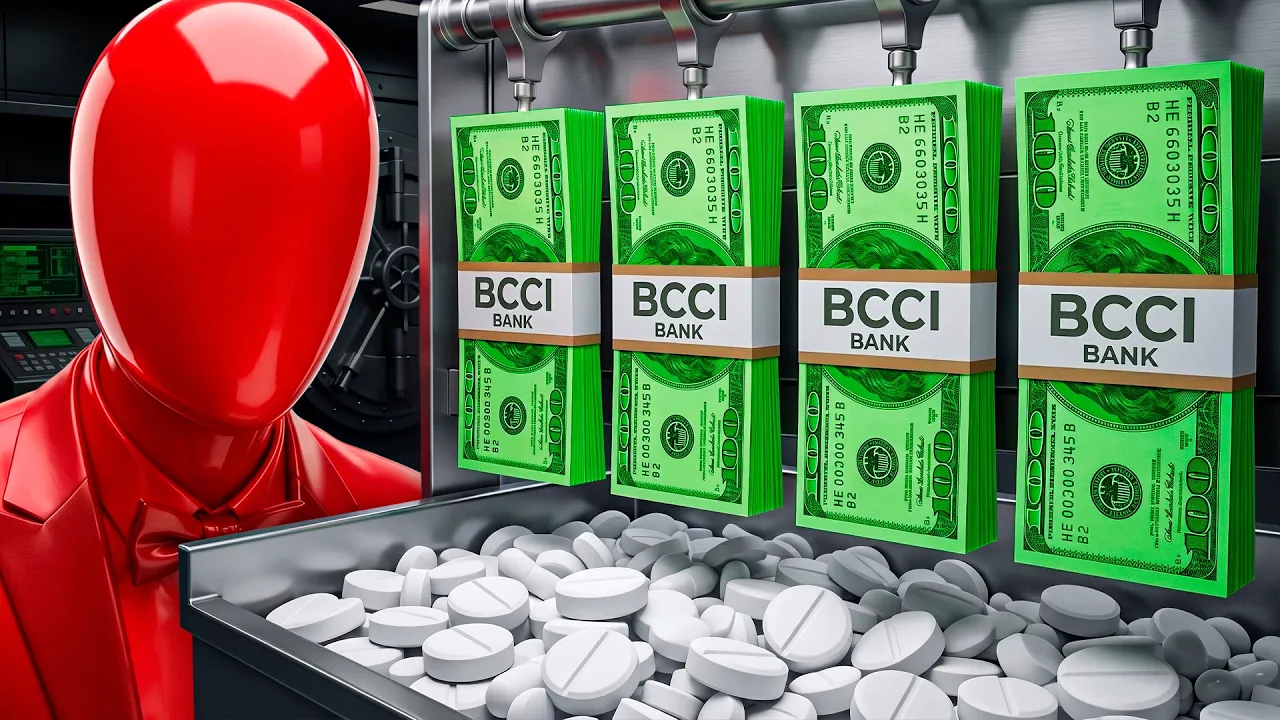
July 5th, 1991. In seven countries at once, at the same hour, police walk into the same bank. London, Luxembourg, the Cayman Islands, Abu Dhabi. In minutes, the doors are changed shut and 1.4 million people from London shopkeepers [music] to villagers in Bangladesh wake up to find their money is simply gone. $20 billion. 73 countries, 14,000 [music] employees vanished in a single night. The bank was called BCCI and for 19 years it had been the best kept
80 words, the words spoken in the first 30 seconds at 159 words per minute.
Free, no signup. See how the first 30 seconds hold attention, with rewrites.
Sentence shape
| Measure | This transcript |
|---|---|
| Sentences | 242 |
| Average words per sentence | 12.7 |
| Longest sentence | 47 words |
| Questions asked | 2 |
| Sentences containing a number | 26 |
Most used terms
Filler phrases
6 in total: like 5 · kind of 1.
A literal whole-word count of the same phrase list the Prepublish browser extension uses, so a phrase inside another word is not counted and a phrase used in its ordinary sense still is. It is a count and not a judgement.
Free, no account. See where attention is likely to drop, with a rewrite for each weak line. The free check shows the scores and the one issue costing the most. Or run it on the words above first.
Free · No login · See a sample audit first if you prefer.
What this transcript is
Every word below is the caption track YouTube publishes for this video, pulled from the video itself and reproduced unchanged. It is not Prepublish's writing, not a summary, and not a re-transcription: it is the video's own published captions. English captions, generated automatically by YouTube, in the video’s original language. Source: the video on YouTube. A channel that would rather this page did not exist can ask for its removal through the contact page, and it is removed.
No Script X-ray for this video: YouTube shows a Most replayed graph only once a video has enough views.
July 5th, 1991. In seven countries at once, at the same hour, police walk into the same bank. London, Luxembourg, the Cayman Islands, Abu Dhabi. In minutes, the doors are changed shut and 1.4 million people from London shopkeepers [music] to villagers in Bangladesh wake up to find their money is simply gone. $20 billion. 73 countries, 14,000 [music] employees vanished in a single night. The bank was called BCCI and for 19 years it had been the best kept secret in global finance because its real customers weren't ordinary [music] people.
Its customers were Pablo Escobar's Medí cartel, the dictator Manuel Noriega, the terrorist Abu Nidal, Saddam Hussein, and quietly the Central Intelligence Agency. One bank serving the drug lords, the tyrants, the terrorists, and the spies hunting them all at the same time. Investigators would later call it the largest bank fraud in world history. One prosecutor called it something scarier. A bank that had grown so tangled, so protected, so useful to so many powerful [music] men that it had become too criminal to fail.
So how does a bank founded to help the world's poorest people become the money machine of its worst monsters? And how for [music] 19 years did no one shut it down? It starts with a boy watching a palace from the wrong side of the gate. To build the dirtiest bank in history, you don't start with a criminal. You start with a boy who wanted more than anything to belong. A Hassan Abedi was born in 1922 in Lucknau in British India into an Erdo speaking Muslim family that was comfortable but not rich and his father had a very particular job.
He managed the estate of one of the great landowners of the region, the Raja of Mahmudabad. Sit with what that does to a child. Young Abed grew up inside the orbit of immense aristocratic wealth. The marble, [music] the servants, the power of colonial India, but always on the managing side of it. Close enough to touch the luxury. Never allowed to own it. The clever boy in the manager's house, watching the palace [music] through the gate.
He was brilliant. He earned a master's in English literature and a law degree. He could quote poetry and argue philosophy. And then at 25, history detonated under his feet. In 1947, British India was torn in two. The partition. Millions of Muslims fled toward the new nation of Pakistan. Millions of Hindus and Sikhs fled the other way. One of the largest and bloodiest migrations in human history. And Abedi was in it, leaving behind the only world he'd known to start over from almost nothing in a brand new country.
Think about the man that forges. [music] Someone raised beside wealth he could never have, who then lost even his homeland. A refugee with a poet's mind [music] and a burning need to build something no one could ever take away. He went into banking. He was extraordinary at it. But an ordinary career was never the point. Because Abatty had watched up close exactly who finance served. the Rajas, the empires, the West, and who it locked outside the gate.
People like him. So he dreamed of a bank that would flip the entire order, a bank for the forgotten [music] world. He just needed someone rich enough to make it real. And in the desert, he found him. Abide had a gift no balance sheet can measure. Charisma. Everyone who met him, [music] bankers, presidents, even a future American president, described the same thing. A man who could walk into a room and make every person in it feel chosen.
He didn't sell banking. He preached it like a faith. That gift found its match on a falconry trip. In the deserts of Pakistan, Abed had befriended Shik Hazed, the ruler of Abu Dhabi, a man whose small kingdom was suddenly flooded with oil money beyond imagining. The bond became a lifeline when Pakistan's government turned on Abidi and barred him from even leaving the country. It was Zed who used his influence [music] to protect him.
And in 1972, with about $2.5 million of the shakes's fortune, Abed founded the Bank of Credit and Commerce [music] International. What came next belongs in a legend. In under two decades, BCCI erupted across [music] five continents, 73 countries, more than a million customers, 14,000 employees from over 90 nations to millions across Asia, Africa, and the Middle East. [music] It was pride made real. Finally, a global bank that was theirs.
A bei was celebrated by kings and courted by statesmen. And here is the tragedy that makes this story hurt. The dream was real. The people who believed in it were real. But beneath the beautiful surface from almost the first day, Abidi had built something that had never existed [music] before. Not really a bank, a machine engineered to be invisible to every government on Earth. Every bank in the world answers to somebody, a country, a regulator, someone who can walk in and open the books.
A bee's genius and his crime was building a bank that answered [music] to no one. Watch how BCCI was incorporated in Luxembourg. Its largest operations ran out of London. [music] Its holding company sat in the Cayman Islands. Its money came from Abu Dhabi. Its soul was in Karach. No single government ever held the full picture. Ask London about the books and London pointed to Luxembourg. Ask Luxembourg [music] and Luxembourg pointed to the Caymans.
Abed had deliberately smeared the [music] bank across so many borders that no one regulator could see the whole beast at once. He even split the audit [music] between two different firms so not even the accountants saw it whole. Inside that fog, he built what investigators later called an impenetrable web. Holding companies inside holding companies and secret compartments [music] they gave a name to. Banks within the bank rooms where money could vanish and reappear [music] with no trail.
To look respectable, BCCI needed to seem owned by rich upstanding [music] men. So, it recruited them. Prominent Middle Eastern names listed as major shareholders. Except most were straw men, fronts. They never truly bought their shares. The bank secretly lent them the money and quietly paid the interest itself. They existed to reassure depositors, nothing more. And that exposes the black hole at the center. BCCI was pulling in billions [music] in deposits while hemorrhaging fortunes on reckless loans and outright [music] theft.
To hide the wound, it ran the oldest scam in finance at planetary scale. New depositors [music] money plugged the holes left by the old. It invented loans that didn't exist. It booked profits never earned. It was a Ponzi scheme, the largest ever built, and it could survive on one condition only. It could never stop growing. To grow that fast, BCCI needed a special kind of client. the kind that pays enormous fees and demands absolute secrecy.
Picture yourself a criminal in the 1980s sitting on a mountain of cash with nowhere to put it. BCCI was the answer to your prayers. A real global bank that would move your money anywhere on Earth and never once ask where it came from. The client list reads like a rogu's gallery of the century. Start with Manuel Noriega, the strong man of Panama. He opened secret accounts at BCCI in his own name and his families, and his associates fed them with large unexplained [music] piles of cash.
All told, roughly $23 million of Noriega's money moved through the bank while he ran drugs through his country. Pablo Escobar's [music] Medí cartel used BCCI to wash the profits of the cocaine drowning America's streets. Dirty money went in one end and came out clean on the far side of the planet. Abu Nidal, one of the most feared terrorists alive, kept accounts in BCCI's London [music] branches. Saddam Hussein's Iraq was in the web.
Arms dealers financed weapons shipments through it, complete with forged paperwork. And to guard all of it, BCCI built something no bank on Earth had ever possessed, its own private intelligence service, an enforcement arm. Investigators called it the Black Network. run out of karach as many as 1,500 strong. It used surveillance gear, bribery, extortion, and by some accounts, [music] kidnapping and murder. It ran guns.
It moved gold and drugs. In plain terms, a criminal secret service wholly owned by a bank. Sit with that image. A bank with an army. A bank that couldn't just hide your money. It could threaten your enemies, buy your officials, and make your problems disappear. A tool like that isn't just irresistible to criminals. It's [music] irresistible to governments. Here, the story stops being about greed and becomes about power.
Because the exact traits that [music] made BCCI perfect for the cartels made it perfect for the men whose job was to catch them. A global bank in dozens of nations, beholden to no regulator, able to move cash silently anywhere on Earth, leaving no fingerprints. That isn't just a laundering tool. That's the dream infrastructure of a spy [music] agency. And the CIA knew it. In August 1991, the agency admitted what had long been whispered.
It had used BCCI to move money. The bank sat at the heart of the decade's great secret operations. Through the 1980s, the United States was funneling weapons and cash to the fighters battling the Soviets in Afghanistan, and BCCY's black [music] network had seized control of the port of Karachi itself, handling the flow of arms and paying the bribes that kept it moving. The pipeline [music] of the largest covert operation of the Cold War ran in part straight through this one bank.
Its shadow fell across the Iran Contra affair. It brushed the black market and nuclear technology. the most dangerous secrets on earth bought and sold. And this is the poison logic that kept BCCI alive so long. It served the drug cartels and the agencies hunting the cartels. It moved the terrorists money and the money of the spies chasing the terrorists. Every powerful player had a reason to use it, which meant every powerful player had a reason to protect it.
But Abidi wanted one last prize. The one country his invisible empire was legally forbidden to enter. America itself, a foreign bank with BCCI's [music] whispered reputation, could never openly buy its way into the United States. [music] Regulators would slam the door. So, Abidi did what he always did. He made the ownership disappear. In the late 1970s and early 1980s, a group of wealthy [music] Arab investors quietly bought up one of the biggest banks in the American capital, First American Bank Shares, a Washington institution with branches reaching from Florida [music] to New York.
On paper, it had nothing to do with BCCI. The Arabs owned it. BCCI was merely a helpful adviser. It was a lie top to bottom. The Arabs were fronts. BCCI had secretly loaned them the purchase money. And when the loans defaulted, the bank quietly took the shares. The Bank of the World's criminals now secretly controlled one of the most important banks in [music] Washington, a short walk from the White House. And who stood out front as chairman, lending it a spotless name.
Clark Clifford, one of the most revered men in Washington, a former Secretary of Defense and legendary lawyer who had advised Presidents Truman, Kennedy, Johnson, and Carter. >> We have to know ourselves [snorts] that we're not getting into danger by entering into an agreement with another power. We can know that. With his protege Robert Alman beside him, Clifford looked American regulators in the eye and assured them BCCI did not control First American.
People still argue whether Clifford was a criminal or a dupe, a knowing accomplice or a great man played for a fool by the most charming con artist of the age. Altman was later tried and acquitted. Clifford, gravely ill, never faced a jury, but stripped the argument away, and what remains is staggering. The dirtiest bank in the world, had secretly captured a major American bank in Washington, using a former defense secretary as its human shield.
It would take an outsider, someone the powerful couldn't just wave away, to finally pull the thread. And he did it wearing a wire hidden inside a brass eagle. The first crack didn't come from a regulator. It came from a man pretending to be a criminal. Robert Mazer, a US customs agent who in the mid 1980s dissolved himself into a false identity. Bob Mousella, a wealthy mob connected businessman with money to move and no scruples about it.
It took nearly 2 years just to build the character, the credit history, the companies, the reputation on the street. Then he lived inside it for years. Every detail was armor. [music] He wore Armani suits and he carried a particular briefcase, a Remick, with a recorder hidden inside. To switch it on, he'd casually turn a small decorative [music] brass eagle near the clasp. That tiny gesture captured more than a thousand secret recordings of criminals [music] and bankers hanging themselves with their own words, one lunch at a time.
Following the drug money upward, Missouri arrived at a door. The private client division of BCCI and the bankers, thrilled to serve a rich new launderer, walked him through the entire machine, how to feed and [music] dirty cash and thread it through the maze until it came out spotless on the other side of the world. [music] They had no idea the eagle was listening. Then in 1988, Mazer [music] sprang the trap. And the way he did it is almost unbelievable.
He announced he was [music] getting married. His fiance was in reality another undercover agent. He planned a lavish wedding in Tampa, Florida, and invited his new friends, the BCCI bankers, the cartel money men to celebrate. On the night of the bachelor party, the guests were shown to a fleet of black town [music] cars, and told they were being driven to the festivities. The cars didn't go to a party. They went to the arrests.
There was no wedding. The whole romance had been baked. And by the time it was over, more than a hundred people around the world had been charged. But arresting bankers wasn't the same [music] as killing the bank. For that, it took a second hunter. And this one could not be intimidated. Robert Morganthaw, the legendary district attorney of Manhattan. In 1988, he opened his own investigation. And unlike the federal government, he refused to be steered off it.
Because here's what still stuns. As Morgan thaw dug, he found himself fighting not just the bank, but resistance from inside the American government itself. Agencies slowwalked him. Information dried up. A bank this useful to this many powerful people had defenders in very high places. He didn't stop. In July 1991, his grand jury indicted BCCI, its founder, and its top officers for fraud, bribery, grand lararseny, and moneyaundering.
He called it the largest bank fraud in world history and said the quiet truth out loud. BCCI had robbed ordinary depositors of billions to prop up a bank with no real assets of its own. The secret was out and the machine that could only live by growing was about to stop dead everywhere at once. Behind the scenes, the Bank of England had quietly ordered the accountants at Price Waterhouse [music] to find out what was truly inside BCCI.
What they produced has become legendary. A confidential report with a code name Sandstorm. Its contents were almost beyond [music] belief. Fictitious loans, fake profits, concealed losses, [music] deposits that had simply been stolen, owners who owned nothing, a capital base that was to a shocking degree pure fiction. It laid bare a Ponzi scheme of planetary scale. A bank whose books were a novel. There was no saving it.
The only question was how to kill it without setting off a worldwide panic. So on July 5th, 1991, regulators struck in one coordinated blow. At the same hour, country after country seized BCCI's branches and froze its accounts. Before anyone inside could move a dollar or shred a page by morning, the octopus was dead. And then came the human cost. The part with nothing to [music] do with dictators or spies. Because Aidi really had sold BCCI as the bank of the developing world.
Its victims were overwhelmingly ordinary people, small depositors, immigrant [music] families, shopkeepers, whole communities across South Asia, Africa, and Britain who had trusted the bank that looked like them, spoke their language promised to lift them [music] up. $10 billion or more gone. And the people who lost the most were the exact people Aidi had once vowed to save. The dream had been real to them right up until the morning the doors were chained [music] shut.
So the largest criminal enterprise in banking history was exposed, indicted, and shut down across the planet in a single night. Surely then the guilty went to prison. Almost no one did. Abetti, [music] the refugee boy who'd built an empire to prove he belonged, was in Pakistan, a national hero recovering from a heart transplant. [music] His country refused to hand him over. charged in America and Britain. He never spent a single day in a western courtroom [music] and died at home in Karach in 1995.
A free man, Clark Clifford was ruled too ill to stand trial. [music] Robert Alman was acquitted. The men behind the curtains scattered to countries that would never extradite them and the 10 plus billion dollars was mostly gone, dissolved into two decades of imaginary loans. A US Senate investigation by Senators John Kerry and Hank Brown spent years on it and its verdict cut deeper than the bank itself. Too many people in too many governments had known something was wrong and chosen again and again to say nothing because that was always the real trick.
Abed [music] didn't just build a bank that hid money. He built one that made itself necessary to the cartels and the tyrants, but also to the spies, the regulators, and [music] the politicians who found it far too convenient to much.
The words are the caption track's own and nothing is reworded or re-transcribed. Paragraph breaks are placed between sentences so the text reads as prose.
Free tools for your own script: paste a draft and see where it stands before you record it.
Paste your draft and see where viewers are likely to drop off, with a rewrite for each weak line.
Paste the first 30 seconds of your own draft for a hook score and rewrites.
Check your draft against YouTube's advertiser-friendly guidelines before you record it.
Read this channel's public videos and transcripts, and download a writing brief for it.