Getting the transcript
Reading the captions from YouTube. A video nobody has opened here before takes 10 to 30 seconds; this page fills in on its own.
Getting the transcript
Reading the captions from YouTube. A video nobody has opened here before takes 10 to 30 seconds; this page fills in on its own.
JP Middleton · @OfficialJPMiddleton
This video has no Most replayed graph yet: YouTube shows one only once a video has enough views. These are the moments viewers replayed most in JP Middleton's most watched videos.
Most replayed moment at 30:12
13.2x that video's typical replay level
way where they're assuming, like, oh, he's doing 100k a month providing AI services to business owners when in reality, right, it's all coming from this. And then results, right, what what results do they get? Uh the people they teach. He does get people good results. I've seen the results that he does get people on
Said at 30:06
Most replayed moment at 15:49
3.7x that video's typical replay level
here, we used to use Stripe. We now use Sense. This is one of our accounts before we stopped using it. Here's another one. And then here is another one, 90 1.35. And then finally, right here with 945,000 dollars. And so now the final thing that I want to show you is how to actually get leads. And so one
Said at 15:42
The graph counts replays. It does not show where viewers stopped watching.
Words
9,153
Runtime
36:33
Speaking pace
250wpm
Reading time
38min
250 words per minute, above the 201 75th percentile of 349 measured videos. That distribution comes from the 349-video hook study.
Opening (first 30 seconds)
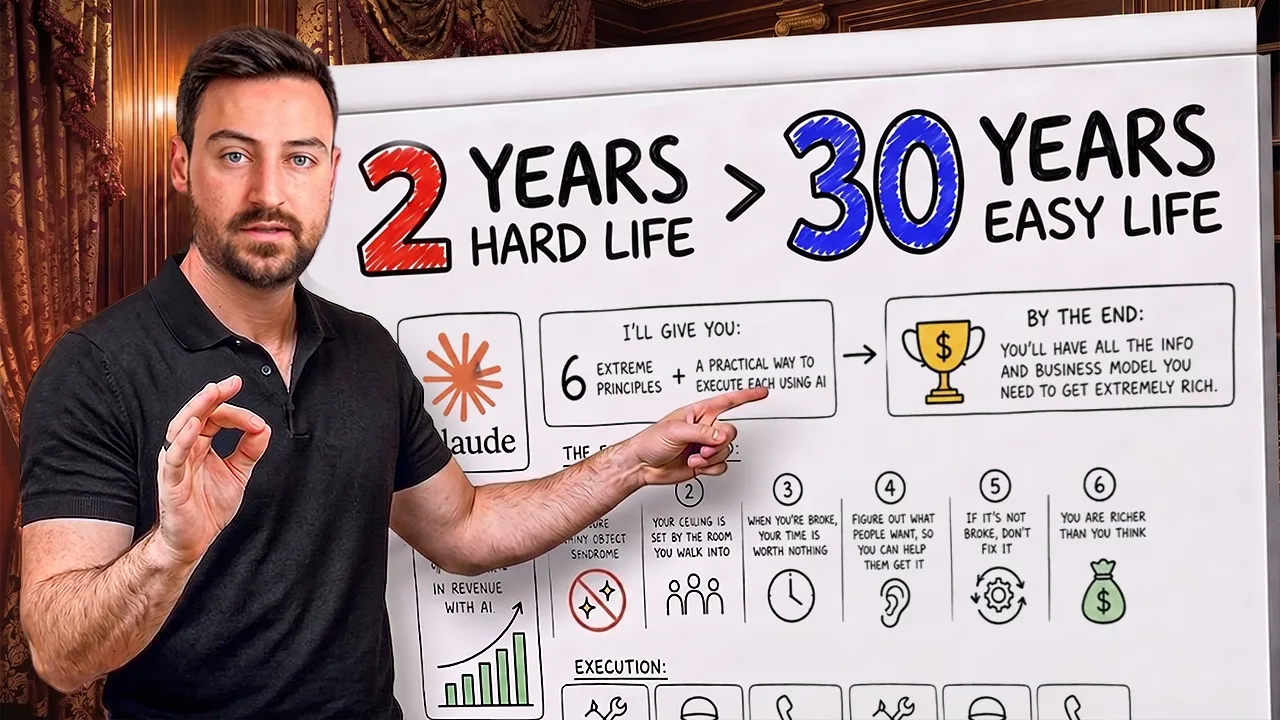
The only way I got extremely rich with AI was by following extreme principles. And there are six of them that I followed to make over $25 million with my AI business, Gym Evers Now, over the last 7 and 1/2 years now. And I've generated more than over $und00 million for the businesses that I've worked with. And I've become the preferred vendor for one of the biggest gym chains on the planet, Anytime Fitness, Exponential Brands. And all of this came from just six principles. And today, I'm going to share them with you. Some of them might sound a bit simple, but I learned the hard way that you need them to build a million-dollar business with AI. So, let's get straight
125 words, the words spoken in the first 30 seconds at 250 words per minute.
Free, no signup. See how the first 30 seconds hold attention, with rewrites.
Sentence shape
| Measure | This transcript |
|---|---|
| Sentences | 525 |
| Average words per sentence | 17.4 |
| Longest sentence | 82 words |
| Questions asked | 75 |
| Sentences containing a number | 45 |
Most used terms
Filler phrases
170 in total: like 46 · actually 37 · right? 32 · literally 15 · basically 13 · kind of 8 · uh 7 · you know 5 · um 4 · I mean 3.
A literal whole-word count of the same phrase list the Prepublish browser extension uses, so a phrase inside another word is not counted and a phrase used in its ordinary sense still is. It is a count and not a judgement.
Free, no account. See where attention is likely to drop, with a rewrite for each weak line. The free check shows the scores and the one issue costing the most. Or run it on the words above first.
Free · No login · See a sample audit first if you prefer.
What this transcript is
Every word below is the caption track YouTube publishes for this video, pulled from the video itself and reproduced unchanged. It is not Prepublish's writing, not a summary, and not a re-transcription: it is the video's own published captions. English captions, generated automatically by YouTube, in the video’s original language. Source: the video on YouTube. A channel that would rather this page did not exist can ask for its removal through the contact page, and it is removed.
The only way I got extremely rich with AI was by following extreme principles. And there are six of them that I followed to make over $25 million with my AI business, Gym Evers Now, over the last 7 and 1/2 years now. And I've generated more than over $und00 million for the businesses that I've worked with. And I've become the preferred vendor for one of the biggest gym chains on the planet, Anytime Fitness, Exponential Brands.
And all of this came from just six principles. And today, I'm going to share them with you. Some of them might sound a bit simple, but I learned the hard way that you need them to build a million-dollar business with AI. So, let's get straight into it. But before we get into it, I want to show you that I actually practice what I preach. This is my business, Gym Members Now, where you can see we're getting reviews very frequently, pretty in-depth reviews of people talking about what we do specifically with AI, right?
You can see right here, we improved your outbound outreach, operations, marketing, follow-up systems, reviews, referrals, all leveraging AI. This is my payment processor where you can see over the last 12 weeks. This is what we've done over the last 14 days. This is my Facebook profile where you can see I've posted literally like I think five testimonials, interviews with customers over the last 5 days because I'm going to a conference with this guy.
This guy's the founder of a franchise that owns over 170 locations. It's called Alloy Personal Training. And me and my team work with over 60 of them. And we're going to their conference, their franchise conference to set up a booth and pitch a ton of them. All right. Just wanted to show you this to show that I actually practice what I preach and that what I'm going to be talking about is something that I actually do and it comes from the wisdom and experience of it.
So, let's get into the six things. So, number one, you want to ignore shiny objects. And we're going to start with the one that makes the other ones work. If you skip this one, the other principles won't matter because you need to ignore the shiny objects. It's something that everybody does and it's very tempting, but you need to avoid it because nobody gets extremely rich because they found the best thing. They get extremely rich because they stuck with one thing long enough that everyone around them they were competing with quit.
That's kind of what has happened for me. And here's what this ultimately looks like. A new tool drops on Tuesday. You watch a 40-minute breakdown on Wednesday. And then on Thursday, you're rebuilding your whole business around it. And then by Friday, you remove all the progress you made and then you get back to the start and basically just start over again. And I know it feels like you're learning, but you're just making excuses.
You're not making progress. Don't convince yourself you are. Task switching can cost you up to 40% of your productive time. That's what studies show. Because you're losing the time you waste learning something new. And also, you're learning the time you spend building what you had before. So, stop trying to be early to every single thing. Being the first to use a tool doesn't mean anything. And I've run my agency on the same stack for years, and I've done over $25 million with it.
I'd never change it for the newest tool because it still works to this day. There's just no reason for that. I just added one tool because it helps me make everything a lot faster. And here's the tool stack I'd choose if I had to start all over again today. I would do go high level. This is the one where I built the system that I sell in my AI agency. I can literally do everything with it. Save all the information from my clients leads like their phone number, their first name, their last name, their email.
I'm able to create landing pages, websites, and set up automations and workflows along with AI integrated into it to respond to leads I generate for my customers with email and SMS and even on Facebook. The thing I like the most is that I can just copy my system for every single client I get. So, I never have to build anything from scratch. It's basically like copying and pasting it over and over again. And it's very easy to use once you get the hang of it.
I would also use meta ads and the meta ad library. This is how I would get customers for my clients. But then most importantly, if you don't know how to run marketing, if you you've never done it before, and you're scared of it, you can use the meta ads library to look at what the competitors are doing, other agencies already doing to just model what's already proven to work. And that's exactly how I got really good at this.
And I'm going to show you a shortcut in this video, a skill I built to be able to do this at scale for any market you want to go after. And then third would be Claude. And so I started my business with just two of these tools, but if I started from scratch, again, I'd add Claude to the list, specifically Claude Code. It can do pretty much everything you ask it to do, and it can help you save a lot of time. Today, I'm going to be breaking down a couple skills that I built from scratch that help me do a lot of stuff and really would help you if you were starting from scratch.
So even though I wouldn't replace go high level with claude, I'd still use it to move faster without a team with things like writing agreements or doing research into the markets I'm going after. Number two is your ceiling is set by the room you walk into. And this next principle is something that if I had known from the start, I would have gone to my first million in half the time. I would have gotten there a lot quicker.
And it's that your ceiling is set by the room you walk into. You can be the best in your market and you can still make very little money, like $4,000 a month, because the people you sell to just can't pay you more than that. So, picking the wrong room of clients will cost you more than you think. And ultimately, the wrong clients will argue about $300 charges or even $100 charges like it's the end of the world. And they're always looking for the cheaper option.
They'll get mad if you work with their com competition, and they'll do things that don't put you in a good position. They won't refer you customers. But the right clients already spend money on marketing every month. So they know the worth of your work and they care about results, not about how complex your offer is. Which means as long as you deliver customers, you keep getting paid. They're not going to cancel. And they know other business owners and will refer you to them and help you grow your business.
To find the best clients, you want to target people who have a real problem and then just make your service the solution to that problem. For example, the problem that I solve is just getting more customers for my clients and I work with gems. And so if you think about a local business like a bucket of water, the water is the customers and then the bucket is the business. But most of the time that bucket has holes in it that leak all the customers the business could have.
So the way I solve the problem of not having enough clients is by plugging all the other problems that are causing the issue in the first place. And then what this does is this solves a real problem. And then the right type of client will be willing to pay you for it. And I chose GEM. But it can be any business where they make more per client than what you charge them. So think about a med spa, a roofer, an HVAC business.
They make more than $2,000 per client. Their average lifetime value per client exceeds that. So if you charge them $2,000 per month or more, which people do, you only need to get them one client or two per month to justify your price. So you need to pick your room properly, which I'm going to show you how to do in a second, but choose one industry where businesses already spend money to get customers and where one client can cover your fee.
All right? And so now what I'm going to show you is a skill that I made. And for this example, we're going to be doing med spas. And so as you can see here, it just pulled this. And so what this does is it just pulled a massive report based around the four things that I know a market needs to hit to be a a market worth your time. Because the reality is, like I just said, if you pick the wrong market, no matter how hard you try, no matter how hard you row the boat, it's going to be like going uphill. you're not going to have the luxury of momentum or gravity pulling you down where it becomes a lot easier.
It's just going to be an uphill battle and a lot of the times it's just too difficult and it's really just not worth it because there are easier games to play. And so in this example with MedSA, the first thing is you want to have proof of concept. And what I mean by that is you want to see agencies that are already having success providing services to that market at a high level. Okay? You want the total adjustable market to be greater than 10,000 customers.
Ideally, you really want it to be um very very large and then you want it to be high ticket where they're charging a lot of money and you want the market to be growing. And so, as you can see here, it says channel fit for medbas is very very high. And then in addition to that, if I scroll through this, it just breaks down all of these in depth. And then in addition to that, what it will also do is it will also break it down based off agencies that already exists in here, pulling their reviews to see how they actually do and really how it does in comparison to what I provide, which I will be going over here in a second, the actual system that I would recommend and encourage to provide.
But as you can see here, it's breaking all of this down based off agencies that already exist and the reviews that they're getting, the feedback that the customers are getting, and then breaking that down. And then in addition to that, you can see where the customers actually come from for these businesses, what services they're actually providing because it does that research for you. And then the final piece to this is what it will do is basically give it a score on different services that you could provide and then it compares it to the service and system that I provide where I actually provide seven services allin one.
And what it really shows is if it's being served within that market and more importantly if there's an agency that's providing all of these services in one. because what I provide is very unique and that's why I've been able to have a lot of success. It's allowed me to close clients a lot easier, a lot more effortlessly and just not spend a lot of money to acquire them and it's allowed me to retain them a lot longer and just charge more money because what I do gets a very good result so they stick around for a very long time and as you can see here for these services you can see served unserved partially served partially served partially served partially served served on ad.
Okay. And so you can see the verdict. Ultimately, there's nobody that does do that, right? And so if you want this skill, uh, let me know. At the very least, it will be able to tell you if a market is worth going after and if a market is not worth going after. And trust me, there are some markets you really want to avoid. And there are some markets where you're just going to be able to have a lot more success putting in the same amount of effort as you would in another market where you will make very, very little money.
All right, so here's how choosing the right room will make you a lot more money with a lot less work. But first, you have to enter that room. And this can be really hard and take a lot of time. Which leads me to the next principle, which is when you're broke, your time is worth nothing. And in the beginning, you'll have no budget to invest in ads or to pay for networking events or meetups, but the only thing you have is your time.
So, make it worth something. Spend most of your time trying to enter those rooms where great clients are at. And here's how I'd do it if I was starting over from scratch. And this is how I did it back in the day. Um, it's just a lot easier now that AI exists, specifically Claude. And so, step one, you're just going to want to open up Claude. And so, what I'm going to show you here is I showed you how to pick a market.
And now, what you want to do is you want to find franchises within that market. And then from there, you want to just use this skill that I created, which will then identify those locations and the owners. Okay? And so I'm aware of a franchise called Restore Hyper Wellness cuz I was actually a customer of a Restore Hyperwitness, which is a large meda franchise. And so I created this skill that will research the owners of these franchises and add them into a sheet, a Excel sheet, a Google sheet, and basically find a bunch of different information on them per state.
So we can just go per state. And so if I just open this up over here, what we can see is that this one person owns nine locations. And that's the incredible thing about franchises is that you could sign up one customer and this person could be paying anywhere from 10 to 25 to $30,000 a month for the company they're working with, especially if you have it set up uh on a performance model where I've had customers that have six, nine gyms and they will I actually had a customer with three gyms and he paid us over $20,000 in one month.
So think about that. That's the really cool thing is that this person owns five gyms, this person owns four or not gyms, med spas, uh, and then this person owns two, right? And then this person owns one, etc. But it pulled all of the owners in this specific state. And then it also pulled their Facebook profile and then it also pulls their LinkedIn. And the reason why we want these is to be able to easily DM them to reach out to them.
And then in addition to that, it tries to pull some other information specifically around who they are. Uh, so that we can work on crafting a specific message. And then now what we want to do from here is you just use this franchise gap outreach skill that I created. And what this will do is it will pull reviews that these businesses have compared to reviews of their competitors that have better reviews and then it will formulate a Facebook message that you can send to them based around my Facebook DMs I use to actually go about getting customers.
Okay. And so, as you can see here, if I scroll down, now what we have is it's pulled this actual stuff, their specific reviews, and then in addition to that right here, you can now see that it's pulled this to see how their competitors do. And then it creates the messages that you actually want to send. Okay? So, you can see right here, quick one from a fellow franchise guy was looking at Chino Hills wellness map and this company about 2 miles from the shops is sitting at a five while you're at a four on 195.
Two tents is the whole difference on a maps result page. page. I help studios like yours with that, right? Worth a tent a call this week. And then you can even see it has follow-up messages. And the reason why this is so important is because this is ultimately how I got my first customer. I literally spent a week on spring break DMing a ton of gems where you can see right here. And I had none of this knowledge that I have right now on how to actually do it more effectively.
This is just this was a really nice guy that gave me the time of day. And as you can see here, literally during spring break back in March, I was able to book a call with him. And then as you can see, this is him. This is literally my first post on my Facebook page from back in 2019 where he's giving my business a testimonial. Now, the cool thing that about today is now I have people coming to me, reaching out to me where you can see this is a franchise owner that owns four locations just like the one I was kind of showing you, right? where these people own multiple multiple locations and he reached directly out to me and I recently did a success call with his CEO, the guy that runs his business and they just hit a record and they're paying us a lot of money and they're not going to stop paying us money, right?
And so this is exactly how I would start if I was starting over because it works. And if you want these skills, just comment, I'll send them to you. So what I want you to do for the next few weeks and just keep it simple, take those skills, find a franchise, right? Pick a market, find a franchise, find those franchise owners, and start reaching out to them on their Facebook business page and their personal profile. And what you should ultimately do is DM a 100 franchise owners per week until you have at least one client.
That's all you need to do. And you don't have to learn anything first, okay? Because with enough volume, you'll learn how to pitch on the phone and every call will make it a lot easier and you'll get a lot better. And I'm going to go into here in a little bit how to actually do that properly based off taking over 4,000 calls of my own and closing over 1500 gym owners on onetoone Zoom calls. Now, before I continue going into this, I've got to tell you something that recently happened is I had my business valued and it was valued at over $5 million. and I was considering selling it, but my broker told me that if I could help other people build the same business as me, but in different verticals, different industries, that we could build a portfolio and exited for 8 to 15 times more than I would get if I sold my business on Amazon.
And that means my agency could be worth at least $20 million if I find the right people. And I'm looking for partners who are willing to put the work in and want to build an AI agency so we can sell in the future. You can apply to partner with me and if you build your agency to the level of mine, we can roll them into a portfolio alongside my other partners and exit for over nine figures. The link is below in the description, you'll get on a call with me or my business partner and we'll see if you're a fit.
Okay, so now let's move on to the next principle. So now they're on a call with you. But if you forget about this principle, getting clients will be 10 times more difficult, 10 times harder. You want to figure out what people want. Okay? And I'm going to give you a skill to be able to do this. So, just think about the last time you sat in front of a doctor, right? They didn't walk in and tell you how good they are at guessing what you have or what your problem is or why you're sick or what you're sick from.
They ask you questions until you could tell or they could tell what was actually wrong with you. And it's the same when you're trying to sell something. You need to make your potential client explain what problems they have and get them to realize they have problems that they don't know how to fix. Because most people will try to sell the first minute into it without getting to that and they'll try to convince them they have a problem.
But if you can make them say the problem out loud and that they don't know how to fix it, you won't have to convince them of anything. And it doesn't become sales. It just becomes logic. And I've taken over 4,000 sales calls. I've signed up over 1500 business owners and I've refined this process. And the one thing those calls taught me is that the sale is one once you know what your client needs. And that is it. And so before I go into the sales framework, what I want to show you uh and gift you is this skill that I built that really breaks all of this down.
And so if you look right here, I did it again for Med Spas. And basically what it pulls here is a lot of different stuff. And so it really just pulls the reviews from agencies. Uh and then it also pulls a lot of forums and a lot of network groups within this specific market of owners talking about their problems, their solutions to those problems, and really what's keeping them from being able to grow their business.
And so when we look at this, it compares it to the system that I provide, which is seven different services all wrapped into one. One is a website. One is reaching out to their database of leads to bring them back in. One is to help them generate reviews and referrals. One is to follow up with leads that go through their website. One is to answer calls that don't go answered after 10 seconds. And then another one is to help their team on sales.
And then lastly, marketing and then nurturing the leads that come through the marketing with ads. And as you can see, they there's a solution for this, not this, not this, somewhat this, not this, somewhat this, somewhat this. Right? In addition to that, if we just kind of scroll past this, it's actually ranking all of the problems. And so you can see I'm spending money on ads and can't really tell what works, right?
Like that's one of the biggest problems. But in addition to the problems or the solutions I just showed you that I solve, it also outlines other problems that you could solve for them that they probably have that you would be able to discover by asking the right questions. But if you have this, you'll know that before going into it. That way you can be perceived as an expert and actually know what you're talking about and actually be an expert.
Because if you do go through this and actually internalize this stuff, you will be an expert. Now, if I had had this when I got started, it would have been a lot easier. Um, but here we are today, right? This is the result of me really having done a lot of this stuff. And then in addition to that, what it will do is it will go over ultimately the fit that this market is for the services that I sell, right? The solutions that I actually sell to gym owners.
And now it breaks down the agencies that have reviews based off what customers are saying they do for them, right? What these agencies do for the med spas. And then what it does is continues to break it down here and then ultimately it comes to a conclusion as far as what it exposes and then it says if there's an agency that provides the entire system that I provide and one of the reasons why I was able to grow my business really fast and make a lot of money is because I kept innovating on a solution that already existed.
I kept making it better and better. And a good way to kind of explain it is like Steve Jobs, right? Steve Jobs built the iPhone which really wasn't anything special because phones already existed. There was just a massive market for phones. But what he did so well is he innovated so well on the phone to the point where he consolidated the market essentially. He made such a good phone that people just abandoned all the other phones that existed then because there were tons of different phones back then.
I can remember. But that's really kind of what I did is I took a service that people were already paying for where there was a big market and I just kept innovating and innovating on it to the point now where I charge a lot more. It's easier to get customers and they stay for a very long time. But the specific sales framework that I use to actually close customers is what I call the closing framework. C L O S I N G. And the C stands for comfort, which just is like the intro.
Okay, the first minute is just about making the person you're speaking with comfortable, letting them know you're a human, asking them what city they're from, what the weather's like, if they have a favorite sports team. That's something I always like to do. It's just letting them know that you're not a robot, that you're not a weirdo, that you're a normal person. And that's really it. And it shouldn't be any longer than a minute.
The second section which is very important is L for learn. And this is where we want to discover their situation. Get them to realize they have a problem based on their numbers. And then from there, we want to get them to realize that that it is not going to get them to to where they want. And then finally, we just want to get them to admit what their goals are and admit that if they keep doing what they're doing, if they keep using the solution they currently have to fix their problem, they're not going to be able to get to their goal.
Right? And if you don't get them to explain their problem and get them to admit that the solution of their problem is not working, if you try and ask that at the end, what's going to end up happening is someone's just going to tell you, if you ask them, look, do you think you're going to be able to get to your goal? They're just going to say, yeah, right? If you don't get them to tell you this stuff, if you don't expose this stuff and really learn it.
And so that's why the second is learn. The third is O for obstacles. And so really right here is where you just want to ask, is there anything we haven't covered that I would need to know that you haven't mentioned so far? And so you want to just ask this after you finish the discovery, after you finished the learning phase of the conversation, because it gives you a second to think back if you accomplished everything, right?
Did you get them to admit their problem? Did you get them to admit that the solution to their problem is inadequate? And did you get them to admit they're not going to get to their goals if they don't change the solution to their problem? Right? So it gives you a second to check, did I check all three of those boxes? And it also gives them a second to think, did I leave anything out? Did I maybe not mention something that would be worth mentioning that I should add here?
And then from there, S is for stakes. This is the fourth piece. And all we want to do here is we want to frame where they are right now based off what they told us and where they want to be. And really just let them know that we understand their situation, that we heard exactly what they were telling us. And then from there, we want to let them know that if they keep staying where they're at, they're ultimately not going to be able to get to where they want to get.
And then we want to ask them permission to continue. And so it could just be something along the lines of, "Look, based off this, I know for a fact I can help you out because you know, you said earlier you currently don't know how to grow your business and you've been stagnant. Well, my area of expertise is helping people just like you that have no idea how to grow their business start to figure out how to grow their business leveraging AI to take work off your plate to make things grow a lot more efficiently.
And it's the same system we've used at over a hundred other med spots. Make sense? Okay, great. At this point now, do you want me to walk you through what that system is?" Okay, so that's setting up the pitch, letting them know we understand their situation, we're confident we can help them out, and then asking permission to pitch them what our service is and how we can actually help. And then from here, I is introduce the system.
Pitch the system. And so from here, what you want to do is you want to show each pillar. And in my case, I'm going to show each pillar of the Aristotle system, those seven services that I actually provide to the customers. And I'm going to be explaining the benefits. And I'm going to be doing it in a way where I'm going, most of what the market does is this. And what we do is this. And this is why it gets a better result.
And this is why what most of the market does not get a better result. And that's how we're different. And then I'm going to be tying it down by saying, what questions do you have on that specifically instead of saying, do you have any questions? Right? Because whenever you ask somebody, do you have any questions? Everyone says no. You want to basically assume they have a question by saying, what questions do you have specifically?
Then you also want to ask, do you see how that's different from anything else you've ever done? So they recognize, I've never done anything like this. And then you want to ask, do you see the value in this? Do you see how this would improve your situation? Do you see how this would get you a different result to get you to your goals? Now, you don't need to ask all three of those on all of them, but I like asking them because they're micro micro tiedowns.
Most people will just ask, you know, what questions you have on that specifically. A lot of people won't ask those other two, and that's really where you get the customer to sell themsel right on on the actual system. And then the the six is in for narrow the gap. And at this point, we're just doing a temp check. And what I mean by a temp check is we're just getting them to basically be sold before we tell them the price, before we actually try to officially sell them.
And so at this point, you just want to ask them, hey, just in terms of the process, how do you feel? Right? Just in terms of the process, is there anything else you think you would need to be successful to be able to get to your goal? And at this point, they're going to tell you whether or not they're sold based off their tone, based off their body language, and based off the specific words that come out of their mouth.
And so somebody says, "I feel all right." That means they're not sold. Okay? Okay. And so at this point, you really want to do a temp check and say, "Look, on a scale of 1 to 10, with one being, I I want to get off this call and 10 being I want to do this. I have no hesitation, right? I'm ready to get started now. Where do you where do you land?" Right? And at that point, they're going to tell you where they land. And if they say anything less than a nine or a 10, that means they're uncertain around how your system can actually help them, which means they don't comprehend what you told them when you're actually introducing the system, when you actually pitch them.
And so at that point, you basically need to rep pitch them and retie them down on everything. But if they tell you, right, when you ask them, hey, just in terms of the process, how do you feel? If they're like, I feel great. This is makes so much sense. It's totally different than anything else I've ever done, and I I really want to like how do I get started? Right? You don't need to do a temp check if that is what they say.
And then now at this point, it's G baby, forget paid. All right, this is the last step. And so ultimately, what we're doing here is we're going to let them know the next steps. And then from there, we're going to let them know that that's going to happen. And then we're going to tell them the price. So, what I mean by that specifically is a big mistake people make is they'll send people contracts, they'll send people invoices and hope that they pay them, which doesn't ever work out.
Okay? Sometimes it does, but do not do that. That is a big rookie mistake. What you want to do is you want to let the prospect know, look, next thing we're going to do if you're ready to get started, we're going to process payment and then we're going to review the contract and make sure you're good with it. Sound good? Okay. So, what I'm basically telling them right there is that they're going to pay me and we're going to review the contract right now.
It's not like we're jumping off and I'm sending it to you so you can review it. We're going to do it together to make sure you're crystal clear. So, we're good to go. Okay. And I'm going to make sure that they know we're going to do that. And then from there, I'm going to say, "Then we'll book your onboarding call and get you set up for success so that we can actually start getting you towards your goal." Sound good?
Cool. Okay. So, the investment to take you from where you're at right now, which is stagnant, to growing while doing less work while we're leveraging AI, is going to be $3,000 a month. Then, you just want to shut up. You don't want to say anything after that. You want to let them talk first and that's it. And the reason why we want to tell them all the stuff before as far as what happens next before we ever tell them the price is so the only thing they have to think about after you drop the price is yes or no.
Okay? And if they say that costs too much, all you want to just do is sidestep the objection and basically say, "Look, money aside, just in terms of the process, I know you said you liked it earlier. How do you feel? Is this something you feel like you need to do to be able to get you to your goals?" And if you just tie them down in that process and get them to admit this is what they need, it just becomes a logistical issue. you can just tell them, "Hey, look, okay, if this just comes down to the fact that you want to do it, but you don't have the money." We can look at coming up with a plan because the last thing I ever want to do is put someone in a worse off spot when it comes to helping them, right?
So, what money do you have available to put down now? Okay? And that's really how you need to handle any objection. If they say they need to speak to their spouse, if they say right now is not not the right time, you just want to say, "Hey, look, timing aside, spouse aside, just in terms of the process, how do you feel? Where are you at?" Because you just need to make sure you tie them down in the process and really get clear on what their actual objection is.
And then it becomes a lot a lot easier. I didn't have this for a long time, that simple way to handle objections. And it cost me tons of deals, but now that I have it, and now that I've refined it, it's literally that simple, it makes closing people very easy. So, just do that. Okay. So, this next principle sounds very simple, but it's hard for a lot of people to really grasp and understand, even including me. When I got my first client, I thought about rebuilding my offer and adding a lot of different features, kind of getting shiny object syndrome, changing my price, increasing my price, decreasing it, and even building a completely different business.
And at the time, it sounded completely reasonable to me because I felt like I had to improve everything fast. But that's when I learned that if it's not broken, don't fix it. Okay? I I was so excited about my first client that I also got afraid of never getting another one. And I thought the same thing wouldn't work again and again just because you get shiny object syndrome and you're so inexperienced. So I tried to change it, but when I changed it, I stopped getting clients.
So if something worked, just keep doing it until it stops working. And if you want to improve it, just change one thing. You don't really need to get crazy when it comes to doing that. If you want to test a new offer, just change one feature. It's that simple. And if you want to test a new sales call script, just change one question. Let's say you want to change an ad. Just change the first two lines of the text. Don't change the entire ad.
You want to see what works and build that foundation and then know what doesn't work and what does work so that when you do start tweaking things you're doing it based off data not based off feeling. Now the last principle is something that took me a while to grasp. It took me years to grasp and you probably won't think that way in the beginning but it's you're richer than you think. And when people get their first client they immediately focus on getting the next one and then they forget all the time and energy it cost them to get the first one.
And I know what you're thinking. More customers means more money. But at this stage, every client that you have is worth more than 10 new clients because every new client will cost you hours of research and calls and time. But selling something else to your current client will cost you only one message, one text, one email, one call. Like I told you before, every business, you really should just think of it like a bucket with a bunch of holes in it where the water's going in and the water's pouring out because they're not patched.
And if you only plug one of those holes, if you only patch one, that means there are more that you can plug for your client. and there's more things you can sell them. So, here's how you raise the value of a client that you already have. Just map out or ask how your client gets clients and then make a list of each problem they have in their system and then choose the one that can make your current offer better and research how businesses solve it.
Kind of like that skill that I showed you earlier to be able to use to apply this. Okay. So, for example, if you're selling an AI receptionist, you can offer to run their ads to make sure your receptionist has messages to actually answer and calls to answer. Then you can create your own solution. And then you can just offer it to your customer for free for 30 days because it's something you haven't done. It's a current customer.
And then if you choose the right problem to solve, your client will see the results after that first month. And then they'll want to pay you for your new service, right? Because there's no risk to them at all for doing that. Now, what I'm just going to kind of break down is how I ultimately came to, you know, what I do as far as my solution and really what I provide. And so if we go back to this skill, what we'll see and what I'll break down for you here is how I actually created the offer that I now sell because it didn't start off this way.
It was an evolution of me just going through this process that I just told you to go through. And so first what I did is I ran ads for them. Well, I actually did reactivations for them where I would take their database of leads and then reach out to them via text where at the time I had a team of people that actually nurtured the leads along with automation where now AI can do it. and I would reach out to their old customers or people that just gave them their information that opted into their website or opted into an ad and never became customers in the first place and then I'd reach out to them for the business.
Okay? And so, as you can see here with MedSpas, this is unserved. It doesn't look like agencies are actually providing this. Okay? That's a good opportunity. I did that to start and then I would also run ads for them and then nurture the leads that came through the ads I ran. And so, that's what I started off with doing. And so what I started to realize going through this is I realized that businesses that I worked with that had more reviews got better results with the ads we ran because what the data shows is that on average 98% of people look at Google reviews before making a purchasing decision when it comes to local service-based business.
And so the flip side to that is that 11% of business owners in their staff ask for reviews. So very few businesses have a good process to get reviews. And so I plugged that hole. I started getting reviews for them without them having to do anything. And now you can do it with AI where our system reaches out to their customers, it gets reviews, it responds to the reviews, and then it even generates referrals by following up with people asking for that just left a review.
Basically saying, "Hey, we'll put you into a raffle to win a award, like a free membership for the year, and if you bring friends and family in, we'll give them like a free 7-day pass, and anyone that comes in with you, we'll put your name into this raffle more and more time, right? So, we've even figured out how to generate leads off of it." In addition to that, we found that the leads that came through business's websites were not being followed up with.
And so, we thought we could do that for them. We'll handle it for them. And back in the day, I had a team that handled it for them that actually manually did it. And now, we have AI that does it. Because on average, business owner and their staff take around 42 hours to follow up with leads. But what the data shows is that if you do it within less than 5 minutes, the chances to get them to become a customer increase exponentially by over 400%.
And then in addition to that, we also found that a lot of these businesses just didn't do a good job answering their phone, right? Have you ever called a local business and they didn't pick up? What the data shows is that on average, 62% of calls that go to local businesses are not answered. And it looks like with MedSpas, there's really no one doing this right now, right? So, there's a big opportunity there. More importantly, there's a massive opportunity if you provided the whole system to them.
But again, right, this is how I developed and ultimately got to my offer. And then in addition to that, I built a team that could coach our clients on sales because over on average 70% of people that work at these local businesses never received any sales training. They weren't taught a script. They don't get role plays with the business owner. They don't get any support when it comes out to actually convert people. And so we give them that support through this.
And then we basically took our process and created an AI that can role play with them and then can review their call. And so you don't even need to have people that know how to do this stuff anymore. You just need to get a customer that already has a good sales process and you can easily build out an AI agent that literally can roleplay with your customers and review their calls which makes this all very very easy compared to what it's like now.
And then we've just refined our whole process even when it comes to ads. And then the last thing is just providing a website that's optimized where you can see it looks like someone's doing this for medbas. Now, this is something we've recently started doing over the last 12 months where we actually helped them with a website because most local businesses websites load very slow and if it takes over 5 seconds, 90% of people just leave.
You know, if you've ever waited for a website to load and you're just like, "All right, I'm leaving." In addition to that, the majority of these local businesses websites are optimized for a computer, a desktop, and not for a phone. So, when you're on it and you're on your phone, the majority of people are on their phone, over 60% on Google, over 98% on Facebook and Instagram. If it's not optimized for a phone, they leave and they go to another business where it is.
And then in addition to that, these businesses just make it hard for people to give them their information or they have like a contact form. There's no incentive. There's no offer, right? Like a free 7-day pass. It literally just says contact us, which has the lowest conversion rate based off Google's data. Where ours will literally get uh build a website for a new customer where they'll go from getting like one to two leads a month organically to getting basically like 20 to 30 just by changing their website and doing those three things.
And so now you have a better offer, but you just need to keep making it a lot better going through the same process that I've gone through. And you just want to repeat it over and over again. And you can use these skills like I've given you to really have a big head start and to easily get customers and really just have direction. I know what to do. And with time, your $200 client could turn into a customer that's paying you $2,000, right?
Like I started off just doing reactivations and I charge $4.99 where now I have customers running the whole system that pay me anywhere from $1,500, $2,500 and some customers have paid me over $10,000 for one location in a single month and then you can just start looking for more clients which will be easier because now you have a better offer and you have proof that it gets good results at the end of the day. And now I did make one last skill to help with people if you're thinking about running ads for customers or doing anything like that.
I made this thing where it will literally pull all the proven ads within the the industry you're going after with big agencies that are already running ads so that you can know what's already proven to work. So you can literally just model it and do it because what already works when it comes to marketing has already been figured out. You just need to find it and then run it. And so as you can see here, this is pretty much the the top offer.
It's a fixed price new client intro type of a treatment. You can see the hook calling out the specific location or the town. The creative is a static image. The call to action is right there. And then in addition to that, what it pulls here is it literally gives it to you the the location, what they're promoting, the offer. And then what this skill does is it cross references the patterns because if they're if a lot of the same ads are being run across a bunch of the same business, but they're not owned by the same people, that means it's working very very well.
Okay? And so that's really what we have right here. And then what it does is it will literally give you, if I pull this open, I'm not going to do it. It will take you directly to the Facebook ad library. Or I might as well just do it. Whatever. And it will take you directly to the link so that you can actually just look at the ads directly. And so, as you can see, it's pulling them up right here where you can see exactly what it looks like.
Hey ladies of Treasure Valley, I'm Amber, owner of blah blah blah. You can see all of it. The actual image. You can literally just copy this image, put it into chat GBT, and say, "Hey, make me this version branded for this business." It will make it. Um, and then you even have the lead form right here. If you click all see all ad details, which is all the lead form is is the thing that pops up once you click this. And here's all of the information right here for the lead form.
So they can literally just build it out. It's that simple. If you want all these skills, just comment below. I'll send them all to you. Now, those are the principles that I'd follow if I wanted to make money with AI if I was starting all over again. And I know that in the beginning, it's not going to be easy for you, right? There's going to be some difficulty, but this stuff will make it a lot easier because you still have to build the Aristotle AI system from nothing.
[music] You got to write the ads to scale. You got to develop the skill to sell it from scratch without having any prior results. And that's months of work before a single dollar even comes in. And that's what I help the people I work with do. My partners get the system ready to sell the ads I run and my own agency ready to run and personal coaching from me to get better at closing people and actually building this thing.
And I give them everything. So, their only focus and the only thing they have to worry about is selling. And you can apply to become a partner of mine in the description below. You'll jump on a one-on-one call with either me or my business partner. And if you're a fit, we'll walk you through exactly what that could look like. Okay, I'll see you in the next one.
The words are the caption track's own and nothing is reworded or re-transcribed. Paragraph breaks are placed between sentences so the text reads as prose.
Free tools for your own script: paste a draft and see where it stands before you record it.
Paste your draft and see where viewers are likely to drop off, with a rewrite for each weak line.
Paste the first 30 seconds of your own draft for a hook score and rewrites.
Check your draft against YouTube's advertiser-friendly guidelines before you record it.
Read this channel's public videos and transcripts, and download a writing brief for it.