Getting the transcript
Reading the captions from YouTube. A video nobody has opened here before takes 10 to 30 seconds; this page fills in on its own.
Getting the transcript
Reading the captions from YouTube. A video nobody has opened here before takes 10 to 30 seconds; this page fills in on its own.
Project Kamp · @ProjectKamp
This video has no Most replayed graph yet: YouTube shows one only once a video has enough views. These are the moments viewers replayed most in Project Kamp's most watched videos.
Most replayed moment at 22:50
5.7x that video's typical replay level
butter is dangling on a thread. So, if any rats get comfortable enough to check that out over the next few days, we see what we find when we wake up. Maybe there's a rat. Maybe.
Said at 22:43
Most replayed moment at 10:05
12.6x that video's typical replay level
is not doing anything at the moment. And I'm quite lucky with the rest of Portuguese people and whoever. But imagine Dave.
Said at 9:59
Most replayed moment at 9:16
8.0x that video's typical replay level
I'm going to put it in a big jar. And after a little while, we're going to refrigerate it. >> [music] [music]
Said at 9:09
The graph counts replays. It does not show where viewers stopped watching.
Words
3,413
Runtime
32:59
Speaking pace
103wpm
Reading time
14min
103 words per minute, below the 160 25th percentile of 349 measured videos. That distribution comes from the 349-video hook study.
Opening (first 30 seconds)
6 years ago, we bought this abandoned [music] piece of land in Portugal to try to find another way of living. And since then, [music] we have been building our base camp and living areas, rebuilding all structures in our land, and documenting [music] what we do so we can all learn
52 words, the words spoken in the first 30 seconds at 103 words per minute.
Free, no signup. See how the first 30 seconds hold attention, with rewrites.
Sentence shape
| Measure | This transcript |
|---|---|
| Sentences | 333 |
| Average words per sentence | 10.2 |
| Longest sentence | 72 words |
| Questions asked | 11 |
| Sentences containing a number | 6 |
Most used terms
Filler phrases
61 in total: like 25 · uh 17 · um 11 · actually 6 · basically 2.
A literal whole-word count of the same phrase list the Prepublish browser extension uses, so a phrase inside another word is not counted and a phrase used in its ordinary sense still is. It is a count and not a judgement.
Run the check on the words above: where attention is likely to drop, with a rewrite for each weak line. The free check shows the scores and the one issue costing the most.
What this transcript is
Every word below is the caption track YouTube publishes for this video, pulled from the video itself and reproduced unchanged. It is not Prepublish's writing, not a summary, and not a re-transcription: it is the video's own published captions. English captions, generated automatically by YouTube, in the video’s original language. Source: the video on YouTube. A channel that would rather this page did not exist can ask for its removal through the contact page, and it is removed.
6 years ago, we bought this abandoned [music] piece of land in Portugal to try to find another way of living. And since then, [music] we have been building our base camp and living areas, rebuilding all structures in our land, and documenting [music] what we do so we can all learn from it. And in this video, we will work in our old basin and its surroundings. Welcome to [music] a new bread camp update. So the basin was one of the key elements of this middleland area.
We have the well where we they used to put a pump to water that top area. They have the basing where they used to water this terrace that used to be for growing veggies. In the bottom they also have some growing terraces. Then they had there the granite ruin where they used to have a kitchen and animals [music] where the brick ruin is now. They also had animals. So they had these key elements around to do like a farming land in the old times.
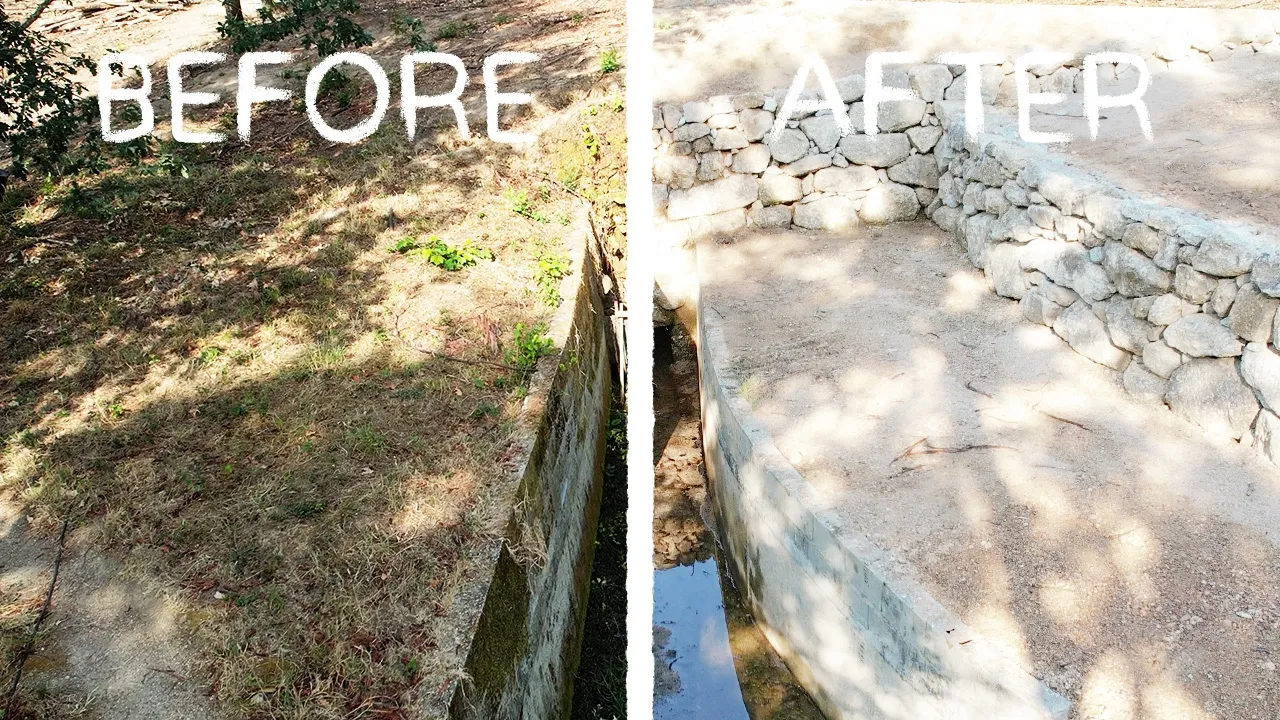
[music] In the past we discover it. It was all covered by vegetation. We clear around. We [music] tried to cleaning empty it to see if we could actually store water. It's still full of leaks. We tried to cover the leaks with cement. It didn't work. [music] We made an experiment to see if it the water at least would rise if we would make it waterproof. It worked. [music] So this season we decided to restore the basin to be able to store water in case of emergencies or future uses and also create some nice landscape [music] around with some terraces to be able to use this area that now is a bit useless because of the rough slopes and [music] the vegetation that is actually now there.
So this is the old retaining wall that is built at the end of the whole basin. It's also made like with a dry stone technique with different stones piled [music] each other to retain all the soil that come from that side. So this is one of the slopes close to the basin. At the moment [music] it's full of mosas steep. I have to say [music] it's a bit dangerous to walk around here too. So the state of the wall in this side is quite bad.
There was some mimosas growing. There's some roots. So, it's actually not in very good state. Our plan is to create a terrace, meaning flat areas around the basin that we can use. We will build a wall with stones from our land that retains [music] the earth. Once the terrace is in place, we plan to work on the basin itself and make it possible to store water here for the future. So, let's start walking. This is the uh the existing drywall at the moment and we don't know how far it extends.
Um to figure that out, we are going to dig a little bit to see what we're working with. Well, maybe the wall finishes right there. I feel there is some stone underneath there. >> Yeah. Okay, there's stone there. Well, this was a quick exploration because the wall ends right here [gasps] for us. That means we have to build a big extension of the wall. So, not necessarily a good outcome. So today we are starting collecting the rocks all around the land and we are starting here with those big stones.
We'll try to leave them. It's really heavy. But anyway, we'll try to get as much as possible. Big ones and small ones. >> One out of >> 20,000. >> Oh my god, this is so heavy. It looks so easy. I'm like, is this a rock? [laughter] What a funny thing. Like pushing and not moving. Okay. Sorry. Sorry. Sorry. >> Two. >> Are we going to count them up? >> Three. >> [music] >> What? What? [music] [music] Is he going TO have the big ones to to unload and we are sorting That's like small size, medium size, and big size.
[music] Let it go. [music] >> [music] >> the leftovers from the dry we did right inside more >> [music] >> Woo! [music] [music] Well, So now we are starting the big terrace. So they're going to dig the height of the wall, make a flat area there. So there will be a lot of earth going out of there. But it goes quite fast actually. So yeah, [music] we have the we discovered that there is a big rock underneath like the boulder and Uh so it's really nice for us.
Now we we'll be able to build on this wall so it will be more sturdy. [music] >> [music] [music] >> The digger placed the most heavy stones as a foundation for us to continue. Especially these stones would be very difficult for us to move by hand. Now we are finally done with the digging of the terrace. We can start cleaning the basin because we have a lot of cracks in the walls here and we want to see where exactly they are.
So everything needs to go out and therefore we get some help from landscaping >> bond. [laughter] We have a little three-step program to clean the basin. Step one is getting out all of these plants. It's grasses and reeds. Once we've removed them, we have a clear side of the water, at least clearer than this, so we can catch a couple of the frogs. You might see it on camera here. There's a lot of frogs in this basin, so we're going to remove them.
And last but not least, we get out all the dirt and the clay and the silt that's been getting in here over the years. And it's clean. Okay, so these support beams were placed so the digger has more support when they're getting the terrace out, but now they can go. [clears throat] What? [laughter] Hold on. >> It's going to be a good idea. >> This is a great idea. >> The other way around. >> Okay. So, the basin has like this tube connected to the bottom.
So, we dig out a little bit more so it runs empty. Uh, and then it's probably easier to get all the grass out. And the frogs can't hide. So, we can take them out if they don't go out by themselves. So there's the pipe. The water runs out and then it goes all the way [groaning] and then somewhere here it will just go into the soil. >> Oh, that smells nice. The mint. >> Yeah. Yeah, >> we have all the grass just connected.
So you can just pull it around the whole bay in and get it out at once. Fascinating. The plants are out. The water level is down. And look who appeared. Do all these frogs. >> Hey guy, I have one. >> Hey [laughter] Jump. Wow. >> Whoa. >> Now see if you can jump. >> Easy jump out. So we got a deeper bucket. Hopefully they can't jump out. Otherwise, if they think they can, they'll be stressing all the time. And this is like a improve lid.
Okay. Yeah. Good boy. Opa. Be free. Be free. This is your new home, guys. Be free. Yes. >> I have the feeling they don't really want to jump. >> Come on, guys. Come on, guys. Dig in there. They're adjusting. [snorts] Is it empty? >> No, there's one of them inside. >> Oh, no. Get out, buddy. Get out. Oh no. I think they're scared of us. I'm going to That's right. We have the second batch. They've been jumping the whole time.
Look at that. Today's task is get all the dirt on the bottom out. Um, so we get an idea if there's actually a foundation or not. What do we need to do to fix it? Um yeah, so first a lot of digging and shoveling and then some pressure washing. I tried to fill the hole so we have less water stream uh so we can dig more dry earth instead of the wet heavy earth. But it seems to COME >> HEY, is that a pipe? >> Oh, that is a pipe.
It's a bite. >> Hey. >> Well, then it does come from the bottom. >> We found something. >> Hey, and a worm. Look at that. Hey, bud. That's why. Oh, there's big water flow actually out of there. Look. Look. Uh, well, then filling up that hole doesn't make a difference at all. Do we already know that there was a pipe here? >> I don't think so. I don't think so. >> But look how strong the flow is. >> And look how clear the water.
Look how beautiful. >> So, I got some plastic foil and some let's say more rigid material. And then I think we try to just close it off and see if it works. I hope there's not a lot of pressure on it. Otherwise, it will not work. But if there's not a lot of pressure on it, it should work. Let's try. [music] >> [music] >> We want to now dry the soil in the basin. But sadly, there's a constant stream of water probably coming in from the well.
It's not from the pipe that we clogged. It's also not directly from the well, but probably through the soil it is seeping in. >> So basically ground water. [music] There's very little dirt and sand and clay left. So, only thing that's left to do is pressure wash all the >> and make it more dirty on the bottom again. >> Exactly. >> Amazing. You can see the entrance from the well is a lot bigger than we thought. So the you see here these stones they go all the way down at the same time here.
So what we thought was only like a very small slit turns out to be very deep and it goes you can look into it. >> Yeah. I think we need to switch positions. >> Okay. So, we were digging and I think we hit a I don't know a a mine or at least there's a big stream of water compared to before that is suddenly coming up. >> From our side, we think it's a mine made in the old times used to harvest water in this way. But what do you think it is?
If you have any theories, you can let us know in the comments. >> Now, we cleaned the basin. we have a little bit more of a clear view what is going on here. First of all, we found big holes in the existing wall, which means it is very brittle. The second thing we found is a pipe. This is coming probably from the well, and it keeps on leaking. So, we have a constant flow of water. The other part is we found a huge cave here.
We don't know yet what it is. The third thing we discovered is Dave's concrete slab that he poured in u I think two seasons ago and we already noticed it is super brittle. Episode 136. >> Thank you Caroline. >> And last thing we have the floor. We ducked all the way to the granite but every not everything is super level and um the granite itself is very brittle. So now it's time to build the actual wall. The main wall is built using large stones and wedges to make it steady.
The back part that is in touch with the earth is filled with the smaller rocks for a better drainage. If you want to find out more about the design, check our research model. The link is in the description. So now we have a good base here. We have a hard ground. Here's the stone. Here is the grenite. Pretty hard. And we can stop rebuilding the wall from this. So, we will do a good one, like a big one, and then trying to build up the wall until like here existing level.
Heat. [music] M [music] nice. I'm decompacting the ground the earth uh in order to have a flat surface [music] to put the layer of stones. The ice already carried. >> You can drop it off, I guess. Super crumbly. It's very crumbly. Phil, could you give me two big scoops here? That's the in bucket. Oh, that's a good scoop. like 10 of you. >> So now that the bottom is nice and flat, we are starting um putting the stones uh into the back wall like here.
And we will block every stones together. >> And like this we make sure that the wall gains stability uh and no sand can run into the back. Uh and we use the shitty stones for it. So, the ones that don't have a flat surface that we can use in the front, uh, the ones that might be a little bit more crumbly. [music] And now we will flatten the top a bit. Make it incline a little so the wall as a whole inclines a little and it pushes back the dirt so the wall doesn't crumble.
[music] We got to do it together. Come on. Nice. [music] >> [music] [music] >> 8 m. So that's it. The foundation is laid. So now we are ready to build up the wall. And now we have to set up those sticks on the existing wall. That will give us the correct angle to copy. So I put one here on the existing one and one here. So basically we'll have to follow this angle to build up the wall for the next rows. And for that we'll use strings.
One here, one here to be sure that we have always the good angle. [music] Okay. So this is the contraption we made. [music] She's called Sandy. She helps us to lift heavy stones. We put this bar here. And the bar has a sling to it where we attach a pulley system. And the pulley system will pull the heavy stones from under here to the top. And then we slide it in place. [music] Then we lower it where we want it to be.
So it means our backs don't have to do all the heavy lifting, which is especially important the higher we get to the wall. [music] Beautiful. I like to do [music] to be like this. [music] We [music] are in the back wall and we put this big stone is touching the granite here and also the stone and it has to be blocked to make so I put a wedge underneath to stabilize it and then we just have to fill in all the gaps and make sure that all the stones we [music] put are tight tightened together so it won't move like I Yes.
And that's it. Yep. You can use the the hand like to assess what's missing like to the the void like where I can see the void is one wrist and one thumb. So I need this thumb like this. [music] Sorry, this stone at least something like this. We're just trying to cover up the stones we've already laid because when the digger is working later, all this soil will fall. And hopefully this blanket will mean we can shake all the dust off and not get it in all the joints of the rocks that we've already laid.
We have the arrival of a tractor and a trailer. Um, and also we have an additional digger has arrived and people to come and help us move. All of these guys, lots of big rocks will be forming part of our wall. The main thing is to get rid of all this earth so we have a nice flat surface to build up around the basin. [music] Heat. [music] Heat. [music] >> [music] [music] >> Heat. Heat. [music] >> [music] >> Heat. Heat.
[music] Heat. [music] Heat. [music] So that's it. Uh the wall is built up thanks to the work of uh Bruno and Philip. They did a really good job. And yeah, it was really exhausting, but finally the wall is here and we have a couple of tasks to do to say it's done. So let me show you right now. As you can see, the top of the wall is uneven and really wavy. So, we'll add a small layer of stones to make it flat. For that, we'll use a string line between the beginning of the wall and the end there.
The same here on the existing wall, we'll t a line a string line from here to there. Our new wall is sticking out. um compared to this one, the existing one. So, we'll try to put the stones a bit further. So, it will be perfectly aligned. >> The highest point is there. >> Yeah. >> To align [music] with the first one. It's [music] leveled and we can see that we have some holes here to fill in this one. Probably this one also.
[music] So, what we're going to do is to lift up these stones [music] and wedge and put like flat stones and we'll see, but we have to wedge. And just by lifting it, it will be aligned with the string. >> [music] >> But yeah, so the digger came last week and lifted all of these big stones into place. And then as they were preparing the area, they moved a lot of this earth to back fill the wall. What we're concerned about is the weight of this bank pushing against the wall, especially as the rain comes.
So, what we're doing now is we're removing some of this earth so that we can extend the top layer. Um, you can see we've already fought to do some of that here. um because you've got the weight of the bank of the terrace pushing forward and then you've got the wall in front and over time that could fall. So by making this top layer go into the side of the bank then the weight is pushing down instead of forward and the wall is less likely to fall over.
That's what we hope anyway. It also helps with drainage. So once we get to the rainy season the earth is less likely to wash away and affect the stability of the wall. >> [music] [music] >> So So that's it. The walls are done. Thanks to the workspace team again and uh thanks to the digger also because it was super difficult to move all the stones alone or with a group of three people. So uh thanks to Bruno and Philip and digger operators.
Uh we managed to doing this in two months almost. So thanks to them. Otherwise it was a nice project. It was [music] slightly different than what I expected um because I'm used to do like to work with [music] lighter stones, but uh at the end it was fun to work with granite, [music] which is the local stone at the end. And it was also nice to see how we build walls with that. And uh yes, I'm really happy with the the result.
As you can see, we extended the this existing part up to there. So now the teras is ready here to plant probably trees, lemon trees, I don't know, or just to ch to [music] chill here as well. Teras is nice to chill. And um yeah, that's it. So now we [music] are much closer to make the basing a nice place and a useful structure for the future. You can already see a nice glimpse of what it could be. Still a bit raw, but we're getting ready for the next steps, but that's not for this [music] update.
That will be in the future. So far, if you like what we do, you can support us in Patreon, so you can [music] already watch the next update without ads and in 4K. And otherwise, you can subscribe in YouTube. [music] Thanks for watching and see you in the next update.
The words are the caption track's own and nothing is reworded or re-transcribed. Paragraph breaks are placed between sentences so the text reads as prose.
Free tools for your own script: paste a draft and see where it stands before you record it.
Paste your draft and see where viewers are likely to drop off, with a rewrite for each weak line.
Paste the first 30 seconds of your own draft for a hook score and rewrites.
Check your draft against YouTube's advertiser-friendly guidelines before you record it.
Read this channel's public videos and transcripts, and download a writing brief for it.