Getting the transcript
Reading the captions from YouTube. A video nobody has opened here before takes 10 to 30 seconds; this page fills in on its own.
Getting the transcript
Reading the captions from YouTube. A video nobody has opened here before takes 10 to 30 seconds; this page fills in on its own.
Chase Chappell · @ChaseChappell
This video has no Most replayed graph yet: YouTube shows one only once a video has enough views. These are the moments viewers replayed most in Chase Chappell's most watched videos.
Most replayed moment at 4:41
1.7x that video's typical replay level
them. Because a strong founder story connects the pain that you once lived, the solution you created, and the mission you believe in, and the struggles that you overcame, and how that transformation now delivers to every customer out there. When you create the story with five key pillars,
Said at 4:35
Most replayed moment at 2:44
7.0x that video's typical replay level
downloaded on your computer so that way you can do this. And one of the first steps is we're going to copy that link. We're going to come in here and click the plus sign, go to connectors, manage connections, and we're going to hit add. We're going to add a custom connector. We'll paste this, and we'll name it Meta
Said at 2:37
Most replayed moment at 4:54
3.8x that video's typical replay level
can recreate it. We're going to go into chat GBT. We're going to start a new chat under chat GBT40. You're going to do the new updated create image option and you're going to paste this exact prompt that I've gone ahead and put together for you below this video that
Said at 4:48
The graph counts replays. It does not show where viewers stopped watching.
Words
6,241
Runtime
29:37
Speaking pace
211wpm
Reading time
26min
211 words per minute, above the 201 75th percentile of 349 measured videos. That distribution comes from the 349-video hook study.
Opening (first 30 seconds)
This is the Facebook ad creative strategy that you need right now. And I've run ads behind thousands of brands and over $600 million in ad spend, and this is the only ad creative strategy I'm recommending, which is responsible for 2xing, 3xing, 5xing, and even 10xing brands. And whether you're spending $1,000 or even a million dollars a month, this is the ad strategy that will be the difference between brands that scale and brands that get left behind. Your spend is leveled across all of your ad creatives, >> [music] >> and this is how you know you did it right. We'll go over
106 words, the words spoken in the first 30 seconds at 211 words per minute.
Free, no signup. See how the first 30 seconds hold attention, with rewrites.
Sentence shape
| Measure | This transcript |
|---|---|
| Sentences | 292 |
| Average words per sentence | 21.4 |
| Longest sentence | 91 words |
| Questions asked | 7 |
| Sentences containing a number | 43 |
Most used terms
Filler phrases
68 in total: like 30 · you know 12 · literally 11 · actually 7 · basically 6 · I mean 2.
A literal whole-word count of the same phrase list the Prepublish browser extension uses, so a phrase inside another word is not counted and a phrase used in its ordinary sense still is. It is a count and not a judgement.
Free, no account. See where attention is likely to drop, with a rewrite for each weak line. The free check shows the scores and the one issue costing the most. Or run it on the words above first.
Free · No login · See a sample audit first if you prefer.
What this transcript is
Every word below is the caption track YouTube publishes for this video, pulled from the video itself and reproduced unchanged. It is not Prepublish's writing, not a summary, and not a re-transcription: it is the video's own published captions. English captions, generated automatically by YouTube, in the video’s original language. Source: the video on YouTube. A channel that would rather this page did not exist can ask for its removal through the contact page, and it is removed.
This is the Facebook ad creative strategy that you need right now. And I've run ads behind thousands of brands and over $600 million in ad spend, and this is the only ad creative strategy I'm recommending, which is responsible for 2xing, 3xing, 5xing, and even 10xing brands. And whether you're spending $1,000 or even a million dollars a month, this is the ad strategy that will be the difference between brands that scale and brands that get left behind.
Your spend is leveled across all of your ad creatives, >> [music] >> and this is how you know you did it right. We'll go over the 33% rule, how to use our three pillars inside your ad account, the old strategy versus the new, the creative formats that you should be running, creative lifetime, and the [music] three pillar speeds, the UGC army, and the creative flywheel. And we also have a bonus at the end for all of you who stay.
All right, for step number one, we're going through the ad creative 33% rule. And most founders get stuck at this point because they're wondering why their ad account can't scale. And a lot of you are facing this issue, and it's because you're not supplying your ad account with what it needs. You don't understand what creative volume, what diversity, and what styling of creative needs to go in the ad account to even be able to hit the KPIs you're looking for in the spin levels that you desire.
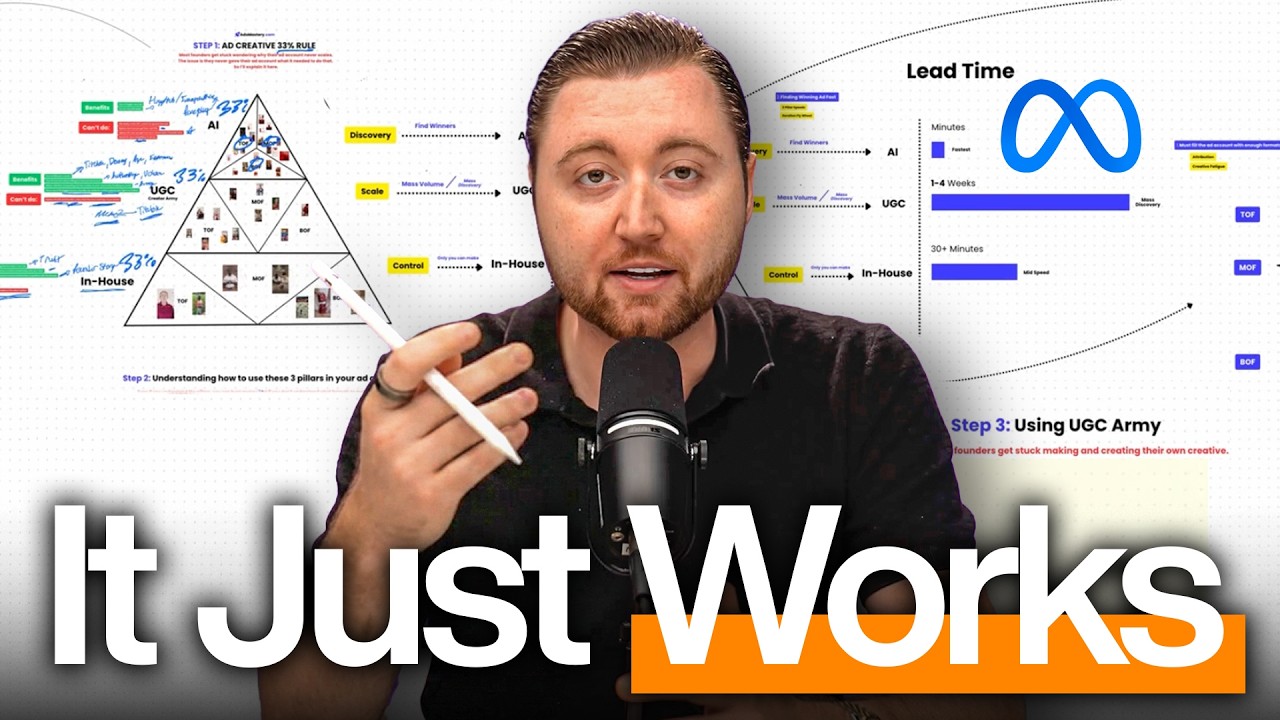
And so, what is the 33% rule? Well, we have 33% of our creatives are going to be in-house creatives. This is content that you're making via Canva, videos you're shooting, basically any content that your team makes yourself and launches into your ads manager. And we're only going to have 33% of our creatives from that source. The other one is 33% is going to be UGC creative, which we're going to spin up a creator army and leverage UGC videos and drop them into our ad account alongside our in-house creatives, as well as 33% AI, because AI is taking off right now, and there's some really cool ways that you can quickly replicate ads with AI and launch them.
So, that way you have as many formats going into your ad account. But what the 33% rule also accounts for is 33% of it is also going to be top of funnel creatives, which is educational, it's basically discovery style creatives. Then we have middle of funnel and bottom of funnel creatives. So essentially we're launching five top of funnel, five middle of funnel and five bottom of funnel ads, which is 33% of each. And then 33% of those are going to be AI, UGC and in-house creatives.
And one of the first pillars is AI creatives. And the benefits of AI creatives are well, we can test angles very quickly now. We can literally use tools like Higgsfield, Imaginative and we can use tools like FourPlay to literally copy and replicate any static ad creative that we want because AI has just gotten that good to this point. And it can be very affordable, like only literally costing a few dollars to be able to launch tons of different creatives.
But what AI can't do is well, it doesn't make UGC videos very affordable. Although we can get UGC AI videos, which are great, they're not necessarily the most cost-efficient. And they also can't replace the trust that you get from real UGC, which is a problem because it's not necessarily fully authentic. So although we can test lots of angles, it doesn't mean we're building trust at the same time if people recognize that it's AI.
Not only that, you can't really replace the trust that you have from in-house content either with AI because anything that you create yourself or film as a founder story is always going to be extremely powerful. But it's also very easy for your competitors to replicate. The interesting thing is right now, a lot of your competitors aren't doing this yet. But as people watch this video and catch on to others, a lot of people are going to start spinning up tons of AI creatives like we covered in this video here where you're quite literally able to replicate any ad out there.
So AI is definitely a mix you want to have because you can test very quickly and do it at very low cost to find out what creatives are working, but it doesn't necessarily carry all the same trust factors as some of these other pillars we're going to be covering. Next we have UGC, but not just user-generated content, it's creator armies. And what we're doing is we're getting tons of different creators from TikTok, so that way we can scale our audiences, we can get them from different demographics, and we can also have any type of user from any age, any background, any experience, and tons of different niches and industries out there where we have so many different perspectives from creators to make content.
And we can build up tons of volume with this strategy. So, we're not just only relying on in-house, we're able to build trust from authenticity. And we can fill the feeds on our ad account with volume. And it also allows us to collect and acquire net new customers to our community where we can build that creator army. And this is by far one of the biggest levers a founder can make for your content volume. And we're going to get into this later, but you're able to spin up literally thousands of creators by sending out samples, getting them videos from TikTok that are going out on feeds, launching them in TikTok G&V Max campaigns, and then rotating them over to Meta.
So, we want to take the content from TikTok and push it over to Meta, so that way we have constant ad creatives going into our ad account. So, now we have a mixture of AI creatives where we're rapidly testing content. We're sourcing from TikTok to get more creators to launch authentic UGC videos, so that way we can plug them into Meta, so that way we have an endless content stream coming in. And all the other gurus out there aren't really talking about creator armies.
They're going over UGC and how you need it, but they're not necessarily talking about how to source it, where we've covered this before. And now you can quite literally leverage one of the biggest opportunities right now, send out free product, get hundreds of videos, and migrate them to Meta, which is absolutely crushing it. Just like this brand Kiara, where he's able to launch over 800 paid collab ads using this strategy.
But, what this can't do is it can't replace the behind the scenes. You're not going to be able to necessarily do the warehouse videos with UGC content. This isn't where you're sharing your founder story. And this also isn't where you're showing the inner workings of your brand, which is the ultimate trust factor. Which leads us to in-house creatives. And in-house creatives you definitely want to keep. You don't only want to have one of these pillars, you want to have a healthy mix of this because it's performing best this way.
With in-house creatives, the benefits are, well, you can build lots of trust that these other ones can't. And the reason is is because it's the most authentic place to create content. If you film a video yourself talking about your brand, sharing the story of how you got started, talking about your product versus others, it's going to feel extremely authentic. And this builds lots of trust in your ad account. So you definitely want to have this style of content constantly.
And the second benefit is you're able to build relationships and trust with your customers and audience through your ads with your team as well. Because if they're also in the videos, they feel personally connected to the brand. It's not always just about the product, it's about the story behind that product. Which is why you want to have this. And it also allows customers to build a relationship and empathize with the founder.
And this is one of the greatest ways to scale your brand. We've covered this before, so you want to make founder style videos. And a lot of people out there say you shouldn't be making founder story and you should be building up your actual product brand, but I totally disagree with that. If you have a stellar story about how you quit your job or one of the shortcomings you had with your product. Maybe your supplier messed up the design of your clothing.
You want to share those stories because it allows you to level with consumers. They feel like it's relatable. You're also facing equal problems as they are in their lives. And they want to support small business. So it's very hard to replace in-house content, especially when your team also knows everything about your brand. So you want to be able to keep this content flow always going. But it's not as scalable as the other two pillars because you're constantly having to create the content yourself as well as your team.
Which is why we break this into 33% across the board. For step two, we're going to understand how to use these three pillars in your ad account. Even if you understand these pillars, you can still burn money fast if you don't know what types of creatives or how to structure this with the right formats. So now that you know where to source creatives, it's equally as important to understand what style of formats to break down in your ad set.
Because we're not just launching AI creatives, UGC, and in-house content for the sake of it. We want to understand what actually takes people from being unaware to being most aware and buying. And the way that we do that is by breaking down not just our campaigns by top of funnel, middle of funnel, and bottom of funnel like all of you know. We're actually doing that on the ad level, where we include all of these creatives inside of an ad set because Meta's Andromeda update and all of the recent changes they've been doing is favoring this structure.
And it's because the algorithms now know when to show the creative at the right time based off of the buyer's awareness stage. And so we first start with unaware creatives. And this is where people don't even realize they have a problem yet. They're completely unaware what your product is, what it does, what problem they're facing. They might not even realize they have a problem to begin with. And so what we're going to do is we're going to make educational style content, where we actually break down what problem they're truly facing.
Like mentioning 74% of people suffer from gut issues. That's a pretty bold stat. And most people don't realize they have gut issues. Maybe they feel groggy, maybe they have an upset stomach, or maybe their bowel movements aren't the greatest. They somewhat know, but they're not 100% sure if it's necessarily a problem because they're so used to it. So we educate them by calling out these stats. And this starts to make people aware.
Same with the founder's story. We talk about a personal reason why we started this brand and the problem that we were facing and it's why we created the product, as well as the core problem. Like did you know if you're taking GLP-1, there's side effects to it? Most people are hopping on a product because of all of the benefits, but they don't realize there's downsides to it. So, we can educate them if our product actually solves for those downsides by making them aware of it.
Same thing with the statistic-based. And this allows us to educate people from the unaware stage and bring them to the problem-aware stage. And this is where we show before and afters. Like, "Hey, now that you understand what problem you're facing, here's what life could look like on the other side of that," which is our actual result. And then we can break down the features callout. Like, "Did you know this gummy is going to support your glow?
It's going to help healthier skin? It's going to fix your gut issues?" And we break down our product benefits, so that way they can start to become solution-aware of how this actually solves the problem they're facing. And then we give three reasons why. "Did you know this is the missing piece to what you're taking," which may be GLP-1, and what our product solves, "or did you know you should go with gummies over other alternatives out there?" Because once they become problem-aware, they're going to start looking for solutions.
So, we want to make sure our ads start to provide the solutions and start to begin to frame our product as that solution for them. Which brings us to our solution-aware stage. And this is where people understand that we have answered the problem that they're facing. And so now we want to start breaking down before they go to look for other products because now they know how to solve it, they're going to start looking for ways to actually buy something to put it in motion.
And before they do that, we need to start telling them, "Hey, this is our product versus our competitor products. Here's why you should go with us." Because we've educated you, we've shown you the problem you face, we showed you what the solution could look like, we now are giving you our product and telling you it's our solution, but they're not fully sold on us yet. They're going to start looking for other people out there, other solutions, and we need to start now framing that we are the ultimate choice that they should go with.
Which is why us versus them creatives are so powerful. And then we want to start showing social proof, how people have been taking this, solving the problem that they now know they need, and we want to back that up with reviews, with social proof, with more information around why people love our products, which is why we have quotes, and we're showing our direct product in here, as well as having testimonial-based videos where we're getting UGC content from creators that have been taking it over time and can now share their personal stories as well to build trust.
So, now that they're taking our product seriously, it moves them into the product aware stage. They know that we can solve their problem, they've been researching our product, they've probably visited our site, but they haven't yet converted. They even could have added to cart because they're starting to trust us at this point, essentially. But, they still need a little bit of convincing to get over the edge. So, that's where we have our limited-time offers, we have our buy ones, we have our bundles, and then we hit them with a few more testimonial UGC videos.
That way we can essentially push them over the edge. And at this point, they are fully aware. And if they haven't converted yet, we want to be running very direct-style ads. And this is where people are most aware. And we're essentially saying, "Hey, you should go ahead and buy our product. Here's the final offer we're giving you. Here's why it's amazing, and you should buy." It's extremely direct, you've left the item in your cart, and it's the final ad that they see in this entire funnel where they get directed to the site to complete their checkout.
So, this is why it is so important to have your top of funnel, middle of funnel, and bottom of funnel creatives broken down this way, so that way you can guide them fully through the funnel and get them to convert. Now, some of you might be looking at this and say, "Hey, I know I need these style of creatives." But, you need to make sure they're all in the same ad set. You're not segmenting these out into different audiences and directing that at yourself, you're allowing Meta to put these creatives in front of people at the right time.
But, a lot of you are still running the outdated strategy, which is what most of you are doing in 2026, which is this right here. A lot of you have been informed that you need to launch these formats, and then based off of which one gets the best row as to then create variations of those. So, you create a variation of let's say a offer-based ad that does really well and you're changing out the background, you're adjusting a little bit of the creative, or you made an educational-based ad and you're making lots of education ads just because you want to have lots of variations to see which one of those convert.
Although this strategy somewhat works, it completely misses the point because even if a creative out of those 15 you launch isn't necessarily performing, it still has a place in your ad account. But most of you believe that you should be creating variants of a format to basically get better results. And this is the outdated strategy. Essentially, if we have an example here of what this looks like, we could say we're selling a sleep-based product and it's people who struggle to fall asleep.
And maybe we're offering a gummy that you take at night that helps solve that solution so you can sleep sounder, go to sleep faster. So, you go and create some ad creatives with all of those formats we just discussed and one of the angles is, well, we're going to lead with ads that say, "Hey, this product's going to help you fall asleep faster." And then you're making another angle where you're saying, "Hey, if your partner hates that you're always up at night and it's causing them not to be able to sleep, well, that partner might actually buy this product for you." And then the third angle is maybe they want a quick fix and they're not looking to do some protocol, they don't want to get off their phone, they don't want to turn their TV off at night, they just want to fall asleep and still keep their same routine.
Well, they would look at this product as a quick fix solution. And then you find out which format works and you create variants of that. Now, this is not the strategy you want to be using. The strategy you want to go with is the 2027 strategy and it's where you have those same pillars except each of these are covering a unique angle. And although if your benefit doesn't perform, that's okay. It's still being shown and it sits in the full funnel.
And the problem with the 2026 strategy is almost all of your ad spend ends up flowing into one to two creatives and if you only have educational based ads at the end of it from all the variance you create, well, once that ad format expires and it hits creative fatigue, your ad account tanks because there's no other creative styles for that budget to flow in. Whereas the 2027 strategy is if you have all these unique formats, you should be seeing spend across every creative because that means you're hitting the Andromeda strategy correctly.
And this allows you to scale much further because you're taking them from the top all the way down to the bottom to be able to convert them and every creative is building on the last one so that way you can convert. And some of them are going to be doing 2x, 3x, 5x, 7x, but you're not turning off necessarily the bad ads, you're still keeping them because they have a place in the strategy. If you are using the 2026 strategy, you're going to agree with this structure that you're seeing right now.
It's where you have creatives in here and all of your spend is pretty much in your top three or four creatives. And the 2026 strategy basically states, well, if you find a winning ad, you just make variations of that, which is what we see here. We have this video here, which is just somebody walking around in the swimwear. Next video, it's the exact same format, another person walking around. Same thing here, just another variation.
Over and over again because that format worked, so you created variations of it. The problem with this is all of the spend gets stuck on only those creatives because that's the only thing that you're using that's working and as soon as this format dies, all of the creatives hit fatigue and drop and your ROAS starts to tank and you go back into this constant cycle of trying to find another new winning ad. Whereas the 2027 strategy should look something like this where all of the creative formats that are totally unique, no one ad is alike and your spend is not stuck just in one creative.
No, your spend is leveled across all of your ad creatives. And this is how you know you did it right, where you've added in every ad format that you could and it allows you to divvy up your spend. So, if one creative stops working, well, we have 14 other ad creatives that are. So, you don't hit creative fatigue that quickly and AdRoll loves this because it can spread the spend, get consistent results for you and you can continue to scale up as much as you would like, which is why we have so many unique ad formats and each of these.
We have three reasons why. We have before and afters. We have, you know, try-on videos. We have comparisons. We have every angle you can think of and when you do it correctly, you'll see your spend get divvied between all of the ad creatives. And that's what the 2027 strategy does. It allows you to get consistency, so that way you can scale. So, now we're going to go over what it looks like over the creative lifetime whenever you use these two different strategies.
If you're using the 2026 strategy, it's going to look something like this. Your spend is going to go up over time as you scale and the red line is going to be your creatives. And this is where it'll look something like this and you find a winning ad and you start to scale the spend. But what ends up happening is you start to see the ROAS go down as your spend goes up and so you launch variants to then be able to scale more and your ROAS somewhat holds because you already found a winning ad, you're just creating variations of that winning ad and the performance holds a little bit longer, but then all of a sudden it starts to drop because it hits creative fatigue and no longer performs.
You're in this constant cycle of having to launch new creatives again, find the winners, make variants and it's a repetitive cycle that is very hard to scale. Whereas the 2027 strategy is something like this. As you scale spend and you have lots of different formats, 10 to 15, and you're not just creating variations, you're always launching formats that fit in that full awareness stage of the buyer's journey, your creatives are somewhat like this.
So, as you scale spend, your creatives aren't fatiguing very quickly and your ROAS is holding. So, that is why it is so imperative to have this structure. All right, so now that we understand the structure and the strategy, we want to understand how fast we can launch these creatives. When we look at this, we have AI and AI is a very quick way that you can discover what formats are working and it's one of the fastest ways to do it.
I mean, you can quite literally clone any ad just like when we went over it in this video with Imaginative. I mean, we can launch and clone ads in minutes and it's very fast. We can spin up tons of creatives and fill in all of the formats that we're missing. So, we get lots of UGC videos where we're doing three reasons why, educational breakdowns, ingredient breakdowns, whatever ad creative formats we're missing, we can supplement that with the AI creatives.
So, it's easy for us to find winners quickly and supplement. UGC, it takes a while to get this content because we're shipping out our products, we're sending the samples out to them which could take 7 days of shipping, then they have other commitments from other brands that they're working with, so they may sit on the product for a week, and then they may or may not even post. And then when they finally get around to posting the video, we're somewhere between 1 to 4 weeks in just to get the creative back.
So, it takes a lot of time, but we can get massive volume out of this because we're not just relying on one creator, we're not relying on an in-house team, we're not relying on somebody to make AI creatives. We're literally getting hundreds of these people to make videos, so we have constant volume always coming into our ad account which allows us to have massive discovery and massive ad volume at scale, which is why you see some of these ad accounts with hundreds of ad creatives or even thousands ad creatives.
And then in-house creatives roughly take 30 minutes or however fast it really takes you to design. Some of you, it may take a few hours, some of you, it may take only, you know, 15, 20 minutes, but on average, it's going to take you roughly 30 minutes to make a creative if you're really putting in some focus into it and doing some research behind it. But, the good thing is you can control these concepts. You know exactly what you're writing, you know exactly what you want to say, and AI can sometimes drift off that actual formula, and sometimes creators can also drift away from the script.
But, in-house gives you much greater control. So, when we look at this, we want to have a blend of each because they each take different times to be able to create, and each have different reasons why we use them, which is what we went over earlier. For the UGC army, this is where you're sourcing creators where they're going to make tons of videos for you, and you have endless amounts of creative to launch in your ad account.
And essentially, how this works is you're going to send out mass invites with a automation tool. And that's going to lead to you getting sample request, and then you're going to approve these creators, and then they're going to post the videos for you. And this is where we can get literally thousands of creators and have all of these videos available to launch on TikTok and on Meta Ads. So, that way we have endless creative content.
Some of them are going to be reviews, some will be unboxing, some of them are going to be problem-solution angles. And all of these creatives are going to allow us to pump our ad account. And one of the things we want to do is be able to not only just get one video back per sample that we send out to a creator, we want to get multiple videos back where we're literally able to two to three X the video to sample product.
So, for every product we send, we want two to three videos back so that way we have endless content, and we also want to work with the top creators. Where tools like Tribe, which I've linked below this video, allow you to spin up a community where we can educate the audience on what videos are working. And this is where we can get into allowing them to have creative freedom with wide briefs where we just leave it open and allow them to make a video on how they interpret the product and their personal story.
And then we have specific briefs, which is very important. And with specific briefs, what we want to do is show them the top performing ads. Like, "Hey, this ad has gotten a 7X ROAS, 10,000 in spend, it's one of our best creatives, go make ads like these." And that's where tools like Tribe come in place for you being able to tell your community exactly what's working so we can get more of the best performing videos in our ad account.
We use a tool like Yoko, which is also linked below this video, for you to be able to send out all of the automations for invites. For example, with a client of ours, we literally sent out 100,000 invites in 60 days and onboarded 6,000 creators and got roughly 5,800 videos back from all of those creators that we then are able to launch on TikTok and migrate to Meta. And then finally, if you want a tool that is totally free, you can also launch your community on Discord.
And Discord is just a free way to do this. A lot of people use it. You just have a free community there and you're essentially inviting the creators who are making content for you to join a private community to get VIP incentives for you to educate them and show them how they can make more videos and money based off of what's already working for you from our specific briefs. And this is what allows us to get winning formats and find them and also have a high volume of winning creative formats using the UGC army.
This isn't a one-time thing. The army is there as basically a sales force. Any new product launch, any new offer, we can go back to the people who already have our product and get thousands of videos back in a matter of weeks to constantly be rotating in creatives for scale. This is one of the easiest and quickest ways you can raise ad spend in your account by having a ton of video assets. So, where does all of this fit into the big picture?
Well, it sits in an ad creative flywheel. And essentially how it works is we're sourcing and automating UGC. All of this is then going into creator briefing based off of the different script styles that we're sending them. We're waiting for those videos to come back. Once we see what's performing, we're telling our actual community, "Hey, these are the winning videos." So, that way they can make more based off of those winners that we've identified.
And then we can take the UGC videos even and basically derive static formats. For example, we had a creator one time make a video breaking down an ingredient label around how all the ingredients on other products are extremely long and how one of our clients' products is very simple and how they're switching to it because it's just a much healthier alternative, where the client previously was doing all in-house creative.
And he was not talking about ingredient labels. In fact, he was talking about the benefits and why it's so simple to use and why people love it. He had no mention around other products and how they have crazy ingredient labels. But if it wasn't for the UGC and us being able to identify that winner, he wouldn't have been able to jump from a 1.7x all the way to a 4x ROAS across his entire ad account. And because of that, he created more AI creatives and in-house creatives around this, which allowed him to raise his spend and ROAS, keeping it stable so he could scale.
So this is how the creative flywheel works. We're constantly rotating in UGC videos now that we have that system integrated. We're launching AI creatives to supplement where we don't have creatives. And then we're using our in-house creatives based off what we know to control our brand and be able to constantly pump assets. And that is where the 33% rule lives inside of this ad creative flywheel, where it's perpetually always going and we're always launching, finding winners, scaling up the campaigns, and stabilizing our ROAS.
And as a bonus, we're going to look at personification. Personification is great for brands that are scaling up rapidly, spending thousands a day, 10,000 a day, and millions of dollars a month. This is where most people miss and aren't able to hit these significant scale numbers. Brands like I May Health are doing this exact strategy. And what it is is you personify not only your actual audiences, but your creatives and copy.
So rather than just speaking to one avatar, which most of you do, let's say you're selling that sleep product and you say, "We're going to focus on people who struggle to fall asleep because our product is a sleep product. So we're just helping people sleep better and fall asleep faster." It's very general. And so you're only focusing on that one avatar. And as you scale up, you create more formats for it, you find winners, and and rises.
But eventually you hit a plateau because you've started to max out that specific audience because we've done millions of impressions. We've spent a ton of money and it's gone well for many months or even years, but most people don't realize they need to open up more avatars. And what this means is another audience in here is people who sleep but wake up groggy. So, we're not talking about people who struggle to fall asleep or struggle with just sleeping in general.
No, we're talking about people who feel like they wake up groggy. So, if our product also solves that problem, but we've never led with that angle, we need to introduce that because these two avatars are very different types of people. One struggles with falling asleep, the other does not. They just struggle with waking up groggy. But then the third avatar is people who fall asleep fast, but they keep waking up throughout the night, maybe to use the restroom, they don't stay asleep, they constantly are tossing and turning.
That is a totally different audience than the other two avatars. And you want to continuously find more problems in more ways to infiltrate different audiences. I mate does a great example of this. They'll say, "Hey, if you're an athlete, this is a great product for you. Hey, if you're an everyday mom that works out three days a week, if you're a busy professional, if you're in the office all day, if you travel constantly, if you want to buy a nutritionist gift for a friend." Think about that.
Those are all different avatars. So, as they scale spend, they can hit different pockets of audiences using this exact strategy so that way they can maximize their performance and scale over time, which is imperative to being able to hit those higher tier spend levels. It's where you go and you personify everything. All right, so just to recap the 33% rule, we have our top of funnel, middle funnel, and bottom of funnel creative formats.
We have our three pillars, which is 33% AI, in-house, and UGC. We have our UGC army and how that fits into the picture for sourcing it. We understand how much time it takes and why each of them important based off of discovering new formats, supplementing, having control, and building trust. We also understand that we're now leveraging all of our creatives based off of where they sit in the funnel inside of the ad set level.
We get that there's a 2026 strategy for the old way and what the new way looks like for 2027 to be able to scale, as well as how this impacts your overall creative fatigue and performance, and how you can leverage this for your creative flywheel have constant creatives, and why and when you need to launch personification to be able to scale. But, here's the part that nobody warns you about. You can build all these three pillars perfectly and still cap your own growth because the best creative in the world still loses money if the ad account it runs in is built wrong.
So, in this next video, I'm going to show you the correct way to set up your ad account, and I'll see you inside that video.
The words are the caption track's own and nothing is reworded or re-transcribed. Paragraph breaks are placed between sentences so the text reads as prose.
Free tools for your own script: paste a draft and see where it stands before you record it.
Paste your draft and see where viewers are likely to drop off, with a rewrite for each weak line.
Paste the first 30 seconds of your own draft for a hook score and rewrites.
Check your draft against YouTube's advertiser-friendly guidelines before you record it.
Read this channel's public videos and transcripts, and download a writing brief for it.