Getting the transcript
Reading the captions from YouTube. A video nobody has opened here before takes 10 to 30 seconds; this page fills in on its own.
Getting the transcript
Reading the captions from YouTube. A video nobody has opened here before takes 10 to 30 seconds; this page fills in on its own.
Genius History · @genius_history01
This video has no Most replayed graph yet: YouTube shows one only once a video has enough views. These are the moments viewers replayed most in Genius History's most watched videos.
Most replayed moment at 6:15
2.9x that video's typical replay level
was the law. They were a superpower that fought Rome and Byzantium for 400 years, but those 400 years of war left Iran exhausted and bleeding. In the 7th century, a new force came out of the deserts of Arabia, the Arab Caliphate. The Persian capital fell, and all of
Said at 6:08
The graph counts replays. It does not show where viewers stopped watching.
Words
2,346
Runtime
12:13
Speaking pace
192wpm
Reading time
10min
192 words per minute, between the 181 median and the 201 75th percentile of 349 measured videos. That distribution comes from the 349-video hook study.
Opening (first 30 seconds)
Imagine a tiny, muddy village on a river bank that somehow grew until it owned every single piece of land around the Mediterranean Sea. A place that started with a few farmers and ended up building massive stone stadiums, roads that lasted thousands of years, and a legal system that we still use today. This is Rome. Its story is a roller coaster of genius, blood, greed, and survival. It is the story of how a small group of outcasts became so powerful that they literally invented the world we live in today. But, how did
96 words, the words spoken in the first 30 seconds at 192 words per minute.
Free, no signup. See how the first 30 seconds hold attention, with rewrites.
Sentence shape
| Measure | This transcript |
|---|---|
| Sentences | 172 |
| Average words per sentence | 13.6 |
| Longest sentence | 34 words |
| Questions asked | 3 |
| Sentences containing a number | 23 |
Most used terms
Filler phrases
13 in total: like 9 · actually 3 · literally 1.
A literal whole-word count of the same phrase list the Prepublish browser extension uses, so a phrase inside another word is not counted and a phrase used in its ordinary sense still is. It is a count and not a judgement.
Run the check on the words above: where attention is likely to drop, with a rewrite for each weak line. The free check shows the scores and the one issue costing the most.
What this transcript is
Every word below is the caption track YouTube publishes for this video, pulled from the video itself and reproduced unchanged. It is not Prepublish's writing, not a summary, and not a re-transcription: it is the video's own published captions. English captions, generated automatically by YouTube, in the video’s original language. Source: the video on YouTube. A channel that would rather this page did not exist can ask for its removal through the contact page, and it is removed.
Imagine a tiny, muddy village on a river bank that somehow grew until it owned every single piece of land around the Mediterranean Sea. A place that started with a few farmers and ended up building massive stone stadiums, roads that lasted thousands of years, and a legal system that we still use today. This is Rome. Its story is a roller coaster of genius, blood, greed, and survival. It is the story of how a small group of outcasts became so powerful that they literally invented the world we live in today.
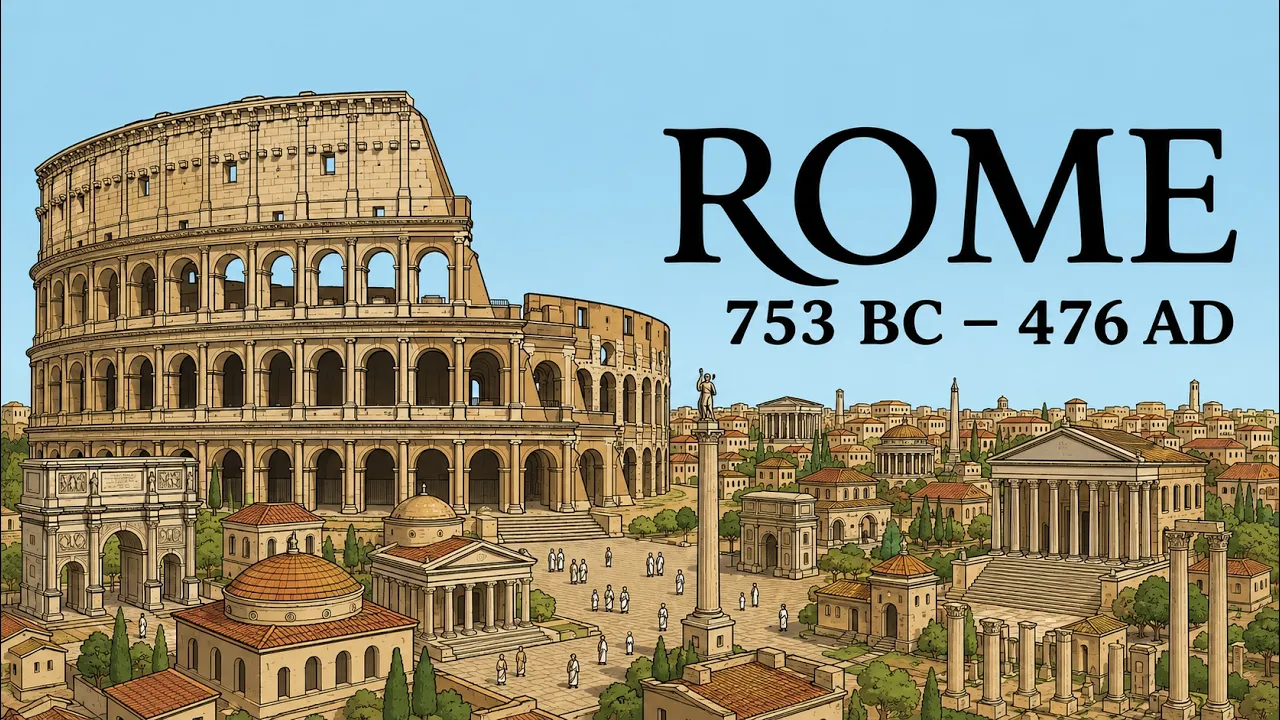
But, how did it happen? How did a group of outlaws build an empire that refused to die for over 2,000 years? Our story starts in the year 753 BC. At this time, the world was ruled by giant empires in the East, like the Assyrians and the Egyptians. In Italy, there were no grand cities, just scattered tribes. According to the legend the Romans told themselves, the city was founded by two twin brothers named Romulus and Remus.
They were supposedly the sons of a god, abandoned as babies and left to drown in the Tiber River. Instead of dying, they were saved by a female wolf who fed them her own milk. When they grew up, they returned to the river to build a city, but they couldn't agree on which of the seven hills to put it on. The argument became so violent that Romulus killed his own brother. This is the original sin of Rome, a city founded on a crime and built on the blood of family.
Romulus became the first king, but he had a problem. His city was empty. To fix this, he turned Rome into what he called an asylum. He invited anyone who was on the run, criminals, runaway slaves, debt dodgers, and exiles. It was a city of people with nothing to lose and everything to prove. For the next 200 years, Rome was a kingdom. Seven different kings ruled, and they slowly built the foundations of a civilization.
They built the first stone temples, the first religious rituals, and a massive underground sewer system called the Cloaca Maxima, which was so well-made that parts of it are still used today. But, the seventh king was a man named Tarquin the Proud. He was a classic tyrant who treated the citizens like slaves. Eventually, the people reached their breaking point. They rose up, kicked the king out, and made a holy vow that would define them forever.
Rome would never have a king again. To a Roman, the word for king became the most hated word in their language. To replace the kings, they created the Roman Republic. The idea was simple, res publica, which means the public thing. Instead of one man having all the power, they divided it. Every year, they elected two leaders called consuls who could stop each other from making bad decisions. They also had the Senate, a group of 300 experienced elders who gave advice and controlled the money.
This was the era of the SPQR, the Senate and the people of Rome. It was a balance of power that made the Romans feel like the city belonged to them, not to a master. This unity turned Rome into a war machine. Rome didn't start with a plan to conquer the world. They started with a plan to survive. This is what historians call expanding defense. Every time a neighbor attacked them, the Romans fought back with a terrifying intensity.
They didn't just win, they conquered the enemies land to make sure they could never attack again. Then the new neighbors would feel threatened by Rome's growth and attack, so the Romans conquered them, too. They were the masters of taking a good idea from their enemies and making it better. When they fought the Greeks, they learned how to use heavy infantry. When they fought the hill tribes, they learned how to fight in the mountains.
By the year 275 BC, Rome owned the entire Italian peninsula. But as they looked across the sea, they saw a rival that could actually destroy them, Carthage. Carthage was a superpower in North Africa. They had a massive navy, a beautiful city made of marble, and more wealth than the Romans could imagine. For over a hundred years, these two titans fought three giant wars. This was the Punic Wars. In the first war, Rome, who had no experience at sea, found a crashed Carthaginian ship, copied its design, and built a fleet of over a hundred ships in just two months.
They even invented a bridge called the Corvus that allowed them to turn a sea battle into a land battle. In the second war, a genius general named Hannibal did the impossible. He marched an army of 40,000 men and 37 war elephants across the freezing Alps to attack Rome from the north. He spent 16 years destroying Roman armies on their own soil. Most nations would have surrendered after one defeat, but the Romans refused to quit.
They just kept raising new armies and eventually took the fight to Africa. They defeated Hannibal and in the third war they decided to end the rivalry forever. They deleted Carthage from the timeline. They burned the city to the ground, enslaved the survivors, and according to legend, they even poured salt into the earth so nothing would ever grow there again. With their only rival gone, Rome became the undisputed master of the Mediterranean.
But this success was a curse. The wealth from the conquest flooded into the city, but it only went to the top. The rich senators bought up all the land while the small farmers who had fought the wars returned home to find their farms gone. Rome became a city of two extremes, the ultra-rich and the starving poor. Generals became more powerful than the government because they were the ones who paid the soldiers. The Republic began to rot from the inside.
Civil wars started breaking out as powerful men fought over who should be in charge. This is when the final boss of the Republic arrived, Julius Caesar. Caesar was a brilliant charismatic general who conquered modern-day France, which was then called Gaul. He was a hero to the people but a nightmare to the Senate. When the Senate ordered him to give up his army, he refused. He marched his elite 13th legion to the Rubicon River, the border of Italy, and crossed it.
This was an act of treason. Caesar took control of Rome and declared himself dictator for life. He was a master of psychology. He gave the people land, canceled their debts, and fixed the chaotic calendar. But to the Senate, he looked like a king. In the year 44 BC, on On Ides of March, a group of senators surrounded him in a meeting hall and stabbed him 23 times. They thought they were saving the Republic, but they were actually the ones who killed it.
The Roman people didn't want the Senate back. They wanted Caesar. His death sparked a massive war of revenge that burned through the last remnants of the old system. Out of the smoke walked Caesar's adopted son, Octavian. He was only 18 when he started his rise, but he was a genius of political maneuvering. He defeated all his rivals and took the name Augustus. He was cleverer than Caesar. He didn't call himself a dictator or a king.
He kept the Senate, the titles, and the old buildings, but he took all the real power for himself. With Augustus, the Roman Empire was officially born. He started a 200-year period of peace and stability called the Pax Romana. This was Rome's golden age. This is when the city truly became the center of the world. They built the Colosseum, where 50,000 people could watch Gladiator fights for free. They built the Pantheon with a dome so large it wasn't surpassed for a thousand years.
They built 50,000 miles of paved roads that connected Britain to the deserts of Iraq. If you were a Roman citizen during this time, you lived in a world of running water, professional police, and high-speed trade. It was the peak of ancient human achievement, but a golden age is like a candle. Eventually, the wax runs out. By the year 180 AD, the last of the good emperors died. The empire entered the 3rd century, which was a 50-year nightmare.
This is known as the Crisis of the 3rd Century. During this time, the empire was a mess. They had over 20 different emperors in five decades, and almost all of them were murdered by their own guards. Plagues wiped out half the population of major cities. Hyperinflation made Roman coins worthless. Barbarian tribes, seeing Rome's weakness, began smashing through the borders. The empire was too large, too expensive, and too complex to be run by one person from a single city.
It looked like the end. A leader named Diocletian finally saved Rome by doing something radical. He performed surgery on the empire. He realized that one man couldn't defend every border at once, so he chopped the empire in half. He created a Western Empire and an Eastern Empire, each with its own ruler. This stopped the bleeding. Then came Constantine, the first Christian emperor. He made Christianity legal, which fundamentally changed the soul of the empire.
He also realized that the wealth and power had shifted to the East. He built a new capital in the city of Byzantium and named it after himself, Constantinople. This was a turning point. All the money, the intellectuals, and the elite soldiers followed the emperor to the East, leaving the original city of Rome behind as a lonely, crumbling province. By the 5th century, the Western Empire was a walking corpse. A terrifying group of nomads called the Huns exploded out of Central Asia, moving like a wave of fire.
As the Huns pushed westward, they forced thousands of Germanic tribes, like the Goths and the Vandals, to flee into Roman territory. These tribes weren't just invaders. They were often refugees looking for safety. But Rome was too weak to control them and too broke to buy them off. In the year 410 AD, for the first time in 800 years, the city of Rome was sacked. The Visigoths broke through the gates, looted the gold, and burned the buildings.
The psychological shock was massive. If the eternal city wasn't safe, then nothing in the world was. Finally, in the year 476 AD, a Germanic general walked into the palace and told the last Western emperor, a teenager ironically named Romulus, to go home. The Western Roman Empire was officially dead. But here is the twist that most people forget. Rome didn't actually die. While the West fell into the Dark Ages, the Eastern Empire, which we now call the Byzantine Empire, lived on for another thousand years.
These people didn't call themselves Byzantines, they still called themselves Romans. They still used Roman law and wore Roman clothes. Under Emperor Justinian and his powerful wife Theodora, they even tried to reconquer the West. They built the Hagia Sophia, the most magnificent church in the world, and they acted as a library for human knowledge. While the rest of Europe was struggling to survive, the Eastern Romans were preserving the philosophy, science, and literature of the ancient world.
They transformed from a Latin-speaking pagan empire into a Greek-speaking Christian superpower. They survived the rise of Islam, the Crusades, and countless sieges. For centuries, they were the shield of Europe. The end finally came in the year 1453. The Ottoman Turks, led by Sultan Mehmet, brought massive cannons to the walls of Constantinople. They were using a new technology, gunpowder, to destroy the ancient stone walls that had protected the Romans for a millennium.
After a brutal siege, the city fell. Only then, over 2,000 years after Romulus first stood on a hill in Italy, was the Roman state finally finished. So, why does any of this matter today? Because Rome never truly went away. When the empire died, it didn't disappear. It dissolved into everything we know. If you speak Italian, French, Spanish, Portuguese, or Romanian, you are speaking a modern version of the Latin that the legionaries spoke.
If you live in a country with a senate or a republic or a system of written laws that protect your rights, you are living in a Roman invention. Our architecture, our stadiums, our roads, and even our calendar are all gifts from the Romans. We use Roman symbols on our money and Roman designs for our government buildings. Rome was a mess of contradictions. It was a civilization built on brutal slavery and bloody conquest, but also on the idea of justice and citizenship.
It was a place where people watched men kill each other for sport, but also where they wrote philosophy that still teaches us how to live a good life. It survived for two millennia because it was the master of adaptation. It changed from a tiny kingdom to a massive republic, to a pagan empire, to a Christian state. Rome proved that a nation is more than just land or walls. It is an idea and as long as that idea lives, Rome is still with us.
It is the foundation of the modern world, the eternal city that refuses to be forgotten. Thank you for watching this journey through 2,000 years of history. Rome is a topic so vast that every time you look closer, you find a new story of a hero, a villain or a genius. If you want to dive deeper into the lives of the emperors or the tactics of the legions, make sure to like and subscribe for more deep dives into the stories that shaped humanity.
The story of Rome is long, but history is even longer. Subscribe and see you in the next one.
The words are the caption track's own and nothing is reworded or re-transcribed. Paragraph breaks are placed between sentences so the text reads as prose.
Free tools for your own script: paste a draft and see where it stands before you record it.
Paste your draft and see where viewers are likely to drop off, with a rewrite for each weak line.
Paste the first 30 seconds of your own draft for a hook score and rewrites.
Check your draft against YouTube's advertiser-friendly guidelines before you record it.
Read this channel's public videos and transcripts, and download a writing brief for it.