Getting the transcript
Reading the captions from YouTube. A video nobody has opened here before takes 10 to 30 seconds; this page fills in on its own.
Getting the transcript
Reading the captions from YouTube. A video nobody has opened here before takes 10 to 30 seconds; this page fills in on its own.
Stefan James · @stefanjames.brandbuilding
Words
3,625
Runtime
18:50
Speaking pace
192wpm
Reading time
15min
192 words per minute, between the 181 median and the 201 75th percentile of 349 measured videos. That distribution comes from the 349-video hook study.
Opening (first 30 seconds)
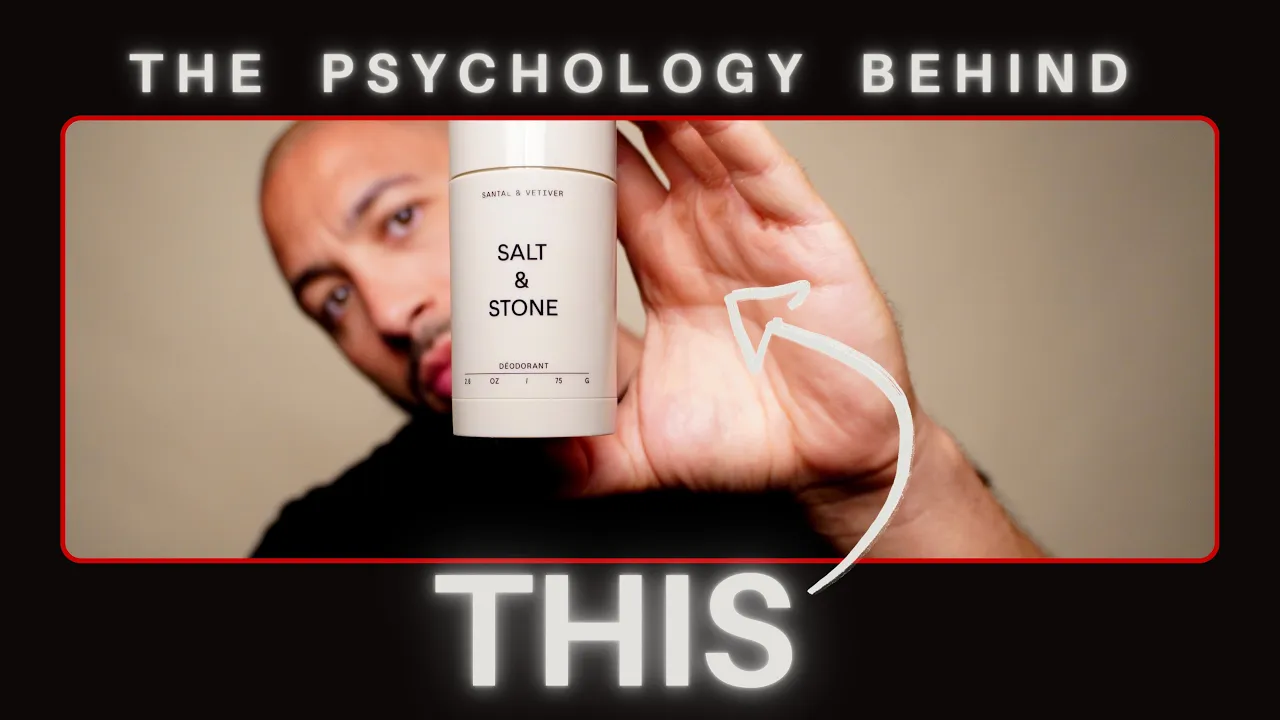
How did the guy with no background in beauty, no venture capital, no investors, no office, no team, just him and his wife in a studio apartment build a deodorant brand that just sold for close to a billion dollars? He is now the number one best-selling deodorant in the country. He outsells every competitor in Sephora. He charges $20 for a deodorant when the category average is under 12 pound, and people pay it happily, repeatedly, and then they rave about how good it is. His name is Nima Jalali, and the brand is Salt
96 words, the words spoken in the first 30 seconds at 192 words per minute.
Free, no signup. See how the first 30 seconds hold attention, with rewrites.
Sentence shape
| Measure | This transcript |
|---|---|
| Sentences | 254 |
| Average words per sentence | 14.3 |
| Longest sentence | 58 words |
| Questions asked | 14 |
| Sentences containing a number | 18 |
Most used terms
Filler phrases
30 in total: like 20 · actually 5 · sort of 2 · basically 1 · literally 1 · right? 1.
A literal whole-word count of the same phrase list the Prepublish browser extension uses, so a phrase inside another word is not counted and a phrase used in its ordinary sense still is. It is a count and not a judgement.
Free, no account. See where attention is likely to drop, with a rewrite for each weak line. The free check shows the scores and the one issue costing the most. Or run it on the words above first.
Free · No login · See a sample audit first if you prefer.
What this transcript is
Every word below is the caption track YouTube publishes for this video, pulled from the video itself and reproduced unchanged. It is not Prepublish's writing, not a summary, and not a re-transcription: it is the video's own published captions. English captions, generated automatically by YouTube, in the video’s original language. Source: the video on YouTube. A channel that would rather this page did not exist can ask for its removal through the contact page, and it is removed.
No Script X-ray for this video: YouTube shows a Most replayed graph only once a video has enough views.
How did the guy with no background in beauty, no venture capital, no investors, no office, no team, just him and his wife in a studio apartment build a deodorant brand that just sold for close to a billion dollars? He is now the number one best-selling deodorant in the country. He outsells every competitor in Sephora. He charges $20 for a deodorant when the category average is under 12 pound, and people pay it happily, repeatedly, and then they rave about how good it is.
His name is Nima Jalali, and the brand is Salt & Stone. But in this video, I'm going to break down exactly how he did it, the psychology, the art direction, the pricing strategy, the brand signals, all of the stuff that he layered on top of each other to turn one of the most boring products in the world into one of the most premium brands on the market. More importantly, I'm going to show you how you can take every single thing he did and apply it to your brand, whatever category you're in, whatever product you sell.
But before we get into it, I've built a free 33-day brand elevation plan for you. Every day you get one email, complex ideas made really simple, practical, bite-size things that you can implement immediately to elevate your brand. No catch, nothing to sell. The link is in the description, but let's get into it. So if you have a great product that nobody understands why it costs what it costs, this video is for you. If you're watching competitors charge more, get more attention, and build more loyalty, build that cult-like following, and you cannot figure out why or what they're doing differently, is exactly what we're going to fix.
See, I've built multiple premium brands across completely different categories. I've worked with global brands, top London agencies, and inside Google's flagship digital marketing program for years. But the brand I'm most proud of is one that I started from a broken living room table, selling units at 200 pound a unit, and steadily increased over the few years to 10,000 and 16,000 a unit. And I've got a waitlist of people ready for the next release.
This stuff works regardless of the product, the category, or where you're starting from. So, here's what we're covering today. The origin story on why it's worth more than any ad campaign. The enemy effect. The brand positioning decision that changed everything. The art direction and why it looks so expensive. The pricing psychology. The behavioral biases that underpin all of this stuff and get consumers' brains ticking.
And I want to present it in a way that you can actually go away and plug it into your brand and help you elevate your brand so you can build that premium brand you want. I'm going to show you something about art direction and where your brand physically lives that most brand builders never think about. I'm going to share a mistake I made in my own brand that cost me nearly 2 years to fix. You do not want to make the same mistake.
Section one, the origin story. Here is something most brand builders completely underestimate. Your origin story is not a nice backstory. And Salt & Stone is one of the best I've ever seen. See, Nima was a professional snowboarder for 10 years. He tore his ACL, while recovering he got deep into health and wellness, and he started reading ingredients labels. He picked up his deodorant one day and read what was in it, did some research on it, and was genuinely alarmed.
Aluminum, parabens, synthetic ingredients, the sort of stuff you cannot pronounce. He went looking for something cleaner, something that actually worked, something that smelled incredible, looked premium enough to sit on his countertop next to his Aesop hand wash. It didn't exist. So, he made it. There is a concept in psychology called narrative transportation. When a story is specific enough and emotionally resonant enough, the listener stops evaluating rationally and starts feeling.
The critical brain almost switches off and their emotional brain switches on. And that is the moment a brand stops being a product and starts being something people believe in. But, notice what makes Nima's story work. It's not vague, it's not a knee injury, it's not a specific health food store, a specific moment of reading a label and genuinely feeling alarmed. That specificity of that story is what makes it really credible.
That's is what makes it stick. Well, the takeaway for your brand is find a specific moment, not the general motivation, that specific moment, that exact thing that made you compelled to build this thing. That moment is your brand's founding myth, and it is worth more than any logo, any packaging, any ad campaign you will ever run. Section two, the enemy effect. [clears throat] Every great premium brand has an enemy, not competitor, an enemy, a thing that exists to defeat.
For Salt & Stone, the enemy is the toxic personal care industry, the casual use of aluminum, parabens, synthetic ingredients, all in products that go directly onto your skin every single day. But, here is what makes their use of this so sophisticated. They never shout about it, they never preach, they never name any names. The enemy is present in the origin story, present in the ingredient philosophy, present in every product decision, but it's never the headline.
Nima has said this directly, clean ingredients should be your baseline, not your brand story. That restraint is what separates Salt & Stone from every other clean beauty brand that leads with sustainability messaging and ends up sounding like a lecture. The enemy that Salt & Stone chose is felt, it's not announced, and that's far more powerful. And Salt & Stone are not alone in this. Some of the most powerful brands in the world have built a cult-like following and audience by defining themselves against an enemy.
Patagonia, they built a cult-like following and an audience by positioning against fast fashion and throwaway consumer culture. Their slogan and motto was don't buy this jacket, quite literally telling their consumer not to buy the jacket. And it's one of the most counterintuitive pieces of brand communication ever made. Liquid Death, they built a cult-like following and an audience by going to war against the bland, corporate, plastic-heavy drinks industry.
They sell water, but they made it look and feel like a heavy metal brand. And Apple built arguably the most cult-like following and audience in history of consumer technology by positioning against the beige corporate world of PC computing. Think different was not just a tagline, it was a declaration of war. Three completely different categories. Define your enemy and your audience will define themselves by standing with you.
And this is the key takeaway. What does your brand exist to defeat? Not who, what. Define that enemy clearly. Let it inform every decision, but resist the urge to shout about it. See, the most powerful enemy effects are the ones that the customer feels without even being told. Section three, positioning. See, here is the most single important decision Salt & Stone ever made and it had nothing to do with the product. Nima decided from day one that Salt & Stone was not your average beauty brand.
He looked at the entire clean beauty category and said, "This is not us." Instead, he looked at Nike, Apple, streetwear brands, legacy lifestyle brands that will still be here in 100 years and he built Salt & Stone to look and feel and behave like one of those brands. See, when you position inside a category, you invite direct comparison with every other brand in that category. Price comparisons, ingredient comparisons, efficacy comparisons.
You are fighting on their terms. And when you position outside of a category as a lifestyle brand, a fine fragrance brand that just happens to make deodorant, you break the comparison entirely and that's what they did. This is exactly what built Red Bull. They didn't position as a soft drink. They positioned as an energy drink and a performance product. By changing the size of the can and the shape, that was one way that they could break the comparison when they stood next to Coke, Fanta, and all the other drinks brands that were basically in the same shape can.
And then what they went on to do is create their own pricing structure. Cadence could have just been another energy drink in a crowded market. Instead, they positioned around hydration for elite performers. A completely different world, a completely different customer, completely different price conversation. And the result Salt & Stone? You are not just comparing them to Native or Schmidt's. You are comparing them to brands like Aesop, to Le Labo, or Byredo.
That comparison makes $20 actually feel like a bargain. Jonah Berger, the author of Contagious, It's about the power of making things publicly visible. His argument is simple, right? Lifestyle brands are worn, displayed, and seen. If something is visible, it advertises itself. Think about the Apple logo on a MacBook. It was deliberately designed in a way to face the logo outward, toward the people looking at the person using it, not towards the user itself.
So, every time someone open a MacBook in a coffee shop or a meeting room, the Apple logo was doing brand work. Salt & Stone made a similar decision. A product beautiful enough to live on your countertop that gets seen every single day by anyone who walks into your house or in your bathroom or when you're in the gym, the product becomes its own advertisement simply by existing in a visible space. But, that only works if you're positioned as a lifestyle brand, a beauty brand that gets tucked in a drawer.
A lifestyle brand like this gets displayed openly and publicly in the same way you'd put your Aesop bottle out when the guests come round. So, the practical takeaway for your brand is stop looking at your direct competitors for positioning inspiration. Ask yourself, what would this brand look like it was built by Nike, Apple, fine fragrance house? And then ask, is my product designed to be seen? Because if it's positioned as a lifestyle brand, but looks like it belongs in a drawer, the positioning is not working.
Design it to be displayed. Design it to be visible. Let the product do the brand work every single day just by existing in the right space. Section four, art direction. Let's talk about the visual identity because this is where Salt & Stone does something most brand builders completely miss. See, Nima had one design brief from day one. a product that you don't tuck away in a drawer. He wanted to live on your countertop.
That single brief drove every art direction decision that the brand has ever made. Clean lines, minimal text, no cluttered ingredient callouts on the front face of the bottle, muted, nature-inspired colors, beautiful color palettes, nothing loud, nothing trend-driven. The packaging does not explain itself. It doesn't need to. The confidence itself is a premium signal. The entire brand, the website, the packaging, the product range is organized around scent families rather than product types.
So, on the website where you can filter by scent, not by product. This is the sort of decision that fine fragrance house make. That single structural decision repositions the entire brand in the customer's mind. Just look at the photography, skin, nature, warm, tactile, aspirational without being unattainable. Gallery on every product page shows the outcome first, how it feels on skin, how it looks supplied before shows you the object.
That is art direction in service of desire rather than information. Now, here's the science behind why the visual environment matters so much. In 2008, researchers from the University of Georgia found that people rated ordinary objects, cutlery, soap dispensers, bathroom fixtures as significantly more luxurious simply because they were displayed next to work of art. Nothing about the object changed, only the context and what was around it.
And a second study reinforces this. See, researchers place an unknown clothing brands ad inside a magazine alongside Chanel, Dior, Hermes. The same ad placed next to standard editorial content scored 70% lower in perceived quality. Same brand, same ad, different neighbors, different perception. You are judged by the company you keep, full stop. And this is why Salt & Stone chose Sephora over Boots, Erewhon over Whole Foods, Nordstrom over Target.
The product never changed, but the neighborhood did. And this is what researchers call the mere proximity effect, one of the most underused tools in brand building. See, I learned this all the hard way. Two years into building my own brand, I was stocked in a load of different retailers. I had to go on a mission to buy back all of my stock from these dodgy, shoddy looking ones because the brand was being judged by the company it was keeping.
And I then spent nearly two years building a completely different strategy, hiring galleries, premium clients, high-end events rather than just average gallery shows. It was painful, but the perception of the brand shifted dramatically, not because the product changed, but because what it was aligned with changed. So, to make this a bit more practical for you brand builders, understand this. Where your brand lives is sending a quality signal, whether you like it or not.
But, it goes deeper than just retail. Think about your packaging architecture. Does every element of the physical design signal the same level of quality? Think about your digital environment. Does your website look like it belongs next to the brands you want to be compared to? Think about your collaborations, your events, your press coverage. Every context your brand appears in is either elevating the perception or eroding it.
There is no neutral. Audit every touchpoint and ask, "Does this neighborhood make my brand look more expensive or less?" And if the answer is less, you already know what to do. Stay with me because in the next section, I'm going to show you something about price and psychology that most brand builders get completely wrong. It's not about the number on the label. It is about something far more subtle. And once you understand it, you will never think about price in the same way again.
Section five, the psychology of price. Here is the simplest way to understand how humans think about price. Nobody knows what anything is actually worth. We just compare things to whatever is nearby and make a judgment from that. And that is it. And that's the whole game. Put your $20 deodorant next to a $4 Dove and it looks expensive. Put it next to a $45 Aesop body wash and it looks like a steal. The product is identical and the price is identical.
The only thing that changed is what is sitting next to. See, Salt & Stone built their entire retail positioning strategy around controlling that comparison set. They never let their products sit next to something cheap, ever. And that is what behavioral scientists call price relativity. First documented by Daniel Kahneman, and it works hand-in-hand with the anchoring effect. But, it simply means that the first number you see sets the benchmark for everything that follows.
And here is one more thing that most people don't know. Higher prices actually increases perceived effectiveness. People who paid full price for a product rated it as working better than people who bought the exact same product at discount. So, the price itself changes the experience. Salt & Stone's $20 price point does not just signal quality. It actively makes the products feel like it works better. The moment you run a sale, you tell your customer two things.
The product was never worth the full price, and if they wait long enough, they can always get it cheaper. Salt & Stone removes both of these thoughts permanently. The price is the price, always. The takeaway for your brand be intentional about what your product sits next to, in store, online, on social, in every context, and stop discounting. If you're running constant sales, you're training your customers to wait and destroying your premium positioning at the same time.
Section six, the product portfolio and price anchoring. So, here's something most brand builders never think about. Every product in your range is doing a psychological job just beyond generating revenue. Salt & Stone does this brilliantly through something called price anchoring. And once you see it, you'll never look at a product range the same way again. The deodorant at $20 gets someone through the door, but the moment they land on the website, they see body oil at $48 and candles at $58.
Those higher-priced products are not just big volume drivers. Their job is to make the $20 products feel like the smart, accessible entry point into a premium world. The expensive products make everything else feel reasonable. The discovery set is the smartest move in the whole portfolio. So, you can get four scents for $40. It's a low barrier to try the brand, and the data shows that 90% of people who buy it come back and buy across all scents.
One purchase turns a curious first-timer into a full brand customer. If you want a practical framework for applying everything in this video to your own brand, I've built a free 33-day brand elevation plan. Every day, one email, one idea, one thing you can implement immediately. Completely free, the link is in the description. A practical takeaway for this section, look at your product range and ask, what is each product's psychological job?
Your entry product gets them in, your premium products raise the ceiling, your bundles convert browsers into believers. And if every product is just trying to generate revenue with no strategic role, you're leaving a lot on the table. Section seven is all about behavioral biases. So, I want to show you a few behavioral biases that I've spotted running underneath all of this. Salt & Stone activates the major psychological biases that drive premium purchasing behavior.
One of them is the Von Restorff effect. See, we remember and are drawn to the one thing that is distinctively different. So, in a category where every clean brand looked the same, earthy, hippie, adjacent, peppermint scented, Salt & Stone looked like a fine fragrance brand. They were the one thing that looked different. And that is the one thing people remembered and reached for. Another one is the labor illusion. Five generations of formula development, hundreds of samples, years of fragrance work.
Research shows that people rate effort-intensive work significantly higher in quality than identical work described as quick and easy. The development story signals quality before the customer has even tried the product. Another one is the mere exposure effect. Eight years, same visual identity, same scent architecture, same brand voice, no trend chasing, no identity refreshes. Repeated exposure to a consistent brand builds warmth, trust, and preference over time.
And this stuff compounds. Every year Salt & Stone stays consistent, the gap between them and competitors who keep refreshing their brand, it widens. The Pratfall effect. By admitting that conventional deodorants contain alarming ingredients, essentially admitting that the category has a flaw, Salt & Stone makes themselves more credible and more human. Research shows that a related flaw, one that directly implies your core strength, increases brand appeal by up to 31%.
The flaw is a toxic category. The strength is Salt N' Stone. So, the key takeaway for your brand in this section is you don't need to be a behavioral scientist to use these principles. What makes your brand distinctively different? What effort have you put in that you're not talking about? What is the peak moment in your customer experience? What is the best moment they can possibly achieve? Answer those questions and you will find the signals you're not sending.
So, let's bring this all together because the lesson of Salt N' Stone is not about deodorant. It's about something much more fundamental. Nima Jalali took one of the most boring, commoditized products in the world and he made it feel premium. Not by spending more on marketing, not by raising more capital, not by hiring a big agency. He did it by making a series of deliberate, layered decisions about positioning, about art direction, about pricing, about storytelling, about where the product was sold and who it was sold next to.
Every single one of those decisions sent a signal. And those signals stacked on top of each other until the brand felt like something that was completely different to everything else in its category. And that is what premium branding is. It's not a logo, it's not a color palette, it's not luxury vibes. It's a series of layered signals, psychological, visual, experiential, and strategic. They all compound over time into a feeling that people are willing to pay a premium for.
Every principle I've shown you today applies to your brand whether you sell supplements, clothing, food, services, software. The psychology is the same, the signals are the same, the strategy is the same. So, subscribe to this channel because every week I'm breaking down brands, the psychology, and the strategies. The stuff that separates premium brands from everyone and everything else. I'll see you in the next video.
The words are the caption track's own and nothing is reworded or re-transcribed. Paragraph breaks are placed between sentences so the text reads as prose.
Free tools for your own script: paste a draft and see where it stands before you record it.
Paste your draft and see where viewers are likely to drop off, with a rewrite for each weak line.
Paste the first 30 seconds of your own draft for a hook score and rewrites.
Check your draft against YouTube's advertiser-friendly guidelines before you record it.
Read this channel's public videos and transcripts, and download a writing brief for it.