Getting the transcript
Reading the captions from YouTube. A video nobody has opened here before takes 10 to 30 seconds; this page fills in on its own.
Getting the transcript
Reading the captions from YouTube. A video nobody has opened here before takes 10 to 30 seconds; this page fills in on its own.
Sam Piliero · @SamPiliero
This video has no Most replayed graph yet: YouTube shows one only once a video has enough views. These are the moments viewers replayed most in Sam Piliero's most watched videos.
Most replayed moment at 0:39
7.2x that video's typical replay level
launching, and changing campaigns right now. Okay, first things first, go into Claude, go to the bottom left corner, and click settings, and then click connectors. Once you're here, click add custom connector. Name this Facebook Ads MCP, and then paste in
Said at 0:32
Most replayed moment at 1:48
2.7x that video's typical replay level
this method 100%. So, first things first, what we need to look at is our audience segments. So, if you go to breakdowns and audience segments, we're now going to see the distinction between new audiences here, existing customers, and engaged customers. Now, if you don't already know what these are, I highly
Said at 1:42
Most replayed moment at 2:40
2.4x that video's typical replay level
solution from the same exact product. And so, I'm a part of Alex Hormozi's private group for $1 million plus business owners. And I posted my full take on Andromeda. And before I break this down, which I will in a second, note that the man himself replied and gave me the stamp of approval. So, just
Said at 2:34
The graph counts replays. It does not show where viewers stopped watching.
Words
2,487
Runtime
12:02
Speaking pace
207wpm
Reading time
10min
207 words per minute, above the 201 75th percentile of 349 measured videos. That distribution comes from the 349-video hook study.
Opening (first 30 seconds)
Facebook lets you raise your budget in seconds. The hard part is knowing whether the business and ad account can handle what happens next. I've been running Facebook ads for the last 11 years at companies like VaynerMedia, BarkBox, and my own agency, The Moonlight Ers. I'm going to show you exactly how I scale ad accounts and then how we scale them again and again and again. Now, the first thing we need to establish is what our actual target and what our goal is. Targets are absolutely critical and generally speaking, we want to start with our break-even return on ad spend
104 words, the words spoken in the first 30 seconds at 207 words per minute.
Free, no signup. See how the first 30 seconds hold attention, with rewrites.
Sentence shape
| Measure | This transcript |
|---|---|
| Sentences | 125 |
| Average words per sentence | 19.9 |
| Longest sentence | 60 words |
| Questions asked | 1 |
| Sentences containing a number | 17 |
Most used terms
Filler phrases
17 in total: actually 9 · like 3 · you know 3 · literally 2.
A literal whole-word count of the same phrase list the Prepublish browser extension uses, so a phrase inside another word is not counted and a phrase used in its ordinary sense still is. It is a count and not a judgement.
Free, no account. See where attention is likely to drop, with a rewrite for each weak line. The free check shows the scores and the one issue costing the most. Or run it on the words above first.
Free · No login · See a sample audit first if you prefer.
What this transcript is
Every word below is the caption track YouTube publishes for this video, pulled from the video itself and reproduced unchanged. It is not Prepublish's writing, not a summary, and not a re-transcription: it is the video's own published captions. English captions, generated automatically by YouTube, in the video’s original language. Source: the video on YouTube. A channel that would rather this page did not exist can ask for its removal through the contact page, and it is removed.
Facebook lets you raise your budget in seconds. The hard part is knowing whether the business and ad account can handle what happens next. I've been running Facebook ads for the last 11 years at companies like VaynerMedia, BarkBox, and my own agency, The Moonlight Ers. I'm going to show you exactly how I scale ad accounts and then how we scale them again and again and again. Now, the first thing we need to establish is what our actual target and what our goal is.
Targets are absolutely critical and generally speaking, we want to start with our break-even return on ad spend or break-even cost per acquisition to acquire a new customer. We're not talking about existing customers at all. We only want to scale to acquire new people that will come back again and again and again to support the business. Now, when it comes to targets, we start at our break-even and we work up from there based on how much take we want from the business.
For example, if you have 50% margins and your average order value is $100, that means you will take home $50. We could technically acquire a customer for $50 or drive a 2x return on ad spend to break even. But, if we want to profit on the first purchase, you need to decide a percentage threshold that you want to profit per order. So, on that $100, make a decision of how much you want to take. For example, if I wanted to take 10%, that would be $10 on the $100 average order value, meaning for every $100 we drove into the business, I want to put $10 into my pocket of profit.
This naturally makes our targets go up. If you're going beyond 20 or 30%, understand that you are not in the e-commerce game to scale. Any e-commerce business that is actually trying to scale tries to work as close to break even as possible and makes their money on the lifetime value of the customer. Every business you have ever seen grow fast has done it this way and not the way of taking a bunch of profit up front.
But, ultimately, look, we're here to make money. I'm not telling you to sacrifice years of profit. Do what you think is best for your business and for you right now. So, now Now your target is set in stone, this is your king goal. We need to understand the relationship between the ad platform and how this will actually impact your target. Because we've all seen ad platforms massively over report, we need to make sure we have safeguards in place so that when Meta says it's doing better and better and better, our actual business is doing better and better and better.
So the way that we do this inside of the ad platform is we go to our column set, we choose compare attribution settings, and we look at incremental attribution. We can then go ahead and click apply. And what you're going to see is an extra set of columns become added. People are very familiar with this, but here's a really easy way of thinking about it. Regular purchase events on a 7-day click, 1-day view attribution window, which is standard by Facebook, are going to count everything that happens, whether that person was all the way at the bottom of the funnel already going to purchase, or if they literally saw your ad and saw your brand for the very first time and made a purchase.
In normal attribution, it does not matter if that person is actually incremental to the business or if Meta did anything to actually influence the purchase. On the other hand, incremental attribution only counts the conversions that happened because of Facebook. So what that very simply means is if Facebook slid in at the last second and showed an ad to someone that was already going to convert, it would not count that conversion in this incremental column.
And the reason we want to use this incremental conversion is because it's going to be a much clearer guide on what's going to happen with the next dollar that we spend. So I don't exclusively use incremental attribution as a guide if under or above my target, but I do use it to understand what's going to happen when I scale next. So for example, in this business right here driving a 2.28 return on ad spend, our incremental attribution is a 1.87.
Now, this is a very high spending business spending $500,000 over just the last 30 days across these four campaigns. Because of that, what I'm focused on on this return on ad spend is knowing that my next dollar spent is more likely coming in at a 1.87 net incremental to my business as opposed to a 2.28, which is my traditional return on ad spend. So, if these two conditions are met where you're comfortable spending at the incremental return on ad spend value and your target return on ad spend, your king goal that we just established previously, is set, then you are ready to take it to the next step and actually scale.
Now, here's the tricky part. There's actually two ways to scale your brand. The first is very traditional and we're going to focus on that to start. The second is how you're going to keep your return on ad spend flat while you're actually spending more money. So, let's start with the first, which is called vertical scaling. Let's say your target return on ad spend was two and you're driving a four. You're so far above your target, I am more comfortable being risky and taking bigger swings.
Instead of going 20 or 30 or 40% In fact, using this exact method, we just had someone in our school community go from $500 a day to 5 thousand dollars per day in the pet category, scaling exactly how I'm breaking it down right here. By the way, if you want to join our school community with over 700 business owners or you want services managed completely for you, then there's always links down in the description of this very video.
Now, when it comes to vertical scaling, it is of course not as simple as just increasing the budget. We want to make sure we're looking at quality checks after we increase. And to do that, we're going to our column set here and we're going to add some new custom columns. The custom columns that we're going to focus on are click to add to cart ratio, add to cart to purchase ratio. And then, if you want to look at this even more simply, what I like to look at is we type in add to cart and we click cost.
We type in initiated checkout, we put cost, and we choose cost per purchase all next to each other. And what this is going to show us, these three right here, are the actual funnel that is taking place. So, if we scroll all the way to the right and for For we'll just remove incremental attribution. And now we'll be able to see the entire campaign or really our entire ad account broken down by cost per attic art, cost per initiated checkout, and cost per purchase.
The reason we do this is because these are leading indicators to what's going to happen very soon. For example, if I increase my budget by 50% or 30% or 100%, what I want to pay attention to first is of course my cost per purchase. If that stays flat, we are green, we are good. The next thing I want to look at is my cost per initiated checkout. If my cost per purchase is a little bit high or going in the wrong direction, but my cost per initiated checkout and my cost per attic art are flat, those are leading indicators that cost per purchase is going to trend in the right direction very soon.
Cuz as we scale, we're literally finding newer people upper in the funnel than we were previously at our current comfy spend. Getting uncomfortable with our ad account makes us find new people. That's how we grow the business. Okay, so when you vertically scale, when you do exactly what I just broke down, two things are going to happen. Your actual spend, which was previously flat, is of course going to go up as you scale and then eventually plateau as you stop scaling.
Inverse to your actual spend is going to be your return on ad spend or your cost per acquisition. Now, typically your return on ad spend is going to be flat as your spend is flat because there's no significant change into who you're reaching. But as you scale, your return on ad spend might sink down and then again remain flat. To avoid this part right here, we need to do something called horizontal scaling. Now, the point of horizontal scaling is not that it solves the problem of the inverse relationship between spending more and return on ad spend dropping, but instead it helps us find a way to close this gap.
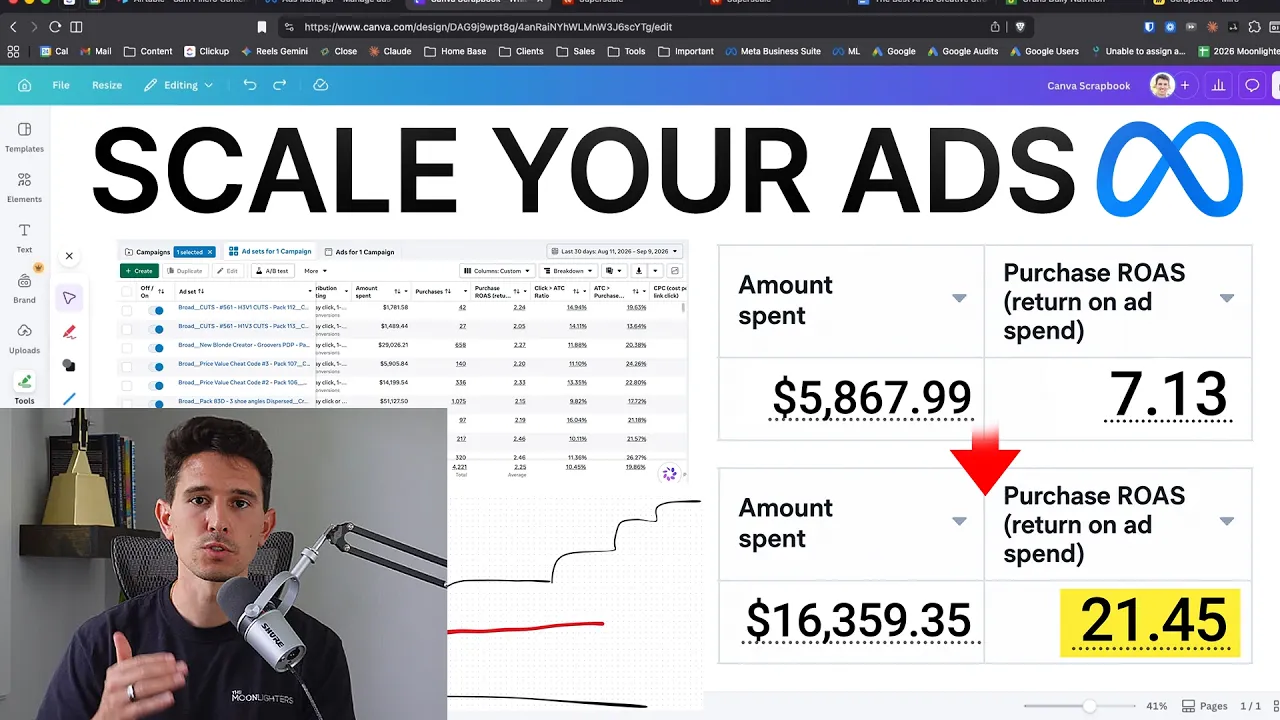
So, if you did horizontal scaling without spending more, typically you're going to see your return on ad spend inch up slightly. But you will hit a wall eventually. That's why doing these both at the same time is how we acquire new customers profitably and we continue to scale again and again. Because ultimately, we want our chart to look like this. We want our return on ad spend to be dead flat while we continue to spend more and more and more.
This would be the perfect chart. Return on ad spend stays above our target while we continue to spend more and more and more, which ultimately acquires more customers, creates an army of customers for us that will propel the business forward. So, what is internal horizontal scaling? This is not old school horizontal scaling where you would duplicate a bunch of ad sets. It has nothing to do with that. Internal horizontal scaling happens in your prospecting CBO campaign.
As you can see on my screen here, we have a whole lot of ad sets in one single campaign. This is completely normal and completely acceptable. The reason that we do this, the reason we have everything packed into one single campaign for our prospecting new customers only, is because now we have the ability to continue to add in here in a test and scale environment combined. What this does for us, and this is the literal cheat code for all businesses, is it actually allows us to use the most amount of meta tools while still being favorable to the algorithm.
Every time we launch new ads, we launch them into a new ad set. I call this a pack. With every new pack, we set a minimum budget and then we allow that budget minimally to spend. This allows everything to be tested adequately on a regular basis, but it doesn't allow anything to blow up. The only time ads blow up is if they could beat your baseline. Only ads that are above your average in that campaign will actually get significant amount of spend and in most cases, most ads won't.
That is an advantage, not a disadvantage. You don't want bad ads sucking up your spend for the sake of testing. The ideal test is a test where you spend a dollar and you know for a fact if that ad is going to work or not. Now, the algorithm's not that perfect, although it's getting pretty close. And in our case, we You to have minimums and maximums to stop ads that are fatiguing and allow new tests to start. So, the process that we follow is very simple.
On a regular basis, we're uploading new ad sets with new rounds of creative. Those new rounds of creative use minimums to force spend against that particular ad set and then at the same time, we use maximums only when ads are fatiguing. This creates a hyper-competitive environment inside of your ad account, which by the way, you can never bid on yourself. So, don't ever worry about that. In addition, when we break out by ad sets, we can use something called value rules.
Value rules allow us to modify the back end of the algorithm bidding up or down based on what's working uniquely for your business. For example, if you know that men convert better than women or certain ages convert better or worse, you could tweak that on the back end and you can tweak that at the ad set level. This also allows us to spend less or more on particular ad sets instead of doing this manually in an environment where the budget can naturally flow to the best performing place.
There's a reason the system works so well for over 100 businesses and why we've been able to spend hundreds of millions of dollars within this system. It's because it gives us the maximum algorithm advantage while also allowing us to have the freedom to test. But just because you scale once doesn't mean you need to stop. Once you successfully implement one scaling move, a 20%, a 30%, or a 50% jump, the next thing you do is critical.
You need to watch all of those metrics in the ad account plus your holistic business metrics, your blended return on ad spend, your MER of your business, your overall profitability. These are key indicators to the health of your business. Once you know that these are looking good as well after a rough 7-to-14-day timeline, it is now time to kick it up a notch again. Do not freak out when things don't work for two or three days.
Things change naturally. Look at the normal fluctuations of your business before you were scaling. The scaling move sets you at a new baseline, finds new customers that will eventually convert. That is it. That's how we scale ad accounts. I tried to pack that in super fast. If you want the long versions of everything, we always have them in school. There's a link in the description for the community. And if you want us to just handle this for you and be one of the 100 plus brands that we have successfully scaled over the last 5 years, then there's also a link to the moonlighters.com where you can apply to see if you're fit to work with us.
Any questions, you let me know in the comments below. I try to reply to as much as I'll see you very soon.
The words are the caption track's own and nothing is reworded or re-transcribed. Paragraph breaks are placed between sentences so the text reads as prose.
Free tools for your own script: paste a draft and see where it stands before you record it.
Paste your draft and see where viewers are likely to drop off, with a rewrite for each weak line.
Paste the first 30 seconds of your own draft for a hook score and rewrites.
Check your draft against YouTube's advertiser-friendly guidelines before you record it.
Read this channel's public videos and transcripts, and download a writing brief for it.