Getting the transcript
Reading the captions from YouTube. A video nobody has opened here before takes 10 to 30 seconds; this page fills in on its own.
Getting the transcript
Reading the captions from YouTube. A video nobody has opened here before takes 10 to 30 seconds; this page fills in on its own.
Theo - t3․gg · @t3dotgg
Where viewers went back to watch this video again, from YouTube's public Most replayed graph, lined up with what was said at that moment.
Most replayed moment #1
3:113.8x the video's typical replay level
really expensive. No, it is not. It comes out to the same price as using Stripe directly. Clerk's DX is best in class, now their payment systems are too. Check it out yourself at soydev.link/clerk. I'm going to go in a pretty weird order here, so just follow along with me. First, I want to go after the people who
Said at 3:04
Most replayed moment #2
22:032.9x the video's typical replay level
on a Mac mini or a Mac Studio so that you can have a dedicated machine doing inference or agent work or whatever, you're kind of just screwed right now. >> [sighs] >> And if you think the base tier Mac mini is enough for our types of agent work, it can be, ish, but mine spends more
Said at 21:56
Most replayed moment #3
7:442.6x the video's typical replay level
better values now. There is one or two other options I feel obligated to bring up, though. The Framework Desktop is one of them. The Framework Desktop uses the Strix processor from AMD, which is an all-in-one chip built to do heavy compute, but also with a GPU in it. So,
Said at 7:36
The graph counts replays. It does not show where viewers stopped watching.
Words
4,790
Runtime
22:43
Speaking pace
211wpm
Reading time
20min
211 words per minute, above the 201 75th percentile of 349 measured videos. That distribution comes from the 349-video hook study.
Opening (first 30 seconds)
Back in my day, Apple computers were way overpriced. If you wanted a certain spec, it was way cheaper to just buy pretty much anything else. But then the RAM crisis happened, and all of a sudden Apple's computers became an actually compelling value. I would argue Apple silicon also helped a lot here in the first place, like the MacBook Air M1 at $1,000 is one of the best computers you could buy for that much money. But nowadays, it's changed a lot. The Mac Mini M5 was an unbelievable deal, and that's why so many people are hyped on them and use them for
106 words, the words spoken in the first 30 seconds at 211 words per minute.
Free, no signup. See how the first 30 seconds hold attention, with rewrites.
Sentence shape
| Measure | This transcript |
|---|---|
| Sentences | 288 |
| Average words per sentence | 16.6 |
| Longest sentence | 73 words |
| Questions asked | 11 |
| Sentences containing a number | 61 |
Most used terms
Filler phrases
71 in total: like 57 · actually 8 · kind of 4 · literally 1 · uh 1.
A literal whole-word count of the same phrase list the Prepublish browser extension uses, so a phrase inside another word is not counted and a phrase used in its ordinary sense still is. It is a count and not a judgement.
Free, no account. See where attention is likely to drop, with a rewrite for each weak line. The free check shows the scores and the one issue costing the most. Or run it on the words above first.
Free · No login · See a sample audit first if you prefer.
What this transcript is
Every word below is the caption track YouTube publishes for this video, pulled from the video itself and reproduced unchanged. It is not Prepublish's writing, not a summary, and not a re-transcription: it is the video's own published captions. English captions, generated automatically by YouTube, in the video’s original language. Source: the video on YouTube. A channel that would rather this page did not exist can ask for its removal through the contact page, and it is removed.
Back in my day, Apple computers were way overpriced. If you wanted a certain spec, it was way cheaper to just buy pretty much anything else. But then the RAM crisis happened, and all of a sudden Apple's computers became an actually compelling value. I would argue Apple silicon also helped a lot here in the first place, like the MacBook Air M1 at $1,000 is one of the best computers you could buy for that much money. But nowadays, it's changed a lot.
The Mac Mini M5 was an unbelievable deal, and that's why so many people are hyped on them and use them for things like their open claws. But now the prices have changed. Literally. Apple previously confirmed they would probably have to do a price hike due to the amount of RAM prices have changed. I did not think it would hit quite this hard, quite this suddenly though. And the new prices are nuts. It's kind of crazy to me that even like the HomePod and Apple TV are being hit, but also that they somehow dodged price hiking the iPhone.
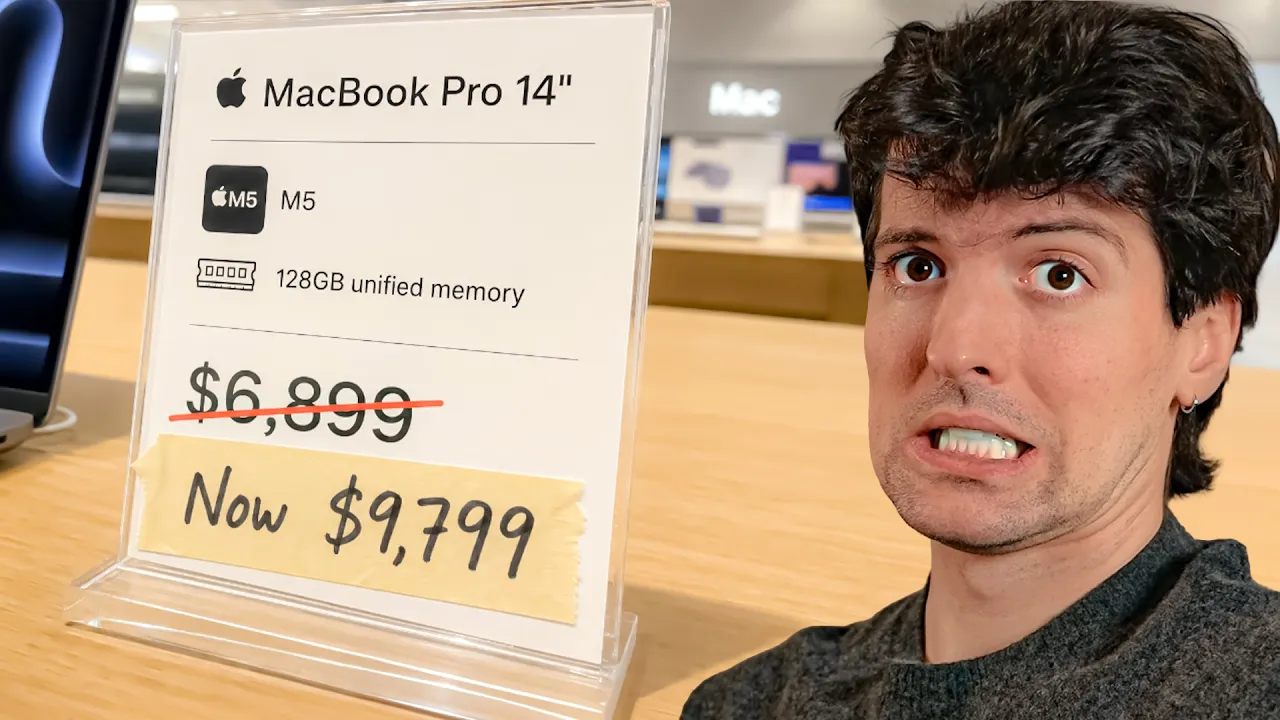
There's a lot to dig into here, from what this means for the industry to how we get the right Mac for the things that we want to do, to whether or not it's even worth using Macs for our day-to-day work anymore. Does Apple have any value prop in a world where these computers can be as high as $10,000 to buy? And I'm not bluffing by the way. This MacBook is a maxed-out M5, and I paid around seven grand for it when it dropped.
The same spec is worth about 10 now. Insane that this price change has hit so hard, so fast. But I do have some tricks to get around it, at the very least to get close to the original pricing. They're not going to last for long though, so definitely stay tuned. But if I ever want to be able to afford a Mac again, I need to make a little bit of cash, so I hope you forgive me for a quick break for today's sponsor. I have a weird SF story to tell quick.
Trust me, this one's worth it. I was at an event recently and I was talking to somebody on the Stripe team about how horrible it is to integrate Stripe into modern applications. It just doesn't fit right. The fact that I have to deal with all the data myself, I have to mirror it because the rate limits are garbage, and just it's not pleasant. It's so bad that when you Google search for Stripe recommendations, the first thing that comes up is a repo I made a year and a half ago crashing out about how miserable it is to set up Stripe.
Thankfully, I have an answer now. If you're trying to add billing to your services in a way that doesn't suck, then you probably wouldn't have looked at an auth company like Clerk for that because they're helping you make a sign-in button, not helping you bill your users. Well, that was the case, but now they have my favorite billing product ever because it's linked to the user, which is where it should be. Your code doesn't subscribe, your features don't have credit cards, your users do.
So, why are we putting this stuff other places? Why do I have to mirror the data Stripe should be giving me somewhere else and then manually link it to my users and then hope it all goes well until they fail to rebuild a third time, go click a link in their email, pay, and then the wrong webhook gets sent so I never actually activate the user. At least I didn't because I built this stuff myself before and it was hell.
Now, I just go to the Clerk dashboard and I can set it all up from there. The code couldn't be simpler, not that you would care anyways, your agents are going to write it, but the agents love the SDK, they love the docs cuz they're all really well written and formatted expecting agents to be the ones using them. When I tell people about this at events, the first question they have is is it really that good? I say yes.
The second question is okay, it must be really expensive. No, it is not. It comes out to the same price as using Stripe directly. Clerk's DX is best in class, now their payment systems are too. Check it out yourself at soydev.link/clerk. I'm going to go in a pretty weird order here, so just follow along with me. First, I want to go after the people who don't understand that you can't really compare the specs of a Mac with a traditional PC in almost any way.
There are some exceptions, but not many. Specifically, I want to talk about how the memory and storage work in Apple computers. As I mentioned before, my Mac has 128 gigs of RAM and a lot of storage on it. And that RAM is super useful, not just because more RAM means you can do more things, because of the nature of the RAM on a Mac. I'm not sure if you guys have seen these before, these clusters where you will take a bunch of Mac Studios and link them together to do AI stuff.
You might be confused about this. Like, why would you ever use Macs for this? Why wouldn't you just use a PC with equivalent specs that's way cheaper? The reason is RAM. But, isn't the RAM on this so much more expensive than just buying a normal computer even with the RAM price hikes? Yes, but it's not just normal RAM. Apple's processors are just one chip. The one chip has everything on it. The CPU, the GPU, the video encoding and decoding, and the RAM, all on the same die.
It is shared between the CPU and the GPU. When you build a traditional computer like any of the gaming rigs or even the stream PC that I'm using right now to film, those have RAM that is for the CPU and separately the GPU has its own RAM on board. The graphics card is kind of like its own whole computer in a lot of ways. Apple doesn't do things that way, which means when you get a lot of RAM on an Apple computer, it can be used for both day-to-day tasks, but also for inference.
Let's take an app like LM Studio for example. It lets you run models locally. There's a lot of models you can run on modern hardware pretty well. For example, Qwen 3 627B can run on my GPUs that I have in most of my gaming PCs here. My 4090s and 5090s can all handle this model great. But, once you go a little bit bigger like Qwen 3.5 122B, all of a sudden that's not going to run on most GPUs. Because even the highest end GPUs like a 5090 only have 32 gigs of RAM, which means if your model's too big for that, it has to offload, and then things get much slower like absurdly so.
It's crazy cuz if a model fits, my 5090 will absolutely smoke my MacBook. Like running Qwen 3 627B, that model flies on my desktop, but it runs pretty rough on here. If you take a model that's a bit bigger like GPT-OSS-120B, which is a 60 GB model. Let's open this. It's loading. I can open Activity Monitor and you can see how it is using my system. We now have 50 gigs of memory wired. It's still loading, so it'll get worse over time. 52, 63, 73, 83, 98, 108.
Now, this model is loaded into memory, which means the GPU can use it. This is a pretty big model, to be clear. Like, it's not huge like the trillion per amp models that we're seeing like GLM-52 or frontier stuff, but it's 120 billion parameters. It's 60 GB. You can't run that on most things, but my MacBook can. I'm going to ask it to write three poems about how cool Apple silicon is. And it's flying. Faster than you can read.
It just did that at almost 100 tokens per second. And it can do that mostly because it has enough RAM to fit the whole thing. Obviously, if you're using a small enough model that could fit in a normal GPU, you should do that. But, if you want to experiment with these local models that are bigger than 30 gigs, one of the best values you can buy right now is a MacBook with a lot of RAM, even after these price hikes. Sure, it's using 100 gigs of RAM total right now across all the stuff I'm doing on my computer, but like you can actually do this.
And there are some models, for example, DeepSeek-4 Flash, where this is actually pretty useful. There's even plugins to attach this in a lot of cool environments. For example, antirez, the creator of Redis, built his own system and simple C-based runtime for DeepSeek-4 Flash that you can trivially install and run in anything, especially environments like PyTorch as a plugin, and use your Mac's RAM to do real inference and get real code work done without even needing to be on the internet.
This is really cool. Are these models as capable as frontier things from the major labs? No, not at all. They're not even as good as GLM-52, which you are not running locally unless you quantize the hell out of it and then get way, way worse quality. It's incredible what you can get away with on a machine like this with this much RAM. I'm not saying it fully replaces cloud stuff, but if you do want to use models on your computer without relying on external providers, Apple has one of the better values now.
There is one or two other options I feel obligated to bring up, though. The Framework Desktop is one of them. The Framework Desktop uses the Strix processor from AMD, which is an all-in-one chip built to do heavy compute, but also with a GPU in it. So, the RAM is shared, and they did that with LPDDR5, which is way faster than standard DDR5. So, if you do want to be able to run bigger models on a decent chip that is in a package that you can run locally, the Max Pro 395 128 gig version of the Framework Desktop is one of the better options you have now.
It is much more expensive than it was originally because that 128 gigs of RAM is crazy. It's now $3,500, and if you drop down to 64, it goes down to two grand, which is a much better deal. It's worth noting that it doesn't come with storage, though, so you better have an SSD around. But, if you're like me and want to cheap out a bit, you can get the refurbished 64 gig version for just $1,700, a little bit under. Still needs to bring an SSD, but that's a pretty good deal for what this is capable of.
And the 128 gig version's probably the cheapest you'll be able to run models of that quality right now. I ended up grabbing the 64 gig for other reasons that we'll talk about in future videos. You should be excited for those. Nvidia also has the DGX Spark with 128 gigs of RAM on their eight arm processor line. I have one of these. It's kind of garbage. I would not recommend anyone buy one of these unless you specifically need CUDA and wants to be able to use CUDA with a lot of RAM without having to buy a [ __ ] like H100 or something.
That's the only reason this is useful, and it's not that great. I much prefer things like my Framework box and even just my MacBook. So, hopefully you better understand these stacks of Macs now and why people want them and why more RAM on a Mac is way more valuable than equivalent amounts of RAM on most PCs. The only exceptions here are things like the Spark and things using that AMD Strix processor line. And those aren't really particularly popular exceptions.
I do have one last reason I think Macs are a good value before we can talk about what happened with the pricing. And that thing is the disk speed. This is the Blackmagic disk speed test. This is an app I've used far too often to figure out what capabilities the storage I have on my computers can do. I haven't used this for benchmarking SSDs externally, flash drives, stuff like that. For reference, a PCIe 4 NVMe, which is the standard, can get 7,000 to 7,500 MB per second for read speeds and up to 7,000 MB per second for write.
This is like best-case on relatively modern hardware. There are PCIe 5 drives now, but like no one's using those from what I've seen. I've played a bit, but I want you guys to see what this can do. That is over 12,000 MB per second writes, sometimes going as high as 15, depending on the size of the files that you're writing. That is absurd levels of performance that makes it possible to stream and write very high-quality video files, which is important for me as a video editor and person running a popular YouTube channel.
This type of perf is not really available in almost any other laptop that I know of. And for reference here, DDR4 RAM read-write speeds range from 21,000 MB per second to 36,000 MB per second. We are in spitting distance of DDR4 RAM speeds on my SSD. That's crazy. So hopefully you could better understand why Apple could previously overcharge for their storage and their memory. It's not like they're just putting stock chips in.
They are getting top-of-the-line stuff, they're soldering it onto the processor and onto the board to get the best possible performance. And the results are numbers you can't really get elsewhere. Believe me, I've tried. Everybody complaining, "Well, there's PCIe Gen 5 drives now." Yeah, they're roughly the same speed for the absolute top-of-the-line ones, but no one is getting these. I don't know anyone who's actually rocking PCIe Gen 5 drives right now.
It's not happening. So that's enough about why Apple's prices made any sense before. We need to talk about where things are at now. We all know about the RAM price crisis. PC Part Picker has been tracking this, and you can see how absurd it is. RAM kits like a 32 gig DDR5 kit that cost as little as a bit over a hundred dollars last year are now in the five to six hundred dollar range. It's crazy, and it's still going up.
I had a 64 gig kit that I bought in April or so that was worth 600 bucks when I bought it. The same kit's like 900 now. The flash chips that are being made for RAM are really valuable to GPU manufacturing cuz as we've now established, you need a lot of RAM to run these models. So, companies like Open AI are trying to get as many GPUs as possible, which means companies like Nvidia need to secure as much NAND flash as possible to build their architecture with.
And that's why we are screwed because we are now in a war fighting with companies like Nvidia to get as much allocation as possible, and all the companies that can make RAM for our computers can also make it for Nvidia, and they're all choosing to do the thing that makes them way more money, which is making the chips for the GPUs. And the chips that are used in SSDs are very similar. They're not exactly the same, but they're made in roughly the same way, which means any allocation that could make SSDs for our computers is now being allocated to build things like this, to build all of these GPUs, and to make more AI stuff possible.
But, it also means storage is going up absurdly quick, too. I had a drive that cost me like $700 or so last year that's worth almost two grand now. It's crazy how much the prices have inflated. So, now we have the question of why did Apple just hike prices, especially after they managed to keep them almost entirely under control for the last year where the whole industry was going up and up and up, and Apple just kept their prices the same, and they went from being a little overpriced to arguably very underpriced, especially computers like the MacBook Neo, which were an insane deal when they dropped.
That has changed now, but why did it take so long? Apple does a lot of negotiation for their manufacturing processes. This is like Tim Cook's whole thing is just owning supply chain so hard that they can win in ways no one else can. There are catches there though. They make longer term deals where they agree to buy a lot of allocation for things like chip manufacturing, for things like NAND flash, for all that type of stuff, but they don't produce devices as aggressively as you might think.
They do stock up a bit before a new drop like a new iPhone, but from that point most phones that are sold on shelves were made just a month or two before they got to that shelf. Apple does a great job of condensing their pipeline, so they go from press to sale as quickly as possible. What this means is they didn't have a lot of inventory to sell like other companies may have. They're not trying to clear shelves of things that they've had sitting for a while.
The reason they could keep prices low is because they had those legacy deals with manufacturers. Those deals are starting to come up, and now Apple has to renegotiate. And those negotiations have been interesting. One of my favorite rumors is around how they were dealing with Samsung. Samsung knows Apple hardball. They expect Apple to come in and negotiate hard to try and knock down the prices. The rumor is that they had planned to do a 60% price hike, but they were scared of Apple negotiating, so they started at a 100% markup expecting Apple to push down and they could land on that 60%, but Apple immediately agreed to the 100% price hike.
This is all a rumor, it's hard to confirm. These things come from all sorts of weird sources, but this shows how crazy things are. Apple was so scared of not getting their allocation that they agreed to a doubling of price for the chips they need for that RAM. And this is particularly funny because even Samsung isn't using their RAM for their phones. They're actually splitting with Micron for their phone RAM. The same way Google's selling TPUs to Meta so they can use them for whatever the hell they're cooking at Facebook for AI models and then they rent GPUs from SpaceX at the same time.
It's crazy. Compute's just shifting all around right now in stupid ways and that's why we end up with crazy things like this. But it does seem like Tim Cook is not done with his stuff yet because he is doing one more crazy negotiation. He is trying to negotiate with the US to allow Apple to buy memory from a company from China that is currently a blacklisted supplier. There's a bunch of Chinese companies that America has decided have too high of a chance of being supply chain risks of selling us devices that are being used to spy on us and stuff and as such they've banned a subset of those companies, one of which is CXMT.
But Apple is so desperate for deals on RAM that they are petitioning the government to get permission to buy from this one particular company. [ __ ] is wild, man. I never thought I would see the day where like this level of Apple's negotiation tactics make it into like front page news and are worth talking about because it's it's really interesting. But we do need to look at the current pricing of Macs and come to a reasonable conclusion about what we should buy especially for us as developers.
My needs are admittedly different cuz I do a lot of media stuff so I need a much more powerful chip for things like video editing and using codex. God, codex is such a performance hog. We'll talk about that a lot in my Linux video, believe me. We need to talk about what Macs make sense now. First, we should look at the Neo. The Neo was a pretty dang good deal when it dropped. But sadly, the price has bumped. It was previously only $600 and now it starts at seven, which makes it a lot less compelling if you're able to find an older MacBook Air for a reasonable price.
For example, the M3 MacBook Air was on sale on Amazon just a few days prior to this price change at $800 for 16 gigs of RAM and a half terabyte SSD. This is a significantly better computer than the Neo for a very good price. The screen's much better, too. The trackpad and keyboard are better. The Neo is an incredibly good computer for its price. But now that it's a little cheaper, not as good. So, if you're buying a computer for like a family member or a friend that like doesn't need to do anything heavy on it, like they're not going to be using Blender, they're not going to be gaming on it, cuz the MacBook Air and Neo don't have a fan, remember.
So, they can perform pretty well, but then they get hot and then the performance throttles down. Good machines, worth the price if you can get them on a discount, but like don't pay full price for a MacBook Air right now. Try to find one refurb or cheaper from another provider like a Best Buy, for example, regularly has them on sale. Let me check quick. Oof, this is worse than I thought. That's rough. 24 gigs of RAM and a 1 terabyte SSD for two grand?
Oof. We're so [ __ ] now. But what about us? I just convinced a bunch of you guys that it's fun to have 128 gigs of RAM on your MacBook Pro, but that used to only be like six grand or so. Now it's as much as 10. What do we do about that? Cuz that's just not worth it at all. Well, I feel bad putting this out there because the moment this information is public, it's not going to work anymore. So, if you're in my chat right now seeing this live and these deals are enticing to you, you should probably take them before it's too late.
Apple's official refurbished store just got an update and the prices are worse than they were before. In fact, some of these refurb prices are worse than the new prices were just a week ago. But they did restock and they do have 128 gig of RAM options again, which means if you want 128 gigs and an M5 Max, you can get it right now. I would highly recommend getting the nano texture if you're going to do it. It's just better.
Because $5800 for an M5 Max with 128 gigs of RAM and a 2 terabyte drive is not the worst deal. It's not great, but it's not terrible. There are some catches to refurb. You can't do a payment plan through your Apple Card. You can't get these in all countries. There's a lot of countries that don't support the Apple Refurbished Store. And you can't stack it with other discounts. In particular, if you have a student discount, it will not apply with the certified refurb deals.
You get one or the other. You can't have both. But if you can't get a student discount, this is a pretty decent option. And you still get the exact same warranty that you would get if you bought it new. I'll be real with you guys. I may have just bought another cuz I'm that scared. I don't like where things are going and I don't want to be in a position where my MacBook fails or I need a second one to like run a job that I want to run.
I'm that scared. I only have three MacBooks now, guys. I have a Neo, I have this one, and I have this additional one I grabbed. I know you guys at chat roasting me for having only three MacBooks, but like one of them was $600. The other one's my main machine that I run my companies with and I run my life with. And if I ever have a problem with it, if I need to replace the battery, if it's out of commission, it's rough.
I My whole team is screwed if I can't be working. And I've had times where I needed to swap my MacBook cuz of like a battery issue and I didn't have a machine ready to go. Let's not talk about all of the other computers I have here. That'll make me feel a lot worse. But uh yeah. Take advantage of these deals while they still exist. Get a nano-texture display. I didn't think they'd be great. They actually are. If you can justify splurging for a Pro and you do real work, I highly recommend it both for the difference in the screen.
The 120 Hz is incredible. Incredible. And because you have a real fan. So, if you're doing work for more than 20 minutes, it won't overheat. In a machine like this with 128 gigs of RAM, even if you move on in the future and get a different computer, you can still use this to run models on your home network. And it's actually a very compelling option for that. So, yeah. Those are my recommendations. If you don't want to run those big beefy models, but you do want to run a lot of Docker, the 64 gig models for three grand are also a really, really good deal right now.
I hate that that's a right now because this is a more expensive than it was before. I would bump for the two terabytes of storage personally. The two terabyte with nano texture is 37, but that is also, in my opinion, a pretty dang good deal right now because the equivalent brand new Yeah, that's 4349 new or 37 used. That's a much better deal. Sadly, there is no way to get a 16-in MacBook Pro at a reasonable price right now.
Personally, I don't care. I got a 16 and ended up returning it cuz I just couldn't stand how big it was. It was just unpleasant. But if you do want the bigger screen, I would honestly recommend getting a 14-in and then buying an external monitor at this point. And if you're looking for a deal on a Mac mini or a Mac Studio so that you can have a dedicated machine doing inference or agent work or whatever, you're kind of just screwed right now. >> [sighs] >> And if you think the base tier Mac mini is enough for our types of agent work, it can be, ish, but mine spends more time at 100° C and 100% CPU than it spends at the opposite.
So, know this when you go in. Hopefully, you now better understand the state of the Mac market, how insane everything is right now, and where it might go cuz I do personally think it's going to get worse way before it gets better. Let me know what you guys think about this video. I know it's not my usual, and I'm genuinely curious if you want to see more stuff like this going forward as the impact of AI hits places that aren't just the ways that we write code.
Curious how y'all felt, so let me know. And until next time, peace, nerds.
The words are the caption track's own and nothing is reworded or re-transcribed. Paragraph breaks are placed between sentences so the text reads as prose.
Free tools for your own script: paste a draft and see where it stands before you record it.
Paste your draft and see where viewers are likely to drop off, with a rewrite for each weak line.
Paste the first 30 seconds of your own draft for a hook score and rewrites.
Check your draft against YouTube's advertiser-friendly guidelines before you record it.
Read this channel's public videos and transcripts, and download a writing brief for it.