Getting the transcript
Reading the captions from YouTube. A video nobody has opened here before takes 10 to 30 seconds; this page fills in on its own.
Getting the transcript
Reading the captions from YouTube. A video nobody has opened here before takes 10 to 30 seconds; this page fills in on its own.
Chase Chappell · @ChaseChappell
This video has no Most replayed graph yet: YouTube shows one only once a video has enough views. These are the moments viewers replayed most in Chase Chappell's most watched videos.
Most replayed moment at 4:41
1.7x that video's typical replay level
them. Because a strong founder story connects the pain that you once lived, the solution you created, and the mission you believe in, and the struggles that you overcame, and how that transformation now delivers to every customer out there. When you create the story with five key pillars,
Said at 4:35
Most replayed moment at 2:44
7.0x that video's typical replay level
downloaded on your computer so that way you can do this. And one of the first steps is we're going to copy that link. We're going to come in here and click the plus sign, go to connectors, manage connections, and we're going to hit add. We're going to add a custom connector. We'll paste this, and we'll name it Meta
Said at 2:37
Most replayed moment at 4:54
3.8x that video's typical replay level
can recreate it. We're going to go into chat GBT. We're going to start a new chat under chat GBT40. You're going to do the new updated create image option and you're going to paste this exact prompt that I've gone ahead and put together for you below this video that
Said at 4:48
The graph counts replays. It does not show where viewers stopped watching.
Words
4,935
Runtime
22:35
Speaking pace
219wpm
Reading time
21min
219 words per minute, above the 201 75th percentile of 349 measured videos. That distribution comes from the 349-video hook study.
Opening (first 30 seconds)
Hello everyone. In today's video, we're going to be covering the Rush Method funnel that we use to be able to take brands from $40,000 per month to $1.7 million per month. And in previous videos, I've covered the actual outline of, you know, operating an e-commerce business and what apps doing ad research and all the different tools that are used to actually be able to scale up. But in this video, we're going to be diving in a lot more specific around the actual core systems that allow you to make these jumps in revenue and how you can deploy these into your e-commerce business to essentially scale.
110 words, the words spoken in the first 30 seconds at 219 words per minute.
Free, no signup. See how the first 30 seconds hold attention, with rewrites.
Sentence shape
| Measure | This transcript |
|---|---|
| Sentences | 371 |
| Average words per sentence | 13.3 |
| Longest sentence | 46 words |
| Questions asked | 11 |
| Sentences containing a number | 38 |
Most used terms
Filler phrases
56 in total: you know 20 · like 12 · actually 7 · literally 6 · kind of 5 · right? 4 · I mean 1 · basically 1.
A literal whole-word count of the same phrase list the Prepublish browser extension uses, so a phrase inside another word is not counted and a phrase used in its ordinary sense still is. It is a count and not a judgement.
Free, no account. See where attention is likely to drop, with a rewrite for each weak line. The free check shows the scores and the one issue costing the most. Or run it on the words above first.
Free · No login · See a sample audit first if you prefer.
What this transcript is
Every word below is the caption track YouTube publishes for this video, pulled from the video itself and reproduced unchanged. It is not Prepublish's writing, not a summary, and not a re-transcription: it is the video's own published captions. English captions, generated automatically by YouTube, in the video’s original language. Source: the video on YouTube. A channel that would rather this page did not exist can ask for its removal through the contact page, and it is removed.
Hello everyone. In today's video, we're going to be covering the Rush Method funnel that we use to be able to take brands from $40,000 per month to $1.7 million per month. And in previous videos, I've covered the actual outline of, you know, operating an e-commerce business and what apps doing ad research and all the different tools that are used to actually be able to scale up. But in this video, we're going to be diving in a lot more specific around the actual core systems that allow you to make these jumps in revenue and how you can deploy these into your e-commerce business to essentially scale.
So, just to highlight this, what we're really going to be going over is a few different systems and I'm going to be breaking down how if you're around the $45,000 month, how do you go from this number to being able to do 100k months? And then from 100k months, what does that leap look like to being able to do, you know, $600,000 in a month and even getting all the way up to $1.7 million per month with your e-commerce business?
So, I'm going to be fully transparent with some of these systems so that way you can understand how they operate and how we deploy them into our clients businesses and use these every day. And one of the first systems we're going to be covering is the attention hacking content ecosystem. Now, what does that mean? That is where we're actually focusing on organic content specifically. And how this works is you're going to be making organic videos and there's going to be different pillars of content that we really dial in here.
It's not just posting for the sake of posting. So many times I see brands just post their product on their social media page. They kind of leave their organic following. You know, they may buy 10,000 followers. There's really not much to their social media, but it is such an underplayed avenue because you can go viral on there and sell out your product. You can build a community. You can get tons of viewers and later retarget these individuals and have your own custom audiences with these other systems.
So organic is very important, especially with Tik Tok shop and Instagram reels and how the feeds operate. You can get lots of views and sales by following some of these strategies. So rather than just posting your product, one of the systems is we want to develop trust, authority and be able to convert these people. So we basically have top ofunnel, middle of funnel and bottom ofunnel organic content. And some of those things might be a founder story.
This is where you actually share how you started the business, why you started it, the reasons behind the product, what is your motivation, the mission. This is going to build trust with your audience and connect a face to the brand. And you might say, "Hey, I'm not comfortable doing founders videos." That's totally fine. You can still share, you know, why you started the business in a post format with just text only.
That's okay, too. But these stories help people connect and relate to the founders, which are going to drive more sales. A lot of times, people will see a video from the founder, feel connected, and want to try the product because of it, because it's very relatable. And we've used founder stories with so many brands where they've gone viral and completely sold out their business because of this. So you do not want to be sleeping on founder stories because they develop trust.
So that's one pillar of content that you can be posting. And you can do different iterations of founder stories. For instance, you can talk about how you started the business, how the shipping works with the products. You can do pack an order with me. You can talk about the problems you face, the adversities you've overcome. And that is one pillar. The next one is going to be your routine base. This is where you kind of incorporate your product in the videos and kind of show the lifestyle behind it.
These can be, you know, model posts. These can be, you know, daily routines. This can be, you know, my travel bag and your products included in this process. It's not meant to be overly promo. It's meant to be more aesthetic based, more lifestyle oriented because that's going to attract people. It's going to get you likes. It's going to get you engagement. People are going to see your product because it's placed in the videos.
And then finally, we're going to have community-based post where you actually connect with individuals. You may reply to a video with a green screen. You may react to a certain news article. You may take photos with people you've had an event at where you've done a trade show and incorporate community-based. This is going to connect people back and make it feel really authentic. And your routine and educational content and product placement, you know, posts.
That's where you can actually tag your product on Instagram shop, Facebook shop, Tik Tok shop, and get sales. And alongside of this, you're going to leverage the viral conversion loop, which is going to include Tik Tok shop creators. And this is where you can actually build a affiliate creator army. This is a very important strategy because we're going to leverage this to eventually parlay that later into ads. And so essentially, you're going to want to get tons of affiliates making videos for you because you can also recycle that content from Tik Tok to Instagram to Facebook to YouTube shorts and get massive omniresence awareness.
This is going to increase your views. you're going to have more audiences to target. You're going to have more chances at bat to get sales. And one of the ways that you do that is by leveraging AI creator outreach automation system. This is a system we use to get thousands of affiliates onboarded onto Tik Tok shop. And we'll then use those videos later on in our ad system, which I'll be going over. And so, one of the things you can do is you can leverage one of the AI tools and scrape your competitor affiliates where you're actually stealing, you know, their entire list of the best affiliates that are generating sales on Tik Tok shop. and that can be a list of about 20,000 creators.
You're then going to leverage a outreach bot to send out 2500 invites per day. That's about the max when you're first starting out if you don't have sales on Tik Tok shop. And then you're going to have a sample request. This is where people are essentially accepting your invitation to have them promote your product. You sent out the invite to all these creators and now some of them are accepting. So let's say you have 100 people who have accepted your request and they want a sample to then receive the product and make a video about it for you.
Well, you're going to follow an approval rubric. This is where you are very specific about who you approve. And one of those things you want to look for is you want to make sure they have no more than 100 brand collabs. The reason we do this is because we don't just want anybody who is going to make a post. And we definitely don't want anyone who is doing collabs every day. If they have more than 100 collaborations, that means they're working with a new brand every 3 days.
Doesn't necessarily mean their audience is very connected. It just means they're, you know, essentially a promo person. That isn't really what we want. Maybe we can get a few ads that way, but it's not going to necessarily relate and get us a ton of sales. So, that's the first metric we want to pay attention to. The other one is the estimated post rate. If we're going to be sending our product to a creator to make a post, and our product costs $30, well, we better be sure that they're going to make a post for us because we're sending that to them.
So, you're going to make sure they have about a 80% estimated post rate. That ensures that 80% of the time they are posting whenever they receive a product. That is a good sign. So, anybody above 80% under 100 brand collabs and GPMs, this can be anywhere between 5 2550. You want to look for a good GPM and that's essentially how much sales they gross per,000 views. So, if they get a,000 views on a video and they have a $25 GPM, well, we know if they get a,000 views, at least they're going to generate $25 in sales on average for us.
So, if our product is worth $25, well, we know that every,000 views, we're going to get one sale. And so, that also means we want to make sure that they average a slightly higher view volume per video. So, that way we can ensure we do the math and we can essentially calculate how much we'll make per creator. So, you want to make sure this number is, you know, anywhere between $5 and $50. It can be lower as long as they get lots of views.
If they don't get a lot of views, you want this number to be higher. And then GMBB, you want to make sure that you know they have about 1,500 GMBB in the last 7 to 30 days. That's fine. That at least is a proof of concept that they know how to generate sales. The higher the GMBB, the better for us. A lot of times if they've have a really really high GMV, like a 100,000 in sales, that usually just means they had one mega viral video.
So don't let that, you know, dictate your decision fully. That is why we have the approval rubric. And there's much more that goes into this, but that's essentially the base of getting started with the organic content. So you have the affiliates where they're making affiliate post. You can then take those affiliates, post them on your organic feed, and you're also leveraging those three pillars that we're talking about where you're doing product placement, you're doing community, you're doing founder story, educational videos.
You want to cycle in your content so it's not so promoy. That way you can grow your following, grow your views, and retarget those later. So now that we have the affiliates and we have the organic content system and we understand how that process works, we can move on to the next system which is the high velocity rorowaz system. And these are both interconnected. This is how we're going to scale up inside of your ad accounts on Meta, Tik Tok, and Tik Tok shop.
And essentially what we're going to do is we're going to have a proven campaign. This is very important. This is where your proven creatives are going to live. This isn't where you're doing testing. No, this is your three to five best performing ads. Your bestselling product. This is working. It's going to be where you're scaling. That way, it stays stable. We're not disrupting it. And it's only what is working. Then we're going to have our testing campaign.
Our testing campaign is where we test new creatives and migrate them over to proven. And then retargeting is finally where we're going to retarget our organic video views, our social media views, our website viewers, our email list, anybody who hasn't converted, our purchases to get them to buy again. That is that campaign. And with paid ads, there's a few different categories. We're going to have problem solutionbased ads.
And as you can see, we have a few here. Always stressed and bloated. This kit was made for you. So problem solution. I can finally enjoy coffee without the heartburn. That's a reviewbased style ad. Heartburn is the problem. The solution is I can enjoy. And then another one we have, you know, world's first deep bloating supplement that works in under an hour. Problem solution. UGC is user generated content. That is where we're taking the best performing affiliate post where we've leveraged our viral content system and attention hacking system to then take those videos and launch them into ads.
As soon as you get some sales from some of these affiliates, let's leverage those UGC videos in ads. So that way we can start getting a higher return in ad spend. We have diversity amongst our creatives. we can get better reach. And then we have our testing pool. And whenever we're doing testing, there's a few things to pay attention to. You're going to be doing net new formats. This means totally unique ideas, totally unique messaging because you want to be able to reach new pockets of audiences.
Find out what angles work. And it's really important when you're doing testing, you're following the high velocity ad testing strategy. This is a strategy that we use to essentially deploy creatives into our testing campaign. And so on Meta, you have that bestseller. And so now we want to test five angles. We're going to have a direct style ad, which is just here's our product. We're going to have a stat, which is a number or a statistic, a data point, something that is going to trigger the logical side of the mind where people are more logic based.
Benefit is going to be the outcome. What is the, you know, result? What does it do? How is it going to help me? This is also educational. It also helps people identify, you know, their own unique problems. And then a note-based. There's so many different ad variations out there that you can do, by the way. I mean, there's literally a list of hundred that we've put together, but these are just a handful that you can start out with.
And one of those might also be the notes base where it's literally a note card. These look very authentic. They're very real. They're very popular right now. People trust them and they do well. And then another one is our problem solution that we were just referring to earlier. So these are five unique angles that we're doing testing in. So once we start gathering some results, maybe some of them are doing well in rorowaz, some of them are not doing so well, some of them are getting a lot of purchases, some aren't.
We're going to start looking at that. Let's say that the problem solution does not work. Okay, the note space. Well, we're getting a really good return on ad spend, 3 to 5x. We've spent $1,000 on it. We're happy. We don't stop there. We now want to iterate on that to find an angle that can handle more spin because maybe this creative is good for this month, but it might die by next month. We don't want that. We want to explore the variations of this creative and take it to the next level until we get a very high rorowaz with very high spend so we can scale this to 1k 10k days.
So what we're going to do is we're going to take that creative and split it into three more variations. These are subtle tweaks but just enough to where they're different. So instead of just having one note card, now we're going to test in just two gummies. Here's the ingredients. Flash cell. Next one. She's not dramatic. She's nutrient deficient. Here's the examples. And another one in the kitchen, right? So, out of these three variations, we found out that this one is spending more, getting a better rorowass.
Let's take this one and make it even better. All right. So, now we make it more clear in case people can't read the injust gummies because of the handwriting. Put it on a backdrop here with lettering so it's more clear. Brighter imagery. Product is in hand. Flash cell is a little bit bolder. And it's a lot easier to read now. Right. That one worked really well. Here's another one. Same thing, fixing up the text, making a little bit better so people can understand it.
Well, this one didn't do as well, but this one can spin more, get a better rorowaz. It moves on to the next variation. And this is our final winner where it literally can run for up to 300 600 days. That is an evergreen creative right there. That means you can run that thing year round because it is converting so well. But you never would have gotten to this creative if you hadn't have gone through the testing strategy, right?
So, you'll continue to do this and break out your different creatives and create different variations until you arrive on your best one. We have a statistic turned into a note-based ad, flipped it to white, ended up taking some of the headlines from the others to see if it works. Here's another statistic. Expanded the ingredients and continued on, sold out six times, joined 460,000 plus parents. That one's absolutely crushing it.
Take it, move it to the proven campaign. So, what does that look like? Well, all of these get moving. All of the best winners get taken and moving over to the proven campaign and you can now scale these up and spend a lot more of them. This process has been well defined over many years and is converting like crazy if you want to go from those 100 to 300k jumps. This is that strategy that is going to help you get there tremendously and it's going to also allow you to jump from those 3 to 500k months.
A lot of people don't have a very robust high velocity ad testing strategy. They're just shooting in the dark. They don't know what they're doing. This is what's going to allow you to scale. Now, moving over to the affiliate ads. So, that is the meta side. Well, we were just covering affiliate posts on Tik Tok. We're not going to let that just go to waste. We're going to take the top three to top six videos that are crushing it.
Now that we've got some affiliates making videos about our product on Tik Tok shop, we have it approved. It's going well. We're going to take those three to six videos. We're going to move them over into a GMV Max campaign. And this is our top performing ads. Similar to how we have a proven campaign on Meta, we can take those and put those over there. But we also have our proven campaign on Tik Tok, which is our GMBB Max campaign.
If you don't know what GMBB Max is, it's kind of like a Google Shopping. If people search up, you know, different products, different keywords, your videos are going to show up from the affiliates as an ad. And it looks very native and get sales. And you can put in like a target ROI, anything above your break even, and essentially scale from there. So, you'll launch those into a GMV Max. And this is where you're able to start scaling to 100K months on Tik Tok shop.
This is literally the system we use. thousands of affiliates, taking the top post, moving them over to GMBB Max campaigns, moving them over to the proven campaigns, migrating them to organic content and so forth. You get it, right? And from 100K to 364K per month, that is very normal. You can literally see a huge jump in sales from one affiliate and then you can extract the juice out of that by scaling it up even further.
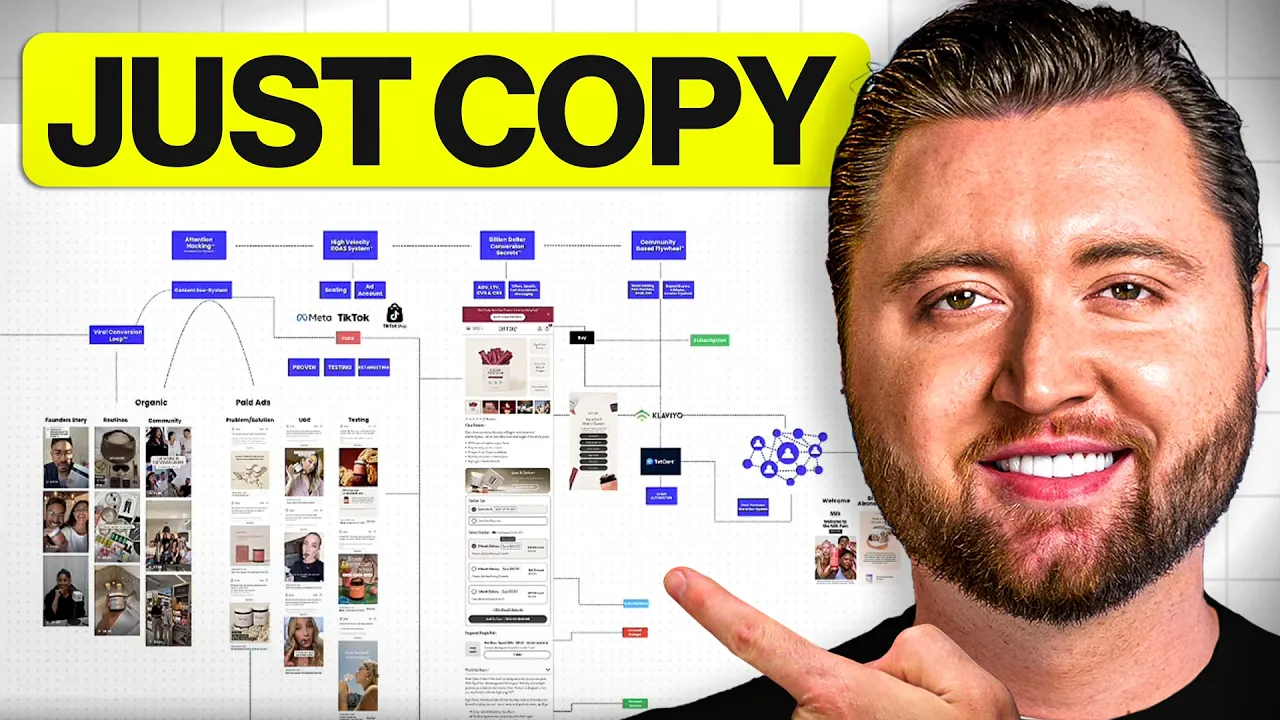
And then we have another one which is like, you know, 20K in 7 days. These are all just screen grabs from some of our clients. So you have the G&B Max campaign and that is the Tik Tok shop creator system. So just looking at this as a whole view, you have your affiliates migrating them over to affiliate ads, migrating them to GMBB Max, moving them over to proven. You have your organic content, you have your paid ad breakdown where you have proven, testing, retargeting, and you're using this high velocity ad testing strategy to move into proven as well.
And everything kind of leads back to scaling up based off of this. Now, as you're scaling, we're sending people to the website. This is a very important step and this is where all the conversion secrets come out where I'm going to break down how this process works. If you do not have a good converting website, a lot of this can go to waste. You can get by and do 40 to 100K, but if you're going to go from 100 to 300 to 500 to a million.7, you got to have a really good landing page.
And it's very important that you do this step right. So, breaking this down, clear product image. Here's our list of ingredients. They can see everything in one view. We have bullet points where we break down the product. If you have a really long description, people don't really like to read those. They like to have it easy scannable. Now, this is the important part. We have subscribe and save. We know subscriptions increase LTVs, which allow you to increase spend and stack revenue.
So, if you did 100K a month off of only new customers, it's going to be pretty hard to do double that because you're going to have to double your customer base. But, if you have subscribe and save, well, going to 200K isn't that hard. You just need to get roughly 50% of people to return two months in a row and you're already at those 200k plus months and it just keeps stacking from there. It's very easy to stack revenue.
Once you have people subscribe and saving and you got them on subscriptions, well, now you're making a lot on your margin because you don't have to spend anything after they subscribe. They bought your product, they're on subscription, you're making money every month. Next up is your upsells. This is how you increase your AOVs. If you're at a really low AO ob, it's very important that you get that higher so that way you have more margin to scale.
One of the ways of doing that is cross-sell bumps. You pair it with another bestselling product to get people to buy more. Then you want to make sure you have your product detail drop downs. These are very important. Social proof, breaking down some of those affiliate videos from earlier. You leverage that system. You're starting to see how they're all intertwined now. Organic can go to paid ads and then you also have them listed on your website.
So, you're leveraging this across the board to maximize its output. Product comparisons. We've covered these in the past. These are very good to compare your product. And then product science. This is data points. This is tapping into the logical side of it once again. And then product reviews, which is social proofed where we're going to be covering emails, ads, all that stuff. You want to use reviews across the board.
And then email opt-in. This is a design that is going to allow you to get a high conversion rate of 3% plus. It's going to help you increase your AOVs, help you increase your LTVs, and make it very easy to scale. This is what million-doll month landing pages look like. Now, your email opt-in is a very important piece of the equation. Most people don't leverage this to its full potential. You want a full width email popup because it's going to increase your email opt-in rates as high as 10 to 15, even 16% on optins.
Most people don't realize if you're getting a,000 people to your website every day, that's 160 free emails going to your list where you can then remarket to them to get them to come back and buy. Doesn't cost you anything. So, you want to have a really good opt-in rate because not only are you able to remarket to those people, get additional sales. This also helps improve your match back ratios. If you don't know what that is, it's where your pixel is able to identify who these people are and match them back to Facebook profiles to then make the algorithm better, improving your overall audience performance and targeting.
All of these things are interconnected, so you want to make sure you have them in the right place. Now, with email, so we have people who bought, they're on subscription. The next one is the community-based flywheel. We do not stop after the first purchase. That is only where things just begin. You're going to be leveraging AI SMS automation. I dropped the tool below this video. It'll automate SMS follow-ups. If people abandon cart, it'll send them an SMS to get them to recover.
It'll literally have a conversation with them. It's a mustave. People are seeing 10 to 20x ROIs on this stuff. It is pretty crazy. And then for our post-purchase, you're going to have email flows. Do not skip your email flows. These are important. You want to welcome people into the process after they purchase. Welcome them. Offer them another incentive. Get them to buy a second time because it's going to increase your ROI, make your rows better, make your overall profit and cash flow much more manageable.
And then browse abandonment. That's essentially where they're browsing on your website. They did not add to cart. They go to abandon and leave your website. Well, good thing you had a high converting email popup because we just sent them an email browse abandonment to get them to come back and buy because sometimes people be scrolling in their car. They'll get busy. The baby, they have to go attend to their kid. They have to go pick up their child from school.
They have to go to dinner. People's lives are very busy, so you need to stay in front of them. And it doesn't cost you anything with emails to do that or with SMS. So, you want to make sure you're following up. And if they add something to cart, remind them with a cart reminder. Post- purchase. After they've bought, you want to get them to come back. So, offer them additional perks, special loyalty programs. You want returning customers so that way you can stack revenue month over month and get to those higher tiers.
And then reviews. Send out review emails asking for them, but also send them out as credibility and social proof to get them to buy. Just like you have them on your website, take a pair of your best reviews, turn those into ads, turn those into a video organically, put them in your emails, put them on your website. Educational. So rather than being super promoy all the time, you need to educate and give value so people don't just, you know, ditch your list and run.
Now, three reasons why people are loving Array Bloat. Sleep guides, health guides, fitness routines, styling guides, three must haves in your wardrobe. This product is beneficial in these three categories. Here's a routine. You want to give use cases, examples, educate people, get them excited, make them more knowledgeable about your product because the more knowledgeable they are, the more likely it is that they'll tell their friends because they feel they're a pro at using whatever you're selling.
Email flows are a great way to continue to keep people in your community. You can then engage with them, get them to make videos for you, and you rinse and repeat these systems, right? So, this is the Rush Method funnel in full. And all of these have, you know, very intricate systems within them. You're not just having one email in each. You're going to have multiple flows. There's multiple landing pages you'll have on your website.
There's going to be way more ads than just these examples. This is just the highlevel overview of how it operates together. But each of these systems have subsystems that interact with one another that you need to know. And if you're interested in learning more about how all of those minor details work, like optimizing your audiences, moving budgets around, being able to know exactly what apps and tools to use, what you should say in all of your copy, where to position what.
Well, go ahead and book a call below with myself and team and we'll walk you through all of these things to be able to help you go from those 40k to 100k, 300,500 and $1.7 million months inside of my one-on-one ads mastery mentorship. Once again, it's your favorite digital marketer here, Chase Shabble. Cheers and bile.
The words are the caption track's own and nothing is reworded or re-transcribed. Paragraph breaks are placed between sentences so the text reads as prose.
Free tools for your own script: paste a draft and see where it stands before you record it.
Paste your draft and see where viewers are likely to drop off, with a rewrite for each weak line.
Paste the first 30 seconds of your own draft for a hook score and rewrites.
Check your draft against YouTube's advertiser-friendly guidelines before you record it.
Read this channel's public videos and transcripts, and download a writing brief for it.