Getting the transcript
Reading the captions from YouTube. A video nobody has opened here before takes 10 to 30 seconds; this page fills in on its own.
Getting the transcript
Reading the captions from YouTube. A video nobody has opened here before takes 10 to 30 seconds; this page fills in on its own.
Bible Today · @BibleTODAY-q1d
Words
1,944
Runtime
12:21
Speaking pace
157wpm
Reading time
8min
157 words per minute, below the 160 25th percentile of 349 measured videos. That distribution comes from the 349-video hook study.
Opening (first 30 seconds)
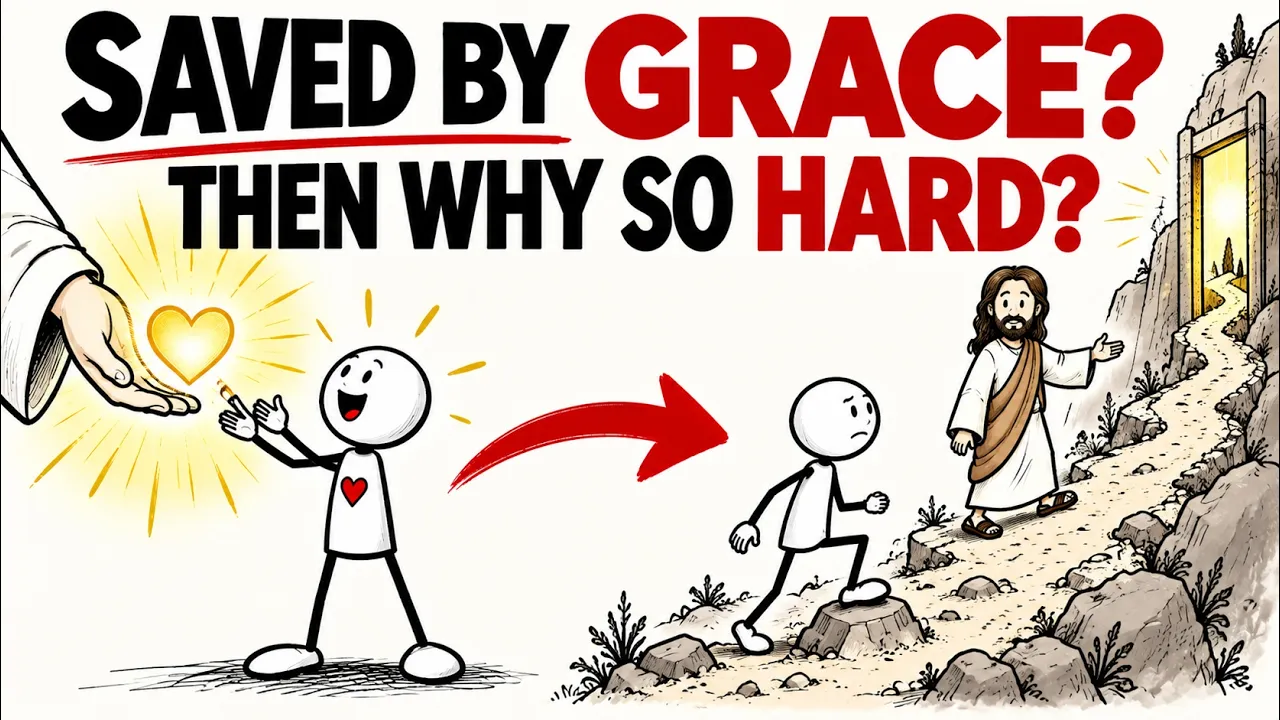
Jesus said, "The gate is narrow and the road is difficult." Paul says, "Salvation is God's gift, not something we earn." So, which is it? If salvation is by grace, why does Jesus make the way sound so difficult? That question sounds like the kind of thing you'd raise in a seminary classroom, but it's really a question a lot of ordinary people have run into quietly on their own. Maybe you grew up hearing over and over that
79 words, the words spoken in the first 30 seconds at 157 words per minute.
Free, no signup. See how the first 30 seconds hold attention, with rewrites.
Sentence shape
| Measure | This transcript |
|---|---|
| Sentences | 117 |
| Average words per sentence | 16.6 |
| Longest sentence | 61 words |
| Questions asked | 12 |
| Sentences containing a number | 7 |
Most used terms
Filler phrases
29 in total: actually 19 · like 6 · kind of 4.
A literal whole-word count of the same phrase list the Prepublish browser extension uses, so a phrase inside another word is not counted and a phrase used in its ordinary sense still is. It is a count and not a judgement.
Free, no account. See where attention is likely to drop, with a rewrite for each weak line. The free check shows the scores and the one issue costing the most. Or run it on the words above first.
Free · No login · See a sample audit first if you prefer.
What this transcript is
Every word below is the caption track YouTube publishes for this video, pulled from the video itself and reproduced unchanged. It is not Prepublish's writing, not a summary, and not a re-transcription: it is the video's own published captions. English captions, generated automatically by YouTube, in the video’s original language. Source: the video on YouTube. A channel that would rather this page did not exist can ask for its removal through the contact page, and it is removed.
No Script X-ray for this video: YouTube shows a Most replayed graph only once a video has enough views.
Jesus said, "The gate is narrow and the road is difficult." Paul says, "Salvation is God's gift, not something we earn." So, which is it? If salvation is by grace, why does Jesus make the way sound so difficult? That question sounds like the kind of thing you'd raise in a seminary classroom, but it's really a question a lot of ordinary people have run into quietly on their own. Maybe you grew up hearing over and over that salvation is a gift, that you can't earn it, that it isn't a reward for good behavior, and then one day you read Jesus saying, "Enter through the narrow gate, for the gate is wide and the way is easy that leads to destruction, and those who enter by it are many.
For the gate is narrow and the way is hard that leads to life, and few people find it." And something in you stops. If salvation is really a gift, something given, not earned, why does Jesus describe the path to life as hard? Why does he describe the gate as narrow, as if most people are going to miss it? That doesn't sound like a gift, it sounds like an obstacle course. We're going to take that question seriously, not resolve it in the first 30 seconds with a tidy phrase, but actually walk through what Jesus says, what comes right after it, and how it fits with what Paul and the rest of the New Testament teach about grace.
By the end, I think you'll see that this isn't really a contradiction at all. It's two different questions being answered, and we've just been reading them as if they were the same question. Let's start with what Jesus actually says in Matthew chapter 7 verses 13 and 14. He describes two gates and two roads. One gate is wide, and the road behind it is easy, and Jesus says many people go through it. The other gate is narrow.
The road behind it is hard, and few people find it. One leads to destruction, the other leads to life. Notice what Jesus doesn't say here. He doesn't say the narrow way is narrow because it's expensive, or because it costs enough good works to buy your way through. He doesn't attach a price to the gate. He simply describes it as narrow, and describes the road on the other side as hard. So, the honest question is what actually makes it narrow?
What makes it hard? We shouldn't assume we already know the answer before looking at what Jesus says next, because Jesus doesn't just drop this saying and move to a completely different topic. He keeps talking, and what he says immediately afterward tells us a lot about what he has in mind. Look at verses 15 through 23, right after the narrow gate saying. He warns about false prophets, people who come in sheep's clothing, but are, in his words, ferocious wolves underneath.
He says, "You'll recognize them by their fruit. A good tree doesn't bear bad fruit, and a bad tree doesn't bear good fruit." Then he says something even more pointed. On the day of judgment, many will say to him, "Lord, Lord, did we not prophesy in your name, and cast out demons in your name, and do many mighty works in your name?" And Jesus will tell them plainly, "I never knew you. Depart from me, you workers of lawlessness." Now, stop and think about what kind of people Jesus is describing here.
These aren't casual unbelievers. These are people who used his name publicly, who performed impressive religious activity, who apparently believed they belonged to him. And Jesus says he never knew them." This is the immediate context surrounding the narrow gate, and it reframes the question. Is Jesus describing a difficult way to earn salvation, or is he describing a demanding way of actually following him as opposed to simply claiming his name while going your own direction?
Matthew 7:13 and 14 don't actually spell out why the gate is narrow. Jesus doesn't pause to define it for us, but the immediate context suggests he isn't simply talking about accumulating enough good deeds. His warnings about false prophets, about fruit, about people who call him Lord but never do the Father's will point toward something deeper. What it actually means to follow him as opposed to merely invoking his name.
The warnings that follow show that religious activity by itself isn't enough. Some people will even appeal to things they did in Jesus' name, prophesying, casting out demons, performing mighty works, and Jesus still says, "I never knew you." So, the narrow way may be narrow less because salvation has a purchase price attached to it, and more because actually following Jesus as opposed to using his name while living for yourself turns out to be something fewer people are willing to do than we'd expect.
That distinction matters. Let's hold on to it because now we need to bring grace into the conversation directly. Paul writes in his letter to the Ephesians chapter 2, "For by grace you have been saved through faith, and this is not your own doing. It is the gift of God, not a result of works, so that no one may boast." That's about as clear as the New Testament gets. Salvation isn't something you build up through enough religious performance.
It's a gift received through faith, and Paul specifically rules out boasting, meaning no one gets to stand before God and claim credit for having contributed enough to earn their place. But Paul doesn't stop there. The very next verse says, "For we are His workmanship, created in Christ Jesus for good works, which God prepared beforehand, that we should walk in them." Read those two ideas together. You are saved by grace, not by works, and you are saved for good works.
A transformed life that God intended from the start. Those aren't contradictory statements. They're describing two different things. One is about the basis of your salvation, the other is about the purpose and direction of the life that salvation produces. Paul makes a similar move in Romans chapter 3, where he writes that all have sinned and fall short of the glory of God, and are justified by His grace as a gift through the redemption that is in Christ Jesus.
And in his letter to Titus, he's even more direct, that God saved us not because of works done by us in righteousness, but according to His own mercy. So, Paul is unmistakably clear. Salvation is not a wage you earn, it's a gift you receive. Which brings us back to the tension we started with. If Paul says grace, and Jesus says narrow and hard, did they actually disagree with each other? I don't think they did, and perhaps the tension becomes clearer once we stop treating these as competing statements, and ask what question each of them is actually answering.
We're taking one sentence from Jesus and placing it directly against one sentence from Paul, as if each of them wrote a single verse summarizing their entire theology, but neither of them did. Paul, who wrote more clearly about grace than almost anyone else in the New Testament, also wrote extensively about repentance, about dying to sin, about pressing on toward the goal, about disciplining his body so that after preaching to others, he himself would not be disqualified.
Paul held grace and a demanding Christian life together constantly without treating them as contradictions. And Jesus, who describes the narrow way as hard, is the same person who says, "My yoke is easy and my burden is light." The same person who tells a paralyzed man, "Your sins are forgiven." before that man has done a single thing to earn it. Jesus doesn't present forgiveness as a transaction requiring enough good behavior first.
So, when we place a phrase from Jesus against a phrase from Paul as if they're competing positions, we're actually missing what both of them are doing. They're not disagreeing about how someone becomes right with God. The New Testament can speak about salvation as God's gracious gift while also describing the life of following Christ as costly and demanding. This is where a distinction becomes necessary and it's the distinction the whole video has been building toward.
There's a real difference between earning salvation and being changed by the salvation you received. Those two things get confused constantly, especially by people trying to defend one side of this question against the other. Earning salvation would mean God owes you something because of your performance. Nothing in the New Testament describes it that way. But, being changed by salvation is different. It's the natural expected outcome of actually encountering God, not a bill you pay afterward, but a transformation that follows from what happened when grace actually took hold of a life.
This is not the same as saying, "If your life isn't perfect, you were never really saved." That kind of thinking creates constant anxiety and misses the patience the New Testament [clears throat] actually shows towards struggling believers. But, it is saying that a genuine encounter with grace tends to produce a different direction in a person's life. Not flawless behavior, but a real ongoing reorientation. And that reorientation is exactly what makes Jesus' road sound difficult.
Following Jesus in his own teaching involves things that go directly against how most people naturally want to live. Surrendering control, repenting honestly instead of making excuses, forgiving people who haven't earned it, loving people who have actively worked against you, choosing truth even when a comfortable lie would be easier, enduring hardship without abandoning faith the moment things get difficult, refusing to build your life around whatever the crowd around you is doing.
None of that is a payment for salvation. All of it is what it actually looks like to walk through a gate you didn't build yourself onto a road you didn't design, following someone whose direction is often the opposite of your own instincts. That's why the way is described as narrow. Not because few people can afford the toll, because few people, once they understand what genuinely following Jesus requires, are actually willing to keep walking.
So, bring this back to Matthew 7 and to yourself. The question worth asking isn't have I done enough good things? That question on its own misses the entire point of grace, and it can leave a person anxious for years without ever resolving anything. The better question, based on what Jesus actually says here, is this. What does it actually mean to enter through the gate and to keep following the one who told us the way would be narrow?
Grace answers where salvation comes from. It comes as a gift, not a wage. The narrow way addresses something different. What an actual ongoing relationship with Jesus looks like, as opposed to a religious performance that uses his name without ever really knowing him. Read that way, these two ideas stop competing. One tells you how the door opened. The other tells you what it actually means to keep walking once you're through it.
When you hear Jesus say the way is narrow, what do you think he's actually asking you to understand about following him? I genuinely like to know how you'd answer that. Leave it in the comments. If you found this kind of careful in-context Bible study helpful, consider subscribing to Bible Today. There's more of this ahead. Until next time, study well.
The words are the caption track's own and nothing is reworded or re-transcribed. Paragraph breaks are placed between sentences so the text reads as prose.
Free tools for your own script: paste a draft and see where it stands before you record it.
Paste your draft and see where viewers are likely to drop off, with a rewrite for each weak line.
Paste the first 30 seconds of your own draft for a hook score and rewrites.
Check your draft against YouTube's advertiser-friendly guidelines before you record it.
Read this channel's public videos and transcripts, and download a writing brief for it.