Getting the transcript
Reading the captions from YouTube. A video nobody has opened here before takes 10 to 30 seconds; this page fills in on its own.
Getting the transcript
Reading the captions from YouTube. A video nobody has opened here before takes 10 to 30 seconds; this page fills in on its own.
Data with Baraa · @DataWithBaraa
Words
4,920
Runtime
23:08
Speaking pace
213wpm
Reading time
21min
213 words per minute, above the 201 75th percentile of 349 measured videos. That distribution comes from the 349-video hook study.
Opening (first 30 seconds)
Hey friends, now if you want to become a data analyst and you search for a road map, you're going to find a lot of them in the internet including mine and we usually make them from our experience, our gut feeling and as well doing some research. >> They searching all our computers. Yeah, >> that already got to yours, Kev. >> That's why they are just opinions. And my favorite quotes about opinions, without data, you are just another person with an opinion. And as well, suggesting a road map from me to you, it is a big responsibility because you might spend a lot
107 words, the words spoken in the first 30 seconds at 213 words per minute.
Free, no signup. See how the first 30 seconds hold attention, with rewrites.
Sentence shape
| Measure | This transcript |
|---|---|
| Sentences | 320 |
| Average words per sentence | 15.4 |
| Longest sentence | 123 words |
| Questions asked | 15 |
| Sentences containing a number | 12 |
Most used terms
Filler phrases
56 in total: like 42 · actually 11 · kind of 2 · you know 1.
A literal whole-word count of the same phrase list the Prepublish browser extension uses, so a phrase inside another word is not counted and a phrase used in its ordinary sense still is. It is a count and not a judgement.
Free, no account. See where attention is likely to drop, with a rewrite for each weak line. The free check shows the scores and the one issue costing the most. Or run it on the words above first.
Free · No login · See a sample audit first if you prefer.
What this transcript is
Every word below is the caption track YouTube publishes for this video, pulled from the video itself and reproduced unchanged. It is not Prepublish's writing, not a summary, and not a re-transcription: it is the video's own published captions. English captions, generated automatically by YouTube, in the video’s original language. Source: the video on YouTube. A channel that would rather this page did not exist can ask for its removal through the contact page, and it is removed.
No Script X-ray for this video: YouTube shows a Most replayed graph only once a video has enough views.
Hey friends, now if you want to become a data analyst and you search for a road map, you're going to find a lot of them in the internet including mine and we usually make them from our experience, our gut feeling and as well doing some research. >> They searching all our computers. Yeah, >> that already got to yours, Kev. >> That's why they are just opinions. And my favorite quotes about opinions, without data, you are just another person with an opinion.
And as well, suggesting a road map from me to you, it is a big responsibility because you might spend a lot of time and money following it. And at the end, my experience, my opinion, it is just one person in one country working for multiple companies for many years. So, how we going to fix this? I've thought about it a lot and found out actually the best way is to find out what the job market now is searching for and for that we need a lot of data and you know me I like doing data projects that's why I have built a machine a process a machine like a data pipeline that extract data it goes and collect every data job ad that it can find but after extraction what we do we clean up the data that's why I spent a lot of time just removing the duplicates the spams the dead jobs the unrelevance the noises all of it And the result, it was just amazing.
Instead of making an opinion from 10 ads, now we are talking about over 22,000 real data job ads from more than 4,000 companies all around the world from almost 100 countries. And of course, we're going to focus on only the data analyst jobs. So, I extracted the data and cleaned up. What comes next is of course analyzing it with one question. What do companies actually want from a data analyst? So, my friends, in this video, I'm going to show you what I found out. all the skills the companies now are expecting from you as a data analyst, the tools, the real tasks, the salary, and what are the AI skills that are now required from you as a data analyst.
And at the end, I'm going to show you a full road map based on the job market and my final opinion and recommendations about this role, the data analyst. So now, let's deep dive and see what the data is actually TELLING US. >> PARKOUR, PARKOUR, [screaming] >> YEAH, >> PARKOUR. >> Let's start with the most important question. What are the skills that are expected from you as a data analyst? Now, we usually find the answer for this question in the job description in the section, what are we looking for?
And you're going to find their bullet points and the order is not random. The first bullet point is the most important skill that is required from you. And as you go lower and down, things gets more optional. And one more thing very important about this is that this is a wish list. This is not a checklist. Nobody going to fulfill all those stuff. And of course, I use LLM and AI agents in order to extract those stuff.
So now the first thing that I want you to see is I grouped all skills into categories. And surprise surprise, the number one category going to be writing a code. But don't panic my friend. It is mostly because of SQL. Then the second group going to be the BI tools, which makes total sense because as a data analyst, you have to generate dashboard reports and some nice visuals. Now after that we get things like for example the data concepts and then we have small percentage for data platforms and engineering and AI and here I got a little bit surprised because I was expecting more AI wording in the job description but I'm going to keep my eye on this as I'm collecting more and more data.
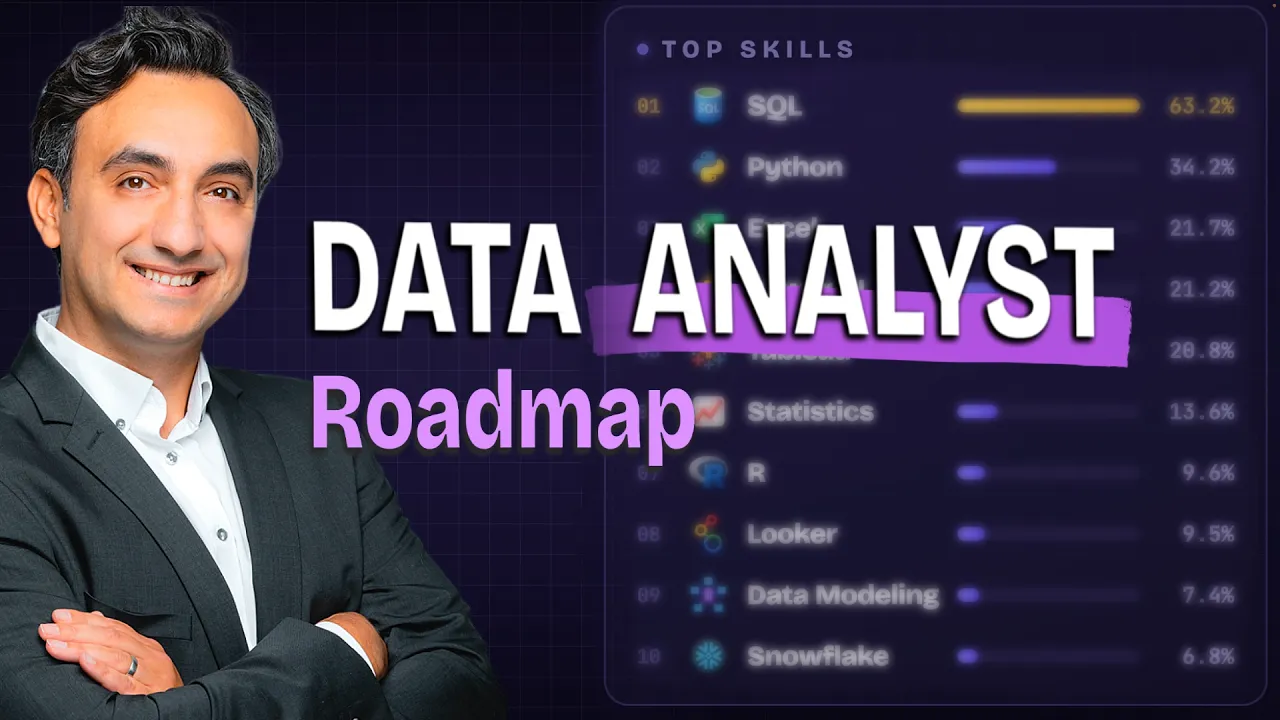
I think this one going to grow over the time very fast. So those are the categories but now don't worry I'm going to show you exactly the names and we're going to drill down and I think no one is surprised. The number one skill is SQL. More than six of every 10 analyst jobs is listing SQL as a must. Now moving on to the number two. This is as well surprised me is Python. I was expecting like PowerBI or Tableau or Excel but Python is number two.
And as well I've done some research and analyze on the side and I have found out that they are requesting Python because of pandas. This is becoming like standards on how to work with data. So the top two skills that is currently dominating the job requirements is SQL and Python. And of course there are more things about programming. So now for example if I just focus on the skills for programming we're still going to find things like R, Git and CI/CD but they are very tiny.
I'm going to say they don't expect you to have skills in Git and CI/CD. That's why I'm going to say mostly you can skip it as an analyst. And by the way my friends I have partnered with data cam for this video because it fits perfectly here. the top three skills SQL, Python and PowerBI. The question is where you actually learn all of those. Now the thing is you retain only tiny fraction of the skills you learn by just watching videos.
But when you learn with real exercises and real projects, retention jumps close to 80 to 90%. And this is exactly what data camp is built for. Now start with the number one skill, the SQL. The associate data analyst in SQL track 11 courses around 40 hours. you write real SQL queries against real business questions. So it's going to start from zero all the way to joins, window functions, the database designs and at the end you can earn the data analyst associate certificate.
And this one is not another multiple choice quiz. It is a timed practical exam. So you actually prove that you can do the work. Number two skill, we have the Python the data analyst with Python track where you learn to clean, analyze and visualize real data with pandas. Number three, we have the data analyst in PowerBI track for dashboard ducks and data moduling. And the good news is that finish the track and data cam gives you 50% of the official Microsoft PL300 exam.
This [music] is what recruiters actually search for. So all those in one subscription. By the way, the first chapter of every course is for free. You can start now with the SQL track today and you can get my link in the top of my description in order to get you 25% of data camp when you upgrade. Now let's go back. Okay, so now to the next question which is interesting one. Which BI tool do companies ask for? So this is interesting tool war.
Let's see who's winning. Look at this my friends. I don't know whether you are surprised but Excel sits at the first place. Yes my friends, Excel is not dead. Sadly of course because I don't like this tool but it is totally expected. Most of the companies do data analytics inside Excel. Even having the best tools in the world like PowerBI and Tableau, still people decide to use Excel and have really hard time migrating from those Excel sheets to more modern platforms.
Now, of course, right behind it, the war that everyone loves to talk about, PowerBI or Tableau. Now, look at this. The numbers are very close to each others. We have a tie. So, the job market didn't decide for you which BI tool you should learn. So, you have really to pick one of them. And of course, I get a lot of this question. Should I learn both PowerBI and Tableau? I checked that for you as well in the job descriptions.
Well, the good news is that there is almost no job description that is asking for both together. So almost you will never see that they are asking for Tableau and PowerBI. What you might see is actually good news. They're going to say Tableau or PowerBI. But now I will not leave you like this. I'm going to show you something that might help you to choose the BI tool for you. Now all the numbers that I'm showing you are based on all the jobs based on the 100 countries.
Now if we zoom in into the three biggest markets, USA, Europe and India, you can see that in USA actually Tableau is winning. Well, it is not that far away from PowerBI. But still number one here is Tableau. But if we look to Europe, the situation there is different. PowerBI there is the number one requested BI tool. And if you look to India, PowerBI there is even stronger. So yeah, if you are targeting jobs in USA, maybe you start with Tableau.
But if you are in Europe or India, I think PowerBI there is going to be good start. And again, you will not do anything wrong if you pick the wrong one because most of the jobs are asking for either Tableau or PowerBI. Okay, so with this we have covered all the important questions about the BI tools war. Now we have another question. Are companies asking data analysts for engineering tools and which one are they are asking for?
So let's see what the number says. Now the numbers they are low but still they are required in the job descriptions. At the first place we have snowflake then dbts, spark and data bricks. Now again those are data platforms. They are originally created for data engineers but over the time they start adding data analyzis features. Now you see the two that are actually dominating is the snowflake and the dbt. And this is not random because both of them rely heavily on SQL.
And since SQL is our number one skill, they're going to expect you as a data analyst to have no issue working with those two. But I'm going to be honest with you as well, data bricks, it is not that hard to learn as well. They are offering now so much features using SQL. And now as I've done some analyzing on this like most of those skills are listed as nice to have. So that means they will not reject you just because you don't know snowflake or dbt.
But on the other side as well, the job market is getting really tough and hard. So if you are competing with many people, which is the situation now with data analysts, you have to have a way in order to stand out. And I think if you add those skills like snowflake or data bricks, for sure you're going to stand out the crowd as a data analyst. All right, moving on to another group of skills. We have the data concepts.
So at the first place, we have statistics, then data modeling, AB testing, and ETL. Now I call these as data concepts because they are like theory. They are not like tools or platforms that you have to learn. Now as you can see the biggest one is the statistics and of course with this comes a lot of other concepts like the experiments and many other names. Now don't worry about it. You don't have to become like a math genius.
You just need to learn the basics. It is more than enough to understand what the data is trying to tell you. And to be honest as I was analyzing those skills I was expecting to have the statistics at a higher rank in the skills. But at the end, people like try to mention a lot of tools inside the job descriptions more than foundations. But to be honest, >> I just I cringe when you talk. I have to be honest. >> This is very important.
You have to learn statistics because this is the foundations that's going to makes you think like an analyst. All right. Now, moving on to very interesting questions. The first one, how much AI do companies ask from a data analyst? So, which AI skills are expected from you as data analyst? Now the top three going to be LLMs, AI agents and prompt engineering those are the most frequently AI concept that are mentioned and yes they have small numbers all of them and in most ads they are sitting on like nice to have list.
So if you want to add AI skills those three are the ones that the companies are naming. Now moving on to the second question about the AI. Which AI tools are required from a data analyst? And no surprise here the cloud is the dominating in the list the most mentioned AI tool in the analyst ads and it is not even close to the sht or copilots. So if you are wondering which AI tool should I learn now you have it. Now again yes the numbers are small like the data platforms.
So yes, there are no so much mentioning about the AI tools and AI skills, but this is a chance. If you already covered the foundations, then you can stand out the crowd with gearing yourself with the AI skills. So that means some companies already understood that we cannot replace a data analyst. The mindset is very important if it is combined [music] with AI. Don't let the numbers fool you. It is a chance for you. All right.
So that was the skills part. But knowing the skills, it is only half of the answer because we have real question. What tasks are expected from you as a data analyst? And the answer for this we usually find it in a lower section in the job description. What you will be doing? Now this is very honest part because usually it is written by the data team and it is deciding your life. What every day you're going to do as a data analyst for the next years if you join the company.
So now let's see the results. The number one task that you will be doing is building dashboards and reports. This one is the most mentioned task and always at the first place they expect you to build things. So you have to use the BI tools that you have learned as a skill in order to build dashboards. And yes, BI tools was mentioned as the second skill but for the task it is the first thing that you're going to do. And in the second place we have work across teams and this is exactly where you need your soft skills in the communications in order to understand what people really need.
Now moving on to the third task that is expected from you. Running ad hoc analyzes. This is an operative part of your work as a data analyst. You're going to get a lot of questions all time from emails, from chats. People going to randomly bing you and start asking you questions about the data because my friend, you are the data expert and you understand the business. They're going to rely on you to get quick answers.
And exactly for this kind of tasks you will be using your skills in SQL and Python where you're going to dig into the data until you find the answer for them. So this is very operative task. Now moving on to the next one is delivering insights. This means my friends that you're going to get tasks in order to unlock let's say patterns, understand the story behind the numbers and tell them what they should do. So they expect from you not only to build dashboards but as well to understand what it is trying to say.
And here of course you need the skills of the statistics. Now moving on to the last one. Take care of the data quality. Checking, validating, cleaning the data so that people can trust the numbers that you are delivering. So my friends, by looking to the tasks, you can understand that as a data analyst, you are not only like building things, people are expecting from you communications, digging into numbers, finding things, understanding.
And now as I was analyzing the data, I have understood that there are differences between the task that are expected from a junior and a senior data analyst. So look at this. The technical work going to stays. So you're going to still building dashboard, communicating with teams, almost no change. But what is dropping down is the digging. It is the ad hoc work, the operative part of the data analyst. So we don't expect from seniors to spend all time like reacting to all those ad hoc questions that we get from the business.
Instead of that what is rising in the task, it is the insights, the presentations of the stories and the mentoring. Of course, this is one of the biggest parts as seniors data analyst is to mentor the other juniors. Now, we can understand from those numbers something really important. A lot of people get it wrong that they think if I want to become senior data analyst, I have to be the expert of all those tools. PowerBI, Tableau, Data Platform, Snowflake, Data Bricks, and I'm going to be the quickest in my team.
Just give me an ATR question. I'm going to answer it very fast. But the numbers and the analyzes behind the ads tells us a different story. If you want to become a real senior data analyst, you have to reduce the operative work and start thinking like a data analyst, start understanding how to tell the story behind the numbers, how to explain it, improve your soft skills with the communications with different people.
You're going to be the one that is making the team better by mentoring the others and as well by making the business smarter. So doing things fast and knowing all the tools doesn't make you a senior datist, but it is all about the thinking and the communication. All right, moving on to the next one. About the salary. How much do companies actually pay? >> More money, more problems. >> Now about this, I've done my best.
The thing is it is really hard to collect all those informations from different country because nobody in Europe writes actually the salaries in the ads. This piece of information is only available in the US market. So if you go to the job descriptions in the USA, you're going to find what they offer. Now for the juniors, it is between like 100 to 120K. for the seniors 160K and for the leads almost 200k. Now what you can take from those numbers is that it's almost the double once you go from junior to elite data analyst.
So from this as well we can understand that data analyst it is not poor path like some people try to [music] tell us. Now moving on to another analyzis that I found from the ads that which work mode do company ask for. Now from numbers from all countries, the hybrid is winning almost half of the ads. And then comes the remote and office. But now as I took a closer look to the numbers, I found some differences between countries.
Like in USA, the office is [music] still number one. Like it's very close to the hybrid. But we can see the remote is declining. But if we look to Europe, you can see that the hybrid is the king. I know that as well from all my colleagues. Everyone is doing still hybrid work. It's almost like have 3 days office and 2 days remote. But the picture in India it's totally different. It is like in USA. So the office the onsite it is more demand but with higher percentage than the others.
So as you can see my friends the remote is not dead yet but it is not the normal anymore. The hybrid now is the normal. All right moving on to another analyzis. It is about how many years are they are asking for. Now most of the odds are asking for 3 years of experience and after the odds comes 5 years. So if you see few years this should not be a showstopper for you. If you are new still you can apply for it and of course my recommendation for you if you want to fill this gap and you don't have any experience always like do projects because projects it is kind of like experience that you can prove during the interview or applying for jobs.
Now moving on to another question which I get a lot in the comments. Do they require degree? Do they want certificates? Now I have for you good news. Almost half of the analyst ads are not even mentioning at all any degree. I was surprised about this but yeah half of them don't require a degree a third are asking for one and then we have 14% for equivalent experience so the door is not closed at all if you didn't have a paper now what are the most mentioned studies the first we have the computer science then comes statistics then mathematic engineering business and economies so I think this is very promising for many of you now moving on to the certificates and here we have the surprise like it's almost 3% of the ads are mentioning even certificates and those mentioned as well.
There are something for finance, the CPA, the CFA and those usually comes from the analyst jobs that are sitting in the finance teams. The only one mentioned in between was the Azure for the PowerBI. And this proved my point from other videos where I said don't go crazy collecting certificates left and right. Don't waste a lot of money and time. One certificate or maximum two that is relevant for you, that's more than enough.
And as well, it's going to maybe open the door for an interview. I will see you at the inter view. All right my friends. So with this we have covered all the analyzes from the ad jobs for the data analyst. But now as I promised you I'm going to put everything together into one full road map based on the job market. The first thing to learn there's no discussion about it. It is everywhere the SQL. The next one to learn is Excel.
I know this is boring but it is mentioned a lot in the job ads. It will cost you a few days to learn it. You have to pick one of the BI tools either PowerBI or Tableau. Again, almost nobody going to ask you for both of them. You have to decide one of them. Then after that, the last skill that we're going to add into your road map is the Python. Again, don't deep dive so much into Python. Just learn the basics. And then after that, learn the library bandas.
So this is the first and the most important group. Then we're going to move to another group, the data concepts. As we saw in the ads, they will not write it as a skill for you, but it's going to be like a task that they expect from you. This going to makes the difference between someone can build a PowerBI dashboard and a real data analyst. Now moving on to my favorite group doing the projects. Here the real learning going to happen and here you can do exactly the top two tasks that we saw in the ads building a dashboard projects and then the second project that you have to do is the ADA where you're going to take a messy chaotic data clean it up and then start asking business questions on top of it.
So take your time here and this going to be a story that you're going to tell in the interviews. Now I'm going to say at this point you are ready to start applying for jobs. Hello, I'd like to apply for a job. So don't wait until you finish everything from this road map. Once you have done the projects perfectly, start applying. Now during applying for jobs, of course you have to keep learning. And here we go to the last group, the standouts.
So here you can start adding things that's going to really makes you stand out. Like for example, learning a data platform. And here we have snowflake and data bricks. If I were you, I might go and pick data bricks. I know this is heavy in data engineering, but now it's becoming very friendly for data analysts as well using SQL. But again, this is something that you decide. Now moving on to the last part. It's all about AI.
I'm going to say have some basic understanding about what is LLM, what is prompt engineering and understand what AI agents means. You can check my video. I have here full introduction about all those topics in very easy way using animations. And after the AI theory, you start using the AI tools. And the clear winner here is the clothes. All right. Now we come to the part where I'm going to give you quickly my honest opinion about this role as I'm talking to a friend.
Compared to other roles that I have analyzed or experienced from my jobs. Now compared to the other role like data engineer, data scientist, AI engineer and all those stuff, data analyst is the easiest one to scale up. So if you start from zero, this is going to be the easiest role. They does not require a lot of things. Other roles they require a lot of skills like data [music] platforms, cloud, math and many deep knowledge in programming.
This can be the easiest one if this is your first let's say tech or data job. So the learning path is very short compared to the others. You have only SQL, Excel, BI tool and then you do a project and then you are in the game. But from the other side, the bad thing is that since it is very easy to become a data analyst, it is as well the most crowded role. You have many people as well now that are skilling up to become a data analyst.
So the competition is very hard and you have really to stand out. That's why I was trying to tell you to learn a little bit about data platforms and as well to add AI skills. So yeah, it is a trade-off. It is easy but as well you have a lot of competition and as well if we are talking about the money as well it is the least paid job compared to the other roles and one last thing that I'm going to say it is not good or bad it really depend on your personality it is one of the jobs that requires a lot of communications with the others you can have a lot of meetings a lot of stakeholders explaining things presenting stories so it is one of the jobs that you don't have to sit all the time behind your screen in your office hiding you have to show up you have to be communicative and talkative to others.
So if you like to talk to people to engage into the business, understand their processes, their pains and try to find answers, then this is perfect job for you. But if you think as a data analyst that I'm going to stay behind the screens and just build dashboard and then throw it to others and that's it. And I like like programming and writing codes, then I'm going to say you are at the wrong path. Maybe you have to think about data engineering and other things.
So my friends with this you have it all. You have the numbers, the results from my new data machine. You have the full road map based on the job market. You have as well my opinion and with that we have covered everything about the data analyst. The next video is going to be about the other roles. If you are interested about data engineering, AI engineering and data science, then I'm going to show you as well the numbers and the results.
Now, if you enjoy these type of videos and you'd like to support the channel, then subscribe, like, and comment [music] in order to reach nice people like you. If you're still here, thank you so much for watching and I'm going to see you in the [music] next video. Bye-bye.
The words are the caption track's own and nothing is reworded or re-transcribed. Paragraph breaks are placed between sentences so the text reads as prose.
Free tools for your own script: paste a draft and see where it stands before you record it.
Paste your draft and see where viewers are likely to drop off, with a rewrite for each weak line.
Paste the first 30 seconds of your own draft for a hook score and rewrites.
Check your draft against YouTube's advertiser-friendly guidelines before you record it.
Read this channel's public videos and transcripts, and download a writing brief for it.