Getting the transcript
Reading the captions from YouTube. A video nobody has opened here before takes 10 to 30 seconds; this page fills in on its own.
Getting the transcript
Reading the captions from YouTube. A video nobody has opened here before takes 10 to 30 seconds; this page fills in on its own.
Data with Baraa · @DataWithBaraa
Words
4,100
Runtime
19:13
Speaking pace
213wpm
Reading time
17min
213 words per minute, above the 201 75th percentile of 349 measured videos. That distribution comes from the 349-video hook study.
Opening (first 30 seconds)
I've spent two months building an AI system that runs daily and collect every data and AI job ads. And now I use it in order to understand how the job market is moving. So now, instead of just analyzing 10 jobs, the system collected over 40k jobs from more than [music] 10,000 companies in 100 countries. And more than 4,000 of them are actually searching for AI engineers. Now, the thing is about AI engineering, it is a new role and the job market and the platforms are changing so fast. >> It all happens so fast. So fast. >> So that it is really hard
107 words, the words spoken in the first 30 seconds at 213 words per minute.
Free, no signup. See how the first 30 seconds hold attention, with rewrites.
Sentence shape
| Measure | This transcript |
|---|---|
| Sentences | 280 |
| Average words per sentence | 14.6 |
| Longest sentence | 48 words |
| Questions asked | 13 |
| Sentences containing a number | 14 |
Most used terms
Filler phrases
29 in total: like 22 · actually 4 · you know 2 · right? 1.
A literal whole-word count of the same phrase list the Prepublish browser extension uses, so a phrase inside another word is not counted and a phrase used in its ordinary sense still is. It is a count and not a judgement.
Free, no account. See where attention is likely to drop, with a rewrite for each weak line. The free check shows the scores and the one issue costing the most. Or run it on the words above first.
Free · No login · See a sample audit first if you prefer.
What this transcript is
Every word below is the caption track YouTube publishes for this video, pulled from the video itself and reproduced unchanged. It is not Prepublish's writing, not a summary, and not a re-transcription: it is the video's own published captions. English captions, generated automatically by YouTube, in the video’s original language. Source: the video on YouTube. A channel that would rather this page did not exist can ask for its removal through the contact page, and it is removed.
No Script X-ray for this video: YouTube shows a Most replayed graph only once a video has enough views.
I've spent two months building an AI system that runs daily and collect every data and AI job ads. And now I use it in order to understand how the job market is moving. So now, instead of just analyzing 10 jobs, the system collected over 40k jobs from more than [music] 10,000 companies in 100 countries. And more than 4,000 of them are actually searching for AI engineers. Now, the thing is about AI engineering, it is a new role and the job market and the platforms are changing so fast. >> It all happens so fast.
So fast. >> So that it is really hard to find one road map for AI engineering where everyone agrees on. And most of road maps are actually opinions. And my favorite quote, "Without data, you are just another person with an opinion." So now, in this video I'm going to show you what is exactly the job market, what are the companies are expecting from you as an AI engineer, everything, the skills, the tools, the salaries, the real tasks.
And not only that, we can as well cover the new trending AI role, the forward deployed engineer. So that at the end you will get a realistic road map that is totally based from what companies are looking for. And by the way, if you are new here, welcome. My name is Baro and I've spent 17 years in data engineering. I lead one of the biggest data platform project at Mercedes-Benz. And now, on this channel I'm sharing everything that I know and my experience.
So subscribe so that you don't miss anything. Now, let's deep dive. >> Your journey begins now. >> All right. Now, let's start with this question, what is an AI engineer? A software engineer who builds applications using AI models. And there is a little bit of as well data engineering because they go and build pipelines to move and feed the data into their AI system. Sounds simple, right? But once you start searching for AI jobs, you're going to find a lot of chaos.
Now, the biggest group of jobs going to be for AI engineers and it comes with different names, applied AI engineer, gen AI engineer, generative AI engineer, agentic AI engineer, different names for the same job. And then comes smaller groups like the AI researcher, the AI architect, the AI product manager. Of course, we don't forget about the new trending one, the forward deployed engineer. It is small, yes, but 2 years ago, nobody used this title.
Now comes the most important question, what are the skills that are expected from you as an AI engineer? Now, in order to answer this, I analyzed the section what we are looking for. Of course, if you look at the job description, you're going to find like a long list of skills, but don't worry about it. Most of them are wish list. Nobody can fulfill everything. And usually the most important skill or the must-have going to be at the beginning.
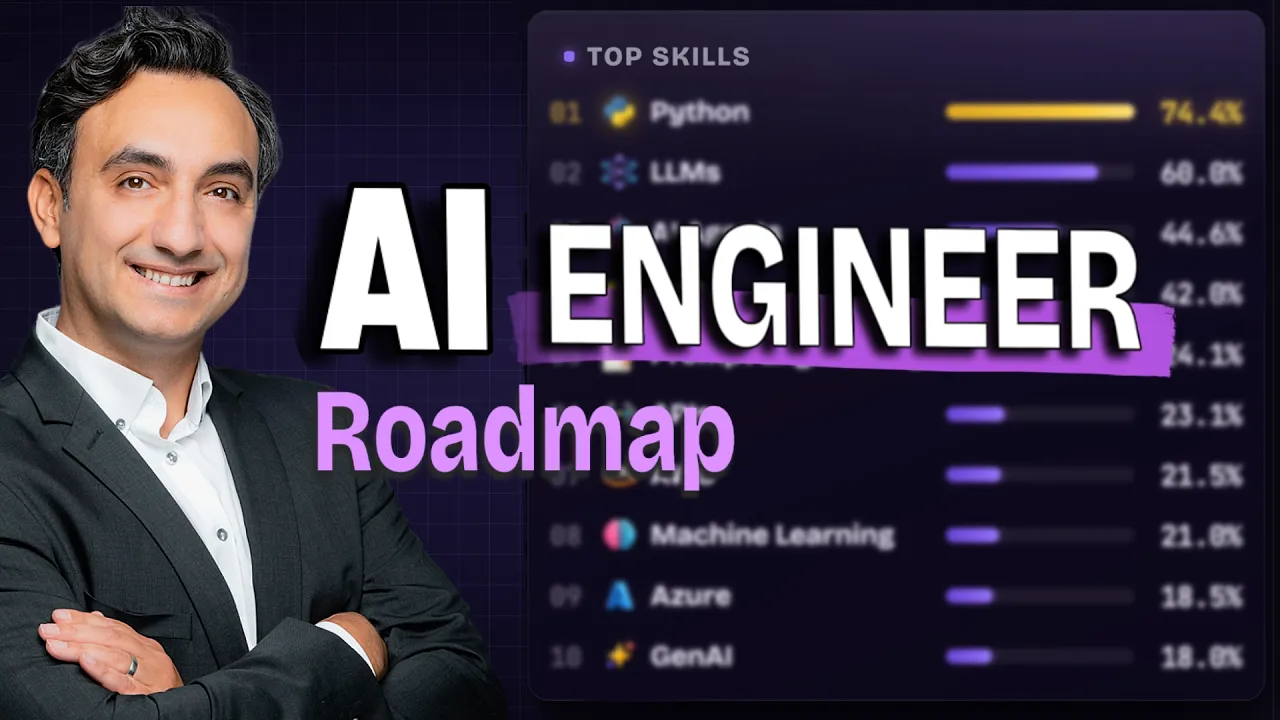
What the data is saying, the most important skill is, no surprise, Python. The whole work going to be depending on your knowledge of using Python. Without it, you cannot do anything. Now, the second skill going to be the LLM, as well very frequently mentioned in the job ads. So, those are the top two, Python and LLM. And with that, we are saying you are an engineer that can use large language model. Now, of course, we have long list of many other skills, but I've grouped them into groups.
The first one is the programming language, and as you can see, Python is a clear winner here. And tiny number of ads are asking for TypeScript and SQL. Now, of course, obvious, my recommendation is to master Python. And if you want second one, then focus in SQL. So, things are clear here. Now, to the second group is about the AI skills. Now, here we have a lot of names. Of course, on the top going to be the LLMs, then AI agent and drag.
Those are the core three that you need for the job. Now, quickly, the LLM is the model that you are going to use inside your application. With an agent, you connect that model to tools so that it take actions. And drag, it is retrieval augmented generation. Your application search the company's documents and gives back the relevant information to the model before it answers. Now, by looking to the next skills, this going to answer question that a lot of people ask or think of.
In order to become an AI engineer, I have to go and start training models. I need a PhD, and I have to understand all the algorithms and the math. Well, no, my friends, you are not a data scientist. You are not doing machine learning and all those stuff. Yes, they are sometimes mentioned in the job, but this is not your main job. You are an engineer. You have to build an AI system and not a scientist where you're going to go and start training models from the scratch.
And now, the question is where I'm going to learn all those skills to become an AI engineer. I have partnered with DataCamp because here's the thing, you remember only tiny fraction of what you passively watch. But when you learn hands-on, writing real code, building real applications, doing projects, retention going to jump close to 80 and 90%. And this is exactly the mindset of DataCamp. And by the way, you write the code directly in your browser and get instant feedback.
Now, if you are starting from zero, begin with the Python programming fundamentals track, four courses around 16 hours, no prior knowledge is required. It covers the variables, the data types like the list, the dictionaries, the functions, the packages, all hands-on with a project at the end. Then after that, I recommend you to take the Associate AI Engineer for Developers track, 10 courses around 30 hours. It covers LLMs, AI agent, the rag, all in one track.
So, you are going to build chatbots, semantic search engines, recommendation system using the OpenAI API, Hugging Face, LangChain, and the vector databases. And as well, by the way, it covers the LLM ops so that you learn how to deploy and maintain those applications. This is going to be your daily job as an AI engineer. And at the end, it prepares you for the DataCamp AI Engineer, so you don't just learn the skills, you can prove them.
So, my friends, both tracks in one subscription. And by the way, the first chapter of every course is for free, so you can start right now with the Python track. And if you want to continue, you can use the link on my description. I can get you 25% discount. Now, let's go back. All right. Now, to the next question, which tools and platforms do companies ask for? All right. Now, to the next question, which tools and platforms do companies ask for?
Now, here we have a long list and they are very close to each others. So, at the top, we have the LangChain, then the PyTorch. After that comes the LangGraph. Again, there is no big decision for this. And about the model providers, here we have the two big names, OpenAI and the Anthropic. ChatGPT or Claude. Currently, my data says OpenAI is winning with little bit percentage than the Anthropic. So, the job market didn't decide for you, and you can see Gemini at the end.
After that comes TensorFlow, Llama Index, and Hugging Face. And to be honest, I was little bit surprised about the Hugging Face. I was expecting this to be mentioned more often. Now, of course, the question is, should I go and learn all those stuff? Well, of course no. My recommendation here, go and pick one framework like the LangChain or the LangGraph, because they are built for agents. And about the providers, it's enough to learn either GPT or Claude.
For me, in my everyday, I use currently Claude, but I might switch. And for the PyTorch and the TensorFlow, I'm going to say leave them for now because they are meant for training models. And as I told you, it's not your main job. Now, after that comes the cloud platform. Of course, many companies are now running on the cloud, and at the top we have the AWS, then Azure, and at the end comes Google. You don't have to go and learn all of them.
Go and pick one of them. And I'm going to say follow the numbers, going to be AWS. Now, we move to the last group about the deployments. Of course, our job will not end after you build the platform. You have always to learn how to deploy it, how to bring it to the target environment, to the production. So, the first thing that is mentioned is working with the APIs. Then after that comes the CI/CD and the Docker. And I can tell you I've met a lot of people that are learning AI engineering, and they skip this.
And this is one of the biggest mistakes that I've seen a lot of people that are doing as they prepare to become an AI engineer. They just learn how to build things, and they totally skip the deployments. This is what going to makes you stand out, and this is what makes you an AI engineer. At the end, you are an engineer, not someone that's just playing with the AI at their home. All right, my friends, by looking to all those skills that are expected from you as an AI engineer, you understand that you are a software engineer that you learn how how use the language model to build an AI system.
And your tools going to be Python and framework like the LangChain in order to build a rag with agents inside it. And you have to learn how to deploy it. So, take it from your local machine to that productive environment. And it is not about training models. >> I do declare. >> All right, my friend. So, that's was for the skills, the first part. But now we can speak about the other part, which is more important and honest.
What tasks are expected from you as an AI engineer? So, that means what the companies are going to expect from you to do every day at their projects once they hire you. Now, for this I analyzed the section what you will be doing. And here again we have usually like a ranked list with the most important at the start. And as you go down going to be nice to have. So, now the numbers are saying building the LLM application it going to be the number one task that you will be doing.
And of course there is no surprise. You are hired as an engineer to build applications. Then the number two you are going to build the AI agents. Of course we are not talking anymore chatbots in the companies. The companies want the models to take actions and finish the work. They want the system that you're going to build to automate their processes. The third task it's deploy it and run it in the cloud. This is the most underrated between people.
Again, they learn how to build but never how to deploy. So, here they expect from you to deploy it to their productive environment and as well to keep watching it. If something breaks in the production, you are the one that can go and fix it. Now, to the next one is going to be the hardest one, evaluating the AI. Companies going to ask you to measure the result with the benchmark testing sets and scores. Because just calling the AI models and build a system it is not that hard.
But the big question is can we trust it? Can we trust those results? So, the companies are expecting from you as an AI engineer to know how to do this. And if you learn it, you going to really stand out the crowd. Then we have many other things like working across teams. And of course integrating the model with the existing systems, building the back end and the APIs, building the rack, keep it safe and compliance. But of course, those are the main things that you have to learn.
And many other things. So, by looking at this, this going to be your day. You are building the AI, the software around it, you deploy it and take care of it. You measure whether we can trust it or not. This is the whole thing what they expect you to do every day at their project once they hire you. All right. Now, moving on to another interesting question. How much do companies actually pay for AI engineers? Now, just warning, those numbers are only from the US job market and only 30% of the ads in USA mention a salary.
But I still I want to show you this to get some feeling about it. But of course, the numbers are totally different at your country. In USA, the average for juniors going to be 150k, for seniors around 200k, and the leaders 235k. Again, average and only in the USA. But I compared those numbers with the other roles like a data engineer, and I can tell you this is higher at every level compared to the other roles. So, yes, companies are willing to pay more for AI engineers, and this is totally expected to be honest, because now most of the companies want to become AI-driven companies, and they need AI engineers to implement their strategy.
So, good money at AI engineering. Now, moving on to another question. Do companies want a degree? And are they asking for certificates? Look at this. Of course, same surprise like the other videos. Half of the AI engineer ads are not even mentioning a degree. So, it's totally possible to enter this role without a degree. But of course, if you get one, you are just hiring your chance. Now, about the certificates, not even 3% of the ads are mentioning one.
So, there's no reason to go crazy and start collecting certificates left and right. And always my recommendation to you is do end-to-end portfolio projects. This is way more important than collecting certificates, and for sure this going to helps you a lot during the interview process. It's always better to explain your portfolio project in the interview than just showing certificates. >> Sir, you're awesome. Here is a plaque.
Here is a certificate. >> All right, my friends. So now, let's talk quickly about the other AI tool that I promised at the start. It is very close to AI engineering. We have the trending forward deployed engineer. So, what is that? It's like solution engineer, but for AI. At companies in the industry, we have big issue that the AI projects are failing so hard. Yes, the companies have access to amazing AI tools, but they are failing to build and integrate AI systems directly at their tools, at their processes.
So now, if you go to the company, you're going to find that they have hundreds of AI projects that are built so fast, but as well, they are dying so fast. So, many of them are going to the garbage, and that's all because of one reason. They are failing to integrate with those systems at the core systems of the company. And this is, of course, a big waste of money and time. And this is exactly where comes the role forward engineer.
They have first to understand the requirements from [music] the customers and take them step by step through the whole process until they finally get integrated AI system to their core tools. So, they are responsible of the whole journey end to end. [music] Now, in order to understand the difference between it and AI engineering, think about it like this. A bank might go and hire an AI engineer at their company in order to build an AI system.
So, they are directly hired at the company. But now, if you have a company like Databricks, a platform, a vendor, they might go and hire forward deployed engineer and then send him or send her to the bank, to the customer of the Databricks, in order to build and integrate Databricks directly at the bank. And they might start working, of course, with the AI engineer that is hired at the company. Just with one main goal, to make sure that Databricks is working correctly at the bank.
So, that means, my friends, this new role is trending so much at the platform, at the vendors, like Databricks, OpenAI, and Anthropic. So, if you are targeting to work there at those companies, then you might consider forward deployed engineer more than AI engineering. But, anyway, I have done the study and I have compared those two side-by-side. Now, by comparing the skills, here's the thing, there is no big difference between them at all.
Yes, you have to learn Python, LLMs, agent track, and so on. So, that means switching from AI engineer to forward deployed engineer does not require any new skills. But, once I start comparing the tasks, you're going to see exactly the difference between them. As a forward deployed engineer, you build the system at the customer side, inside their system, and you're going to stay there until people actually use it. And more than 80% of those ads have a task about the customers own systems.
And half of them talk about as well traveling because you have to go to the customer as well. And as well, I found many ads that they want people who were before solution engineers. So, my friends, both have the same skills, you are building the same thing at the end, but they have different life. So, if you want to build applications directly at the companies, then you have to become an AI engineer. But, if you want to go to the customer and work at the platform themself, at the vendors, then the forward deployed engineer going to be the one for you.
All right, my friends, so with this we have covered the analysis from the ads, and now we have to go and put everything together into a road map for AI engineering. The first thing that you have to learn, there is no discussion about this, is Python. My friends, you have to master it, not only learning the basics, you have really to go into advanced topics. Then, after that, I'm going to say go and learn about APIs because AI applications at the end is a service.
Other softwares from the companies going to go and call it, and your system has to react and answer back. Then, the next one is Git because you are coding, and then CI/CD for the deployments. So, for no AI, that's why the second part, it's all about AI. First, you have to understand the LLMs, what you can do with the models, what you cannot do, how to control the behavior of the LLMs. Then after that, learn about AI agents, where the model calls your tools, follow your plan, and finish the task.
Then the next step, it's all about learning RAG. You can learn how to build a vector database and feed it with data, so that the model answers from your company's document instead of just making things up. And the last one, please don't skip this, is to learn how to evaluate the AI. You have to learn how to prove that the AI system that you are building can be trusted. So, that's was about AI. Now, moving on to the third one, it's all about tools and platforms.
Here you have to make three decisions because you have to pick one for each. So, about the platforms, as I said before, either go with the LangChain or the LangGraph. For the AI provider, I'm going to say maybe go with big clouds. At least I prefer using it. And then the last one, you have to learn about cloud platform, and here the direction is more tending to AWS. But of course, always check the market at your country because here in Europe, we tend to use Azure more than AWS.
Now, to the last phase, this is the most important one. You are going to build end-to-end portfolio projects and try to make it like a real use case, not a demo, not you are building a chatbot or like just uploading a PDF and then the AI going to answer a few questions. No, you have to build a full AI system. So, you have to be building a RAG, building agents, so it answers from the documents and as well it takes action.
And you are recommended to use the fast API. Third, you have to evaluate it, so you write like around 15 questions where you know already the answer and run them. Then you go and change the prompt and run it again in order to compare the scores. So, that you show that you know how to evaluate your AI system. And then the last step, you have to learn how to keep it safe and fast. So, you should teach it how to refuse, it should never like leak informations.
So, you have to learn how to make your own laws and rules inside the system. And the last step, of course, in your project, you have to show that you can deploy it. A container, a pipeline that test every change on the cloud. You just need a container, a pipeline that test every changes that you do, and then one cloud, and then maybe leave it running for a week or something in order to check the logs and see if anything goes wrong during this week.
And that you can show that you can deploy things and as well be responsible for the system. Again, my friends, this going to be the way to stand out the crowd to show that you have built something end-to-end. So, don't rush it, treat it as your baby, and once you get invited to an interview, talk about this portfolio project. So, this is the road map to become an AI engineer, completely based on facts and the job market.
All right, my friends, now we come to my honest opinion about this role, the AI engineering. I'm going to say if you didn't decide yet between data, software, and AI engineering, this one is really promising. AI engineering is one of the highest paid role in between them, and at the same time you don't need like PhD or to be genius in math. You just need to be coder and builder. But, the hardest part of that the tools and expectations from companies change very fast for AI engineers.
So, that means you have the risk of learning something that get outdated very fast. But, I'm going to do my best to keep you updated. >> Updates are ready. I should update. >> But, now in the other side, if you are already a data engineer or software engineer, expanding to AI engineering might be the best expansion that you do in your career. You are already an engineer, you just need to learn some AI topics and you are good to go.
And anyway, we data engineers in the industry, more than 30% of our tasks including AI topics. All right, my friends, so that's what for AI engineering based on the job market. In the next video, I'm going to show you the numbers for data scientists. If you like this type of content and you would like to support that channel, then subscribe, like, and comment in order to reach nice people like you. If you're still here, thank you so much for watching and I'm going to see you in the next video.
Bye-bye. >> I'll catch you on the flippity flip. Bye.
The words are the caption track's own and nothing is reworded or re-transcribed. Paragraph breaks are placed between sentences so the text reads as prose.
Free tools for your own script: paste a draft and see where it stands before you record it.
Paste your draft and see where viewers are likely to drop off, with a rewrite for each weak line.
Paste the first 30 seconds of your own draft for a hook score and rewrites.
Check your draft against YouTube's advertiser-friendly guidelines before you record it.
Read this channel's public videos and transcripts, and download a writing brief for it.