Getting the transcript
Reading the captions from YouTube. A video nobody has opened here before takes 10 to 30 seconds; this page fills in on its own.
Getting the transcript
Reading the captions from YouTube. A video nobody has opened here before takes 10 to 30 seconds; this page fills in on its own.
Chase Chappell · @ChaseChappell
This video has no Most replayed graph yet: YouTube shows one only once a video has enough views. These are the moments viewers replayed most in Chase Chappell's most watched videos.
Most replayed moment at 4:41
1.7x that video's typical replay level
them. Because a strong founder story connects the pain that you once lived, the solution you created, and the mission you believe in, and the struggles that you overcame, and how that transformation now delivers to every customer out there. When you create the story with five key pillars,
Said at 4:35
Most replayed moment at 2:44
7.0x that video's typical replay level
downloaded on your computer so that way you can do this. And one of the first steps is we're going to copy that link. We're going to come in here and click the plus sign, go to connectors, manage connections, and we're going to hit add. We're going to add a custom connector. We'll paste this, and we'll name it Meta
Said at 2:37
Most replayed moment at 4:54
3.8x that video's typical replay level
can recreate it. We're going to go into chat GBT. We're going to start a new chat under chat GBT40. You're going to do the new updated create image option and you're going to paste this exact prompt that I've gone ahead and put together for you below this video that
Said at 4:48
The graph counts replays. It does not show where viewers stopped watching.
Words
3,330
Runtime
16:47
Speaking pace
198wpm
Reading time
14min
198 words per minute, between the 181 median and the 201 75th percentile of 349 measured videos. That distribution comes from the 349-video hook study.
Opening (first 30 seconds)
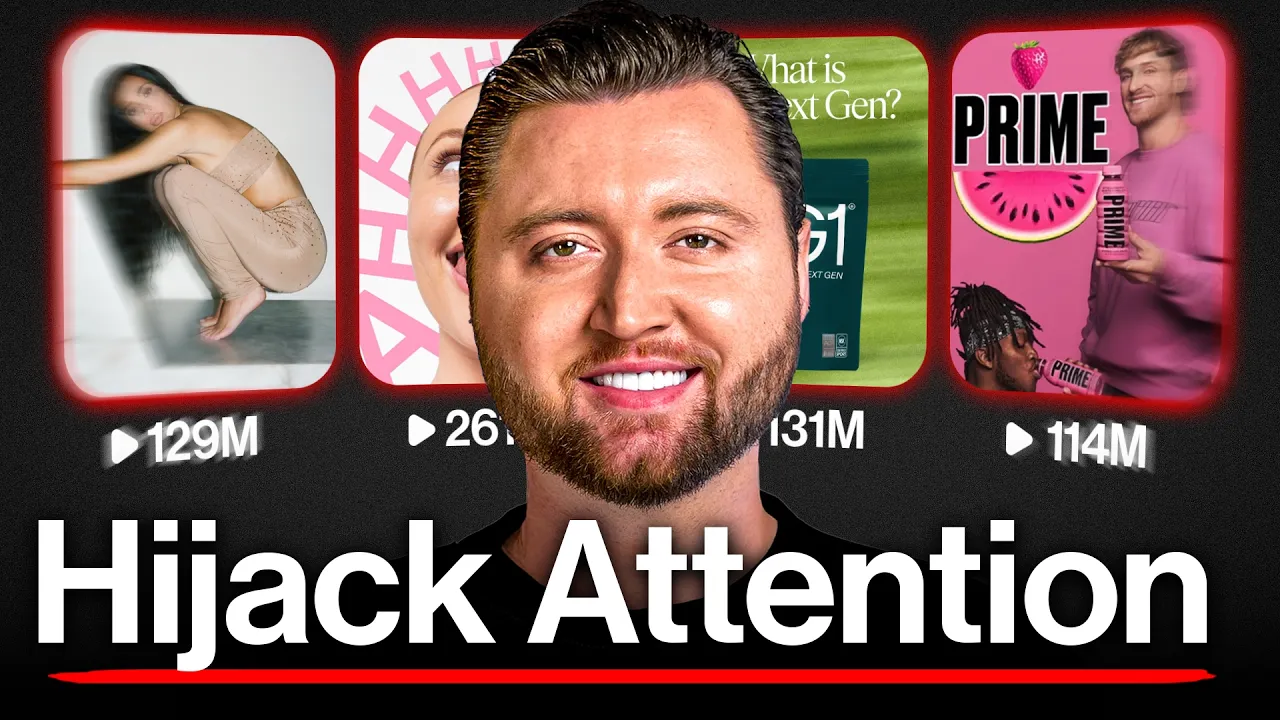
You know those ads you see online? The ones that are just so good they're impossible to skip past. The ones that tap into psychological triggers that you didn't even know you had. The ones that stood out. They look different and they felt different from a normal ad. Those are called attentionhacking creatives. And all of the biggest brands on the internet use them. They're specifically designed to pierce through the noise of political news, celebrity gossip, by this, by that, half- naked models, sporting events, the Kardashians, and even the Beckham family drama. They are creatives that
99 words, the words spoken in the first 30 seconds at 198 words per minute.
Free, no signup. See how the first 30 seconds hold attention, with rewrites.
Sentence shape
| Measure | This transcript |
|---|---|
| Sentences | 275 |
| Average words per sentence | 12.1 |
| Longest sentence | 107 words |
| Questions asked | 29 |
| Sentences containing a number | 7 |
Most used terms
Filler phrases
30 in total: like 15 · actually 4 · kind of 4 · literally 3 · basically 2 · you know 2.
A literal whole-word count of the same phrase list the Prepublish browser extension uses, so a phrase inside another word is not counted and a phrase used in its ordinary sense still is. It is a count and not a judgement.
Free, no account. See where attention is likely to drop, with a rewrite for each weak line. The free check shows the scores and the one issue costing the most. Or run it on the words above first.
Free · No login · See a sample audit first if you prefer.
What this transcript is
Every word below is the caption track YouTube publishes for this video, pulled from the video itself and reproduced unchanged. It is not Prepublish's writing, not a summary, and not a re-transcription: it is the video's own published captions. English captions, generated automatically by YouTube, in the video’s original language. Source: the video on YouTube. A channel that would rather this page did not exist can ask for its removal through the contact page, and it is removed.
You know those ads you see online? The ones that are just so good they're impossible to skip past. The ones that tap into psychological triggers that you didn't even know you had. The ones that stood out. They look different and they felt different from a normal ad. Those are called attentionhacking creatives. And all of the biggest brands on the internet use them. They're specifically designed to pierce through the noise of political news, celebrity gossip, by this, by that, half- naked models, sporting events, the Kardashians, and even the Beckham family drama.
They are creatives that are designed to be impossible to skip. And by the end of this timer, I'll teach you how to make them in four simple steps. First things first, these ads are not always the most shiniest, sexiest, and cleanest looking ads. Attention hacking creatives have one job and one job only. The job is to stop the scroll. They are not designed to sell. They interrupt the viewer's pattern, capture attention immediately, and force engagement before logic kicks in.
All so the messaging actually gets consumed. Attention hacking creatives are designed to hack autopilot [music] behavior inside your brain. They create an emotional spike and literally hack the attention of your brain before the brain can step in and recognize a familiar pattern. Kylie, Kylie, Kelsey, are you drinking? I've had so many of these today. >> And when you were running your ads, you were not competing against all the other marketers.
[music] You were competing against dopamine, Netflix, Tik Toks, podcasts, news, entertainment. Your creative must compete at that level. And a very easy test you can do is simply ask yourself, would this make someone stop scrolling if they didn't care about my industry? Once you ask yourself that question, step number one in creating your own attention-hacking creative is understanding how to interrupt the normal patterns of humans on social media.
If you don't interrupt the pattern, the brain never hands you attention. People scroll fast. Their eyes decide before their brain does. So, your creative must look wrong compared to everything else. When we build our pattern interrupt, we want to ask ourselves these four questions. How can I break the normal pattern? How can I spike an emotional curiosity? How can I create an emotional alignment? How can I persuade? Most marketers start at step four.
And that's where their ads never convert. You can see. >> Okay. So, you apply it like this. Ensure full coverage. >> All right. So, this immediately breaks the normal pattern. Why? Because it's a visual that people aren't used to seeing. We're not used to seeing somebody wear gloves like this in this environment with a purple substance being applied to somebody's teeth. That automatically is going to break the pattern in somebody's feed.
With an ad like this, they're immediately going to be engaged. They're not used to seeing somebody's mouth wide open like this. And it allows us to answer our first question. How can I break the normal pattern? Well, this immediately captures that attention >> bridge of the tooth. And bam, look at that. You can see the immediate color correction working on the surface of the tooth. Come and have a look and watch as we wipe it completely off the surface of the tooth.
You can >> All right. So, this is where we start to notice the emotional curiosity. Now that people have made it past the pattern interrupt, we begin to get invested in this video because now we're emotionally tied to what exactly is going on here. We become curious. He has yellow teeth. We're not used to seeing white teeth in a matter of seconds. So, people are going to be emotionally tied to this because if they have yellow teeth, they're going to want to know what exactly is going on here and what is this science that is happening. >> Really staying put to leave that brightening effect to teeth. that powerful V34 color correction technology at work.
And let me explain V34 in 30 seconds. Imagine that this yellow balloon is any yellow stain. If I use the color purple, I can cancel out the yellow stain. Bleaching or whitening teeth is fundamentally about reducing. >> All right. So now what we're doing is we're emotionally aligning with them. We're taking their yellow teeth, showing them the science behind it, so that way they trust us. And then they're becoming aligned with the video because now they understand the outcome from yellow to white teeth with this product.
So not only have we hooked them in with the pattern interrupt, we built up the emotional curiosity, but we aligned with the actual problem that they're facing. So now, how can we persuade them yellow tones of your teeth? Color correction achieves a similar very desirable effect because it also reduces the yellow appearance of teeth, but it does it instantly. With color correcting, the result is entirely on the surface.
Nothing is penetrating in. So, it is entirely painless and causes zero sensitivity. So, effectively, you're getting a painless and effective solution. >> So, this automatically answers all of the objections they have. Will it be painful? Does my teeth sensitive? How quickly does it work? Is this a month-by-month process or is it just a instant effect? This answers all of the questions that they have and naturally persuades them without giving them a hard pitch.
And then we build up the security of this by making them feel safe. It's painless. It's instant results. And the shock value of how incredible the actual product is. >> Can you see that? That is crazy. >> On this armpit, what have you been wearing? >> I've been wearing Carp Lavender Citrus. Don't >> All right, we broke the pattern. We have somebody who's showing their armpits. We have a microphone. We're curious what the question is going to be.
It's an automatic pattern interrupt. Not only that, but we're showing a visual of something where there's bacteria and we're not really sure exactly what's going on here. So, people are automatically going to start watching this video. >> Carpet, what have you been wearing? >> I've been wearing Carp Lavender Citrus. Don't sleep on it. >> Everyone's wearing gray shirts and I'm turning off the AC. >> Here's your emotional curiosity.
Now, you're invested in understanding what the outcome is going to be whenever he turns up the temperature in the room. >> Turning off the AC. Let's see how carpet holds up. We're checking for the bacteria that >> So now people are invested in the video >> cause odor. We'll start with >> we're starting to align them emotionally with pit stains, pit smells, and we're going to want to stay engaged in this video to see the outcome. >> The non-carbon pit first.
We got Mac. Let's see the pits. >> OH MY GOD. WHAT HAVE you been wearing there? >> We're wearing a >> Let's see the other. Let's see the carpet armpit. Nice. Look at that. I'm not seeing anything on the carpet side. Oh, >> now people are going to be wondering, is it their deodorant that's causing them to sweat more? Is it the deodorant that's not blocking odor? [laughter] >> He's literally reacting in this video which is pulling you in even further. >> I'm wearing a whole body deodorant and unfortunately whole body. >> Now what this video is doing at the entire time they're not hard pitching you on CarpE, but now you're starting to realize all of the problems that other deodorants have and how realistic of an issue this actually is.
And it's framing Carpay as the ultimate solution, which naturally answers question four on how we can persuade them. >> I prefer small ones, not like micro ones, but small ones. >> All right, we're answering the age-old question that everybody is curious to know. Does size really matter? People are going to start watching this video because they want to know the answer. And we're showing multiple different people, which is going to get them curious about where exactly is this video even going. size queen. >> I like them small. >> Notice how there's no product placement yet. >> The big ones always make me feel like I have to pee. >> I made fun of my buddy for having a small one, but I didn't let me hold it.
I low key want a small one, too. >> All right, now we're emotionally aligning. We're showing multiple different demographics, people in different settings, people that may be able to be relatable with. >> I've never had one at all, but if I did, it would be a small one. When I'm drunk, I like a big one, but only when I'm drunk. >> My husband's really into big ones. Kind of weirds me out. So, I just sit in a chair and watch him and his buddies just go to town.
Meanwhile, I'm just over here enjoying the small one. Now, we have small ones. >> All right, so this is the perfect attention hacking creative. If you're not even interested in water, you're still going to be watching this video. It stands out on the feed because they're saying things that most brands would never say. We're being bold, loud, leveraging humor where most brands fail by just promoting their product directly.
But you're emotionally invested because you want to know what's going on because we hit all of these points first. They then get the opportunity to show their product for the new small can launch that they just released. Once you've stopped the scroll, now we have to keep the attention. You do that by creating contrast, not with volume, but with the truth people avoid. You're simply saying what everyone else won't. Most ads try to sound relatable and safe.
They try to agree with you and sound correct. It's the same vanilla boring flavor. High contrasting messaging does the exact opposite. It draws a line in the sand. It makes you pick a side. It makes you feel uncomfortable. And it draws in a reaction. Instead of saying, "We have the number one gut supplement on the market that's proven to fix your gut with pre or probiotics or improve your gut health with probiotics, prebiotics, and digestive enzymes found inside of this product on sale now for a limited time." The brain has seen that thousands of times.
It's a pattern your brain recognizes. Instead, what we want to do is reframe the current market solutions as the villain and sell against the industry lie. Your gut isn't broken. You're just addicted to fixing symptoms. Everyone keeps telling you to add more probiotics. That's why your gut is worse than it was 12 months ago. Because if your gut actually healed, you'd stop needing to buy supplements. Do you see the difference?
Most brands make one or two mistakes. They attack the customer and end up creating defensiveness or resentment or they attack competitors directly and end up sounding petty or salesy. Instead, what we want to do is attack the idea, attack the assumption, attack the industry narrative that keeps the customer on your side. The best place to find this hidden stuff from your market about all your customers is on Reddit. And all these keyboard warriors have all of those gems you need to understand for the assumptions, problems, typical industry solutions, and lies.
And I help does this better than anyone. They use simple attention- hacking creatives to scale from zero to $100 million in just 12 months. >> Tired of your supplement cabinet looking like this? What if all you needed was this? >> I'm always super wary of supplements. These are ingredients I can trust and I love how they make me feel. >> All right. Notice how they're attacking the industry narrative, the idea of taking all of these supplements to fix your gut.
They're assuming that you've already tried solving this issue before. But this allows them to frame themselves as not only the solution, but also without sounding salesy and allowing you to build up engagement from this reaction. >> When you don't have good gut health, you could take supplements, you could eat perfectly, but you're not absorbing all the nutrients. your body is not. >> Same thing here. We're talking about how when you take supplements, you could still have bad gut health.
Whereas all the other ads out there are saying you need to take this to solve XYZ. They're doing the opposite. They're going after the idea, assuming you've already tried these things, and are going against the industry narrative. And they're framing their product as not the supplement to take, but the actual way they designed it for you to be able to consume it and properly fix your gut. At the end of the day, it still is another supplement just like everything else out there, but they're reframing how they position it.
So that way, not only the trust is built, but they go ahead and push all of the other ads away, siloing themselves in such a unique format, so that way people stay engaged. Once we have created our messaging, our third step is immediately creating a curiosity gap in the mind of our customer. At this point, you've stopped the scroll and you've said something bold. Now, we want to create a gap that the brain feels forced to close.
And the brain hates incomplete information. When something feels unfinished, hidden, withheld, partially revealed, the brain leans in automatically. And as the internet CMO, we exploit this on purpose in our ads. The number one mistake I see in ad creatives today is marketers explaining everything too fast. The goal is to let them earn the answer. Immediate curiosity gaps work by giving the brain a problem without letting it see the solution yet. >> I don't have cortisol face anymore.
This is what I looked like a few months ago. My face was brown, bloated, and really, really inflamed. Literally, everyone was laughing a few months ago at me because I was talking about cortisol face. But here I am today testing tons of sleep products and I found one that actually works really good. When I realized that magnesium deficiency is directly related through high cortisol levels, I knew I had to make a change in my diet.
My face is now. >> Notice how we're constantly building up the problem. People are getting more interested. And what is the solution? He's now found the product, but he hasn't yet told you what it is. It's driving you more into the video to want to know what the actual answer is, but he just won't give it to you yet. >> Slim down a ton. And I really didn't realize how inflamed it was until I looked back on these pictures because they were disgusting.
People were right. >> It's a constant buildup. It could aggravate you. It can keep you engaged. It's going to force you to want to know the answer because it's tickling your brain in a way that just forces you to watch. Finally, at the final second, he mentions what the product is and the solution. Now, throughout the video, he's been holding this product. He's been slightly showing it in the background, and you kind of have an idea, but you need that reassurance and validation of exactly is this the product that he's talking about?
And he closes that gap at the very end. >> If your arms look like this and your stomach looks like this, you're not fat. You just have too much cortisol. That's because high cortisol can make you feel puffy and tight at the exact same time without even eating that much. The problem is cortisol basically tells your body to store fat right in your belly. Not just any kind of fat or >> notice how this video continues to drag on and on about the problem.
You're naturally engaged in this because you're wondering what exactly the solution is, but he's just not giving it to you. He's constantly building up all these narratives around what the issues are, which is keeping you engaged. And most ads out there will immediately just start telling you what the product does, how it works for you, and the problem you're facing immediately with a solution. If you're struggling with, you know, this look, here's the answer.
It's a quick hit for most people. Whereas this ad forces you to watch, pay attention, and build up that curiosity to truly understand where is this going and how can I solve this? And we don't even know if it's a product yet, which is allowing us to build our case for conversions. elements are all talk and no these mushrooms need basically not exercise the best part if you don't like the taste if you don't see you have a 30-day mark for me is the normal issue out there for you to consider but in my experience most supplements are all talk and no action >> boom it took us about a minute to get to the actual product placement now we started going into the ingredients some of the solutions but still didn't give you the answer yet which forces you to stay tuned And this is where these attention-hacking creatives drive the most value for you.
When you create your own curiosity gap, first say something that sounds incomplete. Then make it clear there's more to the story. But don't just give it yet. Hint that most people get this wrong or were taught the wrong thing. You want to start a thought and force curiosity in the brain to finish it. But here's the thing. You could do step number one, two, and three perfectly right, but if you mess up on step number four, everything can come crashing down.
In your attention hacking creatives, you want to make them feel before they think. Most ads lose because they start by explaining. Attention hacking starts by making you feel something. In the first 3 seconds, the brain is not listening for facts. It's asking, "Is this safe, boring, or interesting?" If you don't feel anything, your brain checks out, and that's what causes the scroll. You want to spike emotion. You want your viewer to get a jolt of feeling when you cause that moment of discomfort.
That's what creates the attention in your ads. You want to delay the logic. Most ads lead off with data, proof, or credibility. But guess what? So is everyone else's ads. Facts don't matter if nobody feels anything first. If you don't make them feel something in the first 3 seconds, they'll never stay for the logic. You can do this in three simple steps. Cause some kind of discomfort. People scroll when it's a comfortable pattern.
Create urgency or intrigue. You have to open a thought in their mind that makes them have to answer it. Delay the logic. Don't prove why you have the best product. Just activate emotion in them and watch what happens with your ads. Now, whatever rorowaz you are getting or whatever cost per acquisition is using intention hacking creatives will slice your CPAs in half, skyrocket your rorowaz, and increase your sales faster than you can say, "Hey, Chase, I need help scaling my business." If you like this video, then you're going to love this one on how to create a hero mechanism and outsell your competition even in a crowded market.
I'll see you inside of that video in just a few
The words are the caption track's own and nothing is reworded or re-transcribed. Paragraph breaks are placed between sentences so the text reads as prose.
Free tools for your own script: paste a draft and see where it stands before you record it.
Paste your draft and see where viewers are likely to drop off, with a rewrite for each weak line.
Paste the first 30 seconds of your own draft for a hook score and rewrites.
Check your draft against YouTube's advertiser-friendly guidelines before you record it.
Read this channel's public videos and transcripts, and download a writing brief for it.