Getting the transcript
Reading the captions from YouTube. A video nobody has opened here before takes 10 to 30 seconds; this page fills in on its own.
Getting the transcript
Reading the captions from YouTube. A video nobody has opened here before takes 10 to 30 seconds; this page fills in on its own.
Global Silicon Valley · @GlobalSiliconValley
Words
8,669
Runtime
53:10
Speaking pace
163wpm
Reading time
36min
163 words per minute, between the 160 25th percentile and the 181 median of 349 measured videos. That distribution comes from the 349-video hook study.
Opening (first 30 seconds)
Uh good morning or good afternoon depending on uh where you are currently residing. Um my name is Deborah Quazo. I am the co-founder of the ASU GSV summit and the managing partner of GSV ventures and on on behalf of my partners at GSV I want to welcome you to this GSV TV session and to thank our partners at Cambium Learning Group for um sponsoring and supporting this. Um, our topic today is a hot one. It's one that's gotten
82 words, the words spoken in the first 30 seconds at 163 words per minute.
Free, no signup. See how the first 30 seconds hold attention, with rewrites.
Sentence shape
| Measure | This transcript |
|---|---|
| Sentences | 403 |
| Average words per sentence | 21.5 |
| Longest sentence | 123 words |
| Questions asked | 59 |
| Sentences containing a number | 19 |
Most used terms
Filler phrases
409 in total: um 181 · you know 69 · uh 59 · right? 27 · like 21 · kind of 17 · actually 15 · sort of 11 · I mean 8 · basically 1.
A literal whole-word count of the same phrase list the Prepublish browser extension uses, so a phrase inside another word is not counted and a phrase used in its ordinary sense still is. It is a count and not a judgement.
Free, no account. See where attention is likely to drop, with a rewrite for each weak line. The free check shows the scores and the one issue costing the most. Or run it on the words above first.
Free · No login · See a sample audit first if you prefer.
What this transcript is
Every word below is the caption track YouTube publishes for this video, pulled from the video itself and reproduced unchanged. It is not Prepublish's writing, not a summary, and not a re-transcription: it is the video's own published captions. English captions, generated automatically by YouTube, in the video’s original language. Source: the video on YouTube. A channel that would rather this page did not exist can ask for its removal through the contact page, and it is removed.
No Script X-ray for this video: YouTube shows a Most replayed graph only once a video has enough views.
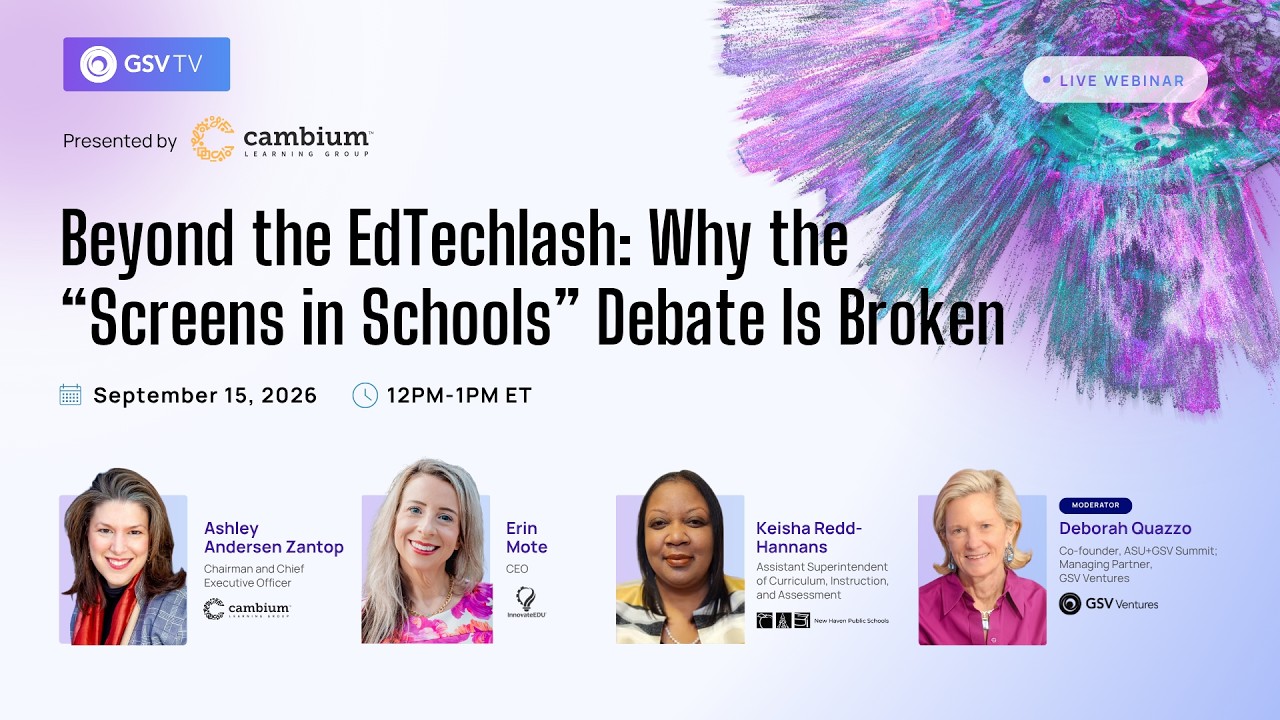
Uh good morning or good afternoon depending on uh where you are currently residing. Um my name is Deborah Quazo. I am the co-founder of the ASU GSV summit and the managing partner of GSV ventures and on on behalf of my partners at GSV I want to welcome you to this GSV TV session and to thank our partners at Cambium Learning Group for um sponsoring and supporting this. Um, our topic today is a hot one. It's one that's gotten um, nationwide attention across kind of all forms of publication, well beyond the the education sphere.
It is beyond the ed techlash, why the screens and schools debate is broken. And and I'm joined in this conversation by three extraordinary women, all who have sp who have spent much time in the classroom um, both teaching, founding schools, running um, running districts. And so it's it's going to be an incredibly great conversation. I also want to say upfront that there's a Q&A um button on your screen and please feel free to shoot in your questions as they come to you and we will um we will sort through those and if we're able to get to them uh we will and if not we'll we'll look to respond otherwise but hopefully we can get to them.
So let me you let me quickly introduce my um incredible group of of panelists. Um Ashley Anderson Xantop the chairman and CEO of Cambium Learning Group. Ashley um Lee, you know, Cambium is a a dominant provider in the K12 sector of of um high efficacy learning uh solutions and she is um started her career in the classroom. So a long a long history of educator leading up to um a a corporate CEO. Aaron Moat is the CEO and founder of in innovate edu.
Um Aaron is the has been a leading voice um on emerging trends, emerging emerging needs for safety, emerging needs for policy around AI and and technology in general. Um she's a policy leader. She created project unicorn which was a data interoperability standard. Um she's on the board is also on the board of digital promise. So we're delighted to have here today. Kesha Red Hannons is um our third panelist. So delighted to have her here today.
She's the assistant superintendent of curriculum, instruction, and assessment um in the New Haven public schools. In that in that role, leading um thousands, you know, tens of thousands of students actually, she has led a K8 reading curriculum overhaul and the portrait of a graduate initiative amongst many other things. So with that, I'd love to um bring up my uh panel partners, panelists, and um and begin our conversation with um with perhaps a little um a bit of framing.
You know, one quick piece of framing on my end. So obviously we're talking about behind the the the the um edtech or tech backlash uh and the a and the AI reaction. Certainly um there has been lots of I don't know if you call it buzz but lots of conversation lots of concerns lots of um discussion around bans and uh and all forms of other things about screen time bands etc. Um but the one thing I would say is constant uh is the declining results of students in the US and around the world.
Uh, and I'm, you know, having been done this, having done sat in this chair for decades now, I'm afraid to admit, um, I I unfortunately have to every time I join a podcast have to say the same thing because um, because there is the consistent the consistency of our inability to turn around um, declines which really began well before um, AI, well before AI and and in the early and and and the advent of edtech um, is is something that's extreme incredibly near and dear to my heart and incredibly important.
I mean, we've even been seeing the long-heralded miracle story of Finland seems to have dissipated, you know, at long last, etc. The recent piece of results, you know, obviously I'm preaching to the choir here, but the results were were disheartening to say the least. You saw, you know, math and reading results for um English-speaking OECD countries at the lowest levels ever. um 28 point decline in reading that's losing one and a half years of learning uh from the last time PI pizza was taken 22 points on math that's loss of a year science was flat um 1if 20% of 15 year olds across all PISA c you know OECD countries that are English- speakaking are now low performers in all three areas reading math and science and this is as they face a a increasingly complex as we all um economy, world things they have to sort through etc.
And so just wanted wanted to to frame that as we sort of dive into the real questions of what you know what is this moment? How do we actually keep our eyes on the prize which is transforming the lives of children and um and and kind of go from there. So Ashley, let me let me actually start with you if we want we want to talk about this sort of naming the moment talking about the tech tech lash narrative. Talk to me about how how we do reframe the conversation.
How do we how do we make this positive and yet you know properly cautious go forward moment? How do we how do we shift the conversation? Yeah, Deborah, I um first of all, I'm uh really pleased to be here with this incredibly thoughtful group and I think your um framing to the conversation today is so important because throughout the conversation, we have to be doing exactly what you said, keeping our eyes on the prize.
What are we trying to do for students? What are we trying to achieve for students? And I think that is the starting place um of reframing this conversation. It's not a this or a that. It's what we're trying to achieve. And I'm for one moment I'll step back. I I think it might surprise some of our uh viewers or listeners to know that as a former education technology entrepreneur and as a now CEO of an education company that specializes in high efficacy technology that we in our family did not allow our child to have a cell phone until the eighth grade.
We never permitted social media ever. Um, and I think that's worth saying upfront because some assumptions can get made about sort of personal ideas or preferences, etc. And I think those are important things to say here in support of some of what I'm going to say next. And I think when we think about what the what it is we're trying to accomplish, the the debate about technology, technology tools, and technology resources in education has to be framed similarly to any debate about any resources or tools in education.
And um and I might boil that down, and I'm oversimplifying, but that is one of my superpowers is to be Captain Obvious. But I'm I'm boiling that down into basically three different categories. Right? When we're thinking about a resource or a tool to use for our students or for our educators or for both, we have to start with is it a high quality solution or tool or resource. Is it purposebuilt to mo to actually move the needle to achieve something intentional for students or educators or both?
So I think that's the first um piece of this discussion that has to be applied to technology for use in education as it is applied to anything for use in education analog or otherwise. The second is is it researchbacked? Does it have evidence to prove that it has not only been purposebuilt for the uh outcome in question but that it's doing it that it can do it. And the third thing is we have to know and understand and be crystal clear about what the requirements are to implemented effectively because effective implementation is actually a requirement to achieve the outcomes in question.
And there is a science behind implementation as there is a science behind highquality researchbacked tools. And the implementation itself takes resources, requires resources, investment of time, energy, dollars, prioritization. And without those three things, it's very difficult to have uh a good effective conversation about technology tools, analog tools or any tools or resources in education in my view. thousand% Kesha can I um as the person as a district leader as an important district lead an important district important leader in important district um you are one I'd love you just to speak for a moment about today versus you know five five years ago you all have inputs coming from everywhere um I mean it is you know whether it's Washington DC or whether it's you know parents down it is it is mind-numbing sometimes to imagine you know being in your shoes.
And so one just a little reflection on how the you know much how this changed environment has I mean how the rapid you know frankly rapid evolution of of AI um and has sort of changed the dynamics within you know within running a district but also and then and then I want to pull back to also the second part here is I understand you were a very early leader in pushing for an AI roadmap um so that you all had um a vision and um and a set of objectives.
And so I would love if you would wouldn't mind taking us through that, how you all were so early to kind of realize you need needed to be controlling your own destiny as you know opposed to it's not exactly happening like that everywhere in the country. Um and uh uh and how and who you know your how you collaborated with the various constituents but etc. So that's I know it's a chunk of stuff but uh anyway love to get your perspective.
Uh thank you and thank you for having me. Um definitely feel privileged to be with this esteemed guest of panelists uh today. Uh you're correct, AI is everywhere. Um it's not going anywhere. Uh and the rapid movement required us in education to move swiftly with it. Um and uh that meant we needed to embrace it but also think about what's the why behind why we're going to implement right and then how do we implement it safely um um for our students.
And so the why for me is simple. We want to strengthen teacher practice. We want to accelerate student learning. Focus on teaching and learning. Strengthen teacher practice, accelerate student learning. AI can help us get there as a tool. It's a resource, right? But we also recognize there's a lot of pitfalls to AI. If we implement it without proper guidance, um then we fall susceptible to um AI then taking over what should be some human interactions that should be occurring, right?
And so we need guard rails. And so we found ourselves at this inflection point of what I consider to be a guidance gap within New Haven public schools. Um an operational gap as well. Um and then quite honestly uh we were also looking at a preparation gap. Um so framing you around the three guidance, operation, preparation, right? And so in order to kind of wrap our arms around what we needed to do, I put together a team of stakeholders, our our AI committee, which included teachers, school-based administrators, central office administrators, IT folks as well.
Let's come in the room. Um I I engaged our unions um and said give me those that are are AI geniuses that are flying um and then give me those who are skeptics as well that are saying no we can't use this and let's all come in a room and have a conversation. Um and what we were able to galvanize energy around was one AI did not replace human interaction. teachers remained at the center of teaching and learning in their classrooms and AI was just another resource. >> Once we came to agreement on those two elements, we were able then to conduct our research and really look at, okay, what kind of guard rails do we need to put in place um within New Haven public schools and what kind of academic freedom do we also need to have in policy? because you don't create policy for it not need to be flexible.
And so we wanted to grant permission in talking to teachers and saying teachers were already using AI for lesson planning. They were already using it if you will to do create some newsletters for families. We wanted to say we're granting you permission to do it and put it in policy so they understood it. And then we also wanted to say it's time for our students to be future ready as well. So we're going to grant our students permission but only under teacher guidance.
So the teachers are in charge of when students are able to use AI and teachers felt a sigh of relief knowing okay I can control this just like any other tool you would give to to students. We give multiplication charts, right? Being very simplistic, right? Some students can use the multiplication chart, some can't. Those are tools that teachers have in their toolbox. And that's what we decided with AI. Teachers can make the professional decision within their classroom when AI usage is appropriate.
And then when we looked at the operational gap, we really needed to look, yes, we're onetoone, but does everyone have access to a particular program? Um, and so we conducted a pilot within New Haven public schools, um, four high schools, four elementary schools. Um, we allowed staff to choose in and they received professional learning and we piloted K12 educational platforms. Um I will say we selected magic school as our platform and that's where we're looking at the preparation gap.
We spent two days uh so far this year um training our teachers on how to use magic schools with the guy with the understanding we're strengthening teacher practice. We're accelerating student learning. And how are we going to do that? We're going to do that through personalized um instruction by using AI as a tool to help us get there. And so um this is how we've galvanized a lot of energy and synergy um around AI. And from our pilot we heard things like oh I can level text now.
Oh I'm able at this point uh within minutes to strengthen I'm using AI as a nice plus to strengthen students reading and comprehension skills. Um it's enhancing student engagement promoting critical thinking. We often hear that critical thinking is not a part, you know, AI is going to take away from that. No, when you're using the right prompting, prompt engineering, you're able to promote more critical thinking um as well.
So, I'll stop there because I can go on and on. Uh but that gives you a little bit of a framework of some of the work we've done in New Haven public schools. >> That's fantastic. And you gave me a thousand other questions. So, so I will um that I I will come back on um really helpful. So Erin, if you could kind of key off all of this and you you've obviously been out in front very early looking to help build guard rails and guidelines and and assistance for the broader system um as people, you know, when when folks perhaps didn't feel as didn't have as much um uh uh sort of initiative or what or resources as as what um New Haven has shown.
So talk to I mean you've also written about the the the prohibition fallacy and because we've all if you because I because it also comes back to this because I want to get y'all to come back on this too. There is a difference between banning devices and banning cell phones and and banning AI and banning you know computers and there's just when when we're conflating that there's such a conflation of these conversations.
Um no I do not want my now four grandchildren. Yes I had four my fourth last week. I didn't. My daughter did. Um and uh and my four grand doing, you know, social media in in uh in their classrooms when they get there. Absolutely not. That I would that would I can't imagine. But I So that seems obvious, but I I I do think we're conflating the, you know, the things that seem that are obvious with the things that will could potentially damage learning and damage sort of career and life outcomes for kids.
And so, you know, Erin, maybe you could kind of jump in there on one of your key key uh key pieces there. >> Yeah. Well, I really appreciate Ashley's comments because I do think the critical question for us right now is how do we move from screen time to screen value? And the questions that Ashley is asking about evidence, about purpose-built instructional tools, about tools that have an idea of what student outcome they're trying to generate with what conditions and for whom and under what dosage are the critical questions that I think every district and state administrator and frankly a tech vendor should be asking themselves.
Can I answer that question about what I believe is the intended student or teacher outcome? And it might not be academics, it might be social engagement, it might be uh, you know, really doubling down on helping a teacher on a productivity piece like um screening kids for dyslexia, right? It's not always going to be about student facing, but we do have to ask the question to your point about PISA, what's the return on instruction of the use of that tool?
So, we talk about ROI all the time when we talk about capital markets and about investment. We have to be thinking about the return on instruction because it really is an investment in our time and our resources when we're choosing tech tools. And then we get to the question about [clears throat] what are the learning experiences we want to create. And I think that is really an important anchor for sort of no matter what grade level we're thinking through.
So, uh, I think this conflation you're talking about, Deb, around cell phone bell-to-bell bans, around AI tool use at the teacher level or the student level, at edtech, social media, and the American public is complaining these things together. And it's very hard to distill that for parents if we're not transparent, if we're not clear, and if we're not articulate. uh like New Haven has been around what the learning experiences we're trying to create for both educators and students.
And so when we're really thinking through and working with districts and states and governments on this work, we really emphasize transparency and trust. And so if you're a school district or a state leader who's listening to this right now, you have to be able to answer for parents and for students and even for educators what technology is even being used in your district. And I think you'd be surprised by how many parents feel like they don't have their handle on even what the educational technology experience looks like for their young person.
And so it's it's easy sometimes uh to think that the experience they're having at home when maybe their young person is watching short videos on Tik Tok or engaging on social media is the same thing that's happening in the classroom. And that's not by and large what's happening. >> Exactly. >> Most educators that I see using educational technology are doing it with the intention of a real purpose-built learning experience.
So, they're thinking in the lower grades about using tools for decoding, those places where you just need like a thousand atbats at the skill. And as a mom of an eight-year-old right now who's in the middle of multiplication tables, let me tell you, we need a thousand at bats at multiplication tables, right? Um, and for my 11-year-old who, uh, is, you know, thinking through and thinking about complex science concepts, it's really awesome when he can go on and see a simulation of what the galaxy looks like rather than a worksheet.
It's engaging for him. It helps him understand things like not all planets are the same size. And so, we really have to, I think, anchor in what are the learning experiences we want to create. And the last thing I'll say about the prohibition fallacy is that I I get the instinct when when folks are angry and coming to you in fear and you're having to really think about this as you know someone who might be overwhelmed by this technology from a district or a state seat.
It seems easy to just say like okay we're just going to stop and we're going to get these these tools. We're not going to use AI. We're not going to do this. We're going to impose screen time limits. But the damage that that will do over the long term is incredible, particularly to students who do not have access to resources at home. And so today I I dropped a piece in Forbes um on AI moratoriums. And I think the thing that we really have to think about is um are we creating a dudable digital divide if we decide that we're just going to have these blunt screen times?
And so I really want to have a calling in here where we think about screen value over screen time and move to the things that as Ashley mentioned are really important safety efficacy interoperability but also to the point of like does this work in schools um you know what are the learning experiences we're trying to create and so I hope that ties uh both of the comments together but I really think we have to have a vision for what we want young people to do with these tools and remember that these are tools.
Um, not the Terminator. >> Yeah, I I I I love that. And actually, maybe Kesha and and Ashley, if you've got I presume you've got a take on this, too, is I do feel like there is that um the the um failure to translate as you watch the the national press is, you know, are we talking to parents enough? Do parents I mean you know I read a whole series on Amira which I a product I know quite well um and it has been you know out there for decades.
Um and which were you know where it was completely improperly improperly described and and so he have you guys had to have you all as a district had to change the way you talk to parents or you have you taken a different tact and then actually love to hear it from you know Cambium's side how how you all are thinking about that. So very interesting and very timely. Um like you said, it's a national debate. It's out there around screen time and I love our teachers union because they make us think, right?
They make us think about what we're doing in our in our classrooms. And so they called out screen time and um it forced us into an analysis of well how much time are we spending on instructional tools that are digital? Okay. and what are the recommendations from the office of academics? Well, we just conducted the the analysis and what we found is students are spending anywhere between 2.47% to 11.89% of their time a week >> a week >> on these digital tools that we're using to provide instruction.
So Erin is correct, right? Whether we're on Alexia that is helping a student learn reading skills or I Ready um helping them learn math skills, right? Our recommended usage for the entire week really falls within a 2 to 12% window of time that is spent on a digital screen. And so I think how we communicate that information to our families, to our stakeholders is increasingly important. Superintendent of schools last night made sure during board meeting to publicly, you know, address the questions around, hey, we know what's out there.
There's a debate, but let's talk about what we're doing in New Haven public schools. So those are concrete numbers that you can't dispute once we say it's only 2% to 12% of time K12 that students are being asked to really spend on instructional tasks on from the office of academics. Now teachers may in their classroom say, "Hey, I found a tool that really works, that's helping, is engaging students. We want them to use that tool, but here is the the parameter of which we're setting um for teaching and learning." And I think we can do a better job of that.
And I have I'm happy that we're only spending that much time because now here here and again, we now have time to build relationships with students, right? we now have time to sit one-on-one with students and talk to them and converse with them. And so those are the meaningful interactions we want to make sure our day encompasses. >> Yeah, it's fascinating. And actually, maybe you can take it and add on also a piece around kind of how the technology becomes a basis for student well-being.
Um because that's kind of what we're talking about at the end of the day in much of this. And I think I think it's I think people people would be flabbergasted to hear 2 to 11%. Because I think based on all the press I think people think it's 150%. Right? I mean it's like you know you never you get in the door and you open your computer and you never get off it for the entire day. Um and so I that that is f boy is that would be a smart transparency for every district to be providing to their all their stakeholders.
Ashley, I think you're on mute. First, Kesha, I um I just wanted to say what you described resonated with me so much there because I think that kind of clarity um is critically important for family members, our stakeholders, etc. And it speaks to the example of when you use the right tool or let's even say the best tool for the job um you are automatically creating efficiency if you implement effectively. And as Aaron described, you know, one of the most efficient and effective ways to get a thousand at bats with your multiplication uh tables is to do that in um a digital environment.
That's a great example of something like that because it allows you to do that as quickly as possible and that means that you have more time to spend connecting human to human on other topics. And so I think you um you hit that right on the head. It certainly resonates um with the way we think about building high efficacy solutions and you mentioned Lexia. Lexia Core 5 and PowerUp is one of our solutions. Um and that is one of the entire foundations for the solution is to identify how much does an individual student need, how much practice, how much skill development does an individual student need in order for that student to have the outcomes that that student needs to be reading on grade level or surpassing those needs.
And what that means is there's a recommendation. here's how many minutes per day or per week a student should be engaging with this tool. And the idea is not to go beyond that. The idea is to engage with that recommended set of minutes in those recommended skilluing activities. Both the activities that take place in the digital tool and the activities that are recommended for a teacher to do with students in person. And that actually creates an efficiency that is so critical to describing these kinds of outcomes because the outcome is not develop the skill at all costs but develop the skill in a way that has a student feeling confident about themselves.
And Deborah, you got to this concept of how does technology play a role in well-being, in student well-being, and we could even extrapolate that to human well-being, right? Adults struggle with this a little bit too. I think um you know we could even uh say I think quite confidently that many adults both inside of and outside of education are starting to question whether the technology tools that they engage with are doing something really important and I think this is one of the litmus tests for are we implementing technology in a way that is healthy and generates well-being.
Does this technology tool that I'm engaging with, if I engage with it the way it was intended, improve my self-concept or degrade it? Does this tool improve my self-concept or degrade it? And if I'm a teacher, thinking about my students, does this tool improve this students self-concept, the sense of themselves, their confidence in themselves as a person, in what they their opportunity is, in their skills as a learner, or does it degrade it?
And if it degrades it, it's either not the right tool or not a good tool or we haven't implemented it well um as intended. And that is true for us as adults. You know how many of us have caught ourselves doom scrolling at night on you know something that la are we improving our self-concept there or are we degrading it right I think we have to apply the same standards to ourselves but we certainly have the responsibility to apply those standards to our students because Erin you gave some great examples of this and Kesha you did too.
The right tool implemented correctly does not intend for students to spend all their time on the tool. It intends for students to improve their outcomes, to develop their skill at something. And when they do that, their confidence improves. So students begin to see themselves as readers, as writers, as mathematicians, as scientists, as engineers, as artists. If they've learned the skills that they need and it allows them to unlock the next skill, they have improved their self-concept.
And that is what helps us propel ourselves through life. It gives us the confidence that we can learn the next thing. We can attack the next frontier as Kesha described. We can be ready for a future that doesn't exist yet. Um we have to develop self-concept and confidence in students in order to do that. And if a tool is mis um implemented, it's either too challenging, not challenging enough, is not an effective use of time, and it doesn't give students the feedback and their family members the feedback they need, then the tool won't do that.
It won't help us improve our student self-concept. And that is one of the most simple litmus tests we can use to determine whether a tool is the right tool andor whether it's been implemented effectively. Ashley, if I could just pick up on a point here because I think you're making a really important point about the type of learning experiences and technology experiences we want. And I'm going to take it just a step further.
You know, I think also when we know something is doing foreseeable or demonstrable harm, we also have to act quickly to get it out of environments. And so I think we're seeing that happen right now with AI companion chat bots and young people forming very harmful parasocial relationships with companion chat bots. And I think this is a place where um policy is moving really fast. School districts are moving really fast.
They're implementing policies which are saying if you are states are moving fast. We're going to watch Florida do something tomorrow on this. If you have an AI consumer chatbot that is building a parasocial emotionally dependent relationship with a young person, those need to not be in our classrooms. And so I think there's also some learning that has happened um from social media that has been really valuable for me watching how fast when there is demonstrable and foreseeable harm educators, our leaders are moving to get this technology out of the hands of kids is incredible.
And I think that's something actually that we have to keep supporting folks when there is foreseeable harm from something. we have to act quickly um and really appreciate that um because that builds trust with our parents when they see action that builds trust with our students and that's a way I think that we really are allowed to innovate when we have social license to operate when we have trust parents will trust you to make great judgments about the tech you're putting in front of kids >> and Erin I think maybe Deb if you don't mind I just going to follow up on that because I think this is so um important.
You know, folks could be listening to us talk about this and say, "Wait a minute. This lady just said that she didn't allow her kid to have a cell phone until her kid was in 8th grade." And Aaron, who has written extensively and spoken extensively about the prohibition fallacy, is talking about taking quick action to prohibit things. These are not contradictory arguments. Um and I think the four of us know this, but it's useful to unpack it a little bit here.
And Deb, I think this speaks to the concept of some of the nuance that's missing in this conversation, which is that all tools, all tools of any kind, analog or otherwise, um, and particularly with the speed that technology is moving now, digital tools, all tools are a resource, a privilege, an opportunity, and a responsibility. And not all tools are the right fit for every person, every student at every age and every skill level um in every use case.
And so part of the responsibility of implementing any resource effectively particularly fastm moving fastch changing digital solutions is to be intentional about saying do we understand what this tool is for and what the potential use cases are the opportunity the privilege and the responsibilities are associated with this tool. And if we're not clear about that, we should go slow to go fast, which is a phrase that we use in technology regularly, which means understand what the requirements are, the opportunity is, and also what the potential consequences might be.
And we have to we have to do a good job, not just a better job, but a really good job, an exceptional job at being clear about what the potential consequences are so that we don't have unintended consequences, right? And I think Erin, you're speaking to that really well here. And that's part of having a good policy, right? You you can and should say when a tool is not the right tool for the moment, for the use case, for the job, for the student population.
Well, I'd also say and Kisha, I love it. It actually to me brings the point back that the the closer that a school and a family and families and communities come together on this because a lot of the action is happening outside of school, right? That that thing then gets brought back into school. And I mean, I've gone, you know, way down a rabbit hole on the horrific um online sports betting um activity that is that is becoming epidemic across, you know, mainly young men and young boys and young men in America. and and uh you know it's mind-blowing.
But it so I I do think that to me comes back to like how do we how do we bring our families more into the conversation so that we're all partners in talking about the the the situations that are that are that are not about the well that are not going to likely end up in a in a healthy well you know situation for children or for young people or for young you know young adults even. Um you know how how do we how do we keep making that better? curious kind of what you all you all are seeing in New Haven, you know, related to all the kind of the activity the broad, you know, h how you all manage the broader activity and and um and try to keep a handle on it um to the extent you see you you get uncomfortable. >> Yeah.
So, one of the things I I just did a podcast um that's going to be broadcast out um to our families on just AI usage in district. Um, and you know, I I find a conversation quite interesting. Uh, if this was 20 years ago, it wouldn't be a podcast. It would be a principal putting a letter together or the person in charge academics putting a letter together, sending it home, right? We're reaching parents by the way that they uh uh uh listen to media, if you will, or hear our messages, right? when we're texting them, when we're doing the same things, our kids are responding similarly, right, to the world and engaging with the world um in the same way.
And so for us, we're honing on responsible usage. Responsible usage is key when we're talking about the chatbot and the chatbot now developing kind of an emotional relationship with the student. That is why we have safeguards in place, right? If you are in a K12 setting, students should be accessing AI in such a way that if there's improper conversations happening, there are automatic notifications going to the teacher, red flagging those those interactions so that they can be reviewed, right?
We are not doing it where we're just saying go on this particular platform or go on this site and then you know you can use it we can't monitor it we can't see your chats no that's not responsible in a K12 setting and unfortunately at home students have more degree of freedom where we're hearing a lot more of these horror stories right but in schools if we are to do it and do it Well, we have to do it around guidance, but if we don't do it, we're doing our students a disservice.
When I think of the what we needed to do with career connected pathways and ensuring our students are ready for the next step, industry sat down and told us, we're asking students, what are your experience with artificial intelligent? Can you navigate it? And so now we're looking at even within our our career connected pathways. How is AI being used in manufacturing? How is AI being used in in the health career field?
These are pertinent questions that our students have to be able to navigate if we want them ready for the careers that they are going to enter into. So we have to embrace it. But in the same breath, Deborah, we still have to educate our families as well. And so, we're working on that educational landscape for them to understand. Look, we're doing it responsibly. And we'll bring you in if you want to to see how our kids are interacting with these various platforms. >> That's um that's fantastic.
And I love that the pod I the podcast I think is probably something every district with with someone who can speak to it in the way that you can. um should be doing. Uh it's sort of like with my final question, I it's been a kind of it's actually been a pretty um unnerving couple of weeks in the uh in the AI world for those who uh um spent much time on the on the hugging face agent episode and all the other prognostications coming out of the um the le the CEO groups at OpenAI and Anthropic and and others.
Um and and and you know, some feel like it's overreact. We'll all see, but um hopefully some of it's an overreaction. Um but uh what I would So I'd love to, you know, end on an optimistic note. We have this massive issue. The massive issue is no different today than it was in 2012 when it we began to see and I argue before that uh when we began to see the the need to you know to better address the skills and learning gaps of our of our kids and um and the e issues of equity and you know inclusivity and um how do we make sure we everyone comes up you know everyone comes up together that all people have equal access to the future. love to hear from each of you your um sort of your your face of optimism on what this next decade could look like as we um as we bring in as we really harness the capabilities of not just necessarily AI but but learning and learning technology and learning innovation you know broadly speaking and um you know Ashley want to start with you and then we can can go around and um and and we could finish on a high note which we could >> yeah absolutely um you know maybe I'll I'll start with um just a an anecdote that um might help us come back to how do we think both about our opportunity and responsibly about our challenge.
So, um, in the vein of thinking about, um, tools that, uh, help students, uh, do great things, um, bringing it back to something personal, um, when my, uh, child was just a little squirt, um, we gifted them a box of crayons, right? [laughter] Um, so here, let your creativity run wild. crayons and paper and um I mean we we got a lot of the kinds of things that folks might expect um things that we wanted to hang on the refrigerator and all that kind of stuff.
We also found out a little bit after the fact um my husband and I were you know sort of supervising the crayons while doing some other things etc. We found um a series of really wonderful um illustrations on a freshly painted wall. So then we had to actually stop and think about um the quality of our implementation. Um so we were less about blaming the crayons and more about um gosh did we maybe we need to be thinking differently about how we implement this in the future where whether we're fully ready for any kind of any moments of unsupervised activity with this tool.
Um so I would say that there's a parallel there um uh between um where we are now in the technology conversation um and just tools in general. Um I don't we did not blame the box of crayons. [laughter] We definitely took a look at our practice and had some notes for ourselves um about that. So I think we are we are in that moment. We are in that moment here. And I think in a more sobering um thought before we come back to the uplifting, I think we have to acknowledge and understand something Deb that both you and Aaron raised earlier, which is the largest and most consistent predictor of student educational outcomes is poverty and socioeconomic level. that is the most consistent um predictor unless there is intervention and I think we have to know and acknowledge that what we're debating now we have to be thinking about through that lens of let us ensure that we are giving all students access to opportunity and a future and that by making whatever decisions and policy recommendations that we are making relative to being thoughtful and being responsible We are not creating unintended consequences.
We cannot afford as you described just based on the results that we started with here that you ran through Deborah the Pisa results. We cannot afford to create a double digital divide. We cannot afford to increase an opportunity gap rather than decrease an opportunity gap here. And I think the good news is as human beings, it is within our power to make really good decisions about how we use tools and how we use tools to create and accelerate opportunity.
We can make really good decisions about whether tools are the right tool for the outcome that we're trying to achieve and whether we are implementing those tools thoughtfully. And Kesha, you gave some great examples of that and whether we're communicating and educating our parents and our community members about those decisions. And I think lastly, the thing I would say building off of um the example Kesha that you gave is in addition to doing all of those things, the other thing that it's going to be critical that we educate our students to do is to think thoughtfully about this, right? because we do need to actually teach students not only how to leverage these tools, but how to go through that decision-making process that I just described.
Is this tool the effective tool for what I need to do in this job and am I using it in a safe and appropriate way? Right? That is what we need to teach students and we need to teach one another and our communities to do well, especially as these tools are more and more powerful. And I think we can that's within our control. We can do that. Awesome. Erin, do you want to come next and let Kisha wrap it up? >> Yeah, I love it.
I, you know, I think we have to remember that education is fundamentally a human enterprise and nothing is going to shift or change that. And so when we think about how we center humans, we have to think about um how do we double down on relationships? And when we look at the piece of scores, there's actually some hope in that. You know, students had better outcomes when their parents asked them about one simple question.
How was your day at school? That is a extraordinary trajectory changing uh fact when you look at the pie scores. And so I would love to see us really think about student centered and human- centered relationships when we're thinking about this technology. And so something that's given me a lot of hope is watching tools that are helping do universal screening for dyslexia using AI in classrooms across this country. as a mom of student with dyslexia who had to fight um to get Robert those resources and he wouldn't be a he would not be sad about me sharing. >> Oops. >> What do we lose? >> I think Erin's lost her she's lost her uh bandwidth. >> Oh well, you want jump in and then Eric maybe she'll come back and finish.
I definitely could jump right right on and um the hope, you know, you put something in action, you have a vision, you you believe this is what's going to help us improve teaching and learning. When we came out of that pilot and our teacher said, Kesha, I have standards aligned lessons now that I'm able to get in seconds. I can personalize my instruction and meet students on different tiers. >> The amount of hours I spent doing this, I am now able to put my thoughts into an AI portal and for it to come out and be a very high quality.
That gives me hope. That gives me promise, right? That says I have 1,800 teachers across this district. I can't get to all of them, but I can level the playing field. >> Yeah. >> Right. Great. >> I get about 125 to 150 new teachers every year. How many kids are those teachers impacting? They don't get a chance to do over grade three, to do over grade four. But if I can help them and help them improve the quality of instruction they're delivering to students, then I'm changing the game, right?
And what I believe it's not an either or conversation. It's a bothin. Because at the same time we're introducing AI tools in the classroom. Guess what? We also introduce high school libraries, actual books in the classroom for all of our high school English classrooms across the district. We're not saying put a book down, only read on screen, only do work on screen. No, we're saying do both and do them well. We want our students to be multifaceted, right? and be able to operate in a world that's going to have high demands on them that they understand technology, but they also understand how to have conversations with folks as well.
And so I have in my mind unlocked the promise of we are going to make our students future ready and they will be successful as they leave NHPS. >> Well, with that, I couldn't ask for more than that. level the playing field and changing the game that that is um and I think it the other thing I do tell because I think we all probably personally experience it whenever you have a victory with AI you feel like wow I could do that you know so there's also self- pride in that you know I you know I'm more technical than I thought I was and um so it so it it is inherently a way of leveling the playing field so thank you so much for your comments and your experience um leadership on the ground in New Haven and um Ashley thank you and thank Erin I think she's she's uh she's gone off into the whatever.
Here we are in 20 2026 and you can't keep your Wi-Fi going, but it's uh but it's uh you know it's always the technology. So um thank you so much. This is a fantastic conversation and um and uh leaves you know I think you leave with a lot of optimism for what for what can happen if things are done properly. Um and with all constituents on board and sort of everybody locking arms really really really great. So thank you >> Deborah.
Thank you so much for creating space for this conversation and um Kesha, we couldn't have closed better with more hopeful remarks. We're really um appreciative of the work that you're doing and making real. >> Absolutely. >> Thank you. I appreciate you. >> Erin, we lost all right. We blamed on the technology. We blamed on the technology. You missed Kesha's fantastic closing remarks, BUT >> OH, I'M SO I'LL WATCH IT BACK.
It's a good reminder even in urban centers in this country, not everybody has reliable connectivity. >> Exactly. Exactly. As >> we think about that double digital divide. So, >> Exactly. All right, guys. Thank you so much. All right. Thank you.
The words are the caption track's own and nothing is reworded or re-transcribed. Paragraph breaks are placed between sentences so the text reads as prose.
Free tools for your own script: paste a draft and see where it stands before you record it.
Paste your draft and see where viewers are likely to drop off, with a rewrite for each weak line.
Paste the first 30 seconds of your own draft for a hook score and rewrites.
Check your draft against YouTube's advertiser-friendly guidelines before you record it.
Read this channel's public videos and transcripts, and download a writing brief for it.