Getting the transcript
Reading the captions from YouTube. A video nobody has opened here before takes 10 to 30 seconds; this page fills in on its own.
Getting the transcript
Reading the captions from YouTube. A video nobody has opened here before takes 10 to 30 seconds; this page fills in on its own.
Stephen Petro · @stephenpetro411
Words
2,281
Runtime
12:46
Speaking pace
179wpm
Reading time
10min
179 words per minute, just under the 181 median of 349 measured videos. That distribution comes from the 349-video hook study.
Opening (first 30 seconds)
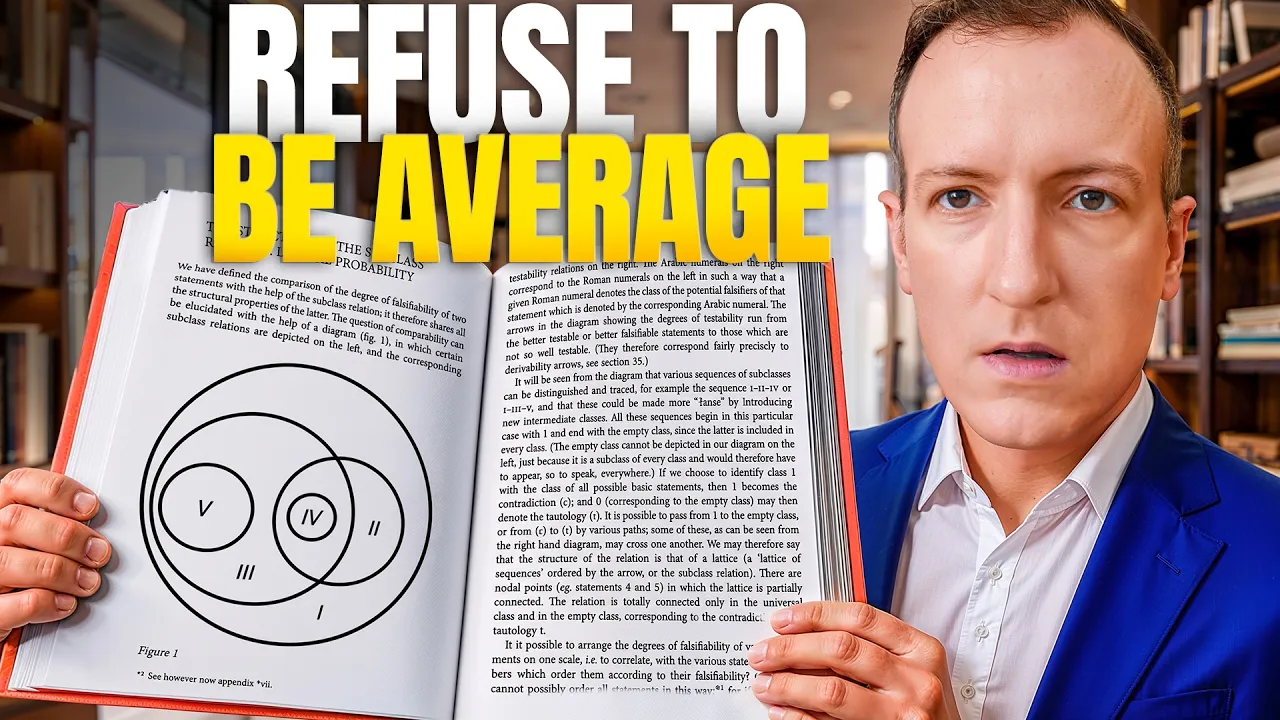
Here's a quick test. I have a secret rule and the sequence 2 4 6 obeys it. You can propose other sequences and I'll tell you whether they also obey the rule. So, what would you test next? Maybe 8 10 12 or 20 22 24? Well, if so, you'd be walking straight into a trap. And in psychologist Peter Wason's original experiment, only one in five people escaped it. In this video, I'm going to overview the book The Logic of Scientific Discovery by Karl Popper to reveal the
90 words, the words spoken in the first 30 seconds at 179 words per minute.
Free, no signup. See how the first 30 seconds hold attention, with rewrites.
Sentence shape
| Measure | This transcript |
|---|---|
| Sentences | 147 |
| Average words per sentence | 15.5 |
| Longest sentence | 46 words |
| Questions asked | 14 |
| Sentences containing a number | 8 |
Most used terms
Filler phrases
18 in total: actually 11 · like 4 · kind of 2 · right? 1.
A literal whole-word count of the same phrase list the Prepublish browser extension uses, so a phrase inside another word is not counted and a phrase used in its ordinary sense still is. It is a count and not a judgement.
Free, no account. See where attention is likely to drop, with a rewrite for each weak line. The free check shows the scores and the one issue costing the most. Or run it on the words above first.
Free · No login · See a sample audit first if you prefer.
What this transcript is
Every word below is the caption track YouTube publishes for this video, pulled from the video itself and reproduced unchanged. It is not Prepublish's writing, not a summary, and not a re-transcription: it is the video's own published captions. English captions, generated automatically by YouTube, in the video’s original language. Source: the video on YouTube. A channel that would rather this page did not exist can ask for its removal through the contact page, and it is removed.
No Script X-ray for this video: YouTube shows a Most replayed graph only once a video has enough views.
Here's a quick test. I have a secret rule and the sequence 2 4 6 obeys it. You can propose other sequences and I'll tell you whether they also obey the rule. So, what would you test next? Maybe 8 10 12 or 20 22 24? Well, if so, you'd be walking straight into a trap. And in psychologist Peter Wason's original experiment, only one in five people escaped it. In this video, I'm going to overview the book The Logic of Scientific Discovery by Karl Popper to reveal the rule here you probably missed and give you five techniques for using Popper's idea that will genuinely put you ahead of the vast majority of people.
Starting with technique number one, hunt the black swan. So, what exactly was the trap here? Well, you see, almost everyone guesses even numbers going up by two, then test something like 8 10 12, then something like 20 22 24, and gets a confirmation each time from the experimenter that, yes, indeed, these do follow the rule. The subjects then confidently declare the rule, namely, even numbers going up by two. But they're totally wrong.
You see, the rule was actually just any three increasing numbers. But the subjects lost because they only tried sequences that confirmed their guess and never one that could disconfirm it. And this is a real experiment conducted by the psychologist Peter Wason in his 1960 study on the failure to eliminate hypotheses in a conceptual task. And it reveals the idea Popper's entire book rests upon, namely, that the evidence that agrees with you is often much less informative than the evidence that could prove you wrong.
And you see, Popper was obsessed with a basic asymmetry in logic. For instance, imagine the claim, all swans are white. Well, how many swans would you have to see to prove it? The answer is that there is no number that's enough. You could see a million white swans and the very next one could be a black one. But, how many black swans do you need to disprove it? Well, just one, right? And that's the whole asymmetry here.
You see, confirming evidence can pile up forever without ever making you certain. While a single piece of disconfirming evidence settles the matter instantly. And Popper's radical point here was that this is how all real knowledge advances, not by proving things to be true, which is, in principle, impossible, but by ruthlessly trying to prove them false and paying attention to what survives in that process. [music] And a claim that survives your hardest attempts to disprove it has legitimately earned something.
And Popper calls this corroboration. But, notice it's not the same as proof. It just means not falsified yet, but that it has thus far survived rigorous testing. And so, you can actually extract a practical rule from this for your own life. Whenever you catch yourself holding a belief, your instinct will be to ask, "What evidence supports this?" But, that's precisely the wrong question, because, let's be real here, you will almost always find the evidence you're looking for.
And so, instead, you should flip the question entirely. Ask, "What would prove me wrong, and let me go looking for that." For instance, say you're a manager who's decided an employee is careless. Well, once you believe that, you'll notice every mistake they make and file it away in your mind as confirmation of that belief. And that's the manager version of testing 8 10 12 over and over and over. But, the black swan approach here is to deliberately go hunting for evidence of their competence, the instances that your belief predicts you shouldn't find.
Or, take the example of that supplement you're convinced is boosting your energy. Well, you're likely, in this case, to remember the good, energetic days and credit the supplement for those. But, you never tracked the days you forgot to take it, did you? Which is the only data that could actually falsify that belief. And so, the skill here is simple to state, yet genuinely hard to practice. Don't build a case for what you already think.
Go looking for the thing that would demolish it. And if you hunt honestly and still can't find your black swan, well, now your belief is actually worth something. Now, hunting for disconfirmation works on beliefs you already hold, but the most powerful place to apply this is before you act, which is technique number two. Run the pre-mortem. Popper's conception of science entails making a bold, risky prediction, and then subjecting it to the most severe test you could design, on purpose, up front.
And you can do exactly this to any goal or plan you personally have. The decision researcher Gary Klein gave it an operational form he calls the pre-mortem, and it works like this. Before you launch that project, or sign that lease, or start that business, you gather all the relevant stakeholders together and say, "Imagine it's a year from now, and this failed." Not it might fail. You actually assume it failed completely.
Now, write down every reason it failed. And here's why this is so much more productive than just a normal risk assessment. Asking something like, "What could go wrong?" politely invites you to consider a few token worries, but declaring the failure as an accomplished fact gives your brain permission to be brutally honest, and from there the real reasons should just come pouring out. Then, work backward and defend against the biggest ones while you still can.
Planning a wedding? Well, run a budget pre-mortem. "We blew the budget by 40%. How the heck did that happen?" And you'll spot the open bar and that guest list creep before they actually happen. Thinking of quitting your job to go independent? Well, run a pre-mortem on that. "It's 18 months later, you're broke, and applying to go back. Well, what happened?" The reason this technique is rare is that it feels pretty awful to our egos.
It cuts straight against our optimism, our excitement, our need to believe that everything's just going to work out. But that discomfort is the entire point. And notice what both of these techniques share. They both attack an idea before you've committed to a story about it, which matters enormously and precisely because of what our minds do after the fact. And that's technique number three, kill the post-hoc story. This one I think is the most valuable of all, and it comes straight out of Popper's rejection of what philosophers call induction, which concerns the logical leap from observed cases to universal conclusions.
The potential mistake here is causal overreach. An outcome occurs and your mind immediately treats one plausible explanation as though it must be the cause. A video of mine goes viral and I might be tempted to think it was definitely this wording in the introduction. And I can admit I've done that before. A quarter goes great and the CEO announces it was all because of our new strategy. You feel sick after dinner and think it was the shellfish.
And then this is the trap. You go looking for evidence that your story is right. And of course you find it. But that is the wrong question entirely. The right question instead is what are all the plausible explanations for this and how would I test among them? Maybe that video went viral because of the hook or because of when you posted it or maybe it was the thumbnail or even the popularity of the topic. Maybe the quarter was great because of the new strategy or because the entire market rose and every competitor was up just as much, which would mean the strategy did nothing.
In short, a single confirming story is worthless precisely because it's so easy to confirm. So force yourself to generate the rival explanations first before you fall in love with one and then ask which piece of evidence would let you distinguish among them. The person who does this makes decisions based on what actually caused the outcome, and everyone else is just telling themselves comforting stories and calling it analysis.
And if you want to dive even deeper into these and other types of critical thinking skills that can help you in your everyday life, then be sure to check out my free masterclass at the link in the pinned comment below. Now, doing all this once is good, but the real power comes when you do it systematically over time, which is technique number four. Build a falsifiable model and keep a calibration log. For Popper, a theory earns its status by making specific predictions and then surviving repeated attempts to break them.
And you can turn your own life into exactly that process with one habit. Before an outcome happens, write down your prediction and how confident you are in it. Then, when the result comes in, check it against what you actually wrote. This does something almost magical. It makes it impossible to lie to yourself after the fact because your prediction is sitting right there in ink. Let me give you a real example from my own life.
When I started this channel, my videos kept underperforming, and I had no idea why. So, I started treating every failed video as a data point rather than as a disappointment. At first, I didn't trust my own guesses, so I went and gathered outside data. I studied other channels and what was working for them. And there are dozens of reasons a video can flop, so I forced myself to narrow it down to the few variables that seemed to matter the most.
And then I started predicting in writing before I hit publish. I think this style of thumbnail with this kind of topic will perform. Sometimes I was wrong. Actually, a lot of times I was wrong, but it was precisely those failures that were the valuable data points. And I even eventually started conditioning myself to react positively to those failures because a wrong prediction told me my model was not quite accurate and needed some adjustment in its assumptions.
And slowly, out of the predictions that kept surviving, a real emerged. One built from my own channel's data, not anyone else's. And you can do this with anything. A salesperson can log before each pitch how likely they think the deal is to close, and discover after 50 entries that their gut is wildly overconfident about a certain kind of client or certain method of questioning they're using. An investor can write down the actual thesis and confidence behind every single buy, so that a year later they can't pretend they knew it all along.
You see, that written log is what turns your biased motivated reasoning into a model you can eventually, yet provisionally, trust. Because it's a model that has survived being tested and then adjusted repeatedly. Which brings us to the last technique, the one that holds all the others together. Technique number five, hold your beliefs as conjectures. [music] For Popper, even a theory that has survived every test is never proven.
It's just not yet falsified. It's provisional. And that word provisional is the key mindset here. The rare thinker holds even their best, most reliable beliefs just a little loosely. Not as settled truths, but as their current best guess. Still open to that one black swan. Think of the investor whose strategy has worked beautifully for years, who came to treat it as simply true, rather than true so far, and who rode it straight off a cliff when the world changed.
Because he'd stopped watching for the counter evidence. That's what happens when a corroborated belief becomes a rigid certainty. Your expertise curdles into dogma the moment you stop holding it as a conjecture. And so the meta skill you need underneath all of this is to simply keep the door open. To treat your firmest conclusions as the best hypothesis you have for now, and to stay genuinely willing to update your beliefs when you find your black swan.
Now, before you go out and start attacking every belief you have, I owe you an honest caveat because Popper isn't the last word here. Later philosophers of science, Thomas Kuhn and Imre Lakatos in particular, pointed out that real scientists don't actually toss out a good theory the instant one experiment goes wrong. And they're right. If a result contradicts a well-established idea, very often the experiment was flawed, not the theory.
There's even a deep problem named after the physicist Pierre Duhem that when a prediction fails, logic alone can't tell you which of your assumptions was the broken one. And so the more nuanced version of everything I've told you so far isn't just abandon any belief the moment you find an anomaly. Instead, the real skill you need to practice is far subtler, namely to actively seek the evidence that could break your beliefs instead of hiding from it.
To hold your conclusions as provisional, and above all, to stop protecting your ideas from the tests they might fail. In other words, you're not trying to simply believe in nothing. Instead, you're trying to make sure that what you do believe has actually earned it. If you want to keep leveling up your critical thinking to make a massive impact not only on your own life, but also on the lives of countless others, then be sure to watch this next video.
The words are the caption track's own and nothing is reworded or re-transcribed. Paragraph breaks are placed between sentences so the text reads as prose.
Free tools for your own script: paste a draft and see where it stands before you record it.
Paste your draft and see where viewers are likely to drop off, with a rewrite for each weak line.
Paste the first 30 seconds of your own draft for a hook score and rewrites.
Check your draft against YouTube's advertiser-friendly guidelines before you record it.
Read this channel's public videos and transcripts, and download a writing brief for it.