Getting the transcript
Reading the captions from YouTube. A video nobody has opened here before takes 10 to 30 seconds; this page fills in on its own.
Getting the transcript
Reading the captions from YouTube. A video nobody has opened here before takes 10 to 30 seconds; this page fills in on its own.
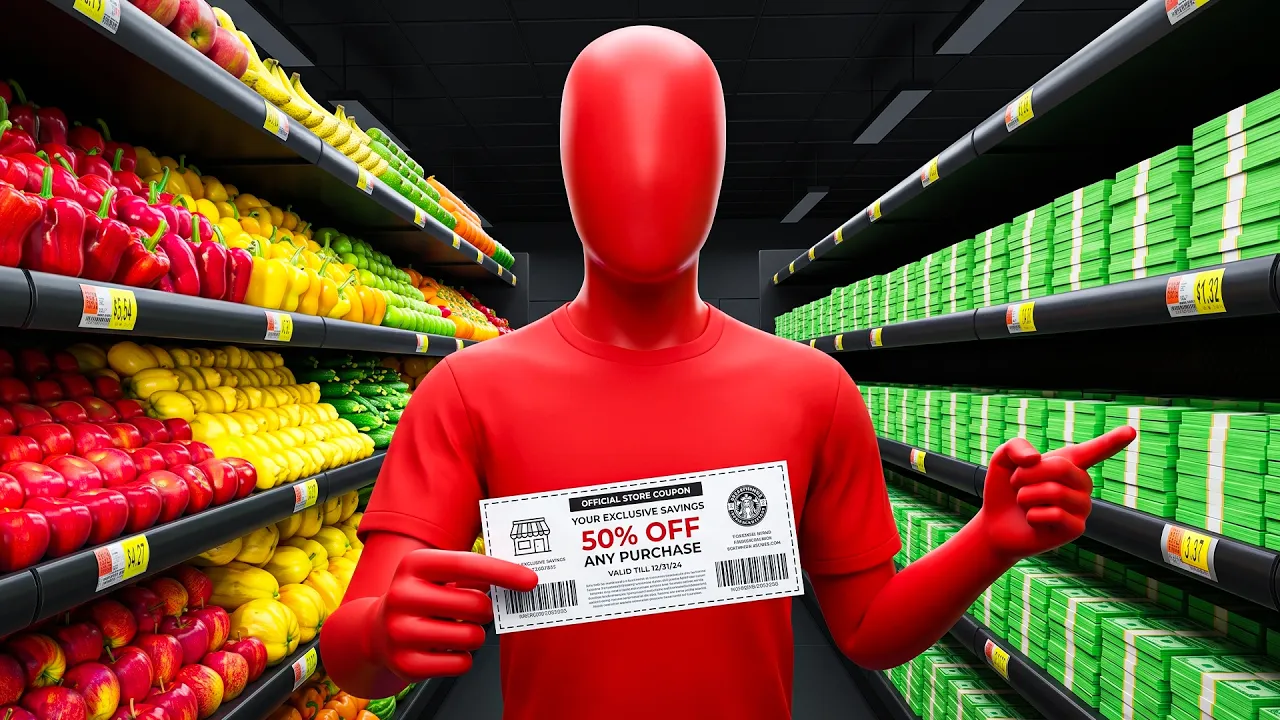
Lume · @lume-channel
Where viewers went back to watch this video again, from YouTube's public Most replayed graph, lined up with what was said at that moment.
Most replayed moment #1
22:567.6x the video's typical replay level
corporate loss was born at head office in Cincinnati. Managers in every documented case were aware, most of them quietly encouraged it. And in Virginia, starting in 2017, five years after Awatukee, a third generation of the same
Said at 22:50
Most replayed moment #2
11:445.7x the video's typical replay level
If the coupon was worth $2, the register applied a $2 discount to every Procter & Gamble product in the basket. If the store required coupon doubling, the register applied a $4 discount to every Procter & Gamble product in the basket. Not a single cashier in America could
Said at 11:36
Most replayed moment #3
6:155.4x the video's typical replay level
it rested on one assumption: paper is hard to counterfeit. Holograms, microtext, watermarks, barcodes, and the CIC. Every layer of it was built against a photocopier, not against a shipping container from Guangzhou. [music]
Said at 6:09
The graph counts replays. It does not show where viewers stopped watching.
Words
3,855
Runtime
26:04
Speaking pace
148wpm
Reading time
16min
148 words per minute, below the 160 25th percentile of 349 measured videos. That distribution comes from the 349-video hook study.
Opening (first 30 seconds)
Every night this port receives between 8 and 12,000 shipping containers. 2 and 1/2% of them are physically inspected by US Customs. The other 97 and 1/2% [music] clear the pier on the strength of a paper declaration. 6:00 the following evening, a leased warehouse in the industrial belt southeast of Phoenix, one container, 42 pallets, 56 cartons per pallet, approximately 8 million counterfeit manufacturer [music] coupons for Procter & Gamble, Kraft, and Coca-Cola.
74 words, the words spoken in the first 30 seconds at 148 words per minute.
Free, no signup. See how the first 30 seconds hold attention, with rewrites.
Sentence shape
| Measure | This transcript |
|---|---|
| Sentences | 284 |
| Average words per sentence | 13.6 |
| Longest sentence | 63 words |
| Questions asked | 1 |
| Sentences containing a number | 116 |
Most used terms
Filler phrases
6 in total: uh 4 · like 2.
A literal whole-word count of the same phrase list the Prepublish browser extension uses, so a phrase inside another word is not counted and a phrase used in its ordinary sense still is. It is a count and not a judgement.
Free, no account. See where attention is likely to drop, with a rewrite for each weak line. The free check shows the scores and the one issue costing the most. Or run it on the words above first.
Free · No login · See a sample audit first if you prefer.
What this transcript is
Every word below is the caption track YouTube publishes for this video, pulled from the video itself and reproduced unchanged. It is not Prepublish's writing, not a summary, and not a re-transcription: it is the video's own published captions. English captions, generated automatically by YouTube, in the video’s original language. Source: the video on YouTube. A channel that would rather this page did not exist can ask for its removal through the contact page, and it is removed.
Every night this port receives between 8 and 12,000 shipping containers. 2 and 1/2% of them are physically inspected by US Customs. The other 97 and 1/2% [music] clear the pier on the strength of a paper declaration. 6:00 the following evening, a leased warehouse in the industrial belt southeast of Phoenix, one container, 42 pallets, 56 cartons per pallet, approximately 8 million counterfeit manufacturer [music] coupons for Procter & Gamble, Kraft, and Coca-Cola. >> Investigators say many of you bought millions of dollars worth of fake coupons online. >> One of the largest coupon scams in the nation.
The money generated brought in more than 2 million dollars this year alone. >> Production costs delivered to Phoenix, 8 cents per coupon. Face value redeemable at any American supermarket register, $3 to $70 per coupon. Total face value of one container, approximately $60 million. This was not the first container and it was not the last. Every step in the chain, from the offset printing plant in Guangzhou, to the leased warehouse in Phoenix, was legal by the letter of United States law.
Not a single automated fraud parameter fired. Not a single alarm code was raised. A 39-year-old housewife in a gated Phoenix subdivision had discovered how to build an entire industry at the exact boundary of what the American retail system was blind to. She never hacked a server. She never picked up a weapon. She read one number that nobody had read in 140 years. >> If you love a deal, and I know you do, you got to hear this. >> Every year Americans redeem manufacturer coupons roughly 300 billion times.
A dollar off Tide, 50 cents off Crest, 75 cents off Bounty. It sounds like small change. Add up all the small change. The coupons distributed in America in a single year carry a combined face value that exceeds $1 trillion. Every coupon that gets scanned enters a clearing chain. The manufacturer reimburses the store for the discount plus an 8-cent handling fee. Approximately $24 billion a year just to count the paper.
The system that moves that $1 trillion is protected by five layers. Special paper stock, four-color offset printing, a 12-digit barcode with a checksum, a holographic security foil, a serial number registered in a private industry database, 140 years of security design [music] built against a photocopier, built against a casual amateur, built [music] against anyone who would try once and give up. Not built against a person who would sit at her kitchen table for 3 years and read the specifications. >> She was the ringleader of a multi-million dollar coupon scam based right here in the valley. >> Three women accused of scamming companies and shoppers out of millions of dollars with savvyshopper.com. >> The volume of fake coupons found during the raid on the business was incredible. >> This is the story of what one American housewife did with a photocopier, a Guangzhou offset plant, and one three-digit number that the industry had reserved as a wild card and forgotten to lock.
By the time anyone noticed, she had extracted $40 million from the American retail system. Her name was Robin Ramirez. She was 39 years old, and she was one of at least 14,000 American women who had figured out the same thing at the same time. In an unmarked office building outside Washington, D.C., there is a private not-for-profit that most Americans have never heard of. It is called the Coupon Information Corporation. >> The Coupon Information Corporation also helps manufacturers catch shady shoppers. >> A single counterfeit can easily cost a million dollars. >> Everyone loves to save a buck, and that's fueled the popularity of coupons.
Bold red lettering threatens a $2 million fine and/or imprisonment if coupons are copied. >> It was founded in 1986 by a consortium of eight American manufacturers: [music] Procter & Gamble, Coca-Cola, PepsiCo, Nestlé, Kraft, Kimberly-Clark, Colgate-Palmolive, and Kellogg's for one purpose: to watch the coupons. 18 full-time investigators, one database that holds the serial number of every legitimate manufacturer coupon ever [music] issued in the United States, direct real-time data feeds from the internal fraud detection systems of every major American supermarket chain, and a room the size of a school gymnasium containing physical copies of every counterfeit coupon the industry has detected in the last 30 years.
Their job is to watch redemption rates. The normal rate, the percentage of distributed coupons that get scanned at a register, sits between 1 and 5% depending on the brand, the region, the season, and the weather. The algorithm knows the weather. When the rate in a specific region climbs to 10 times normal, the algorithm sees it. When the same serial number appears in 30 states in the same week, the algorithm sees it.
The man who ran the Coupon Information Corporation in 2012 was named Bud Miller. >> Hi everybody, welcome back to ASIS Security Snapshots. I'm your host Chuck Harold. My guest, Mr. Bud Miller CPP, is the executive director of the Coupon Information Corporation and member of the ASIS Investigations Committee. >> Miller was not a police officer. He held no arrest authority. His investigators carried no weapons. But he had the database.
He had the algorithm. And he had the phone number of the FBI's Phoenix Field Office. For 140 years, the system worked because it rested on one assumption: paper is hard to counterfeit. Holograms, microtext, watermarks, barcodes, and the CIC. Every layer of it was built against a photocopier, not against a shipping container from Guangzhou. [music] Ahwatukee, a gated subdivision at the base of South Mountain on the southern edge of Phoenix.
Retirement communities and family homes. Manicured landscaping, blue swimming pools on the aerial view. In this house, starting in the autumn of 2007, lived Robin Ramirez, 35 years old, married, two young children. >> Police say that woman ran this website, had 12 bank accounts, and plenty of money. Robin Ramirez was running the website savvyshoppersite.com, where she sold manufacturers' coupons for profit. >> Her husband was a technical specialist at a Phoenix area engineering firm.
She was a full-time housewife. She served on the Parent Teacher Association at her children's elementary school. She attended Sunday services at a [music] Baptist church on the corner of the subdivision. Neighbors interviewed after her arrest described her uniformly as friendly, active, quiet, ordinary. That was precisely the problem. The American coupon defense system had been designed to catch organized crime rings, street counterfeiters, amateurs with photocopiers, a pattern.
It had not been designed to catch a PTA mom who spent her evenings after the children were in bed reading 200 pages of GS1 industry documentation on her laptop. Patience. Not the patience of waiting in a queue. Not the patience of waiting for the bus. A different kind. 3 years. Every night after the children were in bed. Without a partner in the operation. Without help. Alone at the kitchen table with a printed PDF. Attention to detail.
Not the attention that notices dust on a shelf. A different kind. The attention that reads Kroger's printed [music] corporate coupon policy from cover to cover and notices that there is not a single line. Not in section 3. Not in paragraph 7. Not anywhere in the document that excludes family code 999 from the list of accepted values. Absence of fear. Not courage. Not bravado. Not recklessness. Simply the absence of fear as a variable.
She knew that the CIC existed. She knew that every envelope leaving her Phoenix mail drop left a trail. She knew the federal statutory maximum for aggravated coupon counterfeiting [music] was 20 years. She knew. And she continued. Not because she was brave. Because fear didn't register. She began the way every American housewife began. A Sunday newspaper. A dollar off Tide. 50 cents off Crest. Something to save $15 a week on groceries.
But somewhere in the autumn of 2007, she looked at the coupon differently. Not as a shopper. As a logistics analyst. She saw a piece of paper the size of a palm printed at fractions of a cent. Redeemable for up to $70 of grocery. She saw a clearing chain. Procter & Gamble. Kroger. PayPal. The US Postal Service. In which every link trusted the previous link without direct verification. She saw Kroger's printed corporate coupon policy on the wall next to register four, in which not a single line excluded what would happen if she generated coupons with family code 999.
She saw a door, and she asked the question, not how do I save more money, not how do I find better coupons, a different question, the one nobody had asked in 140 years, what if I can print one? Not one, 22 million. To understand what one woman did to the American cash drawer, you do not need to understand a technical barcode standard. You need to understand three things. One, the digit five. Every manufacturer coupon printed in America between 1985 and 2011 began with the digit five.
[music] When a supermarket register scanned a coupon and read the leading five, it triggered a specific software subroutine. The register understood without being told that this was not a product for sale. This was a discount funded by the manufacturer. The store would later be reimbursed by Procter & Gamble or Coca-Cola or Kellogg's plus an 8-cent handling fee. The register did not check whether the coupon was real.
It checked whether the coupon began with a five. The five was the key. The only key. Two, family code 999. Every coupon also carried a three-digit family code. The family code told the register which specific product the discount applied to. Tide 3-liter bottle was family code 042. Crest standard tube was 087. Bounty six-pack was 018. But the industry had reserved three family codes as wildcards for rare corporate-wide campaigns, for legal settlement remediation.
The most famous of them was 999. Family code 999 when scanned meant apply this discount to any product from this manufacturer. If the coupon was worth $2, the register applied a $2 discount to every Procter & Gamble product in the basket. If the store required coupon doubling, the register applied a $4 discount to every Procter & Gamble product in the basket. Not a single cashier in America could track this on the screen in real time.
They saw only the running total. The running total went down. Three, the negative balance rule. In 2010, every major American supermarket chain had a printed corporate coupon policy that stated, in effect, "If applied coupons produce a total below zero, the difference will be paid to the customer in cash from the register drawer." That policy had been written in the early 1990s for a specific case. A customer arrives with one $2 coupon on a $1.50 item.
The register subtracts two from 150, produces minus 50 cents, and pays the customer 50 cents from the drawer. A minor rounding issue. Nobody thought about it. By 2010, one American housewife with 600 paper coupons in a plastic filing case could weaponize that clause into a $412 cash withdrawal. The five told the register, "This is a discount." The 999 told the register, "Apply the discount to every product from this manufacturer." The negative balance rule told the register, "Pay the customer the difference." Three components, all three written by the American consumer goods industry itself.
None of them individually unlawful. Combining them was not unlawful, either. Kroger's own printed coupon policy on the wall next to register four authorized the exact [music] transaction that any woman who walked into that store at 3:00 in the morning with a plastic filing case could execute. Every cash drawer in every American supermarket in 2011 could be persuaded at 3:00 in the morning to open itself [music] and hand over its contents.
Robin Ramirez in Ahwatukee figured this out [music] in 2007. It took her 3 years to connect it to an offset printing plant on the other side of the Pacific. >> Now, police say millions of dollars worth were sold on this website and some of them uh could end up in your stash. >> A search of her home uncovered tens of millions of dollars in fake coupons, which detectives say she sold on her website savvyshoppersite.com. >> In the third year of running Savvy Shopper Site, the coupon exchange website she had launched from her Ahwatukee bedroom in 2007, Robin Ramirez met an East Asian import broker at a Phoenix trade show.
The broker had contacts in Guangdong. She placed a small trial order. A few thousand counterfeit coupons. The invoice described the product as commercial paper stationery. The trial run came back industrial-grade. The coupons were printed on the correct weight of coated stock in the correct security-tinted paper texture with the correct offset litho ink density with the correct micro-registration marks along the edge.
The holographic security foil, for 140 years the last line of defense against a photocopier, was on the Guangzhou counterfeit a near-identical replica. The same class of Chinese foil supplier that produced the holograms for East Asian pharmaceutical packaging was producing the counterfeit foil. Same film, same microstructure, same shift of color under the same angle of light. A standard American supermarket cashier examining a Ramirez coupon by hand under fluorescent lighting at 3:00 in the morning could not visually distinguish it from a coupon clipped that Sunday from the Arizona Republic.
Delivered cost per counterfeit coupon in Phoenix, approximately 8 cents. Face value carried on the same coupon in some categories up to $70. These were not modest 25 cent discounts. The Ramirez coupons were in most categories full value replacement coupons. A buyer on the private site could pay $10 for a coupon that would walk a $70 bag of Iams dog food out of a Kroger for zero at the register. Procter & Gamble reimbursed the store for the full $70 plus the 8 cent handling fee.
At no point in the entire chain did anyone verify whether the coupon was real. By late 2010, the small trial order had scaled. Thousands became tens of thousands. Tens of thousands became hundreds of thousands. Hundreds of thousands became millions. Boxed, palletized, sealed inside 20-ft maritime containers, declared as commercial paper stationery, shipped from the port of Guangzhou, 22 days across the Pacific to the port of Los Angeles, 12 hours by semi-truck across the Mojave.
By 2011, containers were arriving in Phoenix every few weeks. She recruited two operational partners. The first was Amiko Fountain, 42 years old, a Phoenix-based mother of three. She handled the physical fulfillment, addressed the envelopes, ran the Dropbox mail routes, maintained the customer index. The second was Marilyn Johnson, 54 years old, a former real estate agent. She handled the money, opened the PayPal accounts, reconciled the transfers, moved cash into the household economy without leaving a trail that a casual audit would find. >> Police tell us [music] since 2007, Robin Ramirez and her team had fake coupons printed overseas. >> Three Valley women are behind bars accused of running a large-scale counterfeiting and forgery operation in >> And now, Arthur Johnson says his 54-year-old wife, Marilyn, is accused of something she knew nothing about.
Now, we spoke with a relative of Amiko Fountain. She's the other woman accused of helping in the operation, and we were told she's an honest person who couldn't have possibly known about this scheme because she never benefited financially. >> The three women divided the labor with a discipline that Sergeant David Lake of the Phoenix Police Department would later describe as equivalent to a narcotics trafficking organization.
The wholesale side of Savvy Shopper site was not a public storefront. It was gated. To reach the tier of the site where a $100 face value coupon could be purchased for $10 to $15 or a $70 free product coupon for $8. A new customer had to obtain a written referral from an existing member in good standing. Referrals were recorded internally. Payment was handled through PayPal accounts registered to what the FBI would later describe as a rotating set of intermediary suburban addresses.
Coupons were shipped to buyers in unmarked white envelopes with no return address, mailed in staggered batches from post office drop boxes across metropolitan Phoenix to defeat pattern detection by USPS auditor. A first-time buyer who broke the referral system by publicly discussing Savvy Shopper site on an open forum was, in every documented case, immediately banned. Between 2010 and the middle of 2012, the Ramirez ring distributed approximately 22 million counterfeit manufacturer coupons across the continental United States.
The combined face value redeemed at American supermarket registers exceeded $40 million. Procter & Gamble alone documented losses of approximately $11.4 million. The money came back to Ahwatukee in cash. But she was not alone. While Robin Ramirez was building her vertically integrated empire in Ahwatukee, across the whole of Central America, in the suburbs of the industrial Midwest and the Rust Belt, the same architectural flaw in the American coupon system was being discovered by other women.
Not through a maritime container, not through Guangzhou holograms, through a home HP LaserJet and a PDF template downloaded from a Russian-hosted online forum. Somewhere on a Russian-hosted forum whose administrators have never been publicly identified, a set of PDF templates appeared. The templates allowed any user with Adobe Illustrator to generate a manufacturer coupon barcode with any manufacturer code, any face value, any family code, including 999, and any expiration date.
The templates were downloaded approximately 240,000 times between June 2011 and December 2012. A standard Hewlett-Packard LaserJet home printer loaded with white paper stock cut to the industry standard coupon size could produce approximately 800 usable manufacturer coupons per hour. Paper cost, $4 per thousand. Face value on those thousand, over $12,000. Approximately 14,000 suburban American housewives between 2009 and 2013 downloaded the template, loaded it into Illustrator, printed, and walked into a Kroger, Walmart, Giant Eagle, or Meijer at 3:00 in the morning.
Combined economic loss to the American consumer goods industry by the end of the 2012 calendar year, approximately $680 million. >> When they're printed in uncontrolled numbers, there's no way to budget it. The losses are astronomical. We would bring in these coupons from overseas in large quantities, quantities we never could imagine. >> Inside the closed forums and inside the CIC's internal files, these women stopped being called extreme couponers.
They were called glitchers. The exploit itself was called coupon glitching. The glitchers circulated printed cross-reference sheets called decoders, showing that a coupon printed as a discount on a $1 air freshener would, on a specific register firmware, fire against a $50 electric razor from the same manufacturer. Decoders sold form to form for between 40 and $120. A single decoder correctly used could clear the electronics aisle of a suburban miser in one overnight transaction.
Around the glitchers, five dirty economies grew. The newspaper racket, 60% of Sunday coupon inserts printed in America were never sold and went to pulp. Glitchers paid mailroom supervisors $30 in cash for entire pallets of unsold inserts. One pallet, 6,000 coupons, face value over 12,000. The resale market, glitchers didn't consume what they bought. They resold it through Facebook groups, Craigslist, and suburban swap meets at 30% of shelf price.
The perishable dumping problem, infant formula, diapers, and over-the-counter medication hoarded in unheated Ohio garages. By 2012, health inspectors in three separate Ohio counties documented cases of formula contaminated with rodent droppings being sold at underground swap meets to low-income families for $2 a can. The cashier terror routine, glitchers traveled in coordinated pairs at 2:00 in the morning. When the register software returned a validation error, they screamed at the 19-year-old cashier and demanded a manager they knew from the store roster was not on shift.
Kroger internal audits estimated 41% of all overnight shift coupon losses in Ohio between 2010 and 2012 resulted from manual cashier overrides forced under customer pressure. And the store manager blindness, every store manager was bonused on top-line revenue. A glicher who cleared $4,000 of laundry detergent generated $4,000 of top-line revenue for the manager. The corporate loss was born at head office in Cincinnati.
Managers in every documented case were aware, most of them quietly encouraged it. And in Virginia, starting in 2017, five years after Awatukee, a third generation of the same architectural exploit would be discovered by a different woman. Her name was Lori Ann Talens. She would not order maritime containers from Guangzhou. She would not download Russian forum templates. She would reprint the coupons herself in her own garage, applying the micro text by hand under a microscope with a single hair paintbrush for 3 years. >> Prosecutors say a Virginia Beach couple had at least $1 million in coupons in quote every crevice of the house.
Retailers lost $31.8 million. >> So, this is the power of the internet and the computer. People can just do all this fraud from their own home. >> They have to pay back all this money, almost $32 million in restitution. >> The documented damage of the Talens operation, when it was finally traced by CI C and prosecuted by the US attorney for the Eastern District of Virginia, was $31 million. Three suburbs, three tools, one architectural flaw.
Robin Ramirez, 14,000 glitchers of the Rust Belt. Lori Ann Talens, three waves against one system. >> [music] >> By the spring of 2012, there were $2 million in $100 bills inside the walls of a suburban house in Awatukee, not in a safe. Inside the drywall, 283 separate cavities, each one cut, filled, plastered, sanded, and repainted to match the wall around it. Without the original plan, nobody living in that house could have found a single one. >> We seized about, uh, I believe it was $240,000 worth of vehicles, uh, 22 weapons.
Uh, we just found a 40-ft speedboat. >> Investigators found $25 million worth of coupons in boxes ready to be sent out to unsuspecting shoppers across the nation. >> $25 million in in counterfeit coupons boxed and sorted by manufacturer, stacked in the master bedroom closet and two of the three garages. Over 20 cars, a leased aircraft hangar outside Phoenix for the overflow with a $240,000 jet ski still sealed in its factory crate. 22 firearms including a Barrett 50 caliber.
A sergeant from the Phoenix Police Department put it on the record. What they found in that house looked like a narcotics cartel raid and not $1 of it was taken at gunpoint. Not one car was stolen. Not one rifle was ever fired. Every dollar in those walls came out of American supermarket cash drawers one negative balance transaction at a time. She didn't invent anything. She was simply the first person who read all of it to the end.
The system was never broken into. It was read.
The words are the caption track's own and nothing is reworded or re-transcribed. Paragraph breaks are placed between sentences so the text reads as prose.
Free tools for your own script: paste a draft and see where it stands before you record it.
Paste your draft and see where viewers are likely to drop off, with a rewrite for each weak line.
Paste the first 30 seconds of your own draft for a hook score and rewrites.
Check your draft against YouTube's advertiser-friendly guidelines before you record it.
Read this channel's public videos and transcripts, and download a writing brief for it.