Getting the transcript
Reading the captions from YouTube. A video nobody has opened here before takes 10 to 30 seconds; this page fills in on its own.
Getting the transcript
Reading the captions from YouTube. A video nobody has opened here before takes 10 to 30 seconds; this page fills in on its own.
Stefan James · @stefanjames.brandbuilding
Words
3,229
Runtime
17:25
Speaking pace
185wpm
Reading time
13min
185 words per minute, between the 181 median and the 201 75th percentile of 349 measured videos. That distribution comes from the 349-video hook study.
Opening (first 30 seconds)
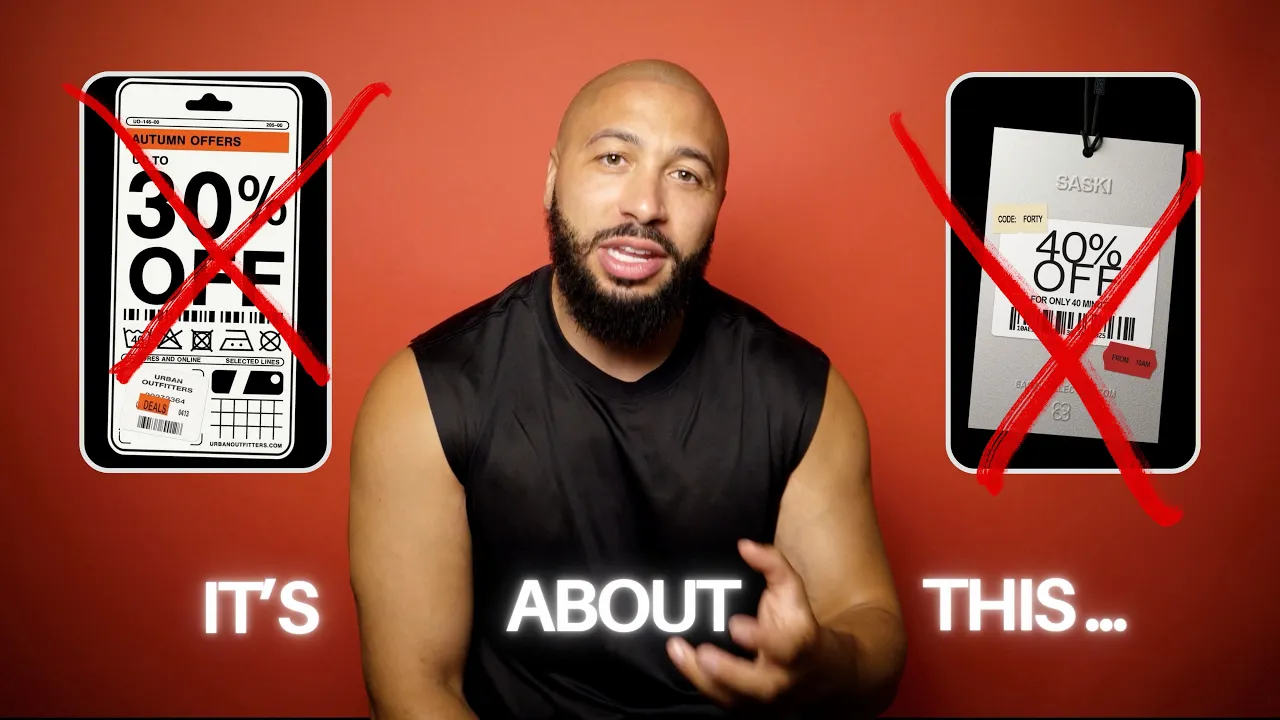
What I'm going to talk to you today is about authentic scarcity, inherent scarcity that is tied to the nature of the product that you sell, not creating fake urgency and fake scarcity. People are too smart for that. It stinks. They see it from a mile. If you've ever added a fake only three left in stock banner on your website and you felt slightly gross about it, you were right to feel that way cuz scarcity isn't a trick you just bolt onto your brand. It's an inherent human survival instinct.
93 words, the words spoken in the first 30 seconds at 185 words per minute.
Free, no signup. See how the first 30 seconds hold attention, with rewrites.
Sentence shape
| Measure | This transcript |
|---|---|
| Sentences | 232 |
| Average words per sentence | 13.9 |
| Longest sentence | 55 words |
| Questions asked | 11 |
| Sentences containing a number | 14 |
Most used terms
Filler phrases
44 in total: like 15 · actually 11 · um 7 · you know 4 · kind of 2 · sort of 2 · uh 2 · right? 1.
A literal whole-word count of the same phrase list the Prepublish browser extension uses, so a phrase inside another word is not counted and a phrase used in its ordinary sense still is. It is a count and not a judgement.
Free, no account. See where attention is likely to drop, with a rewrite for each weak line. The free check shows the scores and the one issue costing the most. Or run it on the words above first.
Free · No login · See a sample audit first if you prefer.
What this transcript is
Every word below is the caption track YouTube publishes for this video, pulled from the video itself and reproduced unchanged. It is not Prepublish's writing, not a summary, and not a re-transcription: it is the video's own published captions. English captions, generated automatically by YouTube, in the video’s original language. Source: the video on YouTube. A channel that would rather this page did not exist can ask for its removal through the contact page, and it is removed.
No Script X-ray for this video: YouTube shows a Most replayed graph only once a video has enough views.
What I'm going to talk to you today is about authentic scarcity, inherent scarcity that is tied to the nature of the product that you sell, not creating fake urgency and fake scarcity. People are too smart for that. It stinks. They see it from a mile. If you've ever added a fake only three left in stock banner on your website and you felt slightly gross about it, you were right to feel that way cuz scarcity isn't a trick you just bolt onto your brand.
It's an inherent human survival instinct. And your job as a brand builder is to find where it's already true, where it already exists in your brand, and then work your magic on publicizing that and making people aware of that in a really authentic way. A few years ago, hundreds of people ran across a car park in West London to trade in their Northface jackets and Monontlair jackets for a jacket from a brand [music] most people had never even seen in a store.
Wasn't spontaneous. The [music] brand had announced a straight swap and revealed the time and the place and [music] the few hours just before this event took place in a single Instagram [music] post. And people queued up to trade in their expensive jackets. They queued up in hand with these jackets [music] for something they couldn't just walk into the shop and buy. I'll tell you exactly which brand later if you stick around.
And by the end of this video, I'll show you why brands built on real scarcity can turn people into a queue overnight. See, I spent years building premium brands, working with founders, CEOs, [music] some top brands, some small brands, plus a stint at Google's own digital marketing [music] training department where we taught some of the most well-known brands, CEOs, founders, entrepreneurs. I've also built my own brand from nothing.
[music] It started at £200 a unit and it now sells for tens of thousands a unit with a weight list of people interested in the next drop just like the brand [music] I announced earlier. See, a lot of that came down to one principle. Real scarcity. Not the fake kind. Not the countdown timer that you know when you say it's sold out, it refreshes magically a day later and suddenly [music] there's 50 more units of stock.
See, this isn't about bullshitting. This is about being genuine, being open and honest with your restrictions as a brand and using that to create demand. So, let's dive in. First, we need to understand why scarcity works and how your brain reacts to it. So for almost all of human history, resources have been genuinely limited. Okay? The people who acted fast on disappearing resources survived. That's just how it went.
It's a bit Darwinian, but that's how it is. That wiring never switched off. Whether it's nations going to war over oil, which unfortunately is still happening. Whether it's nations going to war over land, again, still happening, or water. That same instinct is why entire countries panic buy toilet paper or L roll, however you call it, during a shortage for a product that was never actually going to run out. But here's what's changed over the last millennia.
We've also evolved to spot when that instinct is being used against us. A selling out fast badge sitting on a product that has had the same stock level for the last 6 months doesn't just stop working. It completely and actively damages trust because your audience has seen that trick a hundred of times before. Which means optimizing for authentic scarcity isn't like a nice to have. It's the only version of this that actually works. and I used it to build my own brand which I'll talk about later.
It was directly part of the product and inherently part of the product. So, it was genuine and this really worked for me and I've been thinking about this for a long time. So, now that I'm producing content, I'm going to start sharing stuff like this. By the way, if you like the sound of this, I've got a free 33-day workshop, an email send out essentially, but every day you get a free tip of how to elevate your brand, how to build your brand.
This is all for people who are building premium and luxury brands and want no BS, no fluff. I talk about brand psychology and the way you can use it. I talk about art direction, which is the creative, the visual language that your brand uses. And I also talk about brand positioning. That's my I've been doing it for years. I'm also super passionate about building brands. I'm a serial brand builder. So, jump into the email list.
It's free. I want to unite with brand builders who are more like me, who think like me, who act like me. It's been a very lonely journey building my brands and trying to become the best entrepreneur I can be and I'm now at a stage where I want to share that and I want to grow a community of people who think like me, act like me and just building cool So jump into that. Subscribe to the channel. Back to the schedule program.
So there's a second piece of this psychology underneath this and it's called loss aversion. We've all heard of it. Losing something we could have hurts more than gaining that same thing that would ever feel good. It's why messaging like don't miss outperforms things like you could gain this. See, almost every time it works. Brands that represent Fear of God, all of your favorite clothing brands, you see this all the time.
They use it really well. They aren't inventing a loss. They're just making a real one visible, a genuine weight list, a real closing date, a run of product that's actually limited, said really plainly and flank frankly and not dressed up. One of my favorite brands who do this is UVU, mate. This brand is on fire and they've been quietly building an empire over the last 10 years. They're incredible. The art direction is beautiful.
I'm going to do a deep dive on them on this channel, but what they do essentially is run limited drops and they send you um a really simple login code. We've seen it time and time again, but this stuff works. So, when there's a drop, you get access to the website and the products through a code that you have to put on a website. It's very simple. A lot of brands have done it to death, but UVU is one of the brands I see doing it really well because it works on quite a few different levels.
Again, I'm going to have to go through that in a deep dive. Um, on this channel, I'm going to be covering brand deep dives as well, specifically for people who are trying to build premium and luxury brands. But underneath both of those is something even more basic. The fundamentals of economics, supply and demand. When supply is genuinely lower than demand, value inherently goes up. Not because a brand decided it should, but because that's simply how markets behave.
Scarcity isn't only a psychological lever, it's an economic one as well. The brands that do this best aren't tricking anyone. They're being transparent about the imbalance that is already real and they're using that to generate desire, generate scarcity, generate hype. We've seen it time and time again. I'm just calling it out. That's usually exactly where real scarcity is hiding in your own business. It could be a really high-end material, really rare material that's genuinely hard to source.
Or it could be in lead times that can't be shortened no matter what you do. It could be in demand that's already outpacing what you can actually supply. We've seen this with cadence, and I'll mention them in a minute. It's also how many clients you can personally give real attention to in how much physical space you have to hold your stock. It could be in quality control or vetting steps that simply can't be rushed without the standard slipping.
We see this with Hermes and the Birkin bag. You know, you have specific artisans working on each part of the bag and it won't be rushed for anybody. None of that needs to be invented. It just needs to be spoken about out loud. So, to keep this practical for you, ask yourself, where is demand already ahead of supply in your business right now? and have you actually told anyone about it? Go through your brand and figure out where you can implement this friction, implement a delay of some sort.
You know, it could be if you're creating clothing, it could be using a rare type of leather um that you can only buy in bulk that is really hard to come by and your next product is going to be in that sort of leather. So, that gives you a real reason to say that this thing is scarce. Grab it now before it sells out. Onto the next point. This is a test that separates real scarcity from the fake. So ask yourself, if demand disappeared tomorrow, would that constraint still exist?
See, a flash sale that's ending tonight that quietly relaunches next week under a new banner fails instantly. It was never real. So don't do that. A constraint tied to time, material, or capacity passes every time. A brand like Ferrari, Enzo Ferrari, if you want my finest Italian accent, doesn't limit production to look exclusive. It generally can't make more without compromising what the car is. That's not a marketing overlay.
It's baked into the manufacturing decision itself. I recently watched a fantastic podcast on the history and the life of Enzo Ferrari, and he was a maniac when it came to detail. Maniac. And he wouldn't rush it for anyone. And they would never, they would refuse to overproduce. They would always make sure demand outstrips supply. A brand like Rolex, they do the same thing, but from a retail side. See, certain models simply aren't available off the shelf, no matter how much cash you're waving to the to the shopkeeper.
See, the brand deliberately controls who gets allocated one and when they get allocated one. If you don't know yet, one of the brands that I built, one of the most successful ones is a fine art brand. I built that from next to nothing. no fancy art degree, no connections, didn't even know how to paint. I just understood that people spend a lot of money on art. And I looked at the landscape and I thought, "This is absolutely boring.
The galleries are selling the same old crap. Boring. Artists are producing the same sort of crap. The the artists that actually sell through these galleries and art buyers are just being served the same imagery and types of imagery rehashed over and over and over again. whether it's a landscape or a rehashed image of Marilyn Monroe for the 70th time. So I looked at the whole landscape, the whole of the art world and I created a challenger disruptive brand.
And that disruptive brand has in the last 5 years I've produced and sold in retail value over2 million worth of artwork. And I've done that with next to nothing. And I've built it through retailers. I've built it on a small micro audience of 15,000 followers if that. um didn't use any fa real Facebook ads. Uh I used brand psychology, clever branding, great art direction, and brand positioning and all the stuff that I teach on this channel.
One of my brand psychology levers that I used to pull all the time was that I could only physically produce a handful of pieces a month. So, the product was inherently scarce. I didn't invent that scarcity. It was true. And a weight list starts to form on its own. And then what that allowed me to do is every time I released a series of works. Now the series of works could be six to 20 pieces, 20 original works. I would um release them.
They would sell out over a period of time, some quicker, some longer, but I wouldn't release anything else until they had sold out. And then when they did sell out, the next time round, I release a collection. It might be 20% more, 50% more, 100% more. And gradually via supply and demand, I increased the demand and reduced the supply and I was able to build the price point because it was inherently scarce. I created that drop culture in fine art that people hadn't been really utilizing or using.
That's the entire difference. See, manufactured scarcity is just a lie with a good marketing message behind it. Authentic scarcity is an honest sentence. Here's exactly what's limited and why. And from a psychological point of view, admitting a real limit works in your favor, too. There's something called the Prattful effect. And essentially, it means a small human flaw makes a brand more likable than a flawless one.
We can only make 40 of these a month isn't a weakness. It's proof you're real. If you fake it, though, and the moment someone clocks it, reactance kicks in. That's the instinct to push back the second you feel almost manipulated. And what I'm seeing brand builders do is the second creating reactants in the audience or the buyer or the collector or the client. Okay, they can smell from a mile off. We're all super educated.
Everyone's, you know, using AI to as a decision-m filter to kind of guide them on processes. No one believes your So, take one scarcity claim you're making right now and stress test it. If you quietly stopped mentioning it in your marketing, would the limit still be real? And if a wave of new customers showed up and they showed up tomorrow banging down your door wanting to buy your product, would you actually run out or would 100 units of stock conveniently reappear.
So let's dive into the next part where scarcity already lives. See, real scarcity tends to show up in a few honest places. your own limited time, genuinely rare materials, limited production capacity, curated access. I'm always out and about with my laptop. Okay, so I'm constantly looking for these. They're co-working spaces, but they're actually like private members clubs. Um, I've been a member of one. It's absolutely incredible. 17th century building in the heart of London.
Absolutely lovely. So, I'm a member of there, but I recently joined up to Soho House because why? It's kind of hipster and cool. Two, it's got a great gym underneath it. Three, they serve good food. And four, they've got somewhere where I can just pitch up on a laptop, be creative, network with other people, but also get some done, right? But the hoops I had to go through and the application process I had to go through just to become a member and give them my money was ridiculous.
But they right there and then were curating access and creating friction. And I'm not going to lie, the more they created friction, even I was manipulated to want it more. Brands that do this well, like I said before, is Hermes and the Birkin bag, where allocation is relationship based. If you don't have a relationship with them, you simply can't walk in and just buy one. Two of my favorite brands at the moment, Cadence and Newtonic, uh, and also Gym Shark in its early days.
They all built an audience before they had enough stock to meet it. So, Newtonic is just selling out and selling out and selling out. It it does help that Chris Williamson and James Smith um two legends from the UK are behind it and they've got a reach and a social media reach. It does help that Cadence has George Heaton and Ross McKay who also titans in the brand building space. It does help but the psychology is the same and small brands that are doing this all the time.
What they use is real supply chain limit. It takes ages to build up to the point where you can manufacture drinks at scale and get them to all the retailers and sell through your website to meet demand. That's real. So, when they say we're releasing this special flavor and we're about to drop it in 2 weeks, you better set a reminder because if you want that and you're a fan of the brand and you want the drink, you don't want to miss out.
It's not a manufactured drop. It's real limits and friction in their sales process. And now to bring it full circle. Remember that car park story from the beginning of the video? Well, that was Cortez. A straight swap announced in a single post. Location revealed at the last minute. Genius. It started in a bedroom in West London where I'm from with no investment, no marketing budget. Now one of the most talked about streetear brands in the world.
It releases in small unpredictable drops and refuses to hold permanent stock. the product runs out every time because they choose to make less than total demand, not because they're pretending to. There's another psychological reason why this works. This is called signaling theory. See, when a constraint is visibly real, it doesn't just create urgency. It becomes the proof that the demand is genuine, that the brand isn't quietly printing more stock the moment things get busy.
And whatever people are queuing for is actually worth queuing for. with my brand. I would turn down sales all the time when I could just really create another piece. But I wanted to stay true to what I was doing and make sure that they told a friend who told a friend who told a friend that it was actually rare. So when it came round to me releasing it, they would be the first in line to buy it because they've had to wait for it because I wouldn't just make something off on the spot whenever they wanted it.
And that's also why a real sellout builds a brand's reputation more than any amount of paid advertising ever could. People trust what they see other people fighting for. Signaling theory. So, which of these is already true for your brand right now? And would you actually say it out loud or have you been just assuming people already know? See, scarcity isn't a trick you bolt onto a brand. It's a survival instinct. Your job as a brand builder and someone building a premium or luxury brand is to find where it's already true in your business and stop staying quiet about it.
So take one claim you're making this week, run it through the same test that I've given you in this video. Does it still hold if you stop marketing it tomorrow?
The words are the caption track's own and nothing is reworded or re-transcribed. Paragraph breaks are placed between sentences so the text reads as prose.
Free tools for your own script: paste a draft and see where it stands before you record it.
Paste your draft and see where viewers are likely to drop off, with a rewrite for each weak line.
Paste the first 30 seconds of your own draft for a hook score and rewrites.
Check your draft against YouTube's advertiser-friendly guidelines before you record it.
Read this channel's public videos and transcripts, and download a writing brief for it.