Getting the transcript
Reading the captions from YouTube. A video nobody has opened here before takes 10 to 30 seconds; this page fills in on its own.
Getting the transcript
Reading the captions from YouTube. A video nobody has opened here before takes 10 to 30 seconds; this page fills in on its own.
PsychToons · @PsychToonsHQ
This video has no Most replayed graph yet: YouTube shows one only once a video has enough views. These are the moments viewers replayed most in PsychToons's most watched videos.
Most replayed moment at 5:57
6.0x that video's typical replay level
you've processed it, what comes out won't be a conversation. It'll be something that can't be taken back. So, you hold it. You wait. Not to punish anyone, but because you care enough about the relationship to not blow it apart in a moment of unfiltered pain.
Said at 5:50
Most replayed moment at 8:51
4.9x that video's typical replay level
that your ego will hate it. It feels like rewarding mediocrity, but you are not grading performance here. You are pairing a sensation with a reward, and the pairing only works if the effort itself is what gets paid. Two, move the reward to the doorway. Since dopamine
Said at 8:44
Most replayed moment at 11:10
3.2x that video's typical replay level
does not take requests. Anyone selling you a mind that feels nothing is selling you a fantasy, and chasing it will just add shame on top of pain. The goal is much smaller and much more achievable. The goal is to shorten the distance between the hit and your first controlled action. That's it. That is
Said at 11:04
The graph counts replays. It does not show where viewers stopped watching.
Words
2,787
Runtime
15:21
Speaking pace
182wpm
Reading time
12min
182 words per minute, just over the 181 median of 349 measured videos. That distribution comes from the 349-video hook study.
Opening (first 30 seconds)
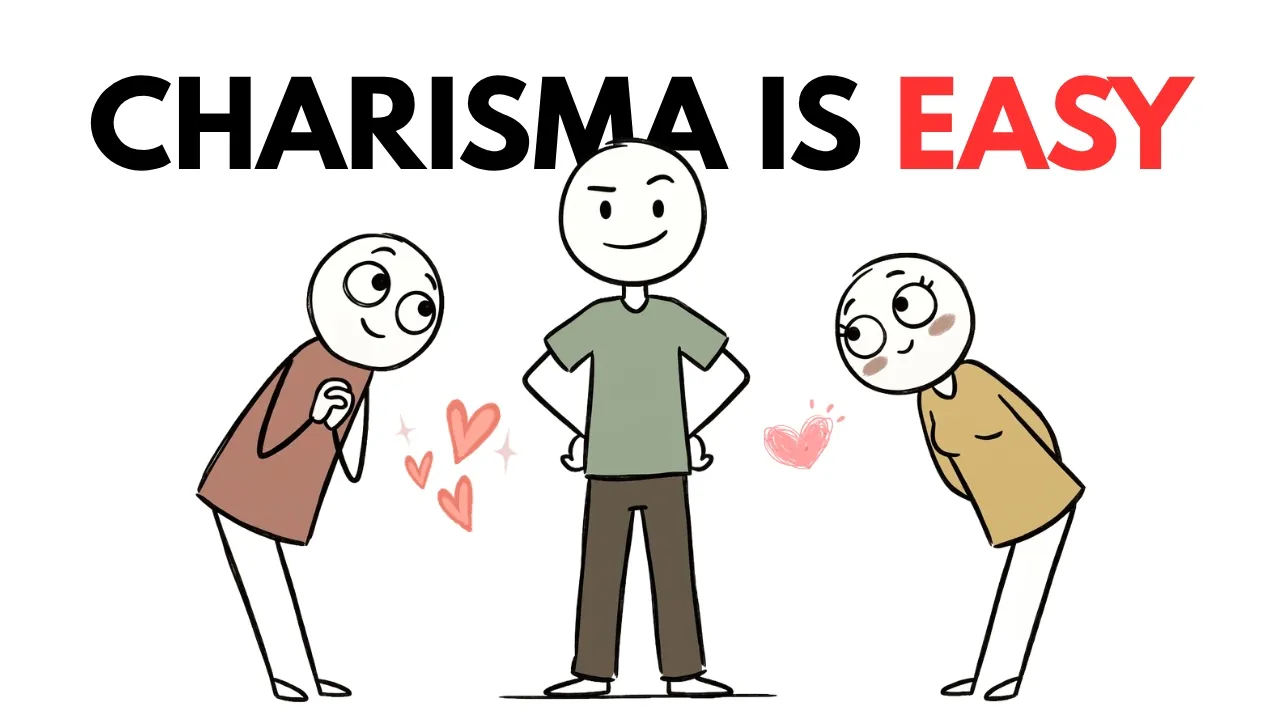
Almost everything you have been taught about charisma is aimed at the wrong target. If you want to make people like you, the advice is always the same. Stand taller. Hold eye contact a second longer. Tell better stories. Be more confident, more interesting, more impressive. So, you tried. You practiced the handshake. You prepared things to say before you walked into the room. And you still leave most rooms with that quiet, deflating feeling that nothing you said actually landed. People were polite to you, but nobody was actually drawn
91 words, the words spoken in the first 30 seconds at 182 words per minute.
Free, no signup. See how the first 30 seconds hold attention, with rewrites.
Sentence shape
| Measure | This transcript |
|---|---|
| Sentences | 264 |
| Average words per sentence | 10.6 |
| Longest sentence | 41 words |
| Questions asked | 8 |
| Sentences containing a number | 9 |
Most used terms
Filler phrases
22 in total: actually 10 · like 10 · kind of 1 · you know 1.
A literal whole-word count of the same phrase list the Prepublish browser extension uses, so a phrase inside another word is not counted and a phrase used in its ordinary sense still is. It is a count and not a judgement.
Free, no account. See where attention is likely to drop, with a rewrite for each weak line. The free check shows the scores and the one issue costing the most. Or run it on the words above first.
Free · No login · See a sample audit first if you prefer.
What this transcript is
Every word below is the caption track YouTube publishes for this video, pulled from the video itself and reproduced unchanged. It is not Prepublish's writing, not a summary, and not a re-transcription: it is the video's own published captions. English captions, generated automatically by YouTube, in the video’s original language. Source: the video on YouTube. A channel that would rather this page did not exist can ask for its removal through the contact page, and it is removed.
Almost everything you have been taught about charisma is aimed at the wrong target. If you want to make people like you, the advice is always the same. Stand taller. Hold eye contact a second longer. Tell better stories. Be more confident, more interesting, more impressive. So, you tried. You practiced the handshake. You prepared things to say before you walked into the room. And you still leave most rooms with that quiet, deflating feeling that nothing you said actually landed.
People were polite to you, but nobody was actually drawn to you. Here is what nobody tells you. All of that advice is built on one assumption that charisma is a signal you transmit. Something you project outward, like a stronger radio tower. And that assumption is the reason it keeps failing you. Because charisma is not something people see in you. It is something they feel about themselves when they are with you. Which means every hour you have spent polishing your own performance was spent tuning an instrument that nobody in the room is listening to.
Welcome back to Psych Tunes. Today we are going to break down the actual psychology of charisma. Why the popular advice fails almost everyone who follows it and the six laws that make people genuinely like you. All of them trainable. All of them backed by real research. Let's get started. Let's start by naming the thing properly. Because for a long time even psychologists refused to. Charisma was treated as a mystery for most of the 20th century.
Something you either had or you didn't. Then in 2018 a team at the University of Toronto led by Constantine Sky published a study in one of the most rigorous journals in the field and they did something surprisingly simple. Instead of listing what charismatic people achieve, they measured what charisma actually is. And it broke cleanly into two parts. The first part is influence. The ability to guide people, to have weight when you speak, to move a room in a direction.
The second part is aphability. The ability to make other people feel comfortable and at ease. Now, which one have you been training? Every book, every video, every piece of advice you have absorbed about presence, about confidence, about commanding a room, all of it lives inside the first category. You have been building influence for years. An influence with no aphibability doesn't read as charisma. It reads as intensity.
People respect it, but they do not warm to it and they do not come back. So what is aphability actually made of? This is where it gets interesting because there is a precise answer. Two researchers, Harry Ree and Philip Shaver, built a model that has quietly become one of the most important ideas in relationship science. They call it perceived partner responsiveness. Their claim is that closeness between two people is not created by how impressive one of them is.
It is created by a specific experience the other person has. And that experience has three components. Understanding. They feel you accurately got what they meant, not just what they said. Validation. They feel their view is respected even when it isn't yours. Caring. They feel that you are actually invested in what happens to them. Look carefully at those three things. Notice what is completely absent from the list.
There is nothing in there about you. Nothing about your stories, your posture, your voice, your achievements, your wit. The entire mechanism of being liked runs on the other person's side of the table. You do not generate liking. You create the conditions in which somebody else generates it. And there is a second piece of research that explains why the popular advice gets this so badly backwards. Susan Fisk and her colleagues spent decades mapping how humans evaluate each other.
And they found that we run essentially two measurements on every person we meet. Warmth, meaning your intentions toward me, and competence, meaning your ability to act on those intentions. Both matter, but warmth is judged first, and it carries far more weight in how people actually feel and behave toward you. Think about why that would be true. For most of human history, the single most urgent question about a stranger was never, "How skilled are you?" It was, "Are you going to hurt me?" Intent came before ability.
Because intent is what decided whether you survived the encounter. That priority is still running in every person you meet before you have finished your first sentence. Which gives us the simplest way to hold all of this. You have been trying to be bright, sharp, impressive, visible, interesting. But light only gets you looked at. What actually draws people in is heat. And warmth and brightness are not the same thing.
You can be the most brilliant person in the room and still be cold to stand next to. So why does almost everyone get this wrong? It's not stupidity. It's training. Think about where you learned to be around people. School graded you on performance. Job interviews graded you on performance. Social media grades you on performance in public with a number attached. Every environment that shaped your social instincts taught you the same lesson that being around other people is an evaluation.
And the way to win an evaluation is to present well. So, you learned to audition. And the entire self-improvement industry sells into that instinct because performance is easy to sell. It's visible. It's teachable in a weekend. It looks like progress. Nobody makes money telling you that the secret is to think about yourself less. But here is where it turns costly. And I need to be direct with you for a moment. The harder you try to be liked, the worse you get at it.
Not because trying is bad, but because of where the effort goes. Every unit of attention you spend monitoring yourself, checking how that sounded, wondering if that joke landed, planning what to say the second they stop talking is a unit of attention that is not on the person in front of you. And attention on the person in front of you is the only raw material responsiveness is made of. You are not failing because you are boring.
You are failing because you are busy. And the research shows this in a way that should genuinely change how you walk out of conversations. In 2018, Erica Boothby and her colleagues published a study in psychological science that has since been replicated across labs, dorms, and workplaces. They had people talk to each other and then rate two things. How much they liked their partner and how much they thought their partner liked them.
The result was consistent every single time. People systematically underestimated how much they were liked. They call it the liking gap. And the reason it happens is almost cruel. The people in those conversations were not judging the conversation. They were grading their own performance and grading it harshly. So sit with the full shape of the trap. You spend the conversation watching yourself, which lowers your warmth.
Then you leave and replay it, which convinces you it went badly. Then you conclude you are just not a charismatic person, and you go back and practice your performance even harder. The self-consciousness that was supposed to protect you from being disliked is the exact thing dimming your heat. So, how do you get out of this? Let's kill one piece of advice first because you are going to hear it again this week and it does nothing.
Just be confident. Just be yourself. Just relax and stop overthinking. That advice fails for the same reason telling someone to stop being nervous has never once worked. Confidence is not an input you can decide to have. It is an output. It arrives after competence, not before it. Nobody has ever willed themselves into charisma. But here is the good news, and it is genuinely good. Charisma is not a personality you were issued at birth.
It is behavior, and behavior can be installed. John Antinoakis at the University of Loausanne ran the study that settled this. He took managers and MBA students, filmed them speaking, then taught them a specific set of charismatic behaviors, and filmed them again weeks later. Independent raiders with no idea who had been trained scored the trained speakers meaningfully higher on charisma. Same people, same personalities, different moves.
That is the whole point. You do not need to become someone else. You need six moves. Here they are. Law one, ask the second question. Researchers at Harvard studied thousands of real conversations, including live speed dating, and found something that almost nobody predicts. The people who asked more questions were better liked. But the effect was concentrated in one specific type. Follow-up questions. Questions that stay on what the other person just said instead of moving on.
Watch how most people actually converse. They ask something, receive the answer, and then produce their own related story. That is not a conversation. That is two people taking turns waiting. The first question is easy. Everybody asks it. The second question is the proof. It says, "I was still listening after you finished." That is understanding, validation, and caring delivered in about 4 seconds. And in that speed dating data, the people who asked more follow-ups got more second dates.
So the next time somebody tells you something, resist the pull to relate it back to yourself. Just stay. Ask about the part they skipped over. Law two, lead with warmth, not credentials. Remember what Fisk found. Warmth is measured first, and it colors everything measured after it. Now think about what you actually do in a first meeting. New job, new team, new group of people. You establish yourself. You mention what you have done, what you know, where you have worked.
You are leading with competence because competence feels like the safe thing to prove. And you are answering a question nobody has asked yet. Reverse the order. Give them warmth in the first 30 seconds and give it away for free. Use their name. Be visibly glad to be there. Ask about them before offering anything about yourself. Your competence will still get noticed and it will get noticed generously because warmth was already established.
Competence introduced first is judged. Competence introduced after warmth is admired. Law three. Say the specific thing out loud. You notice things about people constantly. The way a colleague handled a hard call. How good someone is at explaining things. That your friend has clearly been putting in work. And almost every time you keep it inside because you think it will land awkwardly. Schwanjao and Nicholas Epley tested this across nine experiments.
People who gave genuine compliments consistently underestimated how good the recipient would feel and overestimated how awkward the moment would be. The awkwardness you are bracing for is mostly imaginary and the impact is bigger than you think. But the word that matters here is specific. Nice shirt is noise. What lands is evidence that you were paying attention. You handled that guy in the meeting really well. You never got defensive once.
That is a compliment nobody else could have given them, which is exactly why it works. Law four, handle their good news properly. This one is invisible and it is enormous. Most people focus on being supportive when someone is struggling, but the moment that quietly decides how close somebody feels to you is what you do when they tell you something went right. Research on what psychologists call capitalization shows that how you respond to good news predicts the strength of a relationship at least as much as how you respond to bad news.
And most responses are quietly deflating. That's nice. Congrats. Followed instantly by a change of subject. Or worse, the small deflation. Oh, so is it more money? The move is to slow down and expand it. Ask for the story. Ask how they found out. Ask what it felt like. Let them stay in the good moment for 30 more seconds instead of closing it. People remember exactly who let them be happy out loud. Law five, be the first one to be slightly unpolished.
In 2018, Anna Brookke and her colleagues at the University of Mannheim documented what they named the beautiful mess effect. When we imagine ourselves showing vulnerability, admitting a mistake, asking for help, saying the honest thing first, we evaluate it as weakness. When we watch somebody else do exactly the same thing, we evaluate it as courage. Same behavior, two completely different readings depending on which side of it you are standing on.
Which means your instinct about your own openness is not neutral information. It is a known distortion. You do not need to unload your history on strangers. One honest sentence is enough. I have no idea what I'm doing with this yet. I got that completely wrong. Honestly, I was nervous about today. Something happens in the room when you go first. The other person exhales because you just made it safe to be a real human being here.
And that permission is one of the most attractive things a person can hand out. Law six, show up again. In 1992, Richard Morland and Scott Beach ran an experiment that should be more famous than it is. Four women of similar appearance attended a large university lecture course. One never came. The others attended 5, 10, and 15 sessions. Critically, none of them spoke to a single student. No conversation, no charm, no performance at all, just presence.
At the end of term, students rated them and the pattern was clean. The more times a woman had simply been in the room, the more warmly she was rated. No words, just repetition. So, stop treating liking as something you win in one brilliant encounter. It is built by frequency. Go back to the same gym at the same hour. Say something small to the same colleague every morning. Be the person who is reliably there. Almost everybody underrates this because showing up quietly feels like it doesn't count.
It counts more than the performance you have been rehearsing. Practice these six long enough and something changes that you will feel before you can name it. Charisma stops being a thing you brace for and starts being a byproduct of where your attention goes. You stop walking into rooms with a plan and start walking in curious. The exhaustion drains out of it because you were never tired from socializing. You were tired from performing while socializing and you finally get to stop trying to be the brightest thing in the room.
You get to be the warmest. People will not be able to explain what it is about you. They will just notice they feel better around you than they do around almost anyone else. And they will keep finding reasons to come back. Maybe the deepest truth in all of this is how little it asks of you. Not a new personality, not more achievements, not a voice you have to manufacture, just your attention given honestly to the person in front of you.
The philosopher Simone Vile put it better than anyone has since. Attention, she wrote, is the rarest and purest form of generosity, which is a strange kind of relief when you sit with it, because it means the thing you have been chasing was never in short supply. You already own the only currency that buys it. You have just been spending all of it on yourself. So, of the six laws we went through today, which one are you worst at right now?
The second question, warmth before credentials. Saying the specific thing, handling good news, going first with honesty, or simply showing up again. Be honest in the comments. And I would like to know where you're starting from. And remember what the liking gap tells us. There is a very good chance people already like you more than you think they do. You have just been too busy grading your own performance to notice.
If this video gave you something you can actually use, hit like and send it to that one friend who is genuinely kind, genuinely good company, and completely convinced they're bad at this. They need to hear it from someone. Subscribe to Psych Tunes and turn on notifications so we can keep decoding the hidden mechanics of human behavior together. Goodbye and see you next time.
The words are the caption track's own and nothing is reworded or re-transcribed. Paragraph breaks are placed between sentences so the text reads as prose.
Free tools for your own script: paste a draft and see where it stands before you record it.
Paste your draft and see where viewers are likely to drop off, with a rewrite for each weak line.
Paste the first 30 seconds of your own draft for a hook score and rewrites.
Check your draft against YouTube's advertiser-friendly guidelines before you record it.
Read this channel's public videos and transcripts, and download a writing brief for it.