Getting the transcript
Reading the captions from YouTube. A video nobody has opened here before takes 10 to 30 seconds; this page fills in on its own.
Getting the transcript
Reading the captions from YouTube. A video nobody has opened here before takes 10 to 30 seconds; this page fills in on its own.
Eden · @edendotso
Words
6,883
Runtime
34:05
Speaking pace
202wpm
Reading time
29min
202 words per minute, above the 201 75th percentile of 349 measured videos. That distribution comes from the 349-video hook study.
Opening (first 30 seconds)
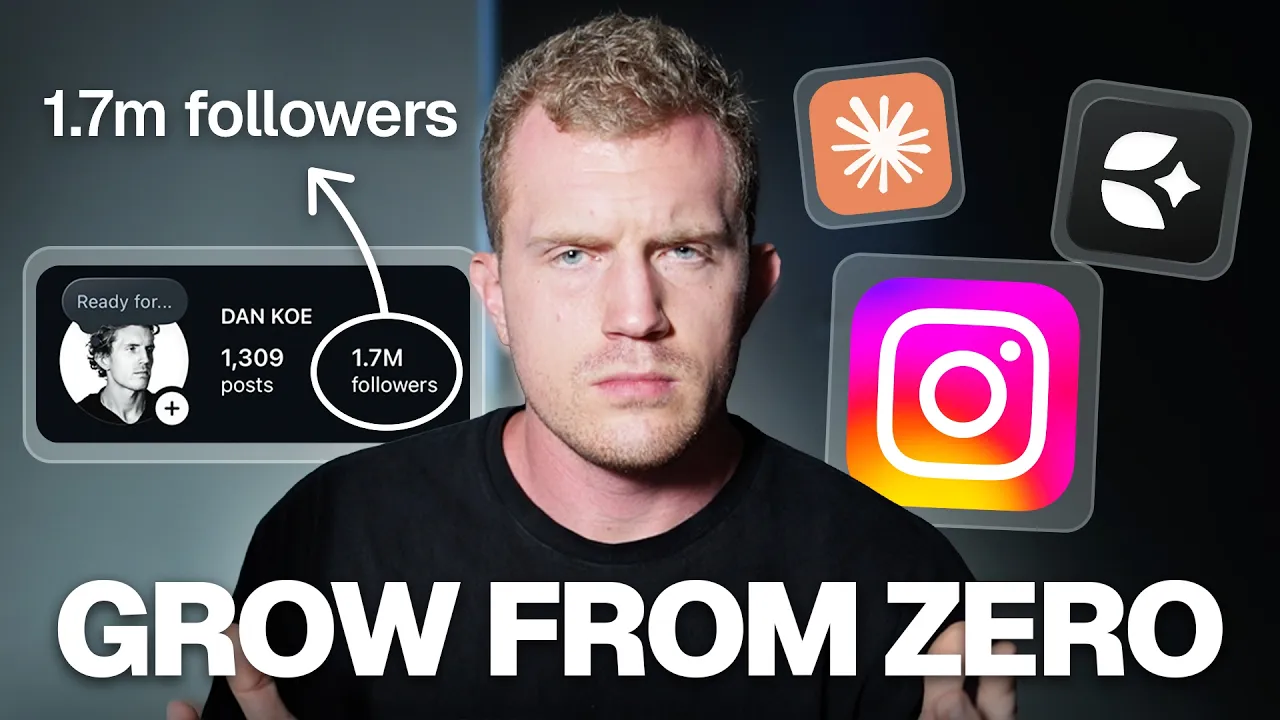
Welcome back to the Eden Channel where we talk about social media growth, unique content strategies, standing out online and not blending in with the herd, and actual useful ways to use AI that gets results and doesn't ruin your brain. Today we're going to go over something special. It's how to grow on Instagram, even if you have zero followers. Now, personally, I've grown my Instagram to 1.7 million. I'm almost at a million on Twitter. On Substack, I'm the number one best seller in philosophy, which is pretty cool, even though I don't talk about philosophy too much. And
101 words, the words spoken in the first 30 seconds at 202 words per minute.
Free, no signup. See how the first 30 seconds hold attention, with rewrites.
Sentence shape
| Measure | This transcript |
|---|---|
| Sentences | 383 |
| Average words per sentence | 18.0 |
| Longest sentence | 77 words |
| Questions asked | 25 |
| Sentences containing a number | 15 |
Most used terms
Filler phrases
100 in total: like 61 · actually 19 · kind of 8 · right? 7 · you know 3 · I mean 1 · literally 1.
A literal whole-word count of the same phrase list the Prepublish browser extension uses, so a phrase inside another word is not counted and a phrase used in its ordinary sense still is. It is a count and not a judgement.
Free, no account. See where attention is likely to drop, with a rewrite for each weak line. The free check shows the scores and the one issue costing the most. Or run it on the words above first.
Free · No login · See a sample audit first if you prefer.
What this transcript is
Every word below is the caption track YouTube publishes for this video, pulled from the video itself and reproduced unchanged. It is not Prepublish's writing, not a summary, and not a re-transcription: it is the video's own published captions. English captions, published by the channel, in the video’s original language. Source: the video on YouTube. A channel that would rather this page did not exist can ask for its removal through the contact page, and it is removed.
No Script X-ray for this video: YouTube shows a Most replayed graph only once a video has enough views.
Welcome back to the Eden Channel where we talk about social media growth, unique content strategies, standing out online and not blending in with the herd, and actual useful ways to use AI that gets results and doesn't ruin your brain. Today we're going to go over something special. It's how to grow on Instagram, even if you have zero followers. Now, personally, I've grown my Instagram to 1.7 million. I'm almost at a million on Twitter.
On Substack, I'm the number one best seller in philosophy, which is pretty cool, even though I don't talk about philosophy too much. And across all of my social accounts, my smallest account is LinkedIn with 180,000 followers. So I know quite a bit about content, and I do not agree with a lot of the content advice that is going around online. And so what you hear in this video may not be something that you've heard before, because I want to focus on the thing that actually matters.
I don't want you to just drown in advice and drown in tutorial hell. I want you to have the things that you know you need to focus on and know you need to get right so that you can ignore everything else. Now, what sparked the idea for this video is my girlfriend came to me today and she is a nutrition coach and she's going to start posting on Instagram, and she went to Claude and asked, hey, what should my first post be?
Which is a reasonable thing to ask for anyone who is looking to start on social media. And it said, oh, you should just introduce yourself and what you talk about. And that is horrible advice. I thought I was supposed to be intelligent, but as we have learned, not only on this channel, but in general, AI is only as intelligent as the person that is using it because it's like a bag of water. You need to be able to mold it.
It's intelligence on tap, but you need to direct it. You need to give it the proper context. And Claude and ChatGPT don't have access to social media posts or data. They can't read social posts, they can't access them. So how do they know what good looks like? They don't know. In preparation for this video, I watched a few other how to Grow on Instagram guides and a lot of them had a ton of views, and I was surprised because I do not agree with quite a few of their points being one profile set up bio and having a searchable name as your name like nutrition coach inside of your name.
And that's the first step that people focus on when I think that should be the last thing you focus on, because you'll just get stuck on it and you won't start posting, which is the only thing that matters. Yes, you need a profile picture that represents you and your vibe and your brand, but honestly, it doesn't matter. You can find social media accounts everywhere with just nothing as a profile picture or an anonymous profile picture or a selfie of them.
It doesn't matter the vibe your brand comes across with the content that you post consistently over time. Your bio honestly doesn't matter either. But yes, it's wise to include what you do and what you can help people with in there, but people are only going to see it once or twice. They see your content, they click on your profile, they read the bio. But that's not going to be a huge decision. And whether or not they follow you or even reach out to you, you're not supposed to sell in your bio.
You're supposed to sell bottom of funnel, and having the nutrition coach in your name may get some people to DMU, and that's okay. But still, most of them are already going to learn that from your content. And frankly, personally, it's just a taste thing. I think it looks corny when you have that in your name, and it makes me feel like you're not a real person behind the counter and that you're trying to sell me all the time, people can smell that.
The second thing that I think is just BS advice is launching to your friends or family first. They're not your audience. They don't care. They may support you here and there, but it's not going to lead to any kind of growth in the slightest. The third piece of advice that I disagree with is to post more reels and carousels than just plain images. That does have some weight to it, though. I feel like reels lead to a lot more follower growth.
So yes, focus on more reels. Carousels can get spread more simply because people can swipe. And then like a specific slight, you're giving people more reasons to like and share to their stories so it gets exposed to more people. But I'll actually show you an example today of one single image, not a carousel, not a real that went super viral and probably led to a lot of followers. And the fourth thing that I disagree with, and I don't think I need to say this, but hashtags do not matter.
Neither does the age of your account or whether or not you should start a fresh account. And people will create reels about this, saying that it's Meta's policy, or they'll say something and it just ends up confusing you. You can grow whether or not you have an old account or not. Now, the thing that I do agree with, and that I think most people should do, is not worry about their first 15 to 20 posts. You use this as the tutorial phase of your brand so that you can practice and learn content and think about it.
Stop worrying so much about your first post, because if people see that and visit your account and they just see one post there, do you think they're going to follow you? It's an empty page. Do they? They don't even think that you post. Of course they're not going to follow you. So you need to fill the page up and treat this as practice because nobody's watching. Anyways, this is where you should mess up and embarrass yourself.
And if you focus on the principles of good content, once you get past that initial period of not having any posts on your account, then you're much more likely to grow over time. So what I'm saying here is to just stop overcomplicating it and think about why you follow an account, why you like posts. You have an entire course in your head by just reverse engineering your own psychology and how you interact with profiles and posts on social media, you see a good piece of content that you like.
You click on their profile, you maybe scroll a bit and you follow them. And then once you see more of their posts, you kind of become ingrained in their head, or they become ingrained in your head and you start to like them more and more. That's just how social media works. So to actually grow your account, we're going to focus on four things that I'm going to walk you through how to do them. The first is that you just need a strategy 90 days to a year.
You need to understand what your content is going to look like over the long term, so that you actually have a theme, you have something that you're working towards. You're not just posting one offs and hoping that they do really well. The second point is that the quality of ideas matter more than anything else. That matters more than hooks. It matters more than the format. The viral formats that everyone obsesses over.
Quality of ideas will go over that point. Number three, you need to treat research and learning as your full time job. By research, I mean you need to understand what is working on Instagram or other platforms today so that you can study the principles of why those posts work. That's when the hook structure comes into play, or the body structure or the format, and then you apply your own ideas to that, which I'll walk you through as well.
In the fourth point that we're not going to dig into too much is that all that really matters is that you're posting consistently, you're posting ideas that have the potential to do well so that they can get spread to more people, and that you're adding something unique to the conversation so that you are differentiated from everyone else and you actually have a brand, you aren't just blending in. Okay? So diving into it.
Here's everything that we're going to go over. But as I mentioned, point number one is your strategy, your personal brand strategy. That is a big topic. We're not going to go over it in detail here, but it is very simple, especially with AI that can act as a coach to interview you and then create a brand strategy document that you can reference with AI at any other point. That is very important. You need a brand strategy document that you can feed AI so that it has the context of what you're trying to do.
So any ideas you feed it or content you try to write or strategy you try to create goes through that document. The last video on this channel was all about that and how I redid my own brand strategy, so you can go and watch that. But the gist of it is there is a personal brand strategist link in the description, and it looks like this. And all you do is click build my personal brand strategy from scratch, and then it will interview you and ask you questions, and then spit out a document that you can reference.
And it is very thorough. It has 12 sources in here that you may or may not be able to see, and it's just personal branding principles galore based on what has worked for me and just what works in general as a brand. And if you don't want to use Eden, you can use Claude and you just go here. There's a link in the description Eden. So workflows and then all you do is you copy the setup prompt this little sentence, paste it into Claude and it'll walk you through everything.
And the reason you do it through here is because it can research the market for you. If you connect to the Eden MCP, which no other MCP can do, because all social media MCC right now are just scrapers. You scrape individual accounts or connect to your own account, but they can't access all creator profiles, all social media posts, or research the trends and what's doing well. That's what the Eden MCP is for. It is foundational.
If you're doing anything on social media, you need the Eden MCP. Now after you have the brand strategy, what I want you to do is a bit of manual research. I want you to build an idea museum, and the way you do that is you find your favorite creators accounts. You look for posts that you really like, and then you save them to an inspiration board or a swipe file board. And what that looks like, this is like a free form canvas view.
But we're going to go over a few examples here. But you can create a board and then name it something like YouTube swipe file. Or in your case it'll be an Instagram swipe file. And then you can come into here when you need inspiration. Think of it as like a vision board for your brand, the designs you want to go after, or if you only want written posts or what kind of reels you like because then you can always come in here, chat with this, or chat with any individual post and then reverse engineer it and apply it to your own idea, which we will go over now a way you can do that inside of here one.
Of course you can go to Instagram, you can scroll on Instagram and then you can paste links into here or paste them wherever you want. But obviously if you paste them into notes, it's just going to be a link. It's not going to actually show the post, but you can come up here to the discover tab, open that, go to the creators tab and then make sure Instagram is checked on so you can see Instagram accounts. But you can save any kind of idea, ideas or ideas.
But then if we go to the actual page, you can filter the creator by top light and then look through their posts and then save any of them to a board using this plus button. And if you don't know what creators are in your niche, then a good way to research them is just by typing in a topic up here in the search or using one of these filter chips. Or you can just ask the AI chat. Or if you connect to the cloud MCP with Eden, it can search for creators and find ones that post in a specific niche.
And you can do your research that way. But as an example, if I select productivity, you can see that productivity creators come up here and I can discover top creators in that niche and start saving their posts to a board. So that's the first part of the research phase, is just start to fill a board with ideas and designs and structures and posts that you like. So you can start to develop this vision for what your page is going to look like, and what type of ideas you're going to include.
Now, before I show you how to reverse engineer one of these posts so we can actually get the post structure and learn how to write better scripts or better posts for Instagram. One important thing here is that you need to balance favored ideas and validated ideas. Validated ideas are the external ones. The ones you research, the ones the trends, the ones that are going viral. So you know what works. But you need to differentiate yourself.
So you also need to capture and write down ideas that you love. But where do you find those ideas? Where do you find the unique ideas that separate you from everyone else? Well, you look where nobody else is looking. You read more books. You follow niche accounts that, having gained much traction but put out great ideas. They haven't studied the validated post, so they don't know how to grow, but they still post great stuff.
You need to find the niche articles that people are passing around in group chats. You need to read a book, summaries you need to get on Substack before it turns very mainstream, because that's where a lot of unique writers are and a lot of unique ideas. And then what you do then inside of Eden or on the mobile app is you capture the ideas so you can save the links inside of here just by pasting them or hitting new link.
And then the thing that I like to do is to just create a card, and then I can jot down the idea inside of here. It's just a quick idea. And the thing about the library is that this auto categorizes and tags everything for you. So if you ever need to find it later, you kind of just drop it here and forget about it. And then when you ask the AI chat for novel connections or novel ideas related to a specific topic, it can find it.
And if you do want to organize it, then of course you can put it on a board. And this is what most creators skip, right? They skip the unique ideas that they love. And another thing you can do is you can connect to Kindle or Sniped or RSS feeds, or you can capture emails, or connect bookmarks or Substack bookmarks so that these are auto imported so that your library grows with unique ideas that you don't need to worry about because you know you can find them later when it's time to actually sit down and create.
So before we get into what the principles are, as like a mini course and how to actually research the market to find validated ideas that if you take them and apply them to your own brand, you will grow faster. I want to show you just how to reverse engineer something. So how to take something that works and turn it into your own. So what you can do is you can break down a specific post, you can reverse engineer how it works, and you can do that inside of here by clicking the boost button on any post and just hitting reverse engineer.
And then that will open a chat and start reverse engineering. Why the post works. Or you can just ask a chat to reverse engineer it for you. And what I would type in here is something like, hey, can you reverse engineer this post and tell me exactly why it works? Act like you are teaching me how to write the post. Give me the psychological tactics, the hook breakdown, and why it went so viral. And then what that will do is it will spit out a breakdown like this that has the macro breakdown of the entire post, the structure of why it works.
And you can open this if you'd like to read through it, but it breaks down exactly why it works. The hook, the line levels, the psychological tactics, everything of that nature. And what I would highly recommend is when you break down a post that you like of your own to actually read through the breakdown, because what you're doing here, and what most people don't realize, is that you're creating your own course on how to create content.
You're creating your own education based on something real. And so just by doing this multiple times, you're learning how to write the content yourself. And this is also how you avoid just copy pasting other people's content. This is a form of intelligent imitation. When you think in the past in the Renaissance era what did the apprentices do? They imitated the masters until they developed their own experience, skill and taste.
Because as a beginner, you don't have taste, you don't have experience. You have to ride the bike with training wheels until you can take them off. That's just how the world works. That's how education and learning works. So now, not only do you have a document of one of your favorite posts that you can reference in a chat at any time, when you want to turn your own idea into a high performing structure? But another cool thing that I recommend beginners doing is typing something like this.
I want you to interview me for content ideas based on my brand strategy, and you can just add that or at mention it if it is inside of Eden, or paste it inside of here. And once I pick an idea, apply the principles of the breakdown to it. This breakdown. That way we turn an idea from my brand into a high performing carousel structure. Because the post that we broke down was a carousel. And then what it did is it read through my brand strategy.
It saw what I talk about. It said that this creator's formula is a perfect fit for this, and then said to narrow the target. Here's four questions. Which pillar my content pillars do you want this carousel to carry? What's the identity you want the reader to walk away wearing? What's the specific discomfort they're feeling right now? What's the in-group vocabulary word? So I could answer all four of these and get four carousels out of it.
Or I can just answer one and get a pretty solid post out of it. Now, the thing with AI in general is that you still have to apply your judgment and taste. I am not, for I'm actually heavily against having AI write everything for you. I think AI should be treated the output of AI or the post that it would write here. It should be treated as a prototype, a first draft inspiration, something that you question, something that you think about.
You don't just accept the default output, you take it and then you write your own completely until it feels like something that you resonate with. And you would write yourself because it is something that you wrote yourself because you're treating the AI just like any form of text. It's not something that you wrote, it's a form of inspiration. And so you can walk through this, and I'm not going to show you how to actually create posts in something like Canva or Figma.
I'm sure there's a ton of templates out there, and even some Claude skills can create carousels now, even though everyone can tell that Claude created it. So I would stay away from that if you want to be unique. But as an example of what I have, I use Figma, which is just a kind of like an illustration or design software, and I just, I don't mine's messy. Right? It's it's chaotic. It's an organized. But my brand vibe is just black and white.
So I have something super simple here. I have a frame that is the size of an Instagram image or post 1200 by 1500, and if I want to turn it into a carousel, I just duplicate that and I add the text inside of here. It's super simple, so it's really dependent on the vibe that you're going after and what you want to create. But you're going to need a software like Canva or Figma, or you need to learn how to create really good images or carousels.
And of course, if you want to create reels, then that's a completely different ball game. But what I like to do is I like to write the script first, so you could break down or reverse engineer a real or multiple so that you have a breakdown document with those real styles in them, and then you can reference that breakdown document whenever you go to Id830 inside of an AI chat. So now you have two things that are very important.
You have your brand strategy document, and then you have a breakdown document with the type of posts that you like. And if you're already a creator, then you break down your own top posts so that you can reference that in how you write. And so whenever it comes time to create using something like AI, then you give it the brand strategy document and the breakdown document. And again if you connect the Eden MCP, then Claude can just find those things inside of your Eden and create new documents inside of Eden for you.
If you want it to store your documents where you actually do this work. So now, before we actually get into how to research top performing content, I want to give you a bit of education. I want you to understand what the principles are so that you can understand them and apply them to your content. So you aren't just going about this blind, because if you don't know what you're doing, then you don't know whether the AI output is good or not.
So I call these the Ten Commandments of Engagement and it looks like this. The first is just specific numbers. You see this all the time in hooks and it catches attention just because it's a pattern interrupt. So things like statistics there are 7 billion people on this Earth. Dollar amounts. Apple's new $1,000 iPhone has this new feature metrics. I sent 322 cold emails or after 293 days, or lists seven bad habits that are preventing you from achieving the life you want.
You see these all the time in hooks and content and Substack titles and YouTube titles because it just works. The second thing is pattern interrupts, and so a pattern interrupt is anything that breaks people out of their normal condition patterns. The way to think about this is on Twitter. I personally now write my posts as just blocks of text, because everyone is spacing out their text and creating lists and trying to make it super readable.
But when I look at it, I see that everywhere. So I know that it's just becoming tiring and people aren't paying as much attention to it anymore. So I have to do something different. And it's interesting because my posts on Twitter do extremely well, simply because I'm doing what you shouldn't do in content by just creating a block of text. So another thing this could look like is if everyone's talking about one thing on Instagram, like, oh, download this new Claude skill, then take the contrarian approach and say, oh, all these Claude skills are just like collecting notion templates.
You aren't doing anything with them, and a lot of people are going to resonate with that because they're tired of all the cloud skills, content. And that also leads into negativity bias. So if you can flip something from positive to negative, something in people's brains causes them to pay more attention to that. So an example you're going to achieve great things compared to you will never hit rock bottom again. That is obviously the one that is going to capture more attention.
Another way to capture attention in your hooks, or just content in general, is calling out your specific target. If you've been on YouTube in the self-improvement space at all, if you are in your 20s or I'm 28 or I'm 42, here's how I turn my life around. People resonate with that, and that specific type of person goes and watches it. Or calling all creators, coaches, and freelancers. If you're promoting something so that people can self qualify and they're going to pay attention because it applies to them, or as an example, fathers are a gift to humankind, and more fathers or mothers are going to pay attention to that and resonate with it.
The next thing is just calling out the problem. This is one that I fall back on all the time. If I don't know how to start a post, I just think, what is the pain point? What is the problem here? Because most people have encountered the same problem or pain as everyone else throughout their life, most people can just resonate with a problem. And the two ways I like to start this, if you want a way to start a post is either most people.
So most people struggle with this. If you if you struggle with this. Those have just been proven for me and they work quite well. Now the six thing that captures attention is readability and esthetics. So using line breaks or short sentences. But as I just said, if this saturates the market and everyone's doing it, then the way to pattern interrupt that is by going against the opposite. But I do think esthetics still matter.
And thinking about that when you post is a good thing, the next thing is just confidence and conviction. And the way you can sound more confident is when you go and look over your post. You want to eliminate words that imply uncertainty or speak in absolutes when possible. Obviously, don't overdo this. Exaggerate your point to add energy. So rather than saying it may be wise if some people developed their skill set or this skill, you say it is crucial that everyone on planet Earth develops their skill set.
I'm way over exaggerating there, but I think you get the point. And I personally use this in my content because it adds impact, right? I'm not saying it because it's absolutely 100% true. I'm saying it because then it gets people to act and change their behavior for the better. Slightly exaggerating your idea, even if that makes it slightly not true or true 100% of the time, you're going to get people in the comments where they're like, well, this isn't true for this specific type of person at this specific time.
It's like how the sun isn't blue when it's nighttime. Yeah, we understand that. But if we say that the sky is blue, I think I said sun. If we say that the sky is blue, people get the point. And that's what I think has made my content stand out quite a bit, is I try my best to just get the point across so that people get it. Now the next is just potential benefit. So the opposite of calling out a problem. So when you read over your post or you're going to generate a post idea, you need to think about what's in it for the reader.
Why should they care? Because if you don't hit on that point in your content, then they're not going to care. They're not going to read or like the potential benefit or why it matters to them. Simply answering that question is what locks in the like and share. If you nail that on the head, then you will grow just fine. The next is just social proof. So if you can subtly or humbly flex any of your results or credentials and what you've done, like I did at the beginning of this video with mentioning how I have a few million followers, it's going to get people to pay more attention, obviously, but if you don't have any social proof yet, that's fine, because growing your audience is how you build social proof.
It's the chicken and the egg problem, and you should just focus on putting out the content, whether you have social proof or not. And the last is just warning or caution. So if you can warn people about something that's going to happen in their lives or in the future, or you caution them of something that's very powerful. So now how do we actually go about researching content? And there's two ways to do it. There's the manual way which is still very beneficial.
And then there's the AI way. So the manual way is you use an outlier tool like Eden or one of ten or Sand Castles, but those two platforms only cover YouTube and Instagram. They don't cover Substack, they don't cover where you can get other ideas from. And a lot of the times you're going to grow the most on social media and stand out the most. If you pull ideas from a different platform that you're trying to grow on and bring it to the platform that you are trying to grow on.
So for me, I would bring an idea from Substack or YouTube or Twitter to Instagram, and if I'm growing on Twitter, then I would do the opposite. And that's what's going to help me stand out. If you're only studying Instagram and you're trying to grow on Instagram, then you're more likely to just blend in with everyone else. So in the discover feed, what I recommend doing is just making it a habit to scroll this maybe once a day, once in the morning.
Come through here, add some filters, click on breakouts and breakouts as smaller accounts that are doing really well so you can get ahead of the trends before they actually happen. And that's advantage against other people. But you come into here, maybe you search some stuff, but you just scroll and you see things that you like, and then you save them to boards so that you can reference them later. Or what I like to do, as I mentioned in the last personal brand strategy video, is if I write on Twitter and other platforms.
So if I'm writing, I will quite literally scroll through here to see validated ideas. It'll spark an idea for me, and then I'll write it inside of here, and then either save it as a draft or save it to my schedule to go out. And you can also schedule on Instagram inside of here and have it go out to Instagram, but you need to create the video first. You can create image posts so like a postcard image or a text only image, but for videos and reels you just have to upload them into here and add it to your Instagram schedule.
And you can also do this while you are scripting. So if you create a board for your scripts and then you open the note. So I could open the eating content here and look at my little guide for this video. And I could write scripts as I'm actually searching through inspiring ideas or looking through my library for ideas that I saved previously. Now the next thing I would do for finding validated ideas or researching the market is just by searching for top creators in that space.
So if I go to my own account here, all of my top content is validated, right? This is all something that I can take and get variations on and create my own ideas around. Or since this is my own content, I can just repurpose it and rewrite it in a better way. So those are the two manual ways to research content ideas. Like if you're on YouTube, obviously you're going to look up a creator in your niche, look at their top posts, look at their thumbnails, look at their titles, save them to a board, and then you can chat with a board when you need title ideas for your own script based on high performing title ideas.
And the same thing with discover. You use discover so you can see posts that are breaking out right now Instagram posts, tweets, ideas or thumbnails and titles. And then you can save these as you scroll here every day so that you're not missing things that you could use. So now there are two ways to actually do this with AI. The first is the real script studio, and there is a link to this in the description. But what this is going to do is it's going to help you turn a rough idea into an actual script or an idea that you can take and run with, and it can research the market and what's working on Instagram for you.
But if we just open a normal AI chat, I typed in here, I want you to find top performing posts on X and Instagram in the productivity niche with some that talk about monk mode, because that's kind of what I want to write about right now. But I can also attach my brand strategy here and say, hey, find top performing posts relating to the ideas that I personally talk about. And one thing you can do here is you can turn on the deep social research, and then you can set it to quick, standard or deep so that you can control how much research it does.
I'm going to stick with standard right now just so it doesn't run for a long time. So I sent that. And now what it's doing is actually doing the research and showing you what it's searching. It says it takes usually a minute or two. You can see the searches it's doing inside of our social corpus that no other AI has access to. And so we're just going to let this finish really quick. All right. This one's kind of funny.
It found a hook or read a piece of content from someone. I'm so locked in. I haven't blinked in 21,600 seconds. It's a pretty good hook, right? So you can even just read through these and what it's reading and start to get an idea of good ideas. All right. So the results came back. And it is giving us a structured output and the ideas. So the first idea that's worth talking about is isolation as the ultimate productivity hack.
So it's giving you the posts. So you see the high performing structures but you're also seeing the idea behind it, which I think is more important because then you can save these ideas to talk about and turn them into a post based on how you want to write it, with a different hook from these people, a different body, however you would specifically write it. The second idea, the phone, not laziness, is the named villain.
So it's not you're not lazy, it's it's your damn phone, as people have talked about before. And it gives you these posts. And you can save these to any board, or just tell the chat to create a new board and save them to it as like a swipe file or your weekly set of ideas that you can write about. The third idea is monk mode as regret, not aspiration. Interesting. So a contrarian take on monk mode, or disappearing or locking in the hyperbole hook.
I'm so locked in I haven't blinked yet. We saw that one, but the through line across all of this is externalizing the enemy, permission over prescriptions, so on and so forth. And now what I can do with this, if I want to, is tell it to save everything to a board and a document that summarizes everything. And I can say, okay, look at my brand strategy document and let's see how we can apply some of these high performing structures to my own ideas, or just output a bunch of ideas based on my own brand strategy.
And then just like that, you have a week's worth of posts or a month's worth of posts. Now, the last thing I want to mention here is just thinking about your style, right? There's a lot of yap video content where you just pick up the phone and start recording yourself and talking to it. That's the easiest way to do things because you just write a very soft script, very soft outline, open it on your phone and then turn on the camera and just yap.
Or you can sit in front of a camera like this and have the script pulled up here, look at it and then say it to the camera. Or you can do written first posts like just text on an image like I showed you earlier, or you can have a mix of them, right? I personally have three types of posts that I do. I have the tweet style posts, which is just an image. I have the carousel and then I have my reels, which what I do for those is I just pull up my Twitter, look at my tweets, say them to the camera and add a bit more onto them.
And since the tweets I know have performed well because I'm good at writing tweets, it's just a natural hook. It just works. And then my expansion on it is just me ranting, which people also like. And then those can go out to Instagram Reels, YouTube shorts or TikTok. So that is really it. Those are the things that you need to focus on. Is writing good content consistently and posting it, not any of the other things.
And that's how you grow on every single platform. If you do want more advanced growth strategies, I can probably talk about them later in later videos. Or we have the Creator Bootcamp. So if you're interested at all in Eden, which I just showed you, the research tool, there is a welcome offer to get 33% off and the boot camp comes with it. And that's just everything I know about branding, content, social growth, short form and long form, and of course the links to everything that I mentioned the personal branch strategy, the real script studio.
That's all in the description as well. So if you want more videos, I'm going to be posting more like this for how to grow on every platform and how to write different types of content in an engaging way. So like subscribe. I'll see you in the next video. Thank you for watching.
The words are the caption track's own and nothing is reworded or re-transcribed. Paragraph breaks are placed between sentences so the text reads as prose.
Free tools for your own script: paste a draft and see where it stands before you record it.
Paste your draft and see where viewers are likely to drop off, with a rewrite for each weak line.
Paste the first 30 seconds of your own draft for a hook score and rewrites.
Check your draft against YouTube's advertiser-friendly guidelines before you record it.
Read this channel's public videos and transcripts, and download a writing brief for it.