Getting the transcript
Reading the captions from YouTube. A video nobody has opened here before takes 10 to 30 seconds; this page fills in on its own.
Getting the transcript
Reading the captions from YouTube. A video nobody has opened here before takes 10 to 30 seconds; this page fills in on its own.
Dan Martell Daily · @DanMartellDaily
Words
1,208
Runtime
5:54
Speaking pace
205wpm
Reading time
5min
205 words per minute, above the 201 75th percentile of 349 measured videos. That distribution comes from the 349-video hook study.
Opening (first 30 seconds)
So, I moved to San Francisco, and I meet all these 22-year-olds that are building $100 million companies. You guys ever think to yourself, these tech nerds, these tech You guys see these people on the internet, right? You guys know some of them, like you you the Mark Zuckerbergs. You guys know these are real people. And there's a lot of them, and they're in San Francisco. Okay, so I move there, and I meet them. And I'm confused. How did this 23-year-old build this? I'm 28 at the time. I'm not dumb. And I'm watching these people, and I'm just like
103 words, the words spoken in the first 30 seconds at 205 words per minute.
Free, no signup. See how the first 30 seconds hold attention, with rewrites.
Sentence shape
| Measure | This transcript |
|---|---|
| Sentences | 123 |
| Average words per sentence | 9.8 |
| Longest sentence | 57 words |
| Questions asked | 13 |
| Sentences containing a number | 9 |
Most used terms
Filler phrases
23 in total: like 13 · you know 6 · right? 2 · actually 1 · kind of 1.
A literal whole-word count of the same phrase list the Prepublish browser extension uses, so a phrase inside another word is not counted and a phrase used in its ordinary sense still is. It is a count and not a judgement.
Free, no account. See where attention is likely to drop, with a rewrite for each weak line. The free check shows the scores and the one issue costing the most. Or run it on the words above first.
Free · No login · See a sample audit first if you prefer.
What this transcript is
Every word below is the caption track YouTube publishes for this video, pulled from the video itself and reproduced unchanged. It is not Prepublish's writing, not a summary, and not a re-transcription: it is the video's own published captions. English captions, generated automatically by YouTube, in the video’s original language. Source: the video on YouTube. A channel that would rather this page did not exist can ask for its removal through the contact page, and it is removed.
No Script X-ray for this video: YouTube shows a Most replayed graph only once a video has enough views.
So, I moved to San Francisco, and I meet all these 22-year-olds that are building $100 million companies. You guys ever think to yourself, these tech nerds, these tech You guys see these people on the internet, right? You guys know some of them, like you you the Mark Zuckerbergs. You guys know these are real people. And there's a lot of them, and they're in San Francisco. Okay, so I move there, and I meet them. And I'm confused.
How did this 23-year-old build this? I'm 28 at the time. I'm not dumb. And I'm watching these people, and I'm just like blown away. And then I meet this guy Naval, and he explains it to me. Crazy. I'm going to You guys want to know how to do I'm going to share it with you. It's like Once you hear it, it's so simple, you'll be like, it's got to be more complicated. He I recall I I renamed it to the four C's the master skills.
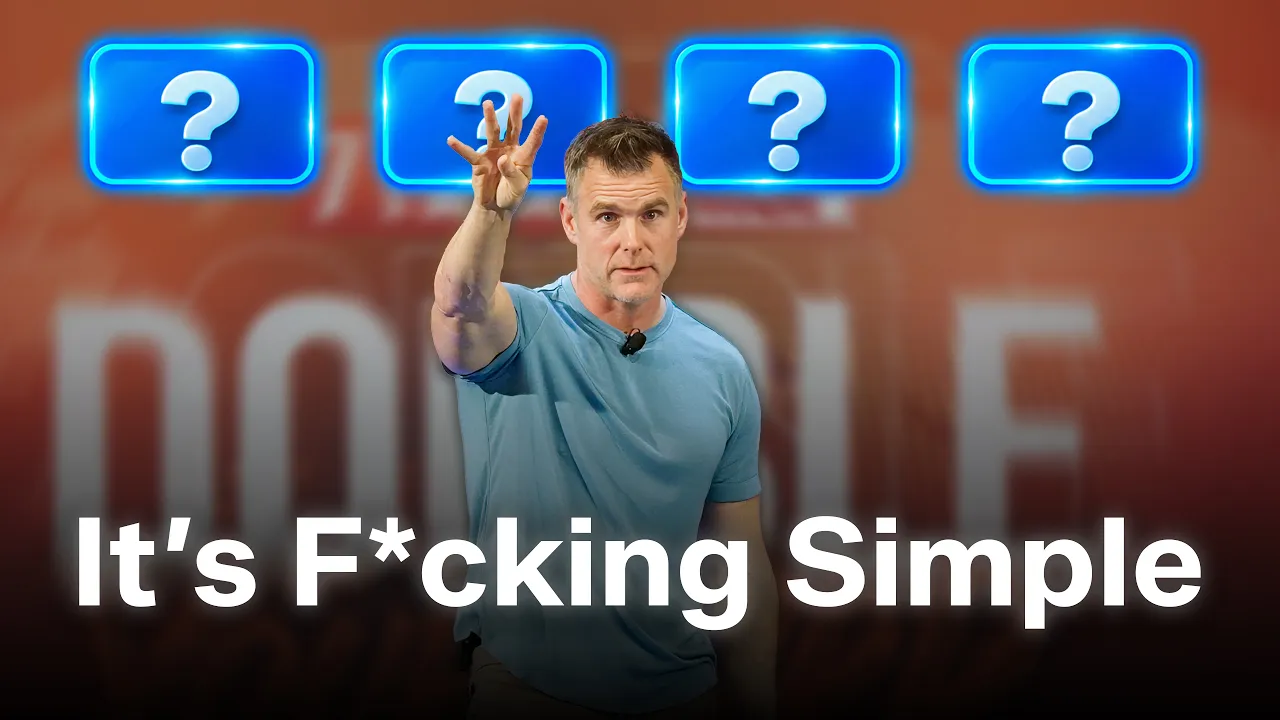
There's four master skills. It's not in my book. I don't talk about this publicly, so write this down. There's four master skills. And he says, "This is how those 23-year-olds, 25-year-olds build these $100 million companies in 7 years." They understand leverage, okay? Time multiplied leverage equals output. People that have a higher output per unit of time, they just know how to get more leverage. The four master skills are the only four ways you can create leverage.
Once you know it, now you know what to go become great at. When you buy back your time, you go build skills, four master skills. First one was code. I'm in San Francisco. That kind of makes sense. Why code? You guys might resonate with this. Automation. Automation, programming, systems, like applications. You you you follow it, it always If everybody follows it, they can't mess it up. You automate it. Today, I would say AI.
You guys know this. If you're not using AI every day, every person on your team every day, you're working harder than you have to. Period. Full stop. So, the code one, I was like, "Oh, I'm a software programmer. I get that. I can do that." He's like, "Yeah, but you got to really understand automation, not just writing code, cuz that's actually slow. You want to use existing tools and connect it all." And he was telling me that I see a day where a 100-person company is a billion revenue business.
I'm like, "Whoa, 100 people billion revenue?" He's like, "Yeah, it will happen." So, code is a big one. Second C, okay, is content. I'm like, mhm, don't get that one. Do tell. Think about standard operating procedure. I sit down, I spend 2 hours and create a checklist, okay, for any part of your business. And whether I give it to one person or 10,000 people, does it take any more of my time? Yes or no? No. Massive leverage.
It's not just the checklist, it's videos. Camcorder method, I talked about it earlier, how to transfer stuff off your plate. That's where I got that idea from. Recording yourself doing the work is content. Okay? I'm on stage, I have two team members from here, Martell Media, on my team, they're here. Now, does my life change if you guys plus some a few people see it or 10 million people see it? Does it take any more of my time?
So, I can help as many people. You guys have no idea how much leverage you have by doing some of this stuff. You're just not doing it. Once you do it, boom, massive leverage. So, content was the second one. Third C, capital. That was a big one I had to learn. He said there's no lack of capital in the world. There's lack of opportunities to fund. Some of you guys think you have a money problem, you don't have a money problem, you have a business model problem.
There's no lack of money to support good businesses, good business models. Right? You just don't have that yet, {comma} yet, you develop it. So, understanding how capital stack work, how does debt work, how does cash flow work, how, you know, all that stuff. Then the fourth C was collaboration. The people side. Here's what's crazy to me. I meet people all the time that call themselves leaders. Guess what? You can't be a leader if you don't have followers.
Paying somebody to work for you does not make you a leader. Some of you guys thinks you're [ __ ] big shots. Nobody would Nobody would quit their job to follow you anywhere. You're not that impressive. And you know it. And I know you know it. And I want you to decide if you don't like what I'm saying, that's okay. If I trigger something in you, good. I'd rather you hear it from me because I care more about your team than your own personal feelings.
Cuz I think it's an honor to be a CEO. I think any person in a position to lead a group of people should consider it a [ __ ] blessing that they should take that as a serious responsibility. And collaboration, that's where I [ __ ] I messed it up. My first company I thought you work for me, do what I say. You work for me, do what I say. Shut up. Don't Like, why are you arguing with me? I pay you, do what I say. That's That's how dumb I was.
And that's why I was always spinning plates. Cuz if I stopped paying attention, they stopped paying attention. They were waiting for me to tell them what to do next. They didn't find initiative or desire or dreams. I didn't understand how to lead. And Naval said to me, "Think about it. All these people that you know, the tech people that you you hear about that build these company, people three times their age quit their job at Microsoft, Apple to go work for that person because of who they are, their ability to communicate, the ability to hold the vision, the the ability to to distort reality." Real quick, you've made it to the end.
Let me tell you what I know about you. You're not somebody that's looking to do shelf help. You're not somebody that's just doom scrolling on social media. You're here cuz you want to build, build a real business, and you're sick and tired of not getting the real insights to grow inside your business. So, I want to help you avoid all the pain trying to figure this out the hard way like I did it. That's why I put together everything I've ever learned into the Scale Workbook.
It's the internal document that I use with every founder I work with that turns a chaotic business into a money-making machine. And teaching you all of this without burning more hours. It's totally free. The link is in the description, or you can just scan the QR code on the screen cuz I'm here to help you build your empire.
The words are the caption track's own and nothing is reworded or re-transcribed. Paragraph breaks are placed between sentences so the text reads as prose.
Free tools for your own script: paste a draft and see where it stands before you record it.
Paste your draft and see where viewers are likely to drop off, with a rewrite for each weak line.
Paste the first 30 seconds of your own draft for a hook score and rewrites.
Check your draft against YouTube's advertiser-friendly guidelines before you record it.
Read this channel's public videos and transcripts, and download a writing brief for it.