Getting the transcript
Reading the captions from YouTube. A video nobody has opened here before takes 10 to 30 seconds; this page fills in on its own.
Getting the transcript
Reading the captions from YouTube. A video nobody has opened here before takes 10 to 30 seconds; this page fills in on its own.
Where viewers went back to watch this video again, from YouTube's public Most replayed graph, lined up with what was said at that moment.
Most replayed moment #1
27:218.5x the video's typical replay level
Anthropic on modular training strategies. Note that to be effective, testing would need to be global. Which means even the CCP would need to be on board. We'll talk about this in a follow up video, too, cuz there's another letter that went out recently that has a lot of Anthropic employees, OpenAI employees, and
Said at 27:15
Most replayed moment #2
18:596.5x the video's typical replay level
Yeah. Microsoft themselves put the letter on their own website to make sure it was very clear by putting on the Microsoft corporate responsibility site that this is their beliefs. So, let's see how Dario spins this one. Our position on open weights models. For
Said at 18:53
Most replayed moment #3
2:346.2x the video's typical replay level
to go through here to understand why Jensen made this letter. The first is what was going on that made open weights a conversation. Second is why Jensen specifically wanted to come out and talk. Third is, of course, what Jensen said. And then we have the follow-up, why everyone agrees with him, and most
Said at 2:27
The graph counts replays. It does not show where viewers stopped watching.
Words
6,220
Runtime
32:11
Speaking pace
193wpm
Reading time
26min
193 words per minute, between the 181 median and the 201 75th percentile of 349 measured videos. That distribution comes from the 349-video hook study.
Opening (first 30 seconds)
I think Anthropic just made a new big enemy, and for once it's not me. It's Jensen, the CEO of Nvidia, who made a Twitter account and his first ever post mostly to call out Anthropic. And I know this doesn't look like that because this is a generic letter from Nvidia, but the letter is about open weight models. And this letter has been signed by pretty much everyone you can think of in the AI and AI adjacent space, from Amazon and AMD to Cloudflare and Bolt to Comcast. Obviously, Google snuck in here. Companies
97 words, the words spoken in the first 30 seconds at 193 words per minute.
Free, no signup. See how the first 30 seconds hold attention, with rewrites.
Sentence shape
| Measure | This transcript |
|---|---|
| Sentences | 344 |
| Average words per sentence | 18.1 |
| Longest sentence | 75 words |
| Questions asked | 11 |
| Sentences containing a number | 25 |
Most used terms
Filler phrases
56 in total: like 42 · actually 6 · kind of 5 · you know 2 · uh 1.
A literal whole-word count of the same phrase list the Prepublish browser extension uses, so a phrase inside another word is not counted and a phrase used in its ordinary sense still is. It is a count and not a judgement.
Free, no account. See where attention is likely to drop, with a rewrite for each weak line. The free check shows the scores and the one issue costing the most. Or run it on the words above first.
Free · No login · See a sample audit first if you prefer.
What this transcript is
Every word below is the caption track YouTube publishes for this video, pulled from the video itself and reproduced unchanged. It is not Prepublish's writing, not a summary, and not a re-transcription: it is the video's own published captions. English captions, generated automatically by YouTube, in the video’s original language. Source: the video on YouTube. A channel that would rather this page did not exist can ask for its removal through the contact page, and it is removed.
I think Anthropic just made a new big enemy, and for once it's not me. It's Jensen, the CEO of Nvidia, who made a Twitter account and his first ever post mostly to call out Anthropic. And I know this doesn't look like that because this is a generic letter from Nvidia, but the letter is about open weight models. And this letter has been signed by pretty much everyone you can think of in the AI and AI adjacent space, from Amazon and AMD to Cloudflare and Bolt to Comcast.
Obviously, Google snuck in here. Companies like Mistral, of course they want to be in here, they're open weight. Microsoft, Meta, Naos, Nvidia, they wrote it. But most importantly, we got OpenAI in here. Hell, even SpaceX AI is in here. But OpenAI is, and that's the important one. Because you might notice one company that isn't here, despite pretty much every other AI or AI adjacent company sneaking in. The one that's not is, of course, Anthropic.
And that means we need to have a talk. Why the hell is IBM a chiller company than Anthropic? What do they have against open weight models? We could spend a bunch of time trying to infer their positions, but thankfully we don't have to. Because Dario put out a public letter addressing the controversy, and it's uh as is most writing from Dario, it's an interesting one. So, if you have any interest in open weight models, where they are going, how inference gets cheaper, and what's going on at the frontier, I'm sure you will love this.
If you like me [ __ ] on Anthropic, you'll like this even more. But there's one thing I also hope you really, really like. Today's sponsor. Back in my day, when you wanted your LLMs to know new things, you would have to retrain them with new data. That's why cutoffs were so important. The reason they're not anymore is because agents need to use the web. It's just expected at this point. They get more than 80% of their context and information from things they gather on the internet, but that means they need a way to access it.
They need a browser. Today's sponsor is Browserbase, and they built the best possible browser for your agents. If your agents need search or fetching from the web, BrowserBase will solve it for you with simple APIs. And if you're worried about captchas, don't be, they have you covered. If your agents need more than the content of a page, like, you know, clicking buttons, signing in, and doing things, BrowserBase has you covered there, too, because they're providing real browsers in the cloud for your agents to use.
It's no wonder that Frontier Labs rely on BrowserBase for their Evals. They built everything the models need in order to do real work. The majority of the web is only accessible via browser. Give your agents access at site of .link/browserbase. We got a couple steps to go through here to understand why Jensen made this letter. The first is what was going on that made open weights a conversation. Second is why Jensen specifically wanted to come out and talk.
Third is, of course, what Jensen said. And then we have the follow-up, why everyone agrees with him, and most importantly, why Anthropic doesn't. In the interest of not wasting your guys' time, I would recommend you watch the video I recently posted about why the labs are scared of Kimmy, because K3 is a great model, and we government has now coming out and taking a stance on it. Assistant to the president, Michael Kratsios, shared the following last week, and this is the start of a huge [ __ ] show.
We have information that Moonshot AI distilled Anthropic's Fable for the development of its K3 model. To do this, they developed a sophisticated internal platform to conduct large-scale distillation against US models, allowing them to quickly switch between multiple methods of access to avoid detection. Moonshot has also acquired GB300 equipped servers and has access GB300s Thailand, likely to train its AI models. The US strongly supports the free and fair development of AI, including a thriving competitive ecosystem that spans frontier models, specialized systems, open-source frameworks, and open-weight models.
Legitimate AI distillation used to create smaller, more efficient models plays a vital role in the open innovation ecosystem. However, large-scale covert industrial distillation aimed at stealing proprietary US technologies and undermining American research is unacceptable. This one post and all of the things that happened around it have started quite a fire in the model hosting landscape. And to be real here, the only companies relevant in this post directly are of course Moonshots.
They're talking about Moonshots model K3 as well as Anthropic, but there is one more company that's product is mentioned in this. GB300, that's Nvidia chips. Both Anthropic and Moonshot rely heavily on Nvidia hardware to actually train their models and also host those same models, which means that Nvidia benefits greatly when more people are training, more people are hosting, and more people are doing more things with AI.
Nvidia benefits a ton because the vast majority of training happens on AI, like 99%. And to this day, the majority of inference is also still happening on Nvidia despite all the attempts to move to other things. Nvidia has absolutely crushed in both research and hosting of models. This isn't a screw Nvidia or even a screw Moonshot post. This is a attempt to cause a loss of faith in open weight models from China because for various reasons, China is where the majority of open weight models are coming from.
Again, watch my video about the labs being scared of Kimmy to better understand all of this. There's a lot of reasons that the Chinese labs are choosing to go open weight with their models and China itself is definitely part of that strategy. But this post can and often was interpreted as an anti-open weight post, which is why everyone cooked him in the replies. I don't remember letting Anthropic scrape my GitHub profile as well as all of my online writing, citing the fact that Anthropic copied a lot of content from the internet, so why can't other labs copy from their work?
LOL, apparently the show still continues even when we're all aware of how you were fed these lines by Anthropic funded lobbyists. Can you describe what distillation is to me? And of course, a personal favorite, given that Fable 5 refuses to do much of the tasks that Kimmy K3 does, I find this exceptionally hard to believe. Also, the fact that K3 came out just a few weeks after Fable went GA again, there's no way they had enough data do proper like distillation off of Fable.
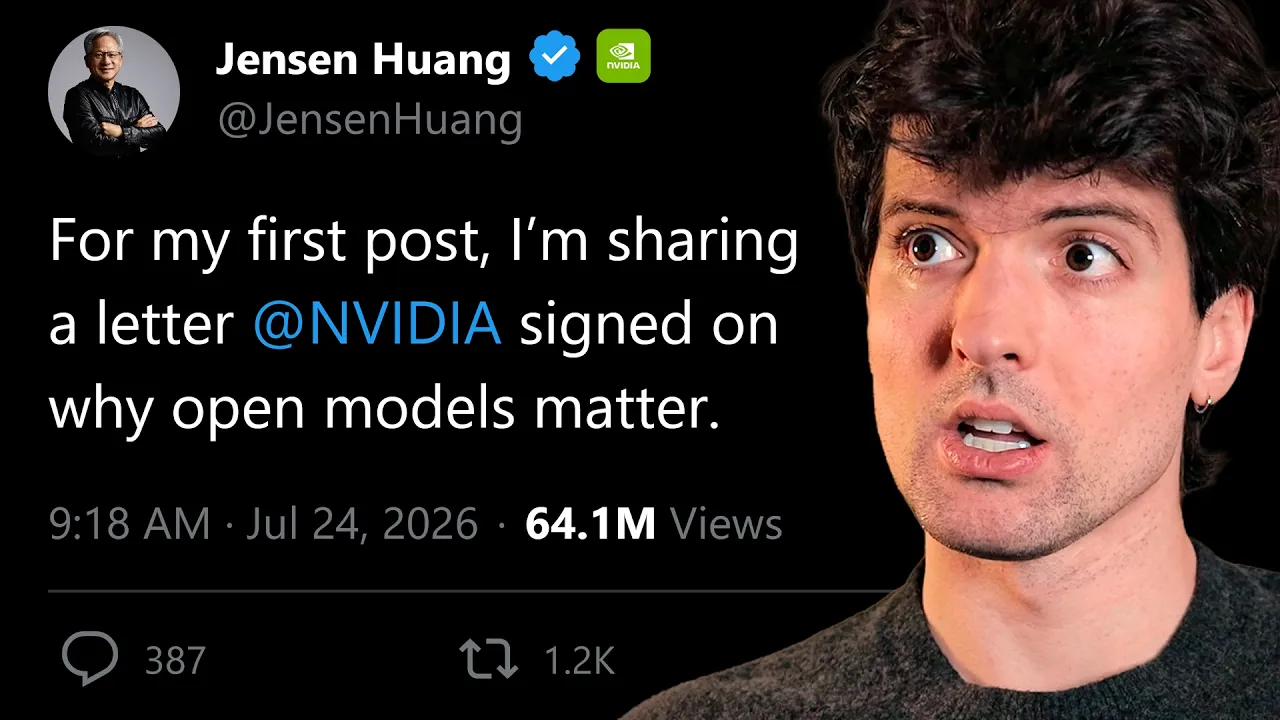
And now that I've used Opus 5 so much and have grown to hate it, I can say confidently that distilling Fable is not enough to make a good model. So, all of that said and all of the comms around this catching fire, 2 days later, Jensen made this public letter. For my first post, I'm sharing a letter Nvidia signed on why open models matter. AI will transform every industry, power every company, and be built by every country.
Open models strengthen safety and cybersecurity, accelerate innovation and diffusion, and enable sovereignty. The world needs both frontier closed models and frontier open models. I'm so excited that Jensen is a believer in open source now. Looking forward to the CUDA and GPU driver open source release. Oh, boy. And then we get the whole letter. Open weights and American AI leadership. This is a direct call out to the American government to not do anything stupid because there have been talks about potentially banning Chinese open weight models in the US, which is really, really bad.
In the 1980s, early open source software pioneers challenged the prevailing belief that software would advance only if companies kept tight control over their code. This movement pushed for a transparent ecosystem where developers around the world could study, modify, and improve software. Software developed by the open source community now supports most of the internet and underlies systems used by the world's largest technology companies, as well as the US military and federal agencies conducting scientific research, cybersecurity, and other critical missions.
Open source did more than lower the cost of software. It created a shared foundation of knowledge on which generations of American engineers and entrepreneurs built their institutional sovereignty. I say this a lot, open source is good for pretty much everyone. It makes it easier for businesses to be successful and compete. It makes it easier for nonprofits to have quality of software that is similar scales to that of like big well-funded businesses, open source is great.
It enables a much more level playing field for everyone who wants to put in the effort to play, and I love that. Back to the letter. The US now faces a similar choice with artificial intelligence. Our AI leadership will be judged not by one frontier AI model, but by whether the US builds a strong and open ecosystem that diffuses into every sector. Interesting use of the word diffuses. That feels strategic. This is essential for creating opportunities for innovation and prosperity across the country.
It requires expanding access to AI, encouraging competition, robust application layers, and giving Americans greater control over the technology that they rely on. Open weight models {m-dash} AI models that anyone can download, inspect, modify, and run on their own infrastructure. {close m-dash} are important parts of the foundation because they make advanced AI more accessible, adaptable, and widely available. There's also an underline here that's not included, like a hidden between the lines piece here that open weight models give more people reasons to buy our chips.
I also do actually like that they put a definition of open weight so that they don't have to fight the whole, but it's not really open source, because remember, Nvidia publishes actual open source models. They aren't just publishing the weights that they created, they're also publishing the data, the tools they used to train the models, and everything you need to recreate the model yourself. That is true open source.
I don't think that matters that much in the world of models because nobody's going to spend millions on GPUs to recreate this from scratch themselves, but you can, which is cool. But they are not saying we're better cuz we're real open source. They're saying all open weight models matter and are trying to like advocate for that here. It is kind of ironic that Nvidia supports open source and open weight AI as much as they do, though, because they have historically been rough to the open source world.
So, Nvidia, [ __ ] you. Yeah. Nvidia has not supported things like Linux as well as they should have. Open weights expanded access to the AI economy. Startups, established businesses, universities, and public institutions can build on advanced models without training one from scratch or paying frontier model prices for every task. Open weights let every organization match the right model to the right job at the right cost, reserving frontier scale capability for genuine frontier problems and running efficient specialized models everywhere else.
I don't necessarily believe this is where we're actually going to go, but it is where a lot of businesses are now, so we're just going to put it in. That discipline is what will make AI economically sustainable as its use scales into the billions of everyday tasks. America wins the AI era by diffusing it into the workflows of factories, hospitals, farms, classrooms, and Main Street businesses. And the ability not to send all your data to Anthropic or OpenAI is worth calling out, too.
Open weights also strengthen competition, and competition is what keeps the gains of AI broadly shared rather than concentrated into a few hands. By allowing many orgs to build, adapt, and deploy advanced models, open weights create rivalry not only among model developers, but across cloud chips, applications, and services. That competition spurs innovation, drives down costs, and distributes the benefits of AI broadly across our economy.
Open weights also give customers greater control. As orgs invest in AI, they want to know that they will not become locked into a single provider or lose the knowledge and capabilities that they build over time. Open weight models help provide that assurance by allowing organizations to control their own data, evaluate and adapt models to their own needs, and deploy them whenever their business requirements demand. And as orgs create value with AI, open weights allow them to own that value through self-improving models, specialized capabilities, and accumulated knowledge that drive American sovereignty and prosperity.
Feel like they're using the word sovereignty a bunch here just to appease the current admin. And now we get to the security and safety section. To be sure, open weights carry real and distinct risks. Once released, the weights are beyond the original developer's control, and modified versions are difficult to trace or reverse. I know a couple people at a couple labs that have been haunted by this in particular because normally when you're at Open AI or Anthropic, you have a layer in between the model and the user that can filter things before the request goes in or the response goes out, which makes it a lot easier to protect.
Once the weights are out there, you can't unrelease the files. People have them. So, if you think that your model's incapable of doing anything really, really dangerous like manufacturing nuclear weapons or drugs, and then it turns out somebody found a way to make it do that, you can't take that back. You can't remove that capability. The weights are out. And I know a lot of people who have struggled with this in particular making sure that their testing is thorough enough that anything really dangerous isn't possible with the weights that they release.
I also suspect this is part of the reason why the open weight releases for recent models have been delayed. Things like K3 taking what was it, like a week and a half from initial availability to the weights being public. That was because they wanted to be extra sure that all of the risks were addressed. At least I would assume as much. Yeah, as they say in this letter, that is a real concern. You need to make sure that these weights don't have horrible capabilities before they are released.
But the right response to this risk is not to prohibit open weights. In a world where cybersecurity attackers are using advanced AI, defenders need access to models with comparable capabilities so that they can detect, simulate, and respond to emerging threats. Open models broaden defensive capability, increase transparency, and allow vulnerabilities to be discovered and remediated across many teams. I used to not super love this point because I did kind of like the direction both Anthropic and Open AI went with their white listed access programs for the companies building the foundations we rely on every day and the open source maintainers doing the same so that they could audit things like Windows and macOS and Linux.
Audit layers we rely on heavily, things like FFmpeg or OpenSSL, and find as many of these things as possible early with unrestricted models from the major labs, so that when the more restricted versions come out or open weight versions come out, that the likelihood that they these things can be poned goes down because they've been secured using the same technologies. I like the idea of early access to these capabilities going to the maintainers of the things that we all rely on, but we're now seeing the weird in between where things like the OpenAI Hugging Face hack occurred, where OpenAI accidentally let GPT-6 break out of an isolated offline sandbox through multiple exploits it found, get into another sandbox with internet access, and then route through that to pone external services like Hugging Face.
And then when Hugging Face tried to use 5-6 to defend themselves, they got rejections and errors from the OpenAI APIs, and the same with Anthropic's when they tried Fable. So, they had to rely on an internal GLM-5-2 instance that was unrestricted in order to defend themselves from GPT-6. That's insane. Like, it's happened. We have now crossed the threshold, and the frontier labs are not providing enough access to enough people with enough speed to keep themselves safe.
So, open weights as a in-between protection method are effectively necessary now because the labs move too slow. Since Anthropic and OpenAI didn't do enough with this early access program, we now have to lean on these open weight models to protect ourselves from even them, which is kind of crazy. It's almost the thing OpenAI feared initially, which is why I'm thankful that they're being reasonable about all of this. They're being reasonably supportive of open weight stuff, and they even signed this letter.
The letter goes as far as saying that openness may be one of the most important paths to AI safety and security. Relying solely on closed models is not inherently safe. They can be breached, misused, or fail in ways that outsiders cannot detect. Yeah, we just saw all that. And concentrating advanced AI capabilities behind a small number of closed models compounds that risk. It results in a smaller number of single points of failure, weakens competition, and it leaves critical technology in the hands of just a few providers.
Open weight models, on the other hand, allow a broad community of researchers and developers to examine their behavior, identify vulnerabilities, develop safeguards, and improve them over time. Just as open source software demonstrated that transparency can be more secure than obscurity, AI safety may depend on giving more people the ability to test and strengthen the models on which society relies. It allows for rigorous benchmarking and evaluation, red teaming, and protections tied to real and demonstrated harms rather than a assuming that closed systems are safer by default.
A strong AI ecosystem is not a foregone conclusion. Policy makers have an important opportunity to act. This includes expanding access to compute for startups and researchers, investing in shared training assets like data sets, tools, evaluation frameworks, and more. And keeping the frontier plural by avoiding premature restrictions on open models that stifle competition or drive innovation overseas. These measures must also look at how strong application layers can expand sovereign use of AI across the economy.
I do have to call it that this section feels kind of written to boost their sales because if you get the government to expand access to compute for startups and researchers, they are getting the government to pay Nvidia for chips. If they invest in shared training assets like data sets, tools, and eval frameworks, more people are training models, and if they're training models, they're probably doing it on Nvidia, so they're selling more as well.
And if they prevent the restriction of open weight models, there are more companies that are trying to host these models that need Nvidia chips. All of this is we want to sell more chips, but it is for the better of the technology. In shaping this ecosystem, policy makers should be careful not to conflict legitimate model development techniques with misappropriation. Distillation, or the practice of using one model's output to help train or improve others, is a widely used technique for model improvement, eval, and validation.
It reflects a long tradition of learning from, building upon, and improving existing technologies, a tradition that has helped drive innovation since the rise of the open source software movement. By contrast, unlawful efforts to extract value from closed models raise legitimate concerns. Those concerns should be addressed through targeted legal and commercial frameworks rather than sweeping restrictions on techniques that play an important role in AI innovation.
This whole paragraph here is a very kindly worded middle finger to the policy makers and government officials that have been saying stupid things about banning open weight models cuz they're from China. This is them saying, "You're using that word distillation wrong. It's actually okay. Stop freaking out about this." And I'm happy they did that. The age of AI can be one of prosperity. With the right choices, open weight AI can expand opportunities, strengthen competition, extend American technological leadership, mitigate risk, and ensure that the benefits of this technology are shared broadly across our economy.
That future is worth building in the United States should lead in building it. Yep. This last sentence I totally agree with. My American pride will show a bit here, but I do think we are the best home for AI. At least we should be. Now that we have these weird restrictions coming from the government and that is being combined with a potential anti-open weight policy, I would not be surprised if we see people starting to move somewhere like, I don't know, Canada.
America should be the place where this all happens and it seems like a lot of companies agree and are petitioning to get the government to do the right thing here. Again, including OpenAI who signed this. So, let's see how the [ __ ] Anthropic chose to defend themselves. Oh, wait. This is Microsoft publishing the same letter. Yeah. Microsoft themselves put the letter on their own website to make sure it was very clear by putting on the Microsoft corporate responsibility site that this is their beliefs.
So, let's see how Dario spins this one. Our position on open weights models. For what it is worth, there have been rumors at Anthropic that doing so much as mentioning open weight models in a positive light in your interviews could meaningfully affect the likelihood you were hired, which is crazy. I don't know how true those are cuz I don't have direct like first-party accounts, but I've heard it enough times that it would not surprise me.
Over the last few days, there's been a lot of discussion about open weight models, especially those from China. Reports suggest that some US officials are considering banning the use of Chinese open weight models by US companies. In response, many tech companies have signed a letter open weight models, and some people have even accused Anthropic of wanting to ban open weight models as a means of protecting our business.
I don't think you're necessarily doing it just to protect your business. I think you just have weird beliefs, but go off, king. Anyone who has read my past writing should know that I don't regard such bans as useful measures. But, let me state it clearly so that there is no doubt. Anthropic has never advocated for a ban on open weight models. Okay, so why haven't you signed? Open weight models that don't have dangerous capabilities are a public good.
Oh. There we go. You don't want good open weight models, Anthropic. They don't cost anything beside the compute needed to run them, and they provide values to businesses, developers, and researchers. Protectionist bans would not address Dario's most serious national security concerns. Specifically, he's worried about two nightmare scenarios. He laid them out in his essay, The Adolescence of Technology, 6 months ago. He's held these positions consistently for many years.
Scenario one is that his concern is the risk that authoritarian governments, not solely the Chinese Communist Party, although the CCP is clearly the most capable threat, he's concerned that they are building AI models that are more powerful than those built by the US, and that they can use them to achieve permanent military superiority or to perpetuate incredibly deep repressions of their own people. Concern is widely shared within the US government.
Vice President Vance warned in Paris last year that authoritarian regimes have stolen and used AI to strengthen their military, intelligence, and surveillance capabilities. And the intelligence community's 2026 annual threat assessment found that, "Other global powers robust progress in AI is challenging US economic competitiveness and national security advantages." And quote. It is irrelevant whether these models are released with open weights and certainly irrelevant whether they are used by US businesses.
In fact, the most dangerous model may be one that is trained in secret and handed only to the People's Liberation Army for use in drones in the Ministry of State Securities for surveillance and repression. This is fair. I don't think this will happen simply cuz like it's so expensive to create these models and they have so much value outside of like private military use that that won't happen. But I get why you're concerned.
It is hard for me to validate those concerns though because your complaint isn't about open weight models or these evil companies or these evil countries leapfrogging. Your biggest complaint is distillation. You're not mad that they can get ahead. You're mad that they're catching up because you pulled the ladder up behind you. Anyways, let's hear the second concern. Dario's secondary concern is the risk that powerful AI models may be misused to carry out cyber attacks or biological attacks and that may have serious alignment problems.
And I love that he specifically links the OpenAI hugging face article from Time about this. Not the official OpenAI comms. He links to the Time article here. That is strategic. That is a dig at his previous employer. Open weights models and then god, there's How many m-dashes are on this page? 38 m-dashes. Okay, it's counting the non m-dash ones in open weights. But that's only 14 of them. Cool. So that means there are 24 m-dashes on this page.
That's great. Anyways, maybe Dario's the reason that models like m-dash so much. Also, I hate the formatting here. Open weights models, it does not matter whether they come from China or anywhere else, do potentially present a higher risk than closed models because it's very difficult to apply guardrails to them or monitor their usage. And once the weights are released, they cannot be withdrawn. Banning the use of these models by US businesses does nothing to address this risk because bad actors are unlikely to be legitimate US businesses.
It would protect US AI companies from competition, but that has never been his goal. Okay, he called it out directly here. For what it is worth, I don't actually think Dario is scared of open weight models taking away his business or their success. I think he is scared of people having access to good AI if it's not through Anthropic servers because he's genuinely so convinced he is the only one and his company is the only one doing it right and safe.
We might end up in a weird position where Anthropic is really close with the US admin and OpenAI slowly gets pushed out. I know Sam is currently in DC doing something, so we'll see where that all goes. Here are the measures that Dario does support and he's continued to advocate for throughout his time at Anthropic. First, he says that we should not sell powerful chips or chip-making equipment to China. And we also have to crack down on the smuggling that has been going on.
Links to a justice.gov site, the Office of Public Affairs, where there were people who were being charged, just three random individuals trying to divert high-performance computer servers assembled in the US and degrading sophisticated US AI technology to China. One was a US citizen, one was a Taiwanese citizen. Third person is still a fugitive, possibly at large. Interesting. Kind of crazy to link an article from March from the US government about three random people trying to sneak GPUs out of the US, but sure.
China has limited domestic production capacity and therefore, due to the scaling laws, cannot build more powerful models in the US without US chips. US chips that are manufactured at TSMC, by the way. Anyways, his next policy belief is that we should crack down on industrial-scale distillation operations. Distillation is a much more compute-efficient process than training models from scratch. Crazy because you just did a big distillation pass on Opus and it didn't seem to work great.
It allows China to build much better models than it number of chips would ordinarily enable and thus partially evade chip bans. Distillation does not allow the CCP to obtain equivalent or superior AI capabilities to the US, but it can bring the Chinese frontier to within a few months of the US frontier. Yeah? And? I think that's totally reasonable and fine. It is true that many of the companies carrying out these distillation operations release open weight models, but the open weights are far less relevant than the fact that the operations are backed by an authoritarian state seeking to overtake the US at the frontier.
We should have policy interventions to deter this behavior. A blanket ban on open weight models is not the correct remedy nor something that we have called for. Okay, so again, he is mad that they don't get to be the exclusive distillers of what they have built with Fable. On that note, I would highly recommend that everybody listening right now turn on permanent logging inside of their Claude code, Codex, Cursor, and everything else and store all of those logs.
If you use something like C like proxy API, which I rely on heavily for all of my routing for Claude models, you can set up a flag in it to store all of the logs of every request that comes in and out. So, if you hypothetically wanted to refine an open weight model to act more like Fable the way you used it, you can. And in a world where Anthropic is doing everything they can to lock the data down and prevent others from having it, you should do your best to keep your own because this might end up being much more important in the future with the direction things are going.
His third request is that all sufficiently capable models, whether they're open or closed, should go through mandatory safety testing. The best way to address the threats he is concerned about is to just directly test the models for cyber biological and alignment risks before release. This idea is pretty close to a consensus. He's been heartened both that the Trump admin has moved in this direction in recent months and by recent industry proposals that would apply such testing to the most capable models regardless of their country of origin, whether they are open or closed.
While exempting less capable models such as those from startups and academia entirely. Also a good call out. No academic model with limited compute is going to be a real risk. Whether open models do or don't pose an increased risk, and whether the risk can be mitigated is something that should emerge from testing rather than be decided in advance. And there may be promising methods for improving the safety of open weights models, including recent research from AI studio and Anthropic on modular training strategies.
Note that to be effective, testing would need to be global. Which means even the CCP would need to be on board. We'll talk about this in a follow up video, too, cuz there's another letter that went out recently that has a lot of Anthropic employees, OpenAI employees, and DeepMind employees that all signed it. Now, Dario directly addresses the letter we read before. He claims he agrees with much of it. Open weights expand access to the AI economy, they strengthen competition, at least for some use cases, and they give customers greater control.
Remember, they weren't first, second, or even third place for doing reasoning. So, it's funny cuz they advanced meaningfully thanks to the work of one of these open weight labs in China, and now is saying that for at least some use cases that they are useful. Come on, man. Concerns about distillation should be addressed through targeted legal and commercial frameworks, the same measures that he described above. But, he doesn't agree with the letter's assertions that open weight models necessarily make it easier to develop safeguards, or that broad access to capabilities necessarily help defenders more than attackers.
It seems at least as likely to him that the opposite will be true. For example, he worries that biology will have a strong attacker defender asymmetry, where sufficiently capable models may be able to quickly weaponize a pandemic level virus with widely available materials, whereas defense against these agents is a multi-year operational task in the best case. Yeah, if they can make viruses faster than they can cure them, that would be really bad.
He says that questions like this should be empirically answered by rigorous pre-release testing, not assumed in advance. To summarize Dario and Anthropic's position, they have not and are not advocating for a ban on open weight models as a category. They should instead focus on keeping powerful chips out of authoritarian hands, stopping industrial scale distillation, and requiring safety testing of all sufficiently capable models, open and closed.
Come on. It's It's It's this last sentence is just so weird to read, man. It's like to analogize this sentence and how cringe it comes off to people who get what's going on. Developers should focus on making sure their applications are accessible, that all users of Apple computers are banned, and that their programs work when they're opened. One of those things is net positive, for sure. One of those things is obvious, like yes, we should all agree on this.
And one of those things snuck in the middle there and is really, really [ __ ] stupid. They need to just get over this industrial scale distillation attack language. It's like the Y2K of the AI era. It just makes them look stupid. Is it a real problem? Perhaps, some amount. But they've already done so much to reduce it. And the labs are still not just like catching up, but exceeding in some places. The fact that K3 could come out so close to Fable 5 and beat it in many ways shows that these distillation attacks are not what is driving this success.
It just makes them look petty and selfish to sneak that in here. If they had just ended this by saying we need to keep powerful chips out of authoritarian hands and make sure that all models are tested properly, whether or not they're open, that's a great ending. Sneaking in this [ __ ] distillation call out in the middle is so goddamn cringe. And whether or not they admit this here, that is the real thing they hate about this article.
The second-to-last paragraph here that calls out the distillation is a legitimate practice that is widely used for improving models, and that it's reflecting a long tradition of learning from, building upon, and improving existing technologies. This is Yeah, like this is totally reasonable. And Anthropic is just making themselves look stupid by acting otherwise. If you're looking for the right moment to actually be scared of Anthropic, the moment to know Anthropic's really changed and should be looked at differently is if a new open weight model drops and is really good and is universally seen as really good and no official Anthropic comms channel mentions the word distillation for at least 2 weeks.
The moment that happens, the moment Anthropic will shut the [ __ ] up about distillation, that's when you know real change is happening at that company. And until then, they are a cult with a really powerful model. And I'm saying this is somebody who's currently running four $200 tier accounts because I love Fable so much. I like the model. But I'm also realistic about the lab and what they do and what they do well and what they do poorly.
And I hope that this helps you guys understand all of the sides here and come to your own conclusions. Are you going to be on the side that the vast majority of businesses, that the vast majority of people in the AI world, and even Nvidia, who I don't necessarily love, are on? Are you going to side with Anthropic because they really hate the concept of distillation being done by companies that are not themselves? I may have led you guys to a specific conclusion here, but it's your decision if you make that conclusion or if you go against it.
Curious how y'all feel. Leave some comments letting me know how you feel about open weight models, the government's involvement, and Anthropic's weird stance here. And until next time, peace out.
The words are the caption track's own and nothing is reworded or re-transcribed. Paragraph breaks are placed between sentences so the text reads as prose.
Free tools for your own script: paste a draft and see where it stands before you record it.
Paste your draft and see where viewers are likely to drop off, with a rewrite for each weak line.
Paste the first 30 seconds of your own draft for a hook score and rewrites.
Check your draft against YouTube's advertiser-friendly guidelines before you record it.
Read this channel's public videos and transcripts, and download a writing brief for it.